Bhagavad Gita 13.4: meaning and translation
Chapter 13: Kshetra Kshetrajna Vibhaga Yoga. Krishna says
This, Krishna says, the sages (ṛṣis) have sung in many ways and in many separate Vedic hymns, and also in well-reasoned, decisive words about Brahman (brahma-sūtra-pada).
Click or tap a word for its meaning and its dictionary page.
Text and layers
Text and layers
These choices stay in this browser.
Bhagavad Gita 13.4
ऋषिभिर्बहुधा गीतं छन्दोभिर्विविधैः पृथक् ।ब्रह्मसूत्रपदैश्चैव हेतुमद्भिर्विनिश्चितैः ॥
Rishibhirbahudha gitam chhandobhirvividhaih prithakBrahmasutrapadaishchaiva hetumadbhirvinishchitaih
ṛṣibhirbahudhā gītaṃ chandobhirvividhaiḥ pṛthak |brahmasūtrapadaiścaiva hetumadbhirviniścitaiḥ ||
Our explanation This, Krishna says, the sages (ṛṣis) have sung in many ways and in many separate Vedic hymns, and also in well-reasoned, decisive words about Brahman (brahma-sūtra-pada). Shankara takes these words to be the Upanishads' passages on Brahman; Ramanuja takes them to be the Brahma-sūtras.
हिंदी अर्थ कृष्ण कहते हैं कि इसे ऋषियों ने बहुत प्रकार से, अलग-अलग अनेक वैदिक छंदों में गाया है, और ब्रह्म के बारे में तर्कपूर्ण और निश्चित वचनों (ब्रह्मसूत्र-पदों) में भी। शंकराचार्य इन वचनों को उपनिषदों के ब्रह्म-संबंधी वाक्य मानते हैं; रामानुजाचार्य इन्हें ब्रह्मसूत्र मानते हैं।
Word by word
Every word, with its dictionary page
Word by word
- ऋषिभिः ṛṣibhiḥ · by the sages (ṛṣis) (noun (masculine), instrumental plural) Dictionary: ṛṣi, Monier-Williams 1899, p. 226, col. 3 “a singer of sacred hymns, an inspired poet or sage”
- बहुधा bahudhā · in many ways (indeclinable) Dictionary: bahudhā, Monier-Williams 1899, p. 726, col. 2 “in many ways or parts or forms or directions”
- गीतम् gītam · sung (past participle (neuter), nominative singular) Dictionary: gīta, Monier-Williams 1899, p. 356, col. 1 “sung, chanted, praised in songs”
- छन्दोभिः chandobhiḥ · in the hymns (of the Veda) (noun (neuter), instrumental plural) Dictionary: 2. chandas, Monier-Williams 1899, p. 405, col. 1 “the sacred text of the Vedic hymns”
- विविधैः vividhaiḥ · many, various (adjective (neuter), instrumental plural) Dictionary: vi-vidha, Monier-Williams 1899, p. 988, col. 1 “of various sorts, manifold, divers”
- पृथक् pṛthak · separately (indeclinable) Dictionary: pṛthak, Monier-Williams 1899, p. 645, col. 3 “widely apart, separately, differently”
- ब्रह्मसूत्रपदैः brahmasūtrapadaiḥ · in the words about Brahman (compound (neuter), instrumental plural) Dictionary: brahma-sūtra, Monier-Williams 1899, p. 740, col. 2 “the aphorisms of the Vedānta philosophy ascribed to Bādarāyaṇa or Vyāsa”; pada, Monier-Williams 1899, p. 583, col. 1 “a word or an inflected word”
- च ca · and (indeclinable) Dictionary: 2. ca, Monier-Williams 1899, p. 380, col. 1 “and, both, also, moreover, as well as”
- एव eva · also (indeclinable) Dictionary: 1. eva, Monier-Williams 1899, p. 232, col. 2 “just, exactly, very, same, only, even, alone, merely”
- हेतुमद्भिः hetumadbhiḥ · well reasoned (adjective (neuter), instrumental plural) Dictionary: hetu-mat, Monier-Williams 1899, p. 1304, col. 1 “accompanied with arguments, provided with reasons or proofs, well-founded”
- विनिश्चितैः viniścitaiḥ · decisive (past participle (neuter), instrumental plural) Dictionary: vi-niścita, Monier-Williams 1899, p. 971, col. 2 “ascertained, determined, settled, certain”
Old translations
Kashinath Trimbak Telang, 1882. Public domain. Page 102.
(all which) is sung in various ways by sages in numerous hymns1, distinctly, and in well-settled texts full of argument, giving indications or full instruction about the Brahman.
This sentence begins in 13.3.
Footnotes (the translator’s own) - Hymns=scil. from the Vedas about ordinary or special actions and so forth. Argument=e. g. in texts like 'How can entity come from non-entity?' 'Who could breathe, if &c.?' ↩
Compare 3 translations
Kashinath Trimbak Telang, 1882. Public domain. Page 102.
(all which) is sung in various ways by sages in numerous hymns1, distinctly, and in well-settled texts full of argument, giving indications or full instruction about the Brahman.
This sentence begins in 13.3.
Footnotes (the translator’s own) - Hymns=scil. from the Vedas about ordinary or special actions and so forth. Argument=e. g. in texts like 'How can entity come from non-entity?' 'Who could breathe, if &c.?' ↩
You are reading this one
Annie Besant, 1895. Public domain. Page 122–123.
Rishis have sung in manifold ways, in many various chants, and in decisive Brahma-sûtra verses, full of reasonings.
You are reading this one
Swami Swarupananda, 1909 (first printed 1907). Public domain. Page 254.
(This truth) has been sung by Rishis in many ways, in various distinctive chants, in passages indicative of Brahman, full of reasoning, and convincing.
You are reading this one
Cite this verse
The translation: K. T. Telang, The Bhagavadgîtâ (The Sacred Books of the East, vol. VIII, Oxford: Clarendon Press, 1882), p. 102. Bhagavad Gita 13.4.
The translation: Annie Besant, The Bhagavad Gîtâ, or The Lord's Song (London: Theosophical Publishing Society, 1895), pp. 122–123. Bhagavad Gita 13.4.
The translation: Swami Swarupananda, Srimad-Bhagavad-Gita (Mayavati: Prabuddha Bharata Press, 1909; first printed in Prabuddha Bharata, 1907–1909), p. 254. Bhagavad Gita 13.4.
Our explanation: “Bhagavad Gita 13.4: meaning and translation.” Pujadeep. Updated October 25, 2026. https://pujadeep.com/bhagavad-gita/13/4/
Pujadeep’s explanations are free to quote with credit: name Pujadeep and link to the page. How to credit
Classical readings, by school
No readings by school on this verse yet.
Share
Show the ways to share
Send one picture or the text to one chat. The picture names its source and the address of this page.
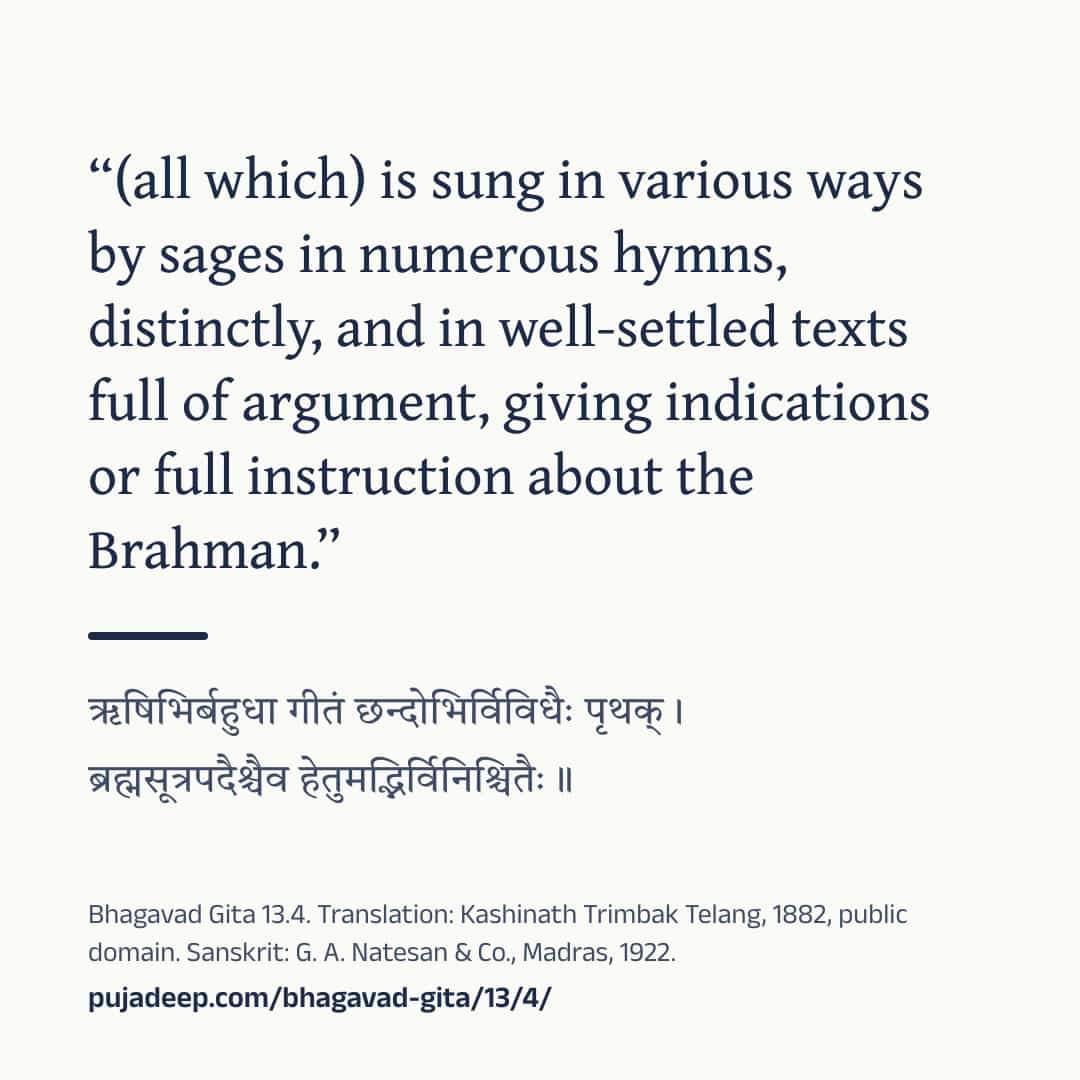
Drawing the picture
See the words
Bhagavad Gita 13.4

ऋषिभिर्बहुधा गीतं छन्दोभिर्विविधैः पृथक् ।
ब्रह्मसूत्रपदैश्चैव हेतुमद्भिर्विनिश्चितैः ॥

“(all which) is sung in various ways by sages in numerous hymns, distinctly, and in well-settled texts full of argument, giving indications or full instruction about the Brahman.”
(K. T. Telang, The Bhagavadgîtâ (The Sacred Books of the East, vol. VIII, Oxford: Clarendon Press, 1882), p. 102, public domain)
This sentence begins in 13.3.

“Rishis have sung in manifold ways, in many various chants, and in decisive Brahma-sûtra verses, full of reasonings.”
(Annie Besant, The Bhagavad Gîtâ, or The Lord's Song (London: Theosophical Publishing Society, 1895), pp. 122–123, public domain)

“(This truth) has been sung by Rishis in many ways, in various distinctive chants, in passages indicative of Brahman, full of reasoning, and convincing.”
(Swami Swarupananda, Srimad-Bhagavad-Gita (Mayavati: Prabuddha Bharata Press, 1909; first printed in Prabuddha Bharata, 1907–1909), p. 254, public domain)

Sanskrit: G. A. Natesan & Co., Madras, 1922.
https://pujadeep.com/bhagavad-gita/13/4/ Nothing is sent from this site. Your own app sends it, to the chat you choose. The picture quotes the translation you chose on this page, with its name and year.
Sanskrit text: The Bhagavad-Gita, or The Lord's Song, with the text in Devanagari and an English translation, 1922. Meanings: written for Pujadeep and checked against the cited edition. Source and changes
Questions families ask
Who speaks Bhagavad Gita 13.4?
Krishna speaks this verse, in chapter 13 (Kshetra Kshetrajna Vibhaga Yoga).
Where does the Sanskrit text come from?
Sanskrit text: The Bhagavad-Gita, or The Lord's Song, with the text in Devanagari and an English translation, 1922. Meanings: written for Pujadeep and checked against the cited edition. See the source
Is the meaning on this page a translation?
Explanation written for this site from the sources listed here, and checked against the cited edition. It is not a translation and not the only way to read the text. Free to quote with credit.
Source and licence
- Sanskrit text
- The Bhagavad-Gita, or The Lord's Song, with the text in Devanagari and an English translation (Annie Besant, G. A. Natesan & Co., Madras, 1922). Public domain. The Sanskrit on these pages was read from this printing’s page images.
- Translation
- The Bhagavadgîtâ with the Sanatsugâtîya and the Anugîtâ, translated by Kâshinâth Trimbak Telang (The Sacred Books of the East, vol. VIII, ed. F. Max Müller) (Kashinath Trimbak Telang, F. Max Müller, Clarendon Press, Oxford, 1882). Public domain. Shown verbatim, as printed.
- Translation
- The Bhagavad Gîtâ, or The Lord's Song, translated by Annie Besant (Annie Besant, Theosophical Publishing Society, London, 1895). Public domain. Shown verbatim, as printed.
- Translation
- Srimad-Bhagavad-Gita, with Sanskrit Text; Paraphrase with Word-by-word Literal Translation; English Rendering and Comments, Index, &c., by the Swami Swarupananda (Himalayan Series, No. XX) (Swami Swarupananda, The Editors and Publishers, Advaita Ashrama, Mayavati, Prabuddha Bharata Press, Mayavati, Almora, Himalayas, 1909). Public domain. Shown verbatim, as printed.
- Common wording
- In this text, 32 words follow today's common wording, checked against sanskritdocuments.org; Sanskrit Wikisource; Gita Press, Gorakhpur; GRETIL, Göttingen and Bhaktivedanta Book Trust.
- Our explanation
- Explanation written for this site from the sources listed here, and checked against the cited edition. It is not a translation and not the only way to read the text. Free to quote with credit.
- Checked
- Checked against the cited edition, October 15, 2026.
- Updated
- October 25, 2026