Bhagavad Gita 13.5: meaning and translation
Chapter 13: Kshetra Kshetrajna Vibhaga Yoga. Krishna says
Krishna lists what makes up the field: the great elements, the sense of “I” (ahaṅkāra), the intellect (buddhi), the unmanifest (avyakta), the ten senses and the one, the mind, and the five objects of the senses.
Click or tap a word for its meaning and its dictionary page.
Text and layers
Text and layers
These choices stay in this browser.
Bhagavad Gita 13.5
महाभूतान्यहङ्कारो बुद्धिरव्यक्तमेव च ।इन्द्रियाणि दशैकं च पञ्च चेन्द्रियगोचराः ॥
Mahabhutanyahankaro buddhiravyaktameva chaIndriyani dashaikam cha pancha chendriyagocharah
mahābhūtānyahaṅkāro buddhiravyaktameva ca |indriyāṇi daśaikaṃ ca pañca cendriyagocarāḥ ||
Our explanation Krishna lists what makes up the field: the great elements, the sense of “I” (ahaṅkāra), the intellect (buddhi), the unmanifest (avyakta), the ten senses and the one, the mind, and the five objects of the senses. The list continues in the next verse.
हिंदी अर्थ कृष्ण बताते हैं कि क्षेत्र किन चीज़ों से बना है: महाभूत, अहंकार (“मैं” का भाव), बुद्धि, अव्यक्त, दस इंद्रियाँ और एक मन, तथा इंद्रियों के पाँच विषय। सूची अगले श्लोक में आगे चलती है।
Word by word
Every word, with its dictionary page
Word by word
- महाभूतानि mahābhūtāni · the great elements (compound (neuter), nominative plural) Dictionary: mahā-bhūta, Monier-Williams 1899, p. 798, col. 2 “a great element, gross el°”
- अहङ्कारः ahaṅkāraḥ · the sense of "I" (ahaṅkāra) (noun (masculine), nominative singular) Dictionary: ahaṃ-kāra, Monier-Williams 1899, p. 124, col. 2 “conception of one's individuality, self-consciousness”
- बुद्धिः buddhiḥ · the intellect (buddhi) (noun (feminine), nominative singular) Dictionary: buddhi, Monier-Williams 1899, p. 733, col. 3 “intelligence, reason, intellect, mind, discernment, judgment”
- अव्यक्तम् avyaktam · the unmanifest (noun (neuter), nominative singular) Dictionary: a-vyakta, Monier-Williams 1899, p. 111, col. 2 “not manifest, unapparent, indistinct, invisible, imperceptible”
- एव eva · also (indeclinable) Dictionary: 1. eva, Monier-Williams 1899, p. 232, col. 2 “just, exactly, very, same, only, even, alone, merely”
- च ca · and (indeclinable) Dictionary: 2. ca, Monier-Williams 1899, p. 380, col. 1 “and, both, also, moreover, as well as”
- इन्द्रियाणि indriyāṇi · the senses (noun (neuter), nominative plural) Dictionary: indriya, Monier-Williams 1899, p. 167, col. 2 “faculty of sense, sense, organ of sense”
- दश daśa · ten (numeral, nominative) Dictionary: daśan, Monier-Williams 1899, p. 472, col. 3 “ten”
- एकम् ekam · the one (the mind) (adjective (neuter), nominative singular) Dictionary: eka, Monier-Williams 1899, p. 227, col. 3 “alone, solitary, single, happening only once, that one only”
- च ca · and (indeclinable) Dictionary: 2. ca, Monier-Williams 1899, p. 380, col. 1 “and, both, also, moreover, as well as”
- पञ्च pañca · five (numeral, nominative) Dictionary: pañcan, Monier-Williams 1899, p. 578, col. 2 “five”
- च ca · and (indeclinable) Dictionary: 2. ca, Monier-Williams 1899, p. 380, col. 1 “and, both, also, moreover, as well as”
- इन्द्रियगोचराः indriyagocarāḥ · the objects of the senses (compound (masculine), nominative plural) Dictionary: indriya, Monier-Williams 1899, p. 167, col. 2 “faculty of sense, sense, organ of sense”; go-cara, Monier-Williams 1899, p. 364, col. 1 “the range of the organs of sense, object of sense”
Old translations
Kashinath Trimbak Telang, 1882. Public domain. Page 102.
The great elements1, egoism, the understanding, the unperceived also, the ten senses, and the one, and the five objects of sense,
This sentence goes on in 13.6.
Footnotes (the translator’s own) - Cf. Aitareya-âranyaka, p. 97. The subtle elements, earth, fire, &c., are meant. The unperceived=nature; the one=mind; courage=that by which the drooping body and senses are supported; egoism=self-consciousness—the feeling 'this is I.' ↩
Compare 3 translations
Kashinath Trimbak Telang, 1882. Public domain. Page 102.
The great elements1, egoism, the understanding, the unperceived also, the ten senses, and the one, and the five objects of sense,
This sentence goes on in 13.6.
Footnotes (the translator’s own) - Cf. Aitareya-âranyaka, p. 97. The subtle elements, earth, fire, &c., are meant. The unperceived=nature; the one=mind; courage=that by which the drooping body and senses are supported; egoism=self-consciousness—the feeling 'this is I.' ↩
You are reading this one
Annie Besant, 1895. Public domain. Page 123.
The great Elements, Ahankâra, Buddhi and also the unmanifested, the ten senses, and the one, and the five pastures of the senses;
This sentence goes on in 13.6.
You are reading this one
Swami Swarupananda, 1909 (first printed 1907). Public domain. Page 255.
The great Elements, Egoism, Intellect, and also the Unmanifested (Mula Prakriti), the ten senses and the one (mind), and the five objects of sense; desire, hatred, pleasure, pain, the body, intelligence, fortitude,—the Kshetra has been thus briefly described with its modifications.
This sentence covers verses 13.5 to 13.6.
You are reading this one
Cite this verse
The translation: K. T. Telang, The Bhagavadgîtâ (The Sacred Books of the East, vol. VIII, Oxford: Clarendon Press, 1882), p. 102. Bhagavad Gita 13.5.
The translation: Annie Besant, The Bhagavad Gîtâ, or The Lord's Song (London: Theosophical Publishing Society, 1895), p. 123. Bhagavad Gita 13.5.
The translation: Swami Swarupananda, Srimad-Bhagavad-Gita (Mayavati: Prabuddha Bharata Press, 1909; first printed in Prabuddha Bharata, 1907–1909), p. 255. Bhagavad Gita 13.5–6.
Our explanation: “Bhagavad Gita 13.5: meaning and translation.” Pujadeep. Updated October 25, 2026. https://pujadeep.com/bhagavad-gita/13/5/
Pujadeep’s explanations are free to quote with credit: name Pujadeep and link to the page. How to credit
Classical readings, by school
No readings by school on this verse yet.
Share
Show the ways to share
Send one picture or the text to one chat. The picture names its source and the address of this page.
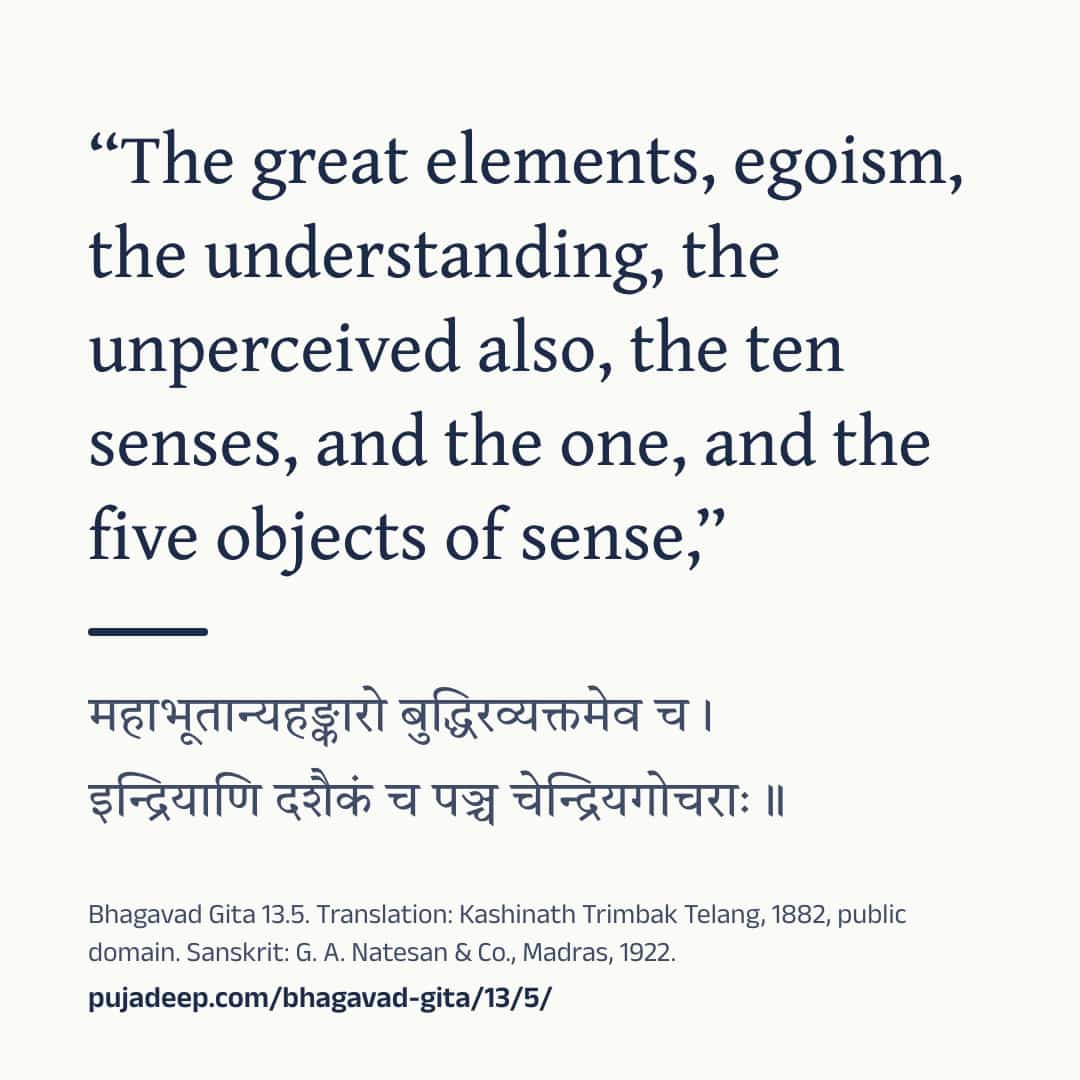
Drawing the picture
See the words
Bhagavad Gita 13.5

महाभूतान्यहङ्कारो बुद्धिरव्यक्तमेव च ।
इन्द्रियाणि दशैकं च पञ्च चेन्द्रियगोचराः ॥

“The great elements, egoism, the understanding, the unperceived also, the ten senses, and the one, and the five objects of sense,”
(K. T. Telang, The Bhagavadgîtâ (The Sacred Books of the East, vol. VIII, Oxford: Clarendon Press, 1882), p. 102, public domain)
This sentence goes on in 13.6.

“The great Elements, Ahankâra, Buddhi and also the unmanifested, the ten senses, and the one, and the five pastures of the senses;”
(Annie Besant, The Bhagavad Gîtâ, or The Lord's Song (London: Theosophical Publishing Society, 1895), p. 123, public domain)
This sentence goes on in 13.6.

“The great Elements, Egoism, Intellect, and also the Unmanifested (Mula Prakriti), the ten senses and the one (mind), and the five objects of sense; desire, hatred, pleasure, pain, the body, intelligence, fortitude,—the Kshetra has been thus briefly described with its modifications.”
(Swami Swarupananda, Srimad-Bhagavad-Gita (Mayavati: Prabuddha Bharata Press, 1909; first printed in Prabuddha Bharata, 1907–1909), p. 255, public domain)
This sentence covers verses 13.5 to 13.6.

Sanskrit: G. A. Natesan & Co., Madras, 1922.
https://pujadeep.com/bhagavad-gita/13/5/ Nothing is sent from this site. Your own app sends it, to the chat you choose. The picture quotes the translation you chose on this page, with its name and year.
Sanskrit text: The Bhagavad-Gita, or The Lord's Song, with the text in Devanagari and an English translation, 1922. Meanings: written for Pujadeep and checked against the cited edition. Source and changes
Questions families ask
Who speaks Bhagavad Gita 13.5?
Krishna speaks this verse, in chapter 13 (Kshetra Kshetrajna Vibhaga Yoga).
Where does the Sanskrit text come from?
Sanskrit text: The Bhagavad-Gita, or The Lord's Song, with the text in Devanagari and an English translation, 1922. Meanings: written for Pujadeep and checked against the cited edition. See the source
Is the meaning on this page a translation?
Explanation written for this site from the sources listed here, and checked against the cited edition. It is not a translation and not the only way to read the text. Free to quote with credit.
Source and licence
- Sanskrit text
- The Bhagavad-Gita, or The Lord's Song, with the text in Devanagari and an English translation (Annie Besant, G. A. Natesan & Co., Madras, 1922). Public domain. The Sanskrit on these pages was read from this printing’s page images.
- Translation
- The Bhagavadgîtâ with the Sanatsugâtîya and the Anugîtâ, translated by Kâshinâth Trimbak Telang (The Sacred Books of the East, vol. VIII, ed. F. Max Müller) (Kashinath Trimbak Telang, F. Max Müller, Clarendon Press, Oxford, 1882). Public domain. Shown verbatim, as printed.
- Translation
- The Bhagavad Gîtâ, or The Lord's Song, translated by Annie Besant (Annie Besant, Theosophical Publishing Society, London, 1895). Public domain. Shown verbatim, as printed.
- Translation
- Srimad-Bhagavad-Gita, with Sanskrit Text; Paraphrase with Word-by-word Literal Translation; English Rendering and Comments, Index, &c., by the Swami Swarupananda (Himalayan Series, No. XX) (Swami Swarupananda, The Editors and Publishers, Advaita Ashrama, Mayavati, Prabuddha Bharata Press, Mayavati, Almora, Himalayas, 1909). Public domain. Shown verbatim, as printed.
- Common wording
- In this text, 32 words follow today's common wording, checked against sanskritdocuments.org; Sanskrit Wikisource; Gita Press, Gorakhpur; GRETIL, Göttingen and Bhaktivedanta Book Trust.
- Our explanation
- Explanation written for this site from the sources listed here, and checked against the cited edition. It is not a translation and not the only way to read the text. Free to quote with credit.
- Checked
- Checked against the cited edition, October 15, 2026.
- Updated
- October 25, 2026