Bhagavad Gita 13.17: meaning and translation
Chapter 13: Kshetra Kshetrajna Vibhaga Yoga. Krishna says
Krishna says it is the light even of all lights, and is said to be beyond darkness.
Click or tap a word for its meaning and its dictionary page.
Text and layers
Text and layers
These choices stay in this browser.
Bhagavad Gita 13.17
ज्योतिषामपि तज्ज्योतिस्तमसः परमुच्यते ।ज्ञानं ज्ञेयं ज्ञानगम्यं हृदि सर्वस्य विष्ठितम् ॥
Jyotishamapi tajjyotistamasah paramuchyateJnanam jneyam jnanagamyam hridi sarvasya vishthitam
jyotiṣāmapi tajjyotistamasaḥ paramucyate |jñānaṃ jñeyaṃ jñānagamyaṃ hṛdi sarvasya viṣṭhitam ||
Our explanation Krishna says it is the light even of all lights, and is said to be beyond darkness. It is knowledge, what is to be known, and what is reached through knowledge, and it is seated in the heart of everyone.
हिंदी अर्थ कृष्ण कहते हैं कि वह सब ज्योतियों की भी ज्योति है, और अंधकार से परे कहा जाता है। वही ज्ञान है, वही ज्ञेय है, और वही ज्ञान से पाया जाने वाला है; और वह सबके हृदय में स्थित है।
Word by word
Every word, with its dictionary page
Word by word
- ज्योतिषाम् jyotiṣām · of the lights (noun (neuter), genitive plural) Dictionary: jyotis, Monier-Williams 1899, p. 427, col. 3 “light (of the sun, dawn, fire, lightning, &c.; also pl.)”
- अपि api · even (indeclinable) Dictionary: api, Monier-Williams 1899, p. 55, col. 1 “in the sense of even, also, very”
- तत् tat · that (pronoun (neuter), nominative singular) Dictionary: tad, Monier-Williams 1899, p. 434, col. 1 “m. he, f. she, n. it, that, this”
- ज्योतिः jyotiḥ · the light (noun (neuter), nominative singular) Dictionary: jyotis, Monier-Williams 1899, p. 427, col. 3 “light (of the sun, dawn, fire, lightning, &c.; also pl.)”
- तमसः tamasaḥ · darkness (noun (neuter), ablative singular) Dictionary: tamas, Monier-Williams 1899, p. 438, col. 1 “darkness, gloom”
- परम् param · beyond (indeclinable) Dictionary: 1. para, Monier-Williams 1899, p. 586, col. 1 “highest, supreme, chief”
- उच्यते ucyate · is called (present passive, 3rd person singular) Dictionary: vac, Monier-Williams 1899, p. 912, col. 1 “to be called or accounted, be regarded as”
- ज्ञानम् jñānam · knowledge (noun (neuter), nominative singular) Dictionary: jñāna, Monier-Williams 1899, p. 426, col. 1 “knowing, becoming acquainted with, knowledge”
- ज्ञेयम् jñeyam · what is to be known (gerundive (to be done) (neuter), nominative singular) Dictionary: jñeya, Monier-Williams 1899, p. 426, col. 2 “to be known”
- ज्ञानगम्यम् jñānagamyam · reached through knowledge (compound (neuter), nominative singular) Dictionary: jñāna, Monier-Williams 1899, p. 426, col. 1 “knowing, becoming acquainted with, knowledge”; gamya, Monier-Williams 1899, p. 348, col. 1 “to be gone or gone to, approachable, accessible, passable, attainable”
- हृदि hṛdi · in the heart (noun (neuter), locative singular) Dictionary: hṛd, Monier-Williams 1899, p. 1302, col. 2 “the heart (as the seat of feelings and emotions)”
- सर्वस्य sarvasya · of everyone (pronoun (masculine), genitive singular) Dictionary: sarva, Monier-Williams 1899, p. 1184, col. 3 “whole, entire, all, every”
- विष्ठितम् viṣṭhitam · seated (past participle (neuter), nominative singular) Dictionary: vi-ṣṭhita, Monier-Williams 1899, p. 999, col. 1 “standing or being on or in (loc. or comp.)”; adhi-ṣṭhita, Monier-Williams 1899, p. 1310, col. 3 “in Bhag. xiii, 17, the text has dhi-shṭhita, with elision of a”
2 printings differ
Edition differences. Another printing or text reads this place differently.
- The printed edition reads: ज्योतिषामपि तज्ज्योतिस्तमसः परमुच्यते ।
ज्ञानं ज्ञेयं ज्ञानगम्यं हृदि सर्वस्य धिष्ठितम् ॥ - Word The 1922 Madras printing reads: ज्ञानं ज्ञेयं ज्ञानगम्यं हृदि सर्वस्य धिष्ठितम् The 1922 base printing (leaf n201, read at high zoom: the loop of ध, not the ring of व) reads धिष्ठितम्, adhiṣṭhitam without its first a; Monier-Williams (1899, p. 1310, col. 3) notes that 'in Bhag. xiii, 17, the text has dhi-shṭhita'. Under decision 14 the display follows the common wording विष्ठितम्, printed by Gita Press (p. 151) and read in sanskritdocuments.org, GRETIL and Sanskrit Wikisource. Both words mean 'seated, established'.
Old translations
Kashinath Trimbak Telang, 1882. Public domain. Page 104.
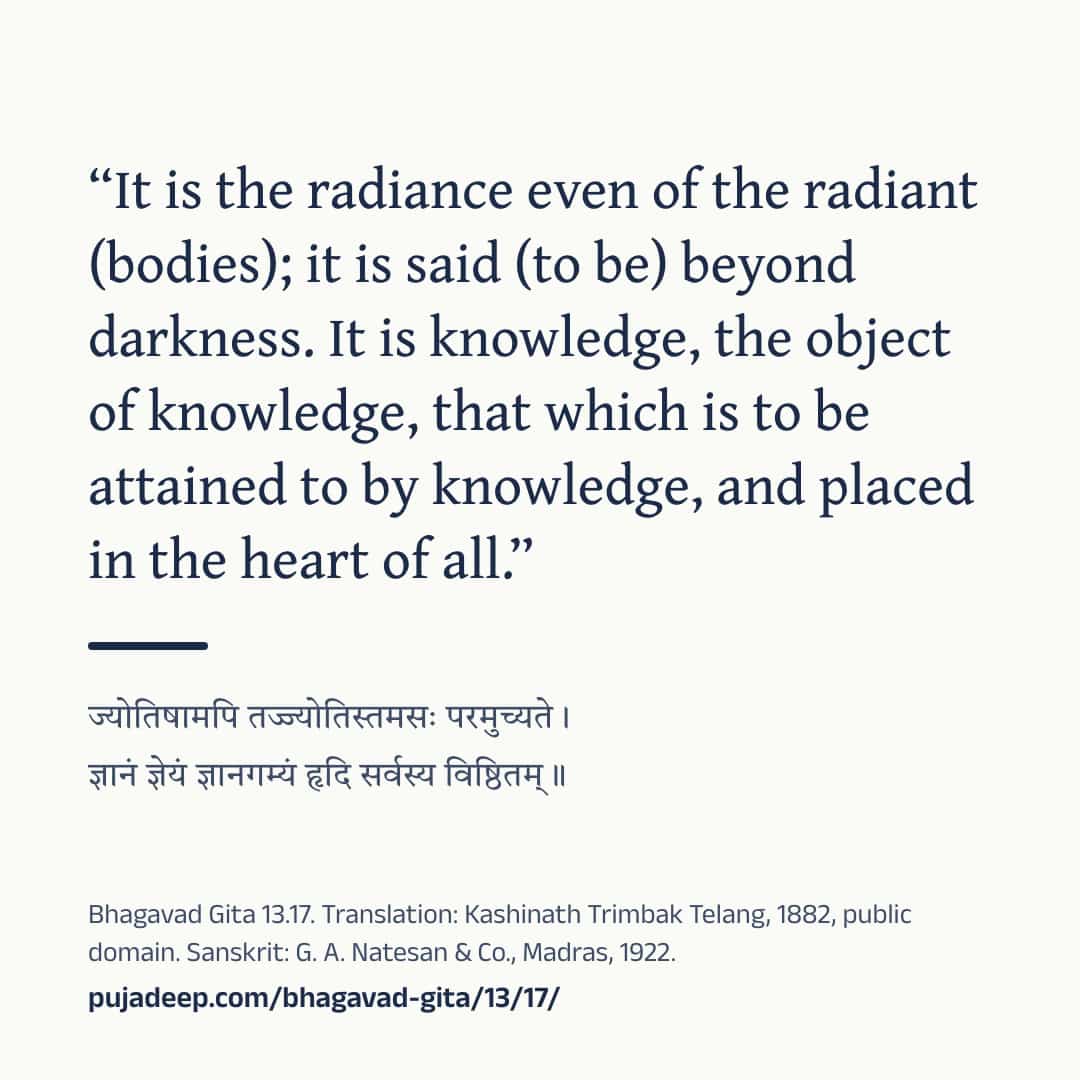
It is the radiance even of the radiant (bodies); it is said (to be) beyond darkness. It is knowledge, the object of knowledge, that which is to be attained to by knowledge, and placed in the heart of all1.
Footnotes (the translator’s own) - Cf. p. 88. ↩
Compare 3 translations
Kashinath Trimbak Telang, 1882. Public domain. Page 104.
It is the radiance even of the radiant (bodies); it is said (to be) beyond darkness. It is knowledge, the object of knowledge, that which is to be attained to by knowledge, and placed in the heart of all1.
Footnotes (the translator’s own) - Cf. p. 88. ↩
You are reading this one
Annie Besant, 1895. Public domain. Page 125.
THAT, the Light of all lights, is said to be beyond darkness; wisdom, the wisdom to be gained, the end of wisdom, seated in the hearts of all.
You are reading this one
Swami Swarupananda, 1909 (first printed 1907). Public domain. Page 261.
The Light even of lights, It is said to be beyond darkness; Knowledge, and the One Thing to be known, the Goal of knowledge, dwelling in the hearts of all.
You are reading this one
Cite this verse
The translation: K. T. Telang, The Bhagavadgîtâ (The Sacred Books of the East, vol. VIII, Oxford: Clarendon Press, 1882), p. 104. Bhagavad Gita 13.17.
The translation: Annie Besant, The Bhagavad Gîtâ, or The Lord's Song (London: Theosophical Publishing Society, 1895), p. 125. Bhagavad Gita 13.17.
The translation: Swami Swarupananda, Srimad-Bhagavad-Gita (Mayavati: Prabuddha Bharata Press, 1909; first printed in Prabuddha Bharata, 1907–1909), p. 261. Bhagavad Gita 13.17.
Our explanation: “Bhagavad Gita 13.17: meaning and translation.” Pujadeep. Updated October 25, 2026. https://pujadeep.com/bhagavad-gita/13/17/
Pujadeep’s explanations are free to quote with credit: name Pujadeep and link to the page. How to credit
Classical readings, by school
No readings by school on this verse yet.
Share
Show the ways to share
Send one picture or the text to one chat. The picture names its source and the address of this page.
Drawing the picture
See the words
Bhagavad Gita 13.17

ज्योतिषामपि तज्ज्योतिस्तमसः परमुच्यते ।
ज्ञानं ज्ञेयं ज्ञानगम्यं हृदि सर्वस्य विष्ठितम् ॥

“It is the radiance even of the radiant (bodies); it is said (to be) beyond darkness. It is knowledge, the object of knowledge, that which is to be attained to by knowledge, and placed in the heart of all.”
(K. T. Telang, The Bhagavadgîtâ (The Sacred Books of the East, vol. VIII, Oxford: Clarendon Press, 1882), p. 104, public domain)

“THAT, the Light of all lights, is said to be beyond darkness; wisdom, the wisdom to be gained, the end of wisdom, seated in the hearts of all.”
(Annie Besant, The Bhagavad Gîtâ, or The Lord's Song (London: Theosophical Publishing Society, 1895), p. 125, public domain)

“The Light even of lights, It is said to be beyond darkness; Knowledge, and the One Thing to be known, the Goal of knowledge, dwelling in the hearts of all.”
(Swami Swarupananda, Srimad-Bhagavad-Gita (Mayavati: Prabuddha Bharata Press, 1909; first printed in Prabuddha Bharata, 1907–1909), p. 261, public domain)

Sanskrit: G. A. Natesan & Co., Madras, 1922.
https://pujadeep.com/bhagavad-gita/13/17/ Nothing is sent from this site. Your own app sends it, to the chat you choose. The picture quotes the translation you chose on this page, with its name and year.
Sanskrit text: The Bhagavad-Gita, or The Lord's Song, with the text in Devanagari and an English translation, 1922. Meanings: written for Pujadeep and checked against the cited edition. Source and changes
Questions families ask
Who speaks Bhagavad Gita 13.17?
Krishna speaks this verse, in chapter 13 (Kshetra Kshetrajna Vibhaga Yoga).
Where does the Sanskrit text come from?
Sanskrit text: The Bhagavad-Gita, or The Lord's Song, with the text in Devanagari and an English translation, 1922. Meanings: written for Pujadeep and checked against the cited edition. See the source
Is the meaning on this page a translation?
Explanation written for this site from the sources listed here, and checked against the cited edition. It is not a translation and not the only way to read the text. Free to quote with credit.
Source and licence
- Sanskrit text
- The Bhagavad-Gita, or The Lord's Song, with the text in Devanagari and an English translation (Annie Besant, G. A. Natesan & Co., Madras, 1922). Public domain. The Sanskrit on these pages was read from this printing’s page images.
- Translation
- The Bhagavadgîtâ with the Sanatsugâtîya and the Anugîtâ, translated by Kâshinâth Trimbak Telang (The Sacred Books of the East, vol. VIII, ed. F. Max Müller) (Kashinath Trimbak Telang, F. Max Müller, Clarendon Press, Oxford, 1882). Public domain. Shown verbatim, as printed.
- Translation
- The Bhagavad Gîtâ, or The Lord's Song, translated by Annie Besant (Annie Besant, Theosophical Publishing Society, London, 1895). Public domain. Shown verbatim, as printed.
- Translation
- Srimad-Bhagavad-Gita, with Sanskrit Text; Paraphrase with Word-by-word Literal Translation; English Rendering and Comments, Index, &c., by the Swami Swarupananda (Himalayan Series, No. XX) (Swami Swarupananda, The Editors and Publishers, Advaita Ashrama, Mayavati, Prabuddha Bharata Press, Mayavati, Almora, Himalayas, 1909). Public domain. Shown verbatim, as printed.
- Common wording
- In this text, 32 words follow today's common wording, checked against sanskritdocuments.org; Sanskrit Wikisource; Gita Press, Gorakhpur; GRETIL, Göttingen and Bhaktivedanta Book Trust.
- Our explanation
- Explanation written for this site from the sources listed here, and checked against the cited edition. It is not a translation and not the only way to read the text. Free to quote with credit.
- Checked
- Checked against the cited edition, October 15, 2026.
- Updated
- October 25, 2026