Bhagavad Gita 13.18: meaning and translation
Chapter 13: Kshetra Kshetrajna Vibhaga Yoga. Krishna says
Krishna sums up: in this way the field, knowledge and what is to be known have been told in brief.
Click or tap a word for its meaning and its dictionary page.
Text and layers
Text and layers
These choices stay in this browser.
Bhagavad Gita 13.18
इति क्षेत्रं तथा ज्ञानं ज्ञेयं चोक्तं समासतः ।मद्भक्त एतद्विज्ञाय मद्भावायोपपद्यते ॥
Iti kshetram tatha jnanam jneyam choktam samasatahMadbhakta etadvijnaya madbhavayopapadyate
iti kṣetraṃ tathā jñānaṃ jñeyaṃ coktaṃ samāsataḥ |madbhakta etadvijñāya madbhāvāyopapadyate ||
Our explanation Krishna sums up: in this way the field, knowledge and what is to be known have been told in brief. His devotee who understands this, he says, becomes fit to attain his state of being.
हिंदी अर्थ कृष्ण सार बताते हैं: इस तरह क्षेत्र, ज्ञान और ज्ञेय संक्षेप में बताए गए। वे कहते हैं कि जो उनका भक्त इसे समझ लेता है, वह उनके भाव (स्वरूप) को पाने के योग्य हो जाता है।
Word by word
Every word, with its dictionary page
Word by word
- इति iti · thus (indeclinable) Dictionary: 2. iti, Monier-Williams 1899, p. 165, col. 1 “in this manner, thus”
- क्षेत्रम् kṣetram · the field (noun (neuter), nominative singular) Dictionary: kṣetra, Monier-Williams 1899, p. 332, col. 1 “a field”
- तथा tathā · and also (indeclinable) Dictionary: tathā, Monier-Williams 1899, p. 433, col. 3 “in that manner, so, thus”
- ज्ञानम् jñānam · knowledge (noun (neuter), nominative singular) Dictionary: jñāna, Monier-Williams 1899, p. 426, col. 1 “knowing, becoming acquainted with, knowledge”
- ज्ञेयम् jñeyam · what is to be known (gerundive (to be done) (neuter), nominative singular) Dictionary: jñeya, Monier-Williams 1899, p. 426, col. 2 “to be known”
- च ca · and (indeclinable) Dictionary: 2. ca, Monier-Williams 1899, p. 380, col. 1 “and, both, also, moreover, as well as”
- उक्तम् uktam · has been told (past participle (neuter), nominative singular) Dictionary: ukta, Monier-Williams 1899, p. 171, col. 3 “uttered, said, spoken”
- समासतः samāsataḥ · in brief (indeclinable) Dictionary: sam-āsa-tas, Monier-Williams 1899, p. 1158, col. 2 “in a summary manner, succinctly, concisely”
- मद्भक्तः madbhaktaḥ · devotee of "me" (Krishna) (compound (masculine), nominative singular) Dictionary: mad-bhakta, Monier-Williams 1899, p. 777, col. 2 “devoted to me”
- एतत् etat · this (pronoun (neuter), accusative singular) Dictionary: etad, Monier-Williams 1899, p. 231, col. 2 “this, this here, here”
- विज्ञाय vijñāya · having understood (absolutive (having done)) Dictionary: vi-jñā, Monier-Williams 1899, p. 961, col. 1 “to distinguish, discern, observe, investigate, recognize, ascertain, know, understand”
- मद्भावाय madbhāvāya · for "my" state of being (compound (masculine), dative singular) Dictionary: mad-bhāva, Monier-Williams 1899, p. 777, col. 2 “my essence”
- उपपद्यते upapadyate · becomes fit (for) (present (middle), 3rd person singular) Dictionary: upa-pad, Monier-Williams 1899, p. 201, col. 3 “to be fit for or adequate to (with loc.)”
Old translations
Kashinath Trimbak Telang, 1882. Public domain. Page 104.
Thus in brief have Kshetra, knowledge, and the object of knowledge been declared. My devotee, knowing this, becomes fit for assimilation with me.
Compare 3 translations
Kashinath Trimbak Telang, 1882. Public domain. Page 104.
Thus in brief have Kshetra, knowledge, and the object of knowledge been declared. My devotee, knowing this, becomes fit for assimilation with me.
You are reading this one
Annie Besant, 1895. Public domain. Page 125.
Thus the Field, wisdom, and that which is to be known, have been briefly told. My devotee, thus knowing, enters into My Being.
You are reading this one
Swami Swarupananda, 1909 (first printed 1907). Public domain. Page 261.
Thus Kshetra, knowledge, and That which has to be known, have been briefly stated. Knowing this My devotee is fitted for My state.
You are reading this one
Cite this verse
The translation: K. T. Telang, The Bhagavadgîtâ (The Sacred Books of the East, vol. VIII, Oxford: Clarendon Press, 1882), p. 104. Bhagavad Gita 13.18.
The translation: Annie Besant, The Bhagavad Gîtâ, or The Lord's Song (London: Theosophical Publishing Society, 1895), p. 125. Bhagavad Gita 13.18.
The translation: Swami Swarupananda, Srimad-Bhagavad-Gita (Mayavati: Prabuddha Bharata Press, 1909; first printed in Prabuddha Bharata, 1907–1909), p. 261. Bhagavad Gita 13.18.
Our explanation: “Bhagavad Gita 13.18: meaning and translation.” Pujadeep. Updated October 25, 2026. https://pujadeep.com/bhagavad-gita/13/18/
Pujadeep’s explanations are free to quote with credit: name Pujadeep and link to the page. How to credit
Classical readings, by school
No readings by school on this verse yet.
Share
Show the ways to share
Send one picture or the text to one chat. The picture names its source and the address of this page.
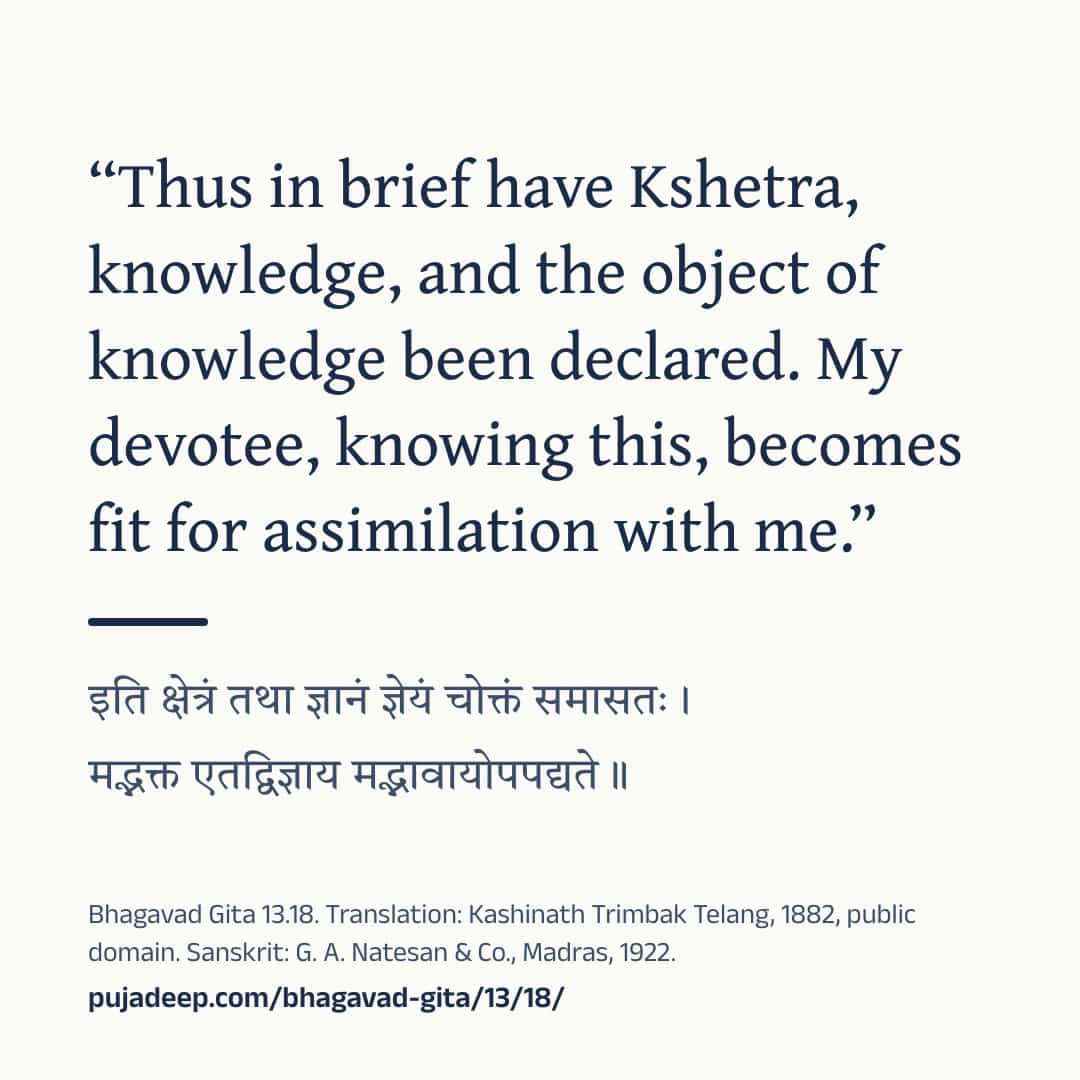
Drawing the picture
See the words
Bhagavad Gita 13.18

इति क्षेत्रं तथा ज्ञानं ज्ञेयं चोक्तं समासतः ।
मद्भक्त एतद्विज्ञाय मद्भावायोपपद्यते ॥

“Thus in brief have Kshetra, knowledge, and the object of knowledge been declared. My devotee, knowing this, becomes fit for assimilation with me.”
(K. T. Telang, The Bhagavadgîtâ (The Sacred Books of the East, vol. VIII, Oxford: Clarendon Press, 1882), p. 104, public domain)

“Thus the Field, wisdom, and that which is to be known, have been briefly told. My devotee, thus knowing, enters into My Being.”
(Annie Besant, The Bhagavad Gîtâ, or The Lord's Song (London: Theosophical Publishing Society, 1895), p. 125, public domain)

“Thus Kshetra, knowledge, and That which has to be known, have been briefly stated. Knowing this My devotee is fitted for My state.”
(Swami Swarupananda, Srimad-Bhagavad-Gita (Mayavati: Prabuddha Bharata Press, 1909; first printed in Prabuddha Bharata, 1907–1909), p. 261, public domain)

Sanskrit: G. A. Natesan & Co., Madras, 1922.
https://pujadeep.com/bhagavad-gita/13/18/ Nothing is sent from this site. Your own app sends it, to the chat you choose. The picture quotes the translation you chose on this page, with its name and year.
Sanskrit text: The Bhagavad-Gita, or The Lord's Song, with the text in Devanagari and an English translation, 1922. Meanings: written for Pujadeep and checked against the cited edition. Source and changes
Questions families ask
Who speaks Bhagavad Gita 13.18?
Krishna speaks this verse, in chapter 13 (Kshetra Kshetrajna Vibhaga Yoga).
Where does the Sanskrit text come from?
Sanskrit text: The Bhagavad-Gita, or The Lord's Song, with the text in Devanagari and an English translation, 1922. Meanings: written for Pujadeep and checked against the cited edition. See the source
Is the meaning on this page a translation?
Explanation written for this site from the sources listed here, and checked against the cited edition. It is not a translation and not the only way to read the text. Free to quote with credit.
Source and licence
- Sanskrit text
- The Bhagavad-Gita, or The Lord's Song, with the text in Devanagari and an English translation (Annie Besant, G. A. Natesan & Co., Madras, 1922). Public domain. The Sanskrit on these pages was read from this printing’s page images.
- Translation
- The Bhagavadgîtâ with the Sanatsugâtîya and the Anugîtâ, translated by Kâshinâth Trimbak Telang (The Sacred Books of the East, vol. VIII, ed. F. Max Müller) (Kashinath Trimbak Telang, F. Max Müller, Clarendon Press, Oxford, 1882). Public domain. Shown verbatim, as printed.
- Translation
- The Bhagavad Gîtâ, or The Lord's Song, translated by Annie Besant (Annie Besant, Theosophical Publishing Society, London, 1895). Public domain. Shown verbatim, as printed.
- Translation
- Srimad-Bhagavad-Gita, with Sanskrit Text; Paraphrase with Word-by-word Literal Translation; English Rendering and Comments, Index, &c., by the Swami Swarupananda (Himalayan Series, No. XX) (Swami Swarupananda, The Editors and Publishers, Advaita Ashrama, Mayavati, Prabuddha Bharata Press, Mayavati, Almora, Himalayas, 1909). Public domain. Shown verbatim, as printed.
- Common wording
- In this text, 32 words follow today's common wording, checked against sanskritdocuments.org; Sanskrit Wikisource; Gita Press, Gorakhpur; GRETIL, Göttingen and Bhaktivedanta Book Trust.
- Our explanation
- Explanation written for this site from the sources listed here, and checked against the cited edition. It is not a translation and not the only way to read the text. Free to quote with credit.
- Checked
- Checked against the cited edition, October 15, 2026.
- Updated
- October 25, 2026