Bhagavad Gita 13.12: meaning and translation
Chapter 13: Kshetra Kshetrajna Vibhaga Yoga. Krishna says
Krishna says he will now describe what is to be known (jñeya), knowing which one gains immortality.
Click or tap a word for its meaning and its dictionary page.
Text and layers
Text and layers
These choices stay in this browser.
Bhagavad Gita 13.12
ज्ञेयं यत्तत्प्रवक्ष्यामि यज्ज्ञात्वाऽमृतमश्नुते ।अनादिमत्परं ब्रह्म न सत्तन्नासदुच्यते ॥
Jneyam yattatpravakshyami yajjnatvamritamashnuteAnadimatparam brahma na sattannasaduchyate
jñeyaṃ yattatpravakṣyāmi yajjñātvā’mṛtamaśnute |anādimatparaṃ brahma na sattannāsaducyate ||
Our explanation Krishna says he will now describe what is to be known (jñeya), knowing which one gains immortality. Telang and Besant translate the second line as the beginningless, supreme Brahman, called neither being (sat) nor non-being (asat). The schools divide and read the words of this line differently (see the views).
हिंदी अर्थ कृष्ण कहते हैं कि अब वे उसका वर्णन करेंगे जो जानने योग्य (ज्ञेय) है, जिसे जानकर अमृत (अमरता) प्राप्त होता है। तेलंग और बेसेंट दूसरी पंक्ति का अनुवाद इस तरह करते हैं कि वह अनादि परम ब्रह्म है, जिसे न सत् कहा जाता है न असत्। इस पंक्ति के शब्दों को परंपराएँ अलग-अलग ढंग से जोड़ती और समझती हैं।
Word by word
Every word, with its dictionary page
Word by word
- ज्ञेयम् jñeyam · what is to be known (gerundive (to be done) (neuter), accusative singular) Dictionary: jñeya, Monier-Williams 1899, p. 426, col. 2 “to be known”
- यत् yat · which (relative pronoun (neuter), nominative singular) Dictionary: yad, Monier-Williams 1899, p. 844, col. 2 “who, which, what, whichever, whatever, that”
- तत् tat · that (pronoun (neuter), accusative singular) Dictionary: tad, Monier-Williams 1899, p. 434, col. 1 “m. he, f. she, n. it, that, this”
- प्रवक्ष्यामि pravakṣyāmi · "I will describe" (future, 1st person singular) Dictionary: pra-vac, Monier-Williams 1899, p. 690, col. 1 “to proclaim, announce, praise, commend, mention, teach, impart, explain”
- यत् yat · which (relative pronoun (neuter), accusative singular) Dictionary: yad, Monier-Williams 1899, p. 844, col. 2 “who, which, what, whichever, whatever, that”
- ज्ञात्वा jñātvā · having known (absolutive (having done)) Dictionary: 1. jñā, Monier-Williams 1899, p. 425, col. 3 “to know, have knowledge, become acquainted with”
- अमृतम् amṛtam · immortality (noun (neuter), accusative singular) Dictionary: a-mṛta, Monier-Williams 1899, p. 82, col. 2 “immortality”
- अश्नुते aśnute · gains (present (middle), 3rd person singular) Dictionary: 1. aś, Monier-Williams 1899, p. 112, col. 2 “to reach, come to, arrive at, get, gain, obtain”
- अनादिमत् anādimat · beginningless (adjective (neuter), nominative singular) Dictionary: an-ādi-mat, Monier-Williams 1899, p. 28, col. 1 “having no beginning”
- परम् param · supreme (adjective (neuter), nominative singular) Dictionary: 1. para, Monier-Williams 1899, p. 586, col. 1 “highest, supreme, chief”
- ब्रह्म brahma · Brahman (noun (neuter), nominative singular) Dictionary: brahman, Monier-Williams 1899, p. 738, col. 1 “one self-existent impersonal Spirit, the one universal Soul”
- न na · neither, nor (indeclinable) Dictionary: 2. na, Monier-Williams 1899, p. 523, col. 1 “ind. not, no, nor, neither”
- सत् sat · being (sat) (noun (neuter), nominative singular) Dictionary: sat, Monier-Williams 1899, p. 1134, col. 2 “that which really is, entity or existence, essence”
- तत् tat · that (pronoun (neuter), nominative singular) Dictionary: tad, Monier-Williams 1899, p. 434, col. 1 “m. he, f. she, n. it, that, this”
- न na · neither, nor (indeclinable) Dictionary: 2. na, Monier-Williams 1899, p. 523, col. 1 “ind. not, no, nor, neither”
- असत् asat · non-being (asat) (noun (neuter), nominative singular) Dictionary: a-sat, Monier-Williams 1899, p. 118, col. 2 “not being, not existing, unreal”
- उच्यते ucyate · is called (present passive, 3rd person singular) Dictionary: vac, Monier-Williams 1899, p. 912, col. 1 “to be called or accounted, be regarded as”
1 printing differs
Edition differences. Another printing or text reads this place differently.
- Spelling A digital text reads Same words. The 1922 edition marks the merged vowel with avagraha (यज्ज्ञात्वाऽमृतम्, leaf n199); the e-text writes यज्ज्ञात्वामृतम्, as another digital text does.
Old translations
Kashinath Trimbak Telang, 1882. Public domain. Page 103.
I will declare that which is the object of knowledge, knowing which, one reaches immortality; the highest Brahman, having no beginning nor end, which cannot be said to be existent or non-existent1.
Footnotes (the translator’s own) - Words indicate a class, a quality, an action, or a relation, says Saṅkara. None of these can be predicated of the Brahman; so you cannot apply either of these words to it. Cf. pp. 84, 96 supra, also Svetâsvatara, p. 346. ↩
Compare 3 translations
Kashinath Trimbak Telang, 1882. Public domain. Page 103.
I will declare that which is the object of knowledge, knowing which, one reaches immortality; the highest Brahman, having no beginning nor end, which cannot be said to be existent or non-existent1.
Footnotes (the translator’s own) - Words indicate a class, a quality, an action, or a relation, says Saṅkara. None of these can be predicated of the Brahman; so you cannot apply either of these words to it. Cf. pp. 84, 96 supra, also Svetâsvatara, p. 346. ↩
You are reading this one
Annie Besant, 1895. Public domain. Page 124.
I will declare that which is to be known, that which being known immortality is gained—the beginningless supreme Brahman, called neither being nor non-being.
You are reading this one
Swami Swarupananda, 1909 (first printed 1907). Public domain. Page 258–259.
I shall describe that which has to be known; knowing which one attains to immortality; the Beginningless Supreme Brahman. It is called neither being nor non-being.
You are reading this one
Cite this verse
The translation: K. T. Telang, The Bhagavadgîtâ (The Sacred Books of the East, vol. VIII, Oxford: Clarendon Press, 1882), p. 103. Bhagavad Gita 13.12.
The translation: Annie Besant, The Bhagavad Gîtâ, or The Lord's Song (London: Theosophical Publishing Society, 1895), p. 124. Bhagavad Gita 13.12.
The translation: Swami Swarupananda, Srimad-Bhagavad-Gita (Mayavati: Prabuddha Bharata Press, 1909; first printed in Prabuddha Bharata, 1907–1909), pp. 258–259. Bhagavad Gita 13.12.
Our explanation: “Bhagavad Gita 13.12: meaning and translation.” Pujadeep. Updated October 25, 2026. https://pujadeep.com/bhagavad-gita/13/12/
Pujadeep’s explanations are free to quote with credit: name Pujadeep and link to the page. How to credit
Classical readings, by school
Each reading is named by its school. None is presented as the only meaning.
What Advaita, Vishishtadvaita and Dvaita teach, in short
Shankara Advaita
Shankara reads anādimat param brahma as one phrase: the beginningless supreme Brahman. He rejects the split anādi mat-param (“having Me as the highest”), because the verse describes Brahman by denying every attribute. Brahman is called neither existent nor non-existent because it is beyond the senses and beyond speech, as the Upaniṣads say “not this, not this”.
Source: The Bhagavad-Gita, with the commentary of Sri Sankaracharya, translated by A. Mahadeva Sastri (2nd ed., Mysore: G. T. A. Printing Works, 1901), commentary on 13.12, pp. 305–307. Summarised in our own words; none of its text is reproduced.
Ramanuja Vishishtadvaita
Ramanuja reads the line as anādi mat-param brahma: “beginningless, having Me as its highest, the brahma”. What is to be known here is the individual self (pratyag-ātman). It has no birth and so no beginning; the Lord is higher than it and it is his body; it is called brahma because it is great, not limited by any body. It is neither sat nor asat because the self itself never takes on the states of cause and effect; those come from karma.
Source: Sri Bhagavad-Gita with Sri Ramanujacharya's Visishtadvaita commentary, translated by A. Govindacharya (Madras, 1898), commentary on 13.12, pp. 422–424. Summarised in our own words; none of its text is reproduced.
Share
Show the ways to share
Send one picture or the text to one chat. The picture names its source and the address of this page.
Drawing the picture
See the words
Bhagavad Gita 13.12

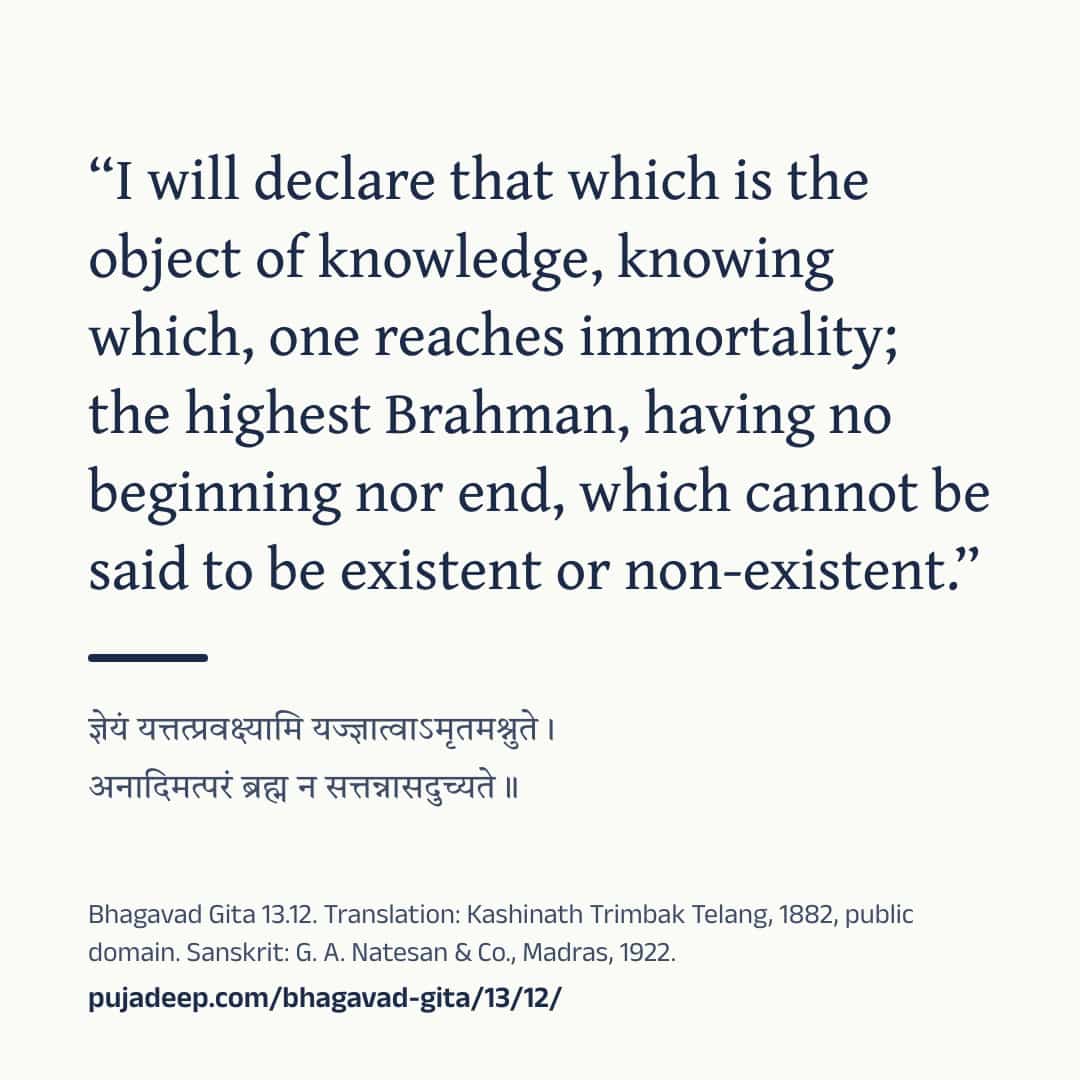
ज्ञेयं यत्तत्प्रवक्ष्यामि यज्ज्ञात्वाऽमृतमश्नुते ।
अनादिमत्परं ब्रह्म न सत्तन्नासदुच्यते ॥

“I will declare that which is the object of knowledge, knowing which, one reaches immortality; the highest Brahman, having no beginning nor end, which cannot be said to be existent or non-existent.”
(K. T. Telang, The Bhagavadgîtâ (The Sacred Books of the East, vol. VIII, Oxford: Clarendon Press, 1882), p. 103, public domain)

“I will declare that which is to be known, that which being known immortality is gained—the beginningless supreme Brahman, called neither being nor non-being.”
(Annie Besant, The Bhagavad Gîtâ, or The Lord's Song (London: Theosophical Publishing Society, 1895), p. 124, public domain)

“I shall describe that which has to be known; knowing which one attains to immortality; the Beginningless Supreme Brahman. It is called neither being nor non-being.”
(Swami Swarupananda, Srimad-Bhagavad-Gita (Mayavati: Prabuddha Bharata Press, 1909; first printed in Prabuddha Bharata, 1907–1909), pp. 258–259, public domain)

Sanskrit: G. A. Natesan & Co., Madras, 1922.
https://pujadeep.com/bhagavad-gita/13/12/ Nothing is sent from this site. Your own app sends it, to the chat you choose. The picture quotes the translation you chose on this page, with its name and year.
Sanskrit text: The Bhagavad-Gita, or The Lord's Song, with the text in Devanagari and an English translation, 1922. Meanings: written for Pujadeep and checked against the cited edition. Source and changes
Questions families ask
Who speaks Bhagavad Gita 13.12?
Krishna speaks this verse, in chapter 13 (Kshetra Kshetrajna Vibhaga Yoga).
Where does the Sanskrit text come from?
Sanskrit text: The Bhagavad-Gita, or The Lord's Song, with the text in Devanagari and an English translation, 1922. Meanings: written for Pujadeep and checked against the cited edition. See the source
Is the meaning on this page a translation?
Explanation written for this site from the sources listed here, and checked against the cited edition. It is not a translation and not the only way to read the text. Free to quote with credit.
Source and licence
- Sanskrit text
- The Bhagavad-Gita, or The Lord's Song, with the text in Devanagari and an English translation (Annie Besant, G. A. Natesan & Co., Madras, 1922). Public domain. The Sanskrit on these pages was read from this printing’s page images.
- Translation
- The Bhagavadgîtâ with the Sanatsugâtîya and the Anugîtâ, translated by Kâshinâth Trimbak Telang (The Sacred Books of the East, vol. VIII, ed. F. Max Müller) (Kashinath Trimbak Telang, F. Max Müller, Clarendon Press, Oxford, 1882). Public domain. Shown verbatim, as printed.
- Translation
- The Bhagavad Gîtâ, or The Lord's Song, translated by Annie Besant (Annie Besant, Theosophical Publishing Society, London, 1895). Public domain. Shown verbatim, as printed.
- Translation
- Srimad-Bhagavad-Gita, with Sanskrit Text; Paraphrase with Word-by-word Literal Translation; English Rendering and Comments, Index, &c., by the Swami Swarupananda (Himalayan Series, No. XX) (Swami Swarupananda, The Editors and Publishers, Advaita Ashrama, Mayavati, Prabuddha Bharata Press, Mayavati, Almora, Himalayas, 1909). Public domain. Shown verbatim, as printed.
- Commentary
- The Bhagavad-Gita, with the commentary of Sri Sankaracharya, translated by A. Mahadeva Sastri (2nd ed., Mysore: G. T. A. Printing Works, 1901) (Public-domain scan, University of California Libraries). Summarised in our own words; none of its text is reproduced.
- Commentary
- Sri Bhagavad-Gita with Sri Ramanujacharya's Visishtadvaita commentary, translated by A. Govindacharya (Madras, 1898) (Scan uploaded to archive.org (folkscanomy collection)). Summarised in our own words; none of its text is reproduced.
- Common wording
- In this text, 32 words follow today's common wording, checked against sanskritdocuments.org; Sanskrit Wikisource; Gita Press, Gorakhpur; GRETIL, Göttingen and Bhaktivedanta Book Trust.
- Our explanation
- Explanation written for this site from the sources listed here, and checked against the cited edition. It is not a translation and not the only way to read the text. Free to quote with credit.
- Checked
- Checked against the cited edition, October 15, 2026.
- Updated
- October 25, 2026