Bhagavad Gita 13.23: meaning and translation
Chapter 13: Kshetra Kshetrajna Vibhaga Yoga. Krishna says
Krishna says that whoever knows spirit and nature, together with the qualities, in this way is not born again, whatever his way of life.
Click or tap a word for its meaning and its dictionary page.
Text and layers
Text and layers
These choices stay in this browser.
Bhagavad Gita 13.23
य एवं वेत्ति पुरुषं प्रकृतिं च गुणैः सह ।सर्वथा वर्तमानोऽपि न स भूयोऽभिजायते ॥
Ya evam vetti purusham prakritim cha gunaih sahaSarvatha vartamanopi na sa bhuyobhijayate
ya evaṃ vetti puruṣaṃ prakṛtiṃ ca guṇaiḥ saha |sarvathā vartamāno’pi na sa bhūyo’bhijāyate ||
Our explanation Krishna says that whoever knows spirit and nature, together with the qualities, in this way is not born again, whatever his way of life.
हिंदी अर्थ कृष्ण कहते हैं कि जो पुरुष और प्रकृति को गुणों सहित इस तरह जान लेता है, वह किसी भी प्रकार जीवन बिताते हुए भी फिर जन्म नहीं लेता।
Word by word
Every word, with its dictionary page
Word by word
- यः yaḥ · who (relative pronoun (masculine), nominative singular) Dictionary: yad, Monier-Williams 1899, p. 844, col. 2 “who, which, what, whichever, whatever, that”
- एवम् evam · in this way (indeclinable) Dictionary: evam, Monier-Williams 1899, p. 232, col. 2 “thus, in this way, in such a manner”
- वेत्ति vetti · knows (present, 3rd person singular) Dictionary: 1. vid, Monier-Williams 1899, p. 963, col. 2 “to know, understand, perceive, learn”
- पुरुषम् puruṣam · spirit (puruṣa) (noun (masculine), accusative singular) Dictionary: puruṣa, Monier-Williams 1899, p. 637, col. 1 “the personal and animating principle in men and other beings, the soul or spirit”
- प्रकृतिम् prakṛtim · nature (prakṛti) (noun (feminine), accusative singular) Dictionary: pra-kṛti, Monier-Williams 1899, p. 654, col. 1 “the original producer of (or rather passive power of creating) the material world”
- च ca · and (indeclinable) Dictionary: 2. ca, Monier-Williams 1899, p. 380, col. 1 “and, both, also, moreover, as well as”
- गुणैः guṇaiḥ · the qualities (noun (masculine), instrumental plural) Dictionary: guṇa, Monier-Williams 1899, p. 357, col. 1 “a quality, peculiarity, attribute or property”
- सह saha · together with (indeclinable) Dictionary: 2. saha, Monier-Williams 1899, p. 1193, col. 2 “together with, along with, with”
- सर्वथा sarvathā · in whatever way (indeclinable) Dictionary: sarvathā, Monier-Williams 1899, p. 1189, col. 2 “in whatever way, however”
- वर्तमानः vartamānaḥ · living (present participle (middle) (masculine), nominative singular) Dictionary: vartamāna, Monier-Williams 1899, p. 925, col. 2 “turning, moving, existing, living, abiding”
- अपि api · even though (indeclinable) Dictionary: api, Monier-Williams 1899, p. 55, col. 1 “in the sense of even, also, very”
- न na · not (indeclinable) Dictionary: 2. na, Monier-Williams 1899, p. 523, col. 1 “ind. not, no, nor, neither”
- सः saḥ · he (pronoun (masculine), nominative singular) Dictionary: tad, Monier-Williams 1899, p. 434, col. 1 “m. he, f. she, n. it, that, this”
- भूयः bhūyaḥ · again (indeclinable) Dictionary: bhūyas, Monier-Williams 1899, p. 763, col. 3 “once more, again, anew”
- अभिजायते abhijāyate · is born (present (middle), 3rd person singular) Dictionary: abhi-jan, Monier-Williams 1899, p. 62, col. 2 “to be born or produced”
Old translations
Kashinath Trimbak Telang, 1882. Public domain. Page 105.
He who thus knows nature and spirit, together with the qualities, is not born again, however living1.
Footnotes (the translator’s own) - I. e. though he may have transgressed rules. ↩
Compare 3 translations
Kashinath Trimbak Telang, 1882. Public domain. Page 105.
He who thus knows nature and spirit, together with the qualities, is not born again, however living1.
Footnotes (the translator’s own) - I. e. though he may have transgressed rules. ↩
You are reading this one
Annie Besant, 1895. Public domain. Page 126.
He who knoweth this Purusha and Prakriti and the various qualities, in whatsoever condition, he shall not be born again.
You are reading this one
Swami Swarupananda, 1909 (first printed 1907). Public domain. Page 264.
He who thus knows the Purusha and Prakriti with Gunas, whatever his life, is not born again.
You are reading this one
Cite this verse
The translation: K. T. Telang, The Bhagavadgîtâ (The Sacred Books of the East, vol. VIII, Oxford: Clarendon Press, 1882), p. 105. Bhagavad Gita 13.23.
The translation: Annie Besant, The Bhagavad Gîtâ, or The Lord's Song (London: Theosophical Publishing Society, 1895), p. 126. Bhagavad Gita 13.23.
The translation: Swami Swarupananda, Srimad-Bhagavad-Gita (Mayavati: Prabuddha Bharata Press, 1909; first printed in Prabuddha Bharata, 1907–1909), p. 264. Bhagavad Gita 13.23.
Our explanation: “Bhagavad Gita 13.23: meaning and translation.” Pujadeep. Updated October 25, 2026. https://pujadeep.com/bhagavad-gita/13/23/
Pujadeep’s explanations are free to quote with credit: name Pujadeep and link to the page. How to credit
Classical readings, by school
No readings by school on this verse yet.
Share
Show the ways to share
Send one picture or the text to one chat. The picture names its source and the address of this page.
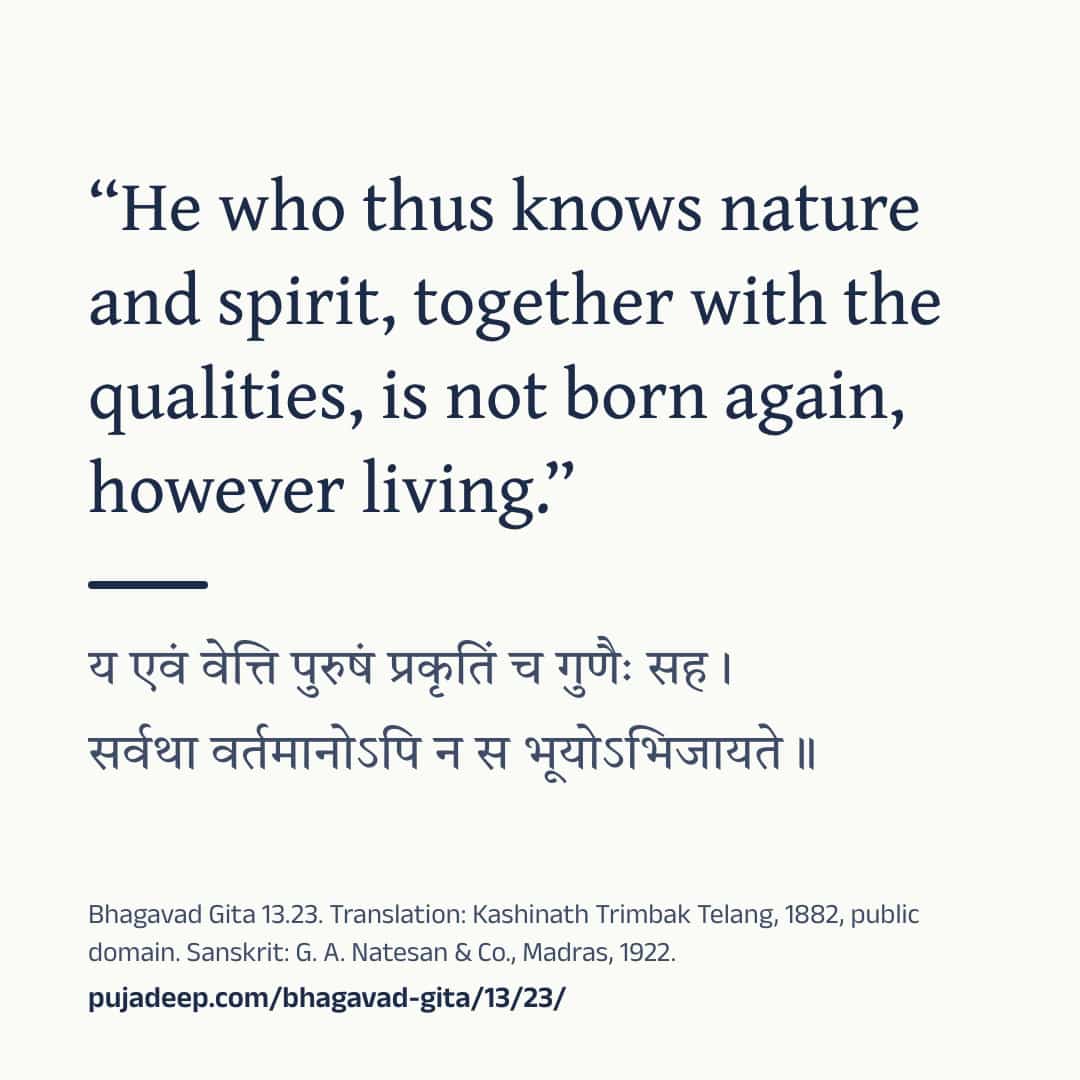
Drawing the picture
See the words
Bhagavad Gita 13.23

य एवं वेत्ति पुरुषं प्रकृतिं च गुणैः सह ।
सर्वथा वर्तमानोऽपि न स भूयोऽभिजायते ॥

“He who thus knows nature and spirit, together with the qualities, is not born again, however living.”
(K. T. Telang, The Bhagavadgîtâ (The Sacred Books of the East, vol. VIII, Oxford: Clarendon Press, 1882), p. 105, public domain)

“He who knoweth this Purusha and Prakriti and the various qualities, in whatsoever condition, he shall not be born again.”
(Annie Besant, The Bhagavad Gîtâ, or The Lord's Song (London: Theosophical Publishing Society, 1895), p. 126, public domain)

“He who thus knows the Purusha and Prakriti with Gunas, whatever his life, is not born again.”
(Swami Swarupananda, Srimad-Bhagavad-Gita (Mayavati: Prabuddha Bharata Press, 1909; first printed in Prabuddha Bharata, 1907–1909), p. 264, public domain)

Sanskrit: G. A. Natesan & Co., Madras, 1922.
https://pujadeep.com/bhagavad-gita/13/23/ Nothing is sent from this site. Your own app sends it, to the chat you choose. The picture quotes the translation you chose on this page, with its name and year.
Sanskrit text: The Bhagavad-Gita, or The Lord's Song, with the text in Devanagari and an English translation, 1922. Meanings: written for Pujadeep and checked against the cited edition. Source and changes
Questions families ask
Who speaks Bhagavad Gita 13.23?
Krishna speaks this verse, in chapter 13 (Kshetra Kshetrajna Vibhaga Yoga).
Where does the Sanskrit text come from?
Sanskrit text: The Bhagavad-Gita, or The Lord's Song, with the text in Devanagari and an English translation, 1922. Meanings: written for Pujadeep and checked against the cited edition. See the source
Is the meaning on this page a translation?
Explanation written for this site from the sources listed here, and checked against the cited edition. It is not a translation and not the only way to read the text. Free to quote with credit.
Source and licence
- Sanskrit text
- The Bhagavad-Gita, or The Lord's Song, with the text in Devanagari and an English translation (Annie Besant, G. A. Natesan & Co., Madras, 1922). Public domain. The Sanskrit on these pages was read from this printing’s page images.
- Translation
- The Bhagavadgîtâ with the Sanatsugâtîya and the Anugîtâ, translated by Kâshinâth Trimbak Telang (The Sacred Books of the East, vol. VIII, ed. F. Max Müller) (Kashinath Trimbak Telang, F. Max Müller, Clarendon Press, Oxford, 1882). Public domain. Shown verbatim, as printed.
- Translation
- The Bhagavad Gîtâ, or The Lord's Song, translated by Annie Besant (Annie Besant, Theosophical Publishing Society, London, 1895). Public domain. Shown verbatim, as printed.
- Translation
- Srimad-Bhagavad-Gita, with Sanskrit Text; Paraphrase with Word-by-word Literal Translation; English Rendering and Comments, Index, &c., by the Swami Swarupananda (Himalayan Series, No. XX) (Swami Swarupananda, The Editors and Publishers, Advaita Ashrama, Mayavati, Prabuddha Bharata Press, Mayavati, Almora, Himalayas, 1909). Public domain. Shown verbatim, as printed.
- Common wording
- In this text, 32 words follow today's common wording, checked against sanskritdocuments.org; Sanskrit Wikisource; Gita Press, Gorakhpur; GRETIL, Göttingen and Bhaktivedanta Book Trust.
- Our explanation
- Explanation written for this site from the sources listed here, and checked against the cited edition. It is not a translation and not the only way to read the text. Free to quote with credit.
- Checked
- Checked against the cited edition, October 15, 2026.
- Updated
- October 25, 2026