Bhagavad Gita 13.33: meaning and translation
Chapter 13: Kshetra Kshetrajna Vibhaga Yoga. Krishna says
Krishna gives another image.
Click or tap a word for its meaning and its dictionary page.
Text and layers
Text and layers
These choices stay in this browser.
Bhagavad Gita 13.33
यथा प्रकाशयत्येकः कृत्स्नं लोकमिमं रविः ।क्षेत्रं क्षेत्री तथा कृत्स्नं प्रकाशयति भारत ॥
Yatha prakashayatyekah kritsnam lokamimam ravihKshetram kshetri tatha kritsnam prakashayati bharata
yathā prakāśayatyekaḥ kṛtsnaṃ lokamimaṃ raviḥ |kṣetraṃ kṣetrī tathā kṛtsnaṃ prakāśayati bhārata ||
Our explanation Krishna gives another image. As the one sun lights up this whole world, he says, so the one who dwells in the field (kṣetrī) lights up the whole field.
हिंदी अर्थ कृष्ण एक और उदाहरण देते हैं। वे कहते हैं कि जैसे एक सूर्य इस पूरे संसार को प्रकाशित करता है, वैसे ही क्षेत्र में रहने वाला (क्षेत्री) पूरे क्षेत्र को प्रकाशित करता है।
Word by word
Every word, with its dictionary page
Word by word
- यथा yathā · as (indeclinable) Dictionary: yathā, Monier-Williams 1899, p. 841, col. 2 “in which manner or way, according as, as, like”
- प्रकाशयति prakāśayati · lights up (causative, present, 3rd person singular) Dictionary: pra-kāś, Monier-Williams 1899, p. 653, col. 1 “to become visible, appear, shine, become evident or manifest”
- एकः ekaḥ · the one (adjective (masculine), nominative singular) Dictionary: eka, Monier-Williams 1899, p. 227, col. 3 “alone, solitary, single, happening only once, that one only”
- कृत्स्नम् kṛtsnam · whole (adjective (masculine), accusative singular) Dictionary: kṛtsna, Monier-Williams 1899, p. 304, col. 3 “all, whole, entire”
- लोकम् lokam · world (noun (masculine), accusative singular) Dictionary: loka, Monier-Williams 1899, p. 906, col. 1 “the wide space or world”
- इमम् imam · this (pronoun (masculine), accusative singular) Dictionary: 1. idam, Monier-Williams 1899, p. 165, col. 2 “this, this here, referring to something near the speaker”
- रविः raviḥ · the sun (noun (masculine), nominative singular) Dictionary: ravi, Monier-Williams 1899, p. 869, col. 1 “the sun (in general) or the sun-god”
- क्षेत्रम् kṣetram · the field (noun (neuter), accusative singular) Dictionary: kṣetra, Monier-Williams 1899, p. 332, col. 1 “a field”
- क्षेत्री kṣetrī · the one who dwells in the field (noun (masculine), nominative singular) Dictionary: kṣetrin, Monier-Williams 1899, p. 332, col. 3 “the soul”
- तथा tathā · so (indeclinable) Dictionary: tathā, Monier-Williams 1899, p. 433, col. 3 “in that manner, so, thus”
- कृत्स्नम् kṛtsnam · whole (adjective (neuter), accusative singular) Dictionary: kṛtsna, Monier-Williams 1899, p. 304, col. 3 “all, whole, entire”
- प्रकाशयति prakāśayati · lights up (causative, present, 3rd person singular) Dictionary: pra-kāś, Monier-Williams 1899, p. 653, col. 1 “to become visible, appear, shine, become evident or manifest”
- भारत bhārata · O Bharata (Arjuna) (noun (masculine), vocative singular) Dictionary: bhārata, Monier-Williams 1899, p. 753, col. 1
Old translations
Kashinath Trimbak Telang, 1882. Public domain. Page 106.
As the sun singly lights up all this world, so the Kshetragña, O descendant of Bharata! lights up the whole Kshetra.
Compare 3 translations
Kashinath Trimbak Telang, 1882. Public domain. Page 106.
As the sun singly lights up all this world, so the Kshetragña, O descendant of Bharata! lights up the whole Kshetra.
You are reading this one
Annie Besant, 1895. Public domain. Page 128.
As this one sun illumineth the whole earth, so the Lord of the Field illumineth every Field, O Bhârata.
You are reading this one
Swami Swarupananda, 1909 (first printed 1907). Public domain. Page 269.
As the one sun illumines all this world, so does He who abides in the Kshetra, O descendant of Bharata, illumine the whole Kshetra.
You are reading this one
Cite this verse
The translation: K. T. Telang, The Bhagavadgîtâ (The Sacred Books of the East, vol. VIII, Oxford: Clarendon Press, 1882), p. 106. Bhagavad Gita 13.33.
The translation: Annie Besant, The Bhagavad Gîtâ, or The Lord's Song (London: Theosophical Publishing Society, 1895), p. 128. Bhagavad Gita 13.33.
The translation: Swami Swarupananda, Srimad-Bhagavad-Gita (Mayavati: Prabuddha Bharata Press, 1909; first printed in Prabuddha Bharata, 1907–1909), p. 269. Bhagavad Gita 13.33.
Our explanation: “Bhagavad Gita 13.33: meaning and translation.” Pujadeep. Updated October 25, 2026. https://pujadeep.com/bhagavad-gita/13/33/
Pujadeep’s explanations are free to quote with credit: name Pujadeep and link to the page. How to credit
Classical readings, by school
No readings by school on this verse yet.
Share
Show the ways to share
Send one picture or the text to one chat. The picture names its source and the address of this page.
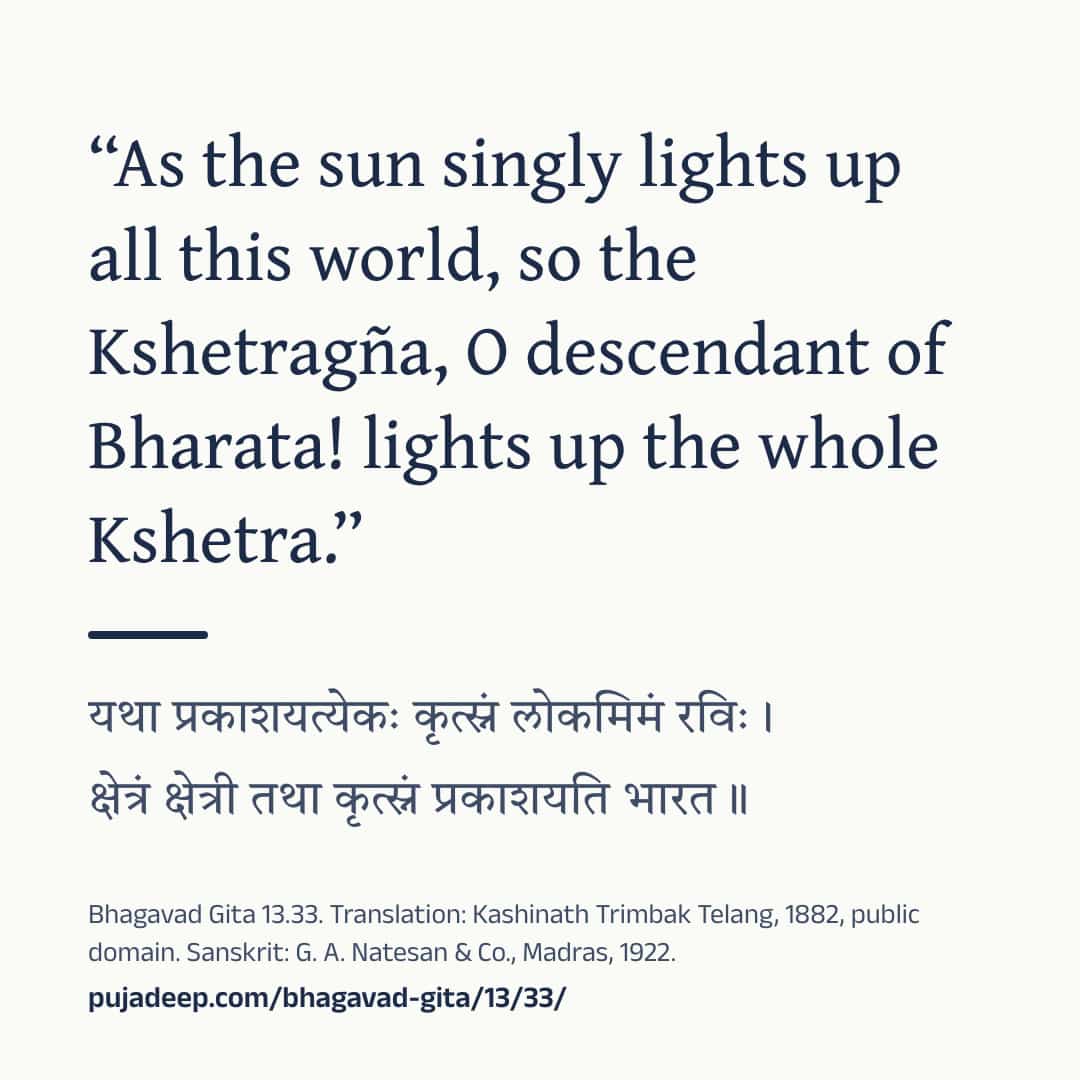
Drawing the picture
See the words
Bhagavad Gita 13.33

यथा प्रकाशयत्येकः कृत्स्नं लोकमिमं रविः ।
क्षेत्रं क्षेत्री तथा कृत्स्नं प्रकाशयति भारत ॥

“As the sun singly lights up all this world, so the Kshetragña, O descendant of Bharata! lights up the whole Kshetra.”
(K. T. Telang, The Bhagavadgîtâ (The Sacred Books of the East, vol. VIII, Oxford: Clarendon Press, 1882), p. 106, public domain)

“As this one sun illumineth the whole earth, so the Lord of the Field illumineth every Field, O Bhârata.”
(Annie Besant, The Bhagavad Gîtâ, or The Lord's Song (London: Theosophical Publishing Society, 1895), p. 128, public domain)

“As the one sun illumines all this world, so does He who abides in the Kshetra, O descendant of Bharata, illumine the whole Kshetra.”
(Swami Swarupananda, Srimad-Bhagavad-Gita (Mayavati: Prabuddha Bharata Press, 1909; first printed in Prabuddha Bharata, 1907–1909), p. 269, public domain)

Sanskrit: G. A. Natesan & Co., Madras, 1922.
https://pujadeep.com/bhagavad-gita/13/33/ Nothing is sent from this site. Your own app sends it, to the chat you choose. The picture quotes the translation you chose on this page, with its name and year.
Sanskrit text: The Bhagavad-Gita, or The Lord's Song, with the text in Devanagari and an English translation, 1922. Meanings: written for Pujadeep and checked against the cited edition. Source and changes
Questions families ask
Who speaks Bhagavad Gita 13.33?
Krishna speaks this verse, in chapter 13 (Kshetra Kshetrajna Vibhaga Yoga).
Where does the Sanskrit text come from?
Sanskrit text: The Bhagavad-Gita, or The Lord's Song, with the text in Devanagari and an English translation, 1922. Meanings: written for Pujadeep and checked against the cited edition. See the source
Is the meaning on this page a translation?
Explanation written for this site from the sources listed here, and checked against the cited edition. It is not a translation and not the only way to read the text. Free to quote with credit.
Source and licence
- Sanskrit text
- The Bhagavad-Gita, or The Lord's Song, with the text in Devanagari and an English translation (Annie Besant, G. A. Natesan & Co., Madras, 1922). Public domain. The Sanskrit on these pages was read from this printing’s page images.
- Translation
- The Bhagavadgîtâ with the Sanatsugâtîya and the Anugîtâ, translated by Kâshinâth Trimbak Telang (The Sacred Books of the East, vol. VIII, ed. F. Max Müller) (Kashinath Trimbak Telang, F. Max Müller, Clarendon Press, Oxford, 1882). Public domain. Shown verbatim, as printed.
- Translation
- The Bhagavad Gîtâ, or The Lord's Song, translated by Annie Besant (Annie Besant, Theosophical Publishing Society, London, 1895). Public domain. Shown verbatim, as printed.
- Translation
- Srimad-Bhagavad-Gita, with Sanskrit Text; Paraphrase with Word-by-word Literal Translation; English Rendering and Comments, Index, &c., by the Swami Swarupananda (Himalayan Series, No. XX) (Swami Swarupananda, The Editors and Publishers, Advaita Ashrama, Mayavati, Prabuddha Bharata Press, Mayavati, Almora, Himalayas, 1909). Public domain. Shown verbatim, as printed.
- Common wording
- In this text, 32 words follow today's common wording, checked against sanskritdocuments.org; Sanskrit Wikisource; Gita Press, Gorakhpur; GRETIL, Göttingen and Bhaktivedanta Book Trust.
- Our explanation
- Explanation written for this site from the sources listed here, and checked against the cited edition. It is not a translation and not the only way to read the text. Free to quote with credit.
- Checked
- Checked against the cited edition, October 15, 2026.
- Updated
- October 25, 2026