Bhagavad Gita 13.25: meaning and translation
Chapter 13: Kshetra Kshetrajna Vibhaga Yoga. Krishna says
Krishna: Others again do not know this themselves, but hear it from others and worship.
Click or tap a word for its meaning and its dictionary page.
Text and layers
Text and layers
These choices stay in this browser.
Bhagavad Gita 13.25
अन्ये त्वेवमजानन्तः श्रुत्वाऽन्येभ्य उपासते ।तेऽपि चातितरन्त्येव मृत्युं श्रुतिपरायणाः ॥
Anye tvevamajanantah shrutvanyebhya upasateTepi chatitarantyeva mrityum shrutiparayanah
anye tvevamajānantaḥ śrutvā’nyebhya upāsate |te’pi cātitarantyeva mṛtyuṃ śrutiparāyaṇāḥ ||
Our explanation Others again do not know this themselves, but hear it from others and worship. Krishna says that they too, devoted to what they have heard, go beyond death.
हिंदी अर्थ कुछ और लोग स्वयं यह नहीं जानते, पर दूसरों से सुनकर उपासना करते हैं। कृष्ण कहते हैं कि सुनी हुई बात में निष्ठा रखने वाले वे भी मृत्यु को पार कर जाते हैं।
Word by word
Every word, with its dictionary page
Word by word
- अन्ये anye · others (pronoun (masculine), nominative plural) Dictionary: 2. anya, Monier-Williams 1899, p. 45, col. 2 “other, different”
- तु tu · but (indeclinable) Dictionary: 2. tu, Monier-Williams 1899, p. 449, col. 3 “but”
- एवम् evam · in this way (indeclinable) Dictionary: evam, Monier-Williams 1899, p. 232, col. 2 “thus, in this way, in such a manner”
- अजानन्तः ajānantaḥ · not knowing (negative present participle (masculine), nominative plural) Dictionary: a-jānat, Monier-Williams 1899, p. 10, col. 1 “not knowing, unaware”
- श्रुत्वा śrutvā · having heard (absolutive (having done)) Dictionary: 1. śru, Monier-Williams 1899, p. 1100, col. 3 “to hear, listen or attend to anything”
- अन्येभ्यः anyebhyaḥ · from others (pronoun (masculine), ablative plural) Dictionary: 2. anya, Monier-Williams 1899, p. 45, col. 2 “other, different”
- उपासते upāsate · worship (present (middle), 3rd person plural) Dictionary: 3. upās, Monier-Williams 1899, p. 215, col. 1 “serve, honour, revere, respect, acknowledge, do homage, worship”
- ते te · they (pronoun (masculine), nominative plural) Dictionary: tad, Monier-Williams 1899, p. 434, col. 1 “m. he, f. she, n. it, that, this”
- अपि api · also (indeclinable) Dictionary: api, Monier-Williams 1899, p. 55, col. 1 “in the sense of even, also, very”
- च ca · and (indeclinable) Dictionary: 2. ca, Monier-Williams 1899, p. 380, col. 1 “and, both, also, moreover, as well as”
- अतितरन्ति atitaranti · go beyond (present, 3rd person plural) Dictionary: ati-tṝ, Monier-Williams 1899, p. 14, col. 1 “to pass through or by or over, cross, overcome, escape”
- एव eva · indeed (indeclinable) Dictionary: 1. eva, Monier-Williams 1899, p. 232, col. 2 “indeed, truly, really”
- मृत्युम् mṛtyum · death (noun (masculine), accusative singular) Dictionary: mṛtyu, Monier-Williams 1899, p. 827, col. 3 “death, dying”
- श्रुतिपरायणाः śrutiparāyaṇāḥ · devoted to what they hear (compound (masculine), nominative plural) Dictionary: 1. śruti, Monier-Williams 1899, p. 1101, col. 2 “hearing, listening”; 1. parāyaṇa, Monier-Williams 1899, p. 587, col. 3 “wholly devoted or destined to, engaged in, intent upon”
1 printing differs
Edition differences. Another printing or text reads this place differently.
- Spelling A digital text reads Same words. The 1922 edition marks the merged vowel with avagraha (श्रुत्वाऽन्येभ्य); the e-text writes श्रुत्वान्येभ्य, as another digital text does.
Old translations
Kashinath Trimbak Telang, 1882. Public domain. Page 105.
others yet, not knowing this, practise concentration, after hearing from others1. They, too, being (thus) devoted to hearing (instruction) cross beyond death.
This sentence begins in 13.24.
Footnotes (the translator’s own) - Cf. Sutta Nipâta, p. 49. ↩
Compare 3 translations
Kashinath Trimbak Telang, 1882. Public domain. Page 105.
others yet, not knowing this, practise concentration, after hearing from others1. They, too, being (thus) devoted to hearing (instruction) cross beyond death.
This sentence begins in 13.24.
Footnotes (the translator’s own) - Cf. Sutta Nipâta, p. 49. ↩
You are reading this one
Annie Besant, 1895. Public domain. Page 126.
Others also, ignorant of this, having heard of it from others, worship; and these also cross beyond death, adhering to what they had heard.
This sentence begins in 13.24.
You are reading this one
Swami Swarupananda, 1909 (first printed 1907). Public domain. Page 265.
Others again not knowing thus, worship as they have heard from others. Even these cross beyond death, regarding what they have heard as the Supreme Refuge.
You are reading this one
Cite this verse
The translation: K. T. Telang, The Bhagavadgîtâ (The Sacred Books of the East, vol. VIII, Oxford: Clarendon Press, 1882), p. 105. Bhagavad Gita 13.25.
The translation: Annie Besant, The Bhagavad Gîtâ, or The Lord's Song (London: Theosophical Publishing Society, 1895), p. 126. Bhagavad Gita 13.25.
The translation: Swami Swarupananda, Srimad-Bhagavad-Gita (Mayavati: Prabuddha Bharata Press, 1909; first printed in Prabuddha Bharata, 1907–1909), p. 265. Bhagavad Gita 13.25.
Our explanation: “Bhagavad Gita 13.25: meaning and translation.” Pujadeep. Updated October 25, 2026. https://pujadeep.com/bhagavad-gita/13/25/
Pujadeep’s explanations are free to quote with credit: name Pujadeep and link to the page. How to credit
Classical readings, by school
No readings by school on this verse yet.
Share
Show the ways to share
Send one picture or the text to one chat. The picture names its source and the address of this page.
Drawing the picture
See the words
Bhagavad Gita 13.25

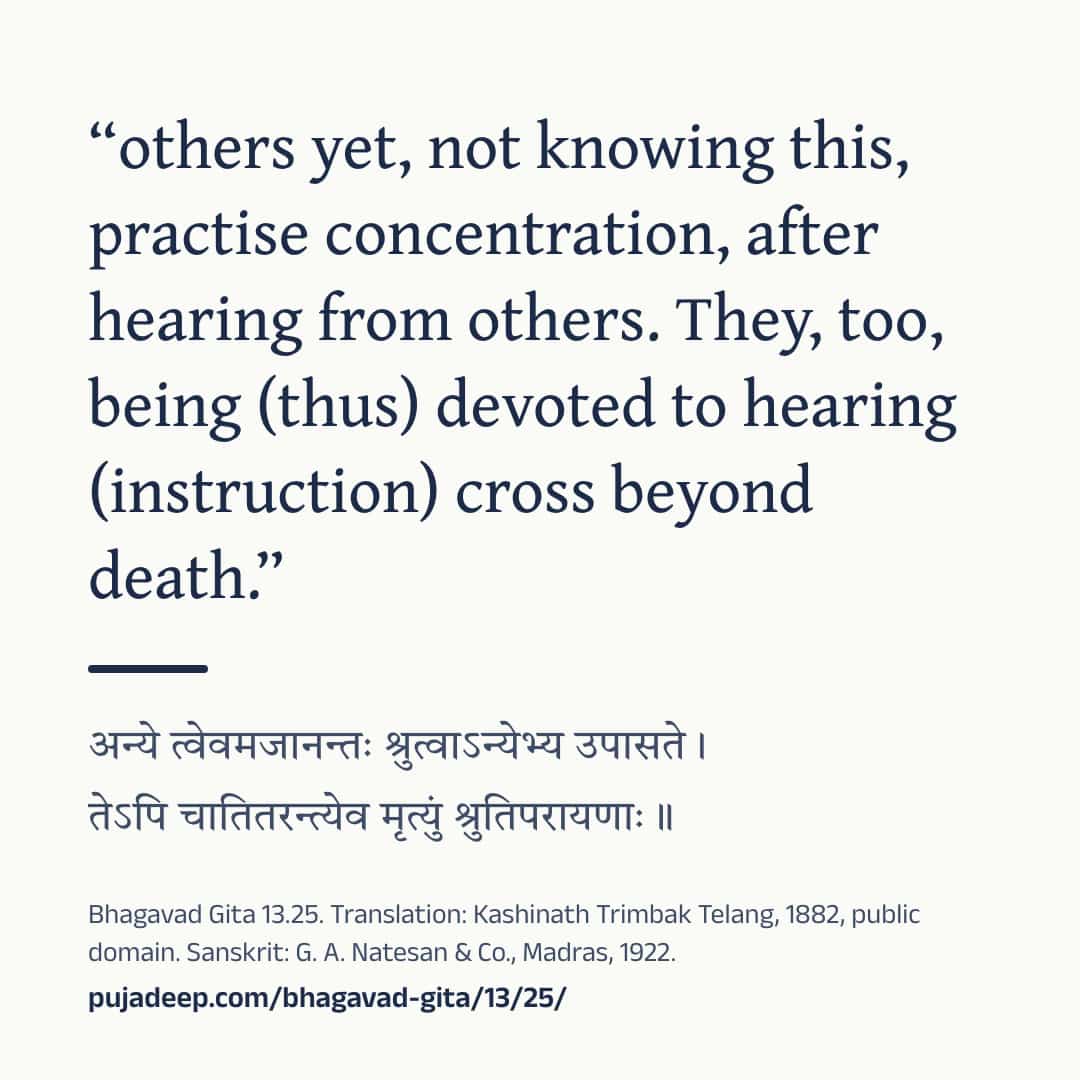
अन्ये त्वेवमजानन्तः श्रुत्वाऽन्येभ्य उपासते ।
तेऽपि चातितरन्त्येव मृत्युं श्रुतिपरायणाः ॥

“others yet, not knowing this, practise concentration, after hearing from others. They, too, being (thus) devoted to hearing (instruction) cross beyond death.”
(K. T. Telang, The Bhagavadgîtâ (The Sacred Books of the East, vol. VIII, Oxford: Clarendon Press, 1882), p. 105, public domain)
This sentence begins in 13.24.

“Others also, ignorant of this, having heard of it from others, worship; and these also cross beyond death, adhering to what they had heard.”
(Annie Besant, The Bhagavad Gîtâ, or The Lord's Song (London: Theosophical Publishing Society, 1895), p. 126, public domain)
This sentence begins in 13.24.

“Others again not knowing thus, worship as they have heard from others. Even these cross beyond death, regarding what they have heard as the Supreme Refuge.”
(Swami Swarupananda, Srimad-Bhagavad-Gita (Mayavati: Prabuddha Bharata Press, 1909; first printed in Prabuddha Bharata, 1907–1909), p. 265, public domain)

Sanskrit: G. A. Natesan & Co., Madras, 1922.
https://pujadeep.com/bhagavad-gita/13/25/ Nothing is sent from this site. Your own app sends it, to the chat you choose. The picture quotes the translation you chose on this page, with its name and year.
Sanskrit text: The Bhagavad-Gita, or The Lord's Song, with the text in Devanagari and an English translation, 1922. Meanings: written for Pujadeep and checked against the cited edition. Source and changes
Questions families ask
Who speaks Bhagavad Gita 13.25?
Krishna speaks this verse, in chapter 13 (Kshetra Kshetrajna Vibhaga Yoga).
Where does the Sanskrit text come from?
Sanskrit text: The Bhagavad-Gita, or The Lord's Song, with the text in Devanagari and an English translation, 1922. Meanings: written for Pujadeep and checked against the cited edition. See the source
Is the meaning on this page a translation?
Explanation written for this site from the sources listed here, and checked against the cited edition. It is not a translation and not the only way to read the text. Free to quote with credit.
Source and licence
- Sanskrit text
- The Bhagavad-Gita, or The Lord's Song, with the text in Devanagari and an English translation (Annie Besant, G. A. Natesan & Co., Madras, 1922). Public domain. The Sanskrit on these pages was read from this printing’s page images.
- Translation
- The Bhagavadgîtâ with the Sanatsugâtîya and the Anugîtâ, translated by Kâshinâth Trimbak Telang (The Sacred Books of the East, vol. VIII, ed. F. Max Müller) (Kashinath Trimbak Telang, F. Max Müller, Clarendon Press, Oxford, 1882). Public domain. Shown verbatim, as printed.
- Translation
- The Bhagavad Gîtâ, or The Lord's Song, translated by Annie Besant (Annie Besant, Theosophical Publishing Society, London, 1895). Public domain. Shown verbatim, as printed.
- Translation
- Srimad-Bhagavad-Gita, with Sanskrit Text; Paraphrase with Word-by-word Literal Translation; English Rendering and Comments, Index, &c., by the Swami Swarupananda (Himalayan Series, No. XX) (Swami Swarupananda, The Editors and Publishers, Advaita Ashrama, Mayavati, Prabuddha Bharata Press, Mayavati, Almora, Himalayas, 1909). Public domain. Shown verbatim, as printed.
- Common wording
- In this text, 32 words follow today's common wording, checked against sanskritdocuments.org; Sanskrit Wikisource; Gita Press, Gorakhpur; GRETIL, Göttingen and Bhaktivedanta Book Trust.
- Our explanation
- Explanation written for this site from the sources listed here, and checked against the cited edition. It is not a translation and not the only way to read the text. Free to quote with credit.
- Checked
- Checked against the cited edition, October 15, 2026.
- Updated
- October 25, 2026