Bhagavad Gita 13.22: meaning and translation
Chapter 13: Kshetra Kshetrajna Vibhaga Yoga. Krishna says
Krishna says that the supreme spirit (puruṣa para) in this body is called the witness (upadraṣṭā), the one who permits, the supporter, the experiencer, the great lord (maheśvara), and also the supreme self (paramātmā).
Click or tap a word for its meaning and its dictionary page.
Text and layers
Text and layers
These choices stay in this browser.
Bhagavad Gita 13.22
उपद्रष्टाऽनुमन्ता च भर्ता भोक्ता महेश्वरः ।परमात्मेति चाप्युक्तो देहेऽस्मिन्पुरुषः परः ॥
Upadrashtanumanta cha bharta bhokta maheshvarahParamatmeti chapyukto dehesminpurushah parah
upadraṣṭā’numantā ca bhartā bhoktā maheśvaraḥ |paramātmeti cāpyukto dehe’sminpuruṣaḥ paraḥ ||
Our explanation Krishna says that the supreme spirit (puruṣa para) in this body is called the witness (upadraṣṭā), the one who permits, the supporter, the experiencer, the great lord (maheśvara), and also the supreme self (paramātmā). The schools differ on who this is (see the views).
हिंदी अर्थ कृष्ण कहते हैं कि इस शरीर में जो परम पुरुष है, वह उपद्रष्टा (साक्षी), अनुमंता (अनुमति देने वाला), भर्ता (धारण करने वाला), भोक्ता, महेश्वर और परमात्मा भी कहा जाता है। यह कौन है, इस पर परंपराएँ अलग राय रखती हैं।
Word by word
Every word, with its dictionary page
Word by word
- उपद्रष्टा upadraṣṭā · the witness (noun (masculine), nominative singular) Dictionary: upa-draṣṭṛ, Monier-Williams 1899, p. 199, col. 2 “a looker-on, spectator; a witness”
- अनुमन्ता anumantā · the one who permits (noun (masculine), nominative singular) Dictionary: anu-mantṛ, Monier-Williams 1899, p. 36, col. 3 “consenting to, permitting”
- च ca · and (indeclinable) Dictionary: 2. ca, Monier-Williams 1899, p. 380, col. 1 “and, both, also, moreover, as well as”
- भर्ता bhartā · the supporter (noun (masculine), nominative singular) Dictionary: bhartṛ, Monier-Williams 1899, p. 748, col. 1 “a preserver, protector, maintainer, chief, lord, master”
- भोक्ता bhoktā · the experiencer (noun (masculine), nominative singular) Dictionary: bhoktṛ, Monier-Williams 1899, p. 760, col. 1 “one who enjoys or eats, enjoyer, eater, experiencer, feeler, sufferer”
- महेश्वरः maheśvaraḥ · the great lord (compound (masculine), nominative singular) Dictionary: maheśvara, Monier-Williams 1899, p. 802, col. 2 “a great lord, sovereign, chief”
- परमात्मा paramātmā · the supreme self (noun (masculine), nominative singular) Dictionary: paramātman, Monier-Williams 1899, p. 588, col. 2 “the Supreme Spirit”
- इति iti · so (called) (indeclinable) Dictionary: 2. iti, Monier-Williams 1899, p. 165, col. 1 “in this manner, thus”
- च ca · and (indeclinable) Dictionary: 2. ca, Monier-Williams 1899, p. 380, col. 1 “and, both, also, moreover, as well as”
- अपि api · also (indeclinable) Dictionary: api, Monier-Williams 1899, p. 55, col. 1 “in the sense of even, also, very”
- उक्तः uktaḥ · is called (past participle (masculine), nominative singular) Dictionary: ukta, Monier-Williams 1899, p. 171, col. 3 “uttered, said, spoken”
- देहे dehe · in the body (noun (masculine), locative singular) Dictionary: deha, Monier-Williams 1899, p. 496, col. 3 “the body”
- अस्मिन् asmin · this (pronoun (masculine), locative singular) Dictionary: 1. idam, Monier-Williams 1899, p. 165, col. 2 “this, this here, referring to something near the speaker”
- पुरुषः puruṣaḥ · spirit, person (puruṣa) (noun (masculine), nominative singular) Dictionary: puruṣa, Monier-Williams 1899, p. 637, col. 1 “the personal and animating principle in men and other beings, the soul or spirit”
- परः paraḥ · supreme (adjective (masculine), nominative singular) Dictionary: 1. para, Monier-Williams 1899, p. 586, col. 1 “highest, supreme, chief”
1 printing differs
Edition differences. Another printing or text reads this place differently.
- Spelling A digital text reads Same words. The 1922 edition marks the merged vowel with avagraha (उपद्रष्टाऽनुमन्ता); the e-text writes उपद्रष्टानुमन्ता, as another digital text does.
Old translations
Kashinath Trimbak Telang, 1882. Public domain. Page 105.
The supreme spirit in this body is called supervisor, adviser1, supporter, enjoyer, the great lord, and the supreme self also.
Footnotes (the translator’s own) - Scil. concerning the operations of the body and senses. Cf. Nrisimha-tâpinî, p. 224. He is adviser because, though he does not interfere, he sees and therefore may be said to sanction the operations alluded to. Supporter, i. e. of body &c. in their workings. ↩
Compare 3 translations
Kashinath Trimbak Telang, 1882. Public domain. Page 105.
The supreme spirit in this body is called supervisor, adviser1, supporter, enjoyer, the great lord, and the supreme self also.
Footnotes (the translator’s own) - Scil. concerning the operations of the body and senses. Cf. Nrisimha-tâpinî, p. 224. He is adviser because, though he does not interfere, he sees and therefore may be said to sanction the operations alluded to. Supporter, i. e. of body &c. in their workings. ↩
You are reading this one
Annie Besant, 1895. Public domain. Page 126.
Spectator and Permitter, Supporter, Enjoyer, the great Îshvara, thus is styled the supreme SELF; in this body the supreme Purusha.
You are reading this one
Swami Swarupananda, 1909 (first printed 1907). Public domain. Page 263.
And the Supreme Purusha in this body is also called the Looker-on, the Permitter, the Supporter, the Experiencer and the Great Lord, and as the Highest Self.
You are reading this one
Cite this verse
The translation: K. T. Telang, The Bhagavadgîtâ (The Sacred Books of the East, vol. VIII, Oxford: Clarendon Press, 1882), p. 105. Bhagavad Gita 13.22.
The translation: Annie Besant, The Bhagavad Gîtâ, or The Lord's Song (London: Theosophical Publishing Society, 1895), p. 126. Bhagavad Gita 13.22.
The translation: Swami Swarupananda, Srimad-Bhagavad-Gita (Mayavati: Prabuddha Bharata Press, 1909; first printed in Prabuddha Bharata, 1907–1909), p. 263. Bhagavad Gita 13.22.
Our explanation: “Bhagavad Gita 13.22: meaning and translation.” Pujadeep. Updated October 25, 2026. https://pujadeep.com/bhagavad-gita/13/22/
Pujadeep’s explanations are free to quote with credit: name Pujadeep and link to the page. How to credit
Classical readings, by school
Each reading is named by its school. None is presented as the only meaning.
What Advaita, Vishishtadvaita and Dvaita teach, in short
Shankara Advaita
Shankara takes this to be the supreme Self, distinct from the body and senses: the near witness who takes no part in their acts, as an expert sits by a sacrifice and watches; the one who seems to permit them; the supporter and experiencer only as pure awareness; and the great Lord, one with the whole universe.
Source: The Bhagavad-Gita, with the commentary of Sri Sankaracharya, translated by A. Mahadeva Sastri (2nd ed., Mysore: G. T. A. Printing Works, 1901), commentary on 13.22, pp. 322–324. Summarised in our own words; none of its text is reproduced.
Ramanuja Vishishtadvaita
Ramanuja takes the “supreme person in this body” to be the individual soul. It directs the body by its will, permits its acts, supports it and experiences pleasure and pain through it; so, within the limits of this body, it is the great lord and the supreme self, higher than body and mind. He cites 15.8 for the soul as lord of the body.
Source: Sri Bhagavad-Gita with Sri Ramanujacharya's Visishtadvaita commentary, translated by A. Govindacharya (Madras, 1898), commentary on 13.22, pp. 431–432. Summarised in our own words; none of its text is reproduced.
Share
Show the ways to share
Send one picture or the text to one chat. The picture names its source and the address of this page.
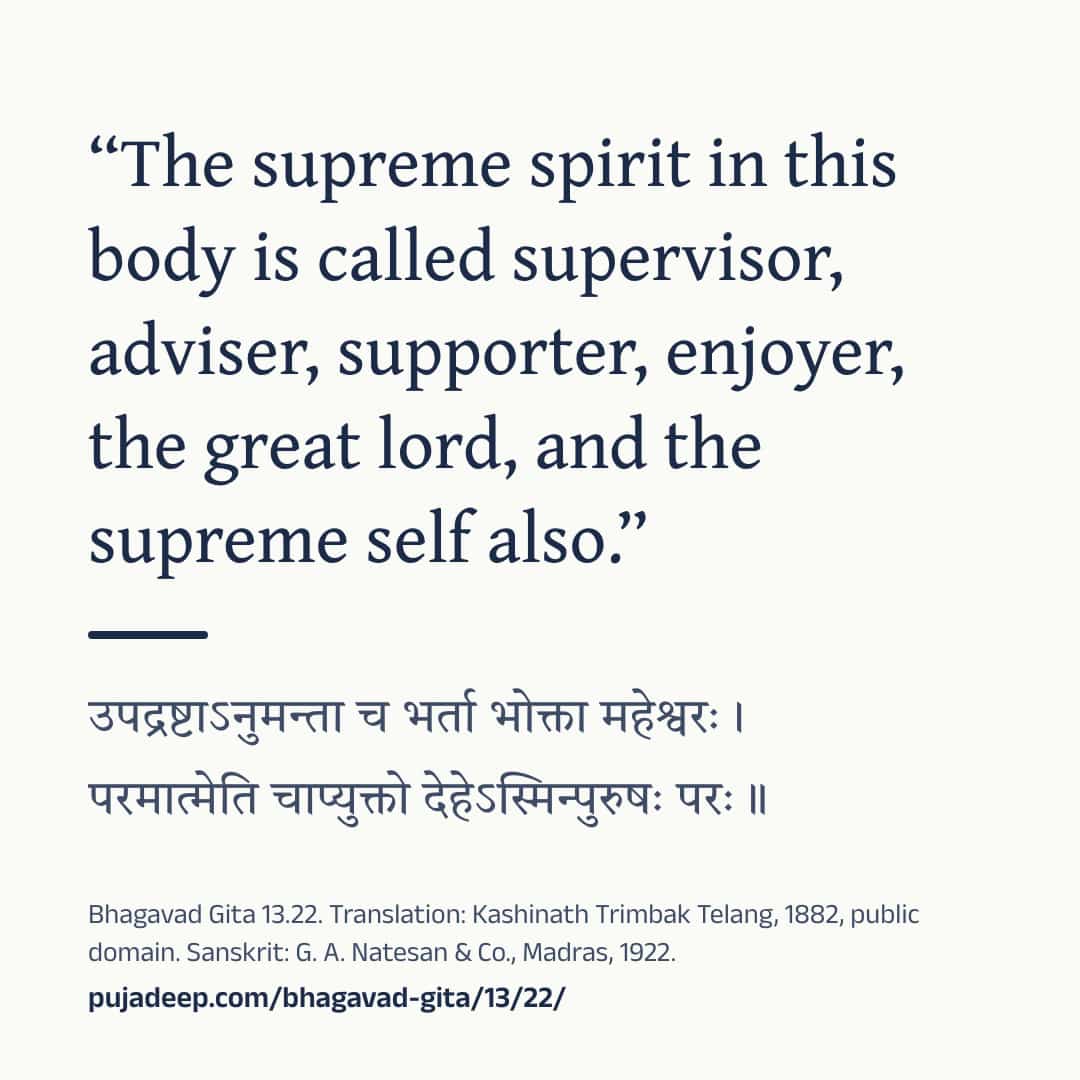
Drawing the picture
See the words
Bhagavad Gita 13.22

उपद्रष्टाऽनुमन्ता च भर्ता भोक्ता महेश्वरः ।
परमात्मेति चाप्युक्तो देहेऽस्मिन्पुरुषः परः ॥

“The supreme spirit in this body is called supervisor, adviser, supporter, enjoyer, the great lord, and the supreme self also.”
(K. T. Telang, The Bhagavadgîtâ (The Sacred Books of the East, vol. VIII, Oxford: Clarendon Press, 1882), p. 105, public domain)

“Spectator and Permitter, Supporter, Enjoyer, the great Îshvara, thus is styled the supreme SELF; in this body the supreme Purusha.”
(Annie Besant, The Bhagavad Gîtâ, or The Lord's Song (London: Theosophical Publishing Society, 1895), p. 126, public domain)

“And the Supreme Purusha in this body is also called the Looker-on, the Permitter, the Supporter, the Experiencer and the Great Lord, and as the Highest Self.”
(Swami Swarupananda, Srimad-Bhagavad-Gita (Mayavati: Prabuddha Bharata Press, 1909; first printed in Prabuddha Bharata, 1907–1909), p. 263, public domain)

Sanskrit: G. A. Natesan & Co., Madras, 1922.
https://pujadeep.com/bhagavad-gita/13/22/ Nothing is sent from this site. Your own app sends it, to the chat you choose. The picture quotes the translation you chose on this page, with its name and year.
Sanskrit text: The Bhagavad-Gita, or The Lord's Song, with the text in Devanagari and an English translation, 1922. Meanings: written for Pujadeep and checked against the cited edition. Source and changes
Questions families ask
Who speaks Bhagavad Gita 13.22?
Krishna speaks this verse, in chapter 13 (Kshetra Kshetrajna Vibhaga Yoga).
Where does the Sanskrit text come from?
Sanskrit text: The Bhagavad-Gita, or The Lord's Song, with the text in Devanagari and an English translation, 1922. Meanings: written for Pujadeep and checked against the cited edition. See the source
Is the meaning on this page a translation?
Explanation written for this site from the sources listed here, and checked against the cited edition. It is not a translation and not the only way to read the text. Free to quote with credit.
Source and licence
- Sanskrit text
- The Bhagavad-Gita, or The Lord's Song, with the text in Devanagari and an English translation (Annie Besant, G. A. Natesan & Co., Madras, 1922). Public domain. The Sanskrit on these pages was read from this printing’s page images.
- Translation
- The Bhagavadgîtâ with the Sanatsugâtîya and the Anugîtâ, translated by Kâshinâth Trimbak Telang (The Sacred Books of the East, vol. VIII, ed. F. Max Müller) (Kashinath Trimbak Telang, F. Max Müller, Clarendon Press, Oxford, 1882). Public domain. Shown verbatim, as printed.
- Translation
- The Bhagavad Gîtâ, or The Lord's Song, translated by Annie Besant (Annie Besant, Theosophical Publishing Society, London, 1895). Public domain. Shown verbatim, as printed.
- Translation
- Srimad-Bhagavad-Gita, with Sanskrit Text; Paraphrase with Word-by-word Literal Translation; English Rendering and Comments, Index, &c., by the Swami Swarupananda (Himalayan Series, No. XX) (Swami Swarupananda, The Editors and Publishers, Advaita Ashrama, Mayavati, Prabuddha Bharata Press, Mayavati, Almora, Himalayas, 1909). Public domain. Shown verbatim, as printed.
- Commentary
- The Bhagavad-Gita, with the commentary of Sri Sankaracharya, translated by A. Mahadeva Sastri (2nd ed., Mysore: G. T. A. Printing Works, 1901) (Public-domain scan, University of California Libraries). Summarised in our own words; none of its text is reproduced.
- Commentary
- Sri Bhagavad-Gita with Sri Ramanujacharya's Visishtadvaita commentary, translated by A. Govindacharya (Madras, 1898) (Scan uploaded to archive.org (folkscanomy collection)). Summarised in our own words; none of its text is reproduced.
- Common wording
- In this text, 32 words follow today's common wording, checked against sanskritdocuments.org; Sanskrit Wikisource; Gita Press, Gorakhpur; GRETIL, Göttingen and Bhaktivedanta Book Trust.
- Our explanation
- Explanation written for this site from the sources listed here, and checked against the cited edition. It is not a translation and not the only way to read the text. Free to quote with credit.
- Checked
- Checked against the cited edition, October 15, 2026.
- Updated
- October 25, 2026