Bhagavad Gita 13.34: meaning and translation
Chapter 13: Kshetra Kshetrajna Vibhaga Yoga. Krishna says
Krishna closes the chapter.
Click or tap a word for its meaning and its dictionary page.
Text and layers
Text and layers
These choices stay in this browser.
Bhagavad Gita 13.34
क्षेत्रक्षेत्रज्ञयोरेवमन्तरं ज्ञानचक्षुषा ।भूतप्रकृतिमोक्षं च ये विदुर्यान्ति ते परम् ॥
Kshetrakshetrajnayorevamantaram jnanachakshushaBhutaprakritimoksham cha ye viduryanti te param
kṣetrakṣetrajñayorevamantaraṃ jñānacakṣuṣā |bhūtaprakṛtimokṣaṃ ca ye viduryānti te param ||
Our explanation Krishna closes the chapter. Those who, with the eye of knowledge, see the difference between the field and its knower, and the freeing of beings from nature, he says, reach the Supreme.
हिंदी अर्थ कृष्ण अध्याय पूरा करते हैं। वे कहते हैं कि जो ज्ञान की आँख से क्षेत्र और क्षेत्रज्ञ का अंतर, और प्राणियों का प्रकृति से छूटना देख लेते हैं, वे परम को प्राप्त होते हैं।
Word by word
Every word, with its dictionary page
Word by word
- क्षेत्रक्षेत्रज्ञयोः kṣetrakṣetrajñayoḥ · of the field and its knower (compound (masculine), genitive dual) Dictionary: kṣetra, Monier-Williams 1899, p. 332, col. 1 “a field”; kṣetra-jña, Monier-Williams 1899, p. 332, col. 2 “'knowing the body,' i.e. the soul, the conscious principle in the corporeal frame”
- एवम् evam · in this way (indeclinable) Dictionary: evam, Monier-Williams 1899, p. 232, col. 2 “thus, in this way, in such a manner”
- अन्तरम् antaram · the difference (noun (neuter), accusative singular) Dictionary: antara, Monier-Williams 1899, p. 43, col. 3 “difference, remainder”
- ज्ञानचक्षुषा jñānacakṣuṣā · with the eye of knowledge (compound (neuter), instrumental singular) Dictionary: jñāna-cakṣus, Monier-Williams 1899, p. 426, col. 1 “the eye of intelligence, inner eye, intellectual vision”
- भूतप्रकृतिमोक्षम् bhūtaprakṛtimokṣam · the freeing of beings from nature (compound (masculine), accusative singular) Dictionary: bhūta, Monier-Williams 1899, p. 761, col. 3 “that which is or exists, any living being”; pra-kṛti, Monier-Williams 1899, p. 654, col. 1 “the original producer of (or rather passive power of creating) the material world”; mokṣa, Monier-Williams 1899, p. 835, col. 1 “emancipation, liberation”
- च ca · and (indeclinable) Dictionary: 2. ca, Monier-Williams 1899, p. 380, col. 1 “and, both, also, moreover, as well as”
- ये ye · those who (relative pronoun (masculine), nominative plural) Dictionary: yad, Monier-Williams 1899, p. 844, col. 2 “who, which, what, whichever, whatever, that”
- विदुः viduḥ · know (perfect, 3rd person plural (present sense)) Dictionary: 1. vid, Monier-Williams 1899, p. 963, col. 2 “to know, understand, perceive, learn”
- यान्ति yānti · go (to) (present, 3rd person plural) Dictionary: 1. yā, Monier-Williams 1899, p. 849, col. 1 “to go towards or against, go or come to, enter, approach, arrive at, reach”
- ते te · they (pronoun (masculine), nominative plural) Dictionary: tad, Monier-Williams 1899, p. 434, col. 1 “m. he, f. she, n. it, that, this”
- परम् param · the Supreme (noun (neuter), accusative singular) Dictionary: 1. para, Monier-Williams 1899, p. 586, col. 1 “highest, supreme, chief”
Old translations
Kashinath Trimbak Telang, 1882. Public domain. Page 106.
Those who, with the eye of knowledge, thus understand the difference between Kshetra and Kshetragña, and the destruction of the nature of all entities1, go to the supreme.
Footnotes (the translator’s own) - Nature, which is the material cause from which all entities are produced; the destruction of it results from true knowledge of the soul. See the third note on p. 107 infra. ↩
Compare 3 translations
Kashinath Trimbak Telang, 1882. Public domain. Page 106.
Those who, with the eye of knowledge, thus understand the difference between Kshetra and Kshetragña, and the destruction of the nature of all entities1, go to the supreme.
Footnotes (the translator’s own) - Nature, which is the material cause from which all entities are produced; the destruction of it results from true knowledge of the soul. See the third note on p. 107 infra. ↩
You are reading this one
Annie Besant, 1895. Public domain. Page 128.
They who by the eye of wisdom perceive the difference between the Field and the Knower of the Field, and the liberation of beings from Prakriti, they go to the Supreme.
You are reading this one
Swami Swarupananda, 1909 (first printed 1907). Public domain. Page 269.
They who thus with the eye of knowledge perceive the distinction between the Kshetra and the Kshetrajna, and also the emancipation from the Prakriti of beings, they go to the Supreme.
You are reading this one
Cite this verse
The translation: K. T. Telang, The Bhagavadgîtâ (The Sacred Books of the East, vol. VIII, Oxford: Clarendon Press, 1882), p. 106. Bhagavad Gita 13.34.
The translation: Annie Besant, The Bhagavad Gîtâ, or The Lord's Song (London: Theosophical Publishing Society, 1895), p. 128. Bhagavad Gita 13.34.
The translation: Swami Swarupananda, Srimad-Bhagavad-Gita (Mayavati: Prabuddha Bharata Press, 1909; first printed in Prabuddha Bharata, 1907–1909), p. 269. Bhagavad Gita 13.34.
Our explanation: “Bhagavad Gita 13.34: meaning and translation.” Pujadeep. Updated October 25, 2026. https://pujadeep.com/bhagavad-gita/13/34/
Pujadeep’s explanations are free to quote with credit: name Pujadeep and link to the page. How to credit
Classical readings, by school
No readings by school on this verse yet.
Share
Show the ways to share
Send one picture or the text to one chat. The picture names its source and the address of this page.
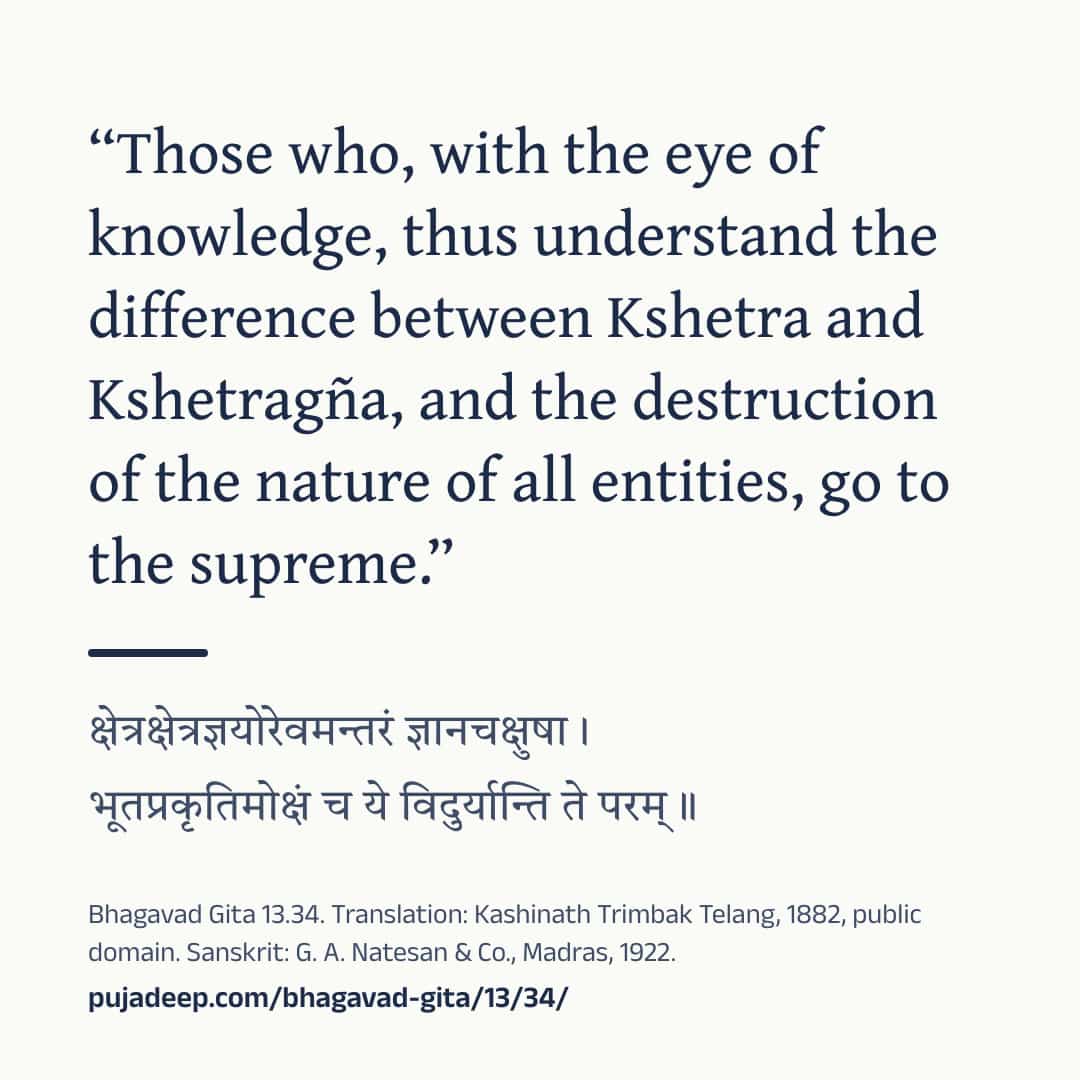
Drawing the picture
See the words
Bhagavad Gita 13.34

क्षेत्रक्षेत्रज्ञयोरेवमन्तरं ज्ञानचक्षुषा ।
भूतप्रकृतिमोक्षं च ये विदुर्यान्ति ते परम् ॥

“Those who, with the eye of knowledge, thus understand the difference between Kshetra and Kshetragña, and the destruction of the nature of all entities, go to the supreme.”
(K. T. Telang, The Bhagavadgîtâ (The Sacred Books of the East, vol. VIII, Oxford: Clarendon Press, 1882), p. 106, public domain)

“They who by the eye of wisdom perceive the difference between the Field and the Knower of the Field, and the liberation of beings from Prakriti, they go to the Supreme.”
(Annie Besant, The Bhagavad Gîtâ, or The Lord's Song (London: Theosophical Publishing Society, 1895), p. 128, public domain)

“They who thus with the eye of knowledge perceive the distinction between the Kshetra and the Kshetrajna, and also the emancipation from the Prakriti of beings, they go to the Supreme.”
(Swami Swarupananda, Srimad-Bhagavad-Gita (Mayavati: Prabuddha Bharata Press, 1909; first printed in Prabuddha Bharata, 1907–1909), p. 269, public domain)

Sanskrit: G. A. Natesan & Co., Madras, 1922.
https://pujadeep.com/bhagavad-gita/13/34/ Nothing is sent from this site. Your own app sends it, to the chat you choose. The picture quotes the translation you chose on this page, with its name and year.
Sanskrit text: The Bhagavad-Gita, or The Lord's Song, with the text in Devanagari and an English translation, 1922. Meanings: written for Pujadeep and checked against the cited edition. Source and changes
Questions families ask
Who speaks Bhagavad Gita 13.34?
Krishna speaks this verse, in chapter 13 (Kshetra Kshetrajna Vibhaga Yoga).
Where does the Sanskrit text come from?
Sanskrit text: The Bhagavad-Gita, or The Lord's Song, with the text in Devanagari and an English translation, 1922. Meanings: written for Pujadeep and checked against the cited edition. See the source
Is the meaning on this page a translation?
Explanation written for this site from the sources listed here, and checked against the cited edition. It is not a translation and not the only way to read the text. Free to quote with credit.
Source and licence
- Sanskrit text
- The Bhagavad-Gita, or The Lord's Song, with the text in Devanagari and an English translation (Annie Besant, G. A. Natesan & Co., Madras, 1922). Public domain. The Sanskrit on these pages was read from this printing’s page images.
- Translation
- The Bhagavadgîtâ with the Sanatsugâtîya and the Anugîtâ, translated by Kâshinâth Trimbak Telang (The Sacred Books of the East, vol. VIII, ed. F. Max Müller) (Kashinath Trimbak Telang, F. Max Müller, Clarendon Press, Oxford, 1882). Public domain. Shown verbatim, as printed.
- Translation
- The Bhagavad Gîtâ, or The Lord's Song, translated by Annie Besant (Annie Besant, Theosophical Publishing Society, London, 1895). Public domain. Shown verbatim, as printed.
- Translation
- Srimad-Bhagavad-Gita, with Sanskrit Text; Paraphrase with Word-by-word Literal Translation; English Rendering and Comments, Index, &c., by the Swami Swarupananda (Himalayan Series, No. XX) (Swami Swarupananda, The Editors and Publishers, Advaita Ashrama, Mayavati, Prabuddha Bharata Press, Mayavati, Almora, Himalayas, 1909). Public domain. Shown verbatim, as printed.
- Common wording
- In this text, 32 words follow today's common wording, checked against sanskritdocuments.org; Sanskrit Wikisource; Gita Press, Gorakhpur; GRETIL, Göttingen and Bhaktivedanta Book Trust.
- Our explanation
- Explanation written for this site from the sources listed here, and checked against the cited edition. It is not a translation and not the only way to read the text. Free to quote with credit.
- Checked
- Checked against the cited edition, October 15, 2026.
- Updated
- October 25, 2026