Bhagavad Gita 13.24: meaning and translation
Chapter 13: Kshetra Kshetrajna Vibhaga Yoga. Krishna says
Krishna names different paths.
Click or tap a word for its meaning and its dictionary page.
Text and layers
Text and layers
These choices stay in this browser.
Bhagavad Gita 13.24
ध्यानेनात्मनि पश्यन्ति केचिदात्मानमात्मना ।अन्ये साङ्ख्येन योगेन कर्मयोगेन चापरे ॥
Dhyanenatmani pashyanti kechidatmanamatmanaAnye sankhyena yogena karmayogena chapare
dhyānenātmani paśyanti kecidātmānamātmanā |anye sāṅkhyena yogena karmayogena cāpare ||
Our explanation Krishna names different paths. Some see the self within themselves, by themselves, through meditation (dhyāna). Others see it through the path of knowledge (sāṅkhya-yoga), and others through the yoga of action (karma-yoga).
हिंदी अर्थ कृष्ण अलग-अलग मार्ग बताते हैं। कुछ लोग ध्यान से अपने भीतर, अपने ही द्वारा आत्मा को देखते हैं। कुछ सांख्य-योग (ज्ञान के मार्ग) से, और कुछ कर्मयोग से।
Word by word
Every word, with its dictionary page
Word by word
- ध्यानेन dhyānena · through meditation (noun (neuter), instrumental singular) Dictionary: dhyāna, Monier-Williams 1899, p. 521, col. 1 “meditation, thought, reflection, (esp.) profound and abstract religious meditation”
- आत्मनि ātmani · in oneself (noun (masculine), locative singular) Dictionary: ātman, Monier-Williams 1899, p. 135, col. 1 “the individual soul, self”
- पश्यन्ति paśyanti · see (present, 3rd person plural) Dictionary: 1. paś, Monier-Williams 1899, p. 611, col. 2 “behold, look at, observe, perceive, notice”
- केचित् kecit · some (pronoun (masculine), nominative plural) Dictionary: kim, Monier-Williams 1899, p. 282, col. 2 “what? how? whence? wherefore? why?”; 2. cid, Monier-Williams 1899, p. 398, col. 1 “even, indeed, also”
- आत्मानम् ātmānam · the self (noun (masculine), accusative singular) Dictionary: ātman, Monier-Williams 1899, p. 135, col. 1 “the individual soul, self”
- आत्मना ātmanā · by oneself (noun (masculine), instrumental singular) Dictionary: ātman, Monier-Williams 1899, p. 135, col. 1 “the individual soul, self”
- अन्ये anye · others (pronoun (masculine), nominative plural) Dictionary: 2. anya, Monier-Williams 1899, p. 45, col. 2 “other, different”
- साङ्ख्येन sāṅkhyena · of knowledge (sāṅkhya) (adjective (masculine), instrumental singular) Dictionary: sāṃkhya, Monier-Williams 1899, p. 1199, col. 1 “rational, discriminative”
- योगेन yogena · through the yoga (noun (masculine), instrumental singular) Dictionary: yoga, Monier-Williams 1899, p. 856, col. 3 “application or concentration of the thoughts, abstract contemplation, meditation”
- कर्मयोगेन karmayogena · through the yoga of action (compound (masculine), instrumental singular) Dictionary: karma-yoga, Monier-Williams 1899, p. 259, col. 1 “performance of a work or business (esp. of religious duties)”
- च ca · and (indeclinable) Dictionary: 2. ca, Monier-Williams 1899, p. 380, col. 1 “and, both, also, moreover, as well as”
- अपरे apare · others (pronoun (masculine), nominative plural) Dictionary: 2. apara, Monier-Williams 1899, p. 50, col. 3 “other, another”
Old translations
Kashinath Trimbak Telang, 1882. Public domain. Page 105.
Some by concentration see the self in the self by the self; others by the Sâṅkhya-yoga; and others still by the Karma-yoga1;
This sentence goes on in 13.25.
Footnotes (the translator’s own) - Concentration=fixing of the mind exclusively on the soul, the senses being quiescent. 'See the self,' i. e. the soul; 'in the self,' i. e. within themselves; 'by the self,' i. e. by the mind. Sâṅkhya-yoga=belief that qualities are distinct from the self, which is only a passive spectator of their operations. Cf. Svetâsvatara, p. 109. Karma-yoga=dedication of actions to the supreme. Cf. as to this the gloss on Saṅkara's Bhâshya on Vedânta-sûtra IV, 2, 21. ↩
Compare 3 translations
Kashinath Trimbak Telang, 1882. Public domain. Page 105.
Some by concentration see the self in the self by the self; others by the Sâṅkhya-yoga; and others still by the Karma-yoga1;
This sentence goes on in 13.25.
Footnotes (the translator’s own) - Concentration=fixing of the mind exclusively on the soul, the senses being quiescent. 'See the self,' i. e. the soul; 'in the self,' i. e. within themselves; 'by the self,' i. e. by the mind. Sâṅkhya-yoga=belief that qualities are distinct from the self, which is only a passive spectator of their operations. Cf. Svetâsvatara, p. 109. Karma-yoga=dedication of actions to the supreme. Cf. as to this the gloss on Saṅkara's Bhâshya on Vedânta-sûtra IV, 2, 21. ↩
You are reading this one
Annie Besant, 1895. Public domain. Page 126.
Some by meditation behold the SELF in the Self by the SELF; others by the Sânkhya Yoga, and others by the Yoga of action;
This sentence goes on in 13.25.
You are reading this one
Swami Swarupananda, 1909 (first printed 1907). Public domain. Page 264.
Some by meditation behold the Self in their own intelligence by the purified heart, others by the path of knowledge, others again by Karma Yoga.
You are reading this one
Cite this verse
The translation: K. T. Telang, The Bhagavadgîtâ (The Sacred Books of the East, vol. VIII, Oxford: Clarendon Press, 1882), p. 105. Bhagavad Gita 13.24.
The translation: Annie Besant, The Bhagavad Gîtâ, or The Lord's Song (London: Theosophical Publishing Society, 1895), p. 126. Bhagavad Gita 13.24.
The translation: Swami Swarupananda, Srimad-Bhagavad-Gita (Mayavati: Prabuddha Bharata Press, 1909; first printed in Prabuddha Bharata, 1907–1909), p. 264. Bhagavad Gita 13.24.
Our explanation: “Bhagavad Gita 13.24: meaning and translation.” Pujadeep. Updated October 25, 2026. https://pujadeep.com/bhagavad-gita/13/24/
Pujadeep’s explanations are free to quote with credit: name Pujadeep and link to the page. How to credit
Classical readings, by school
No readings by school on this verse yet.
Share
Show the ways to share
Send one picture or the text to one chat. The picture names its source and the address of this page.
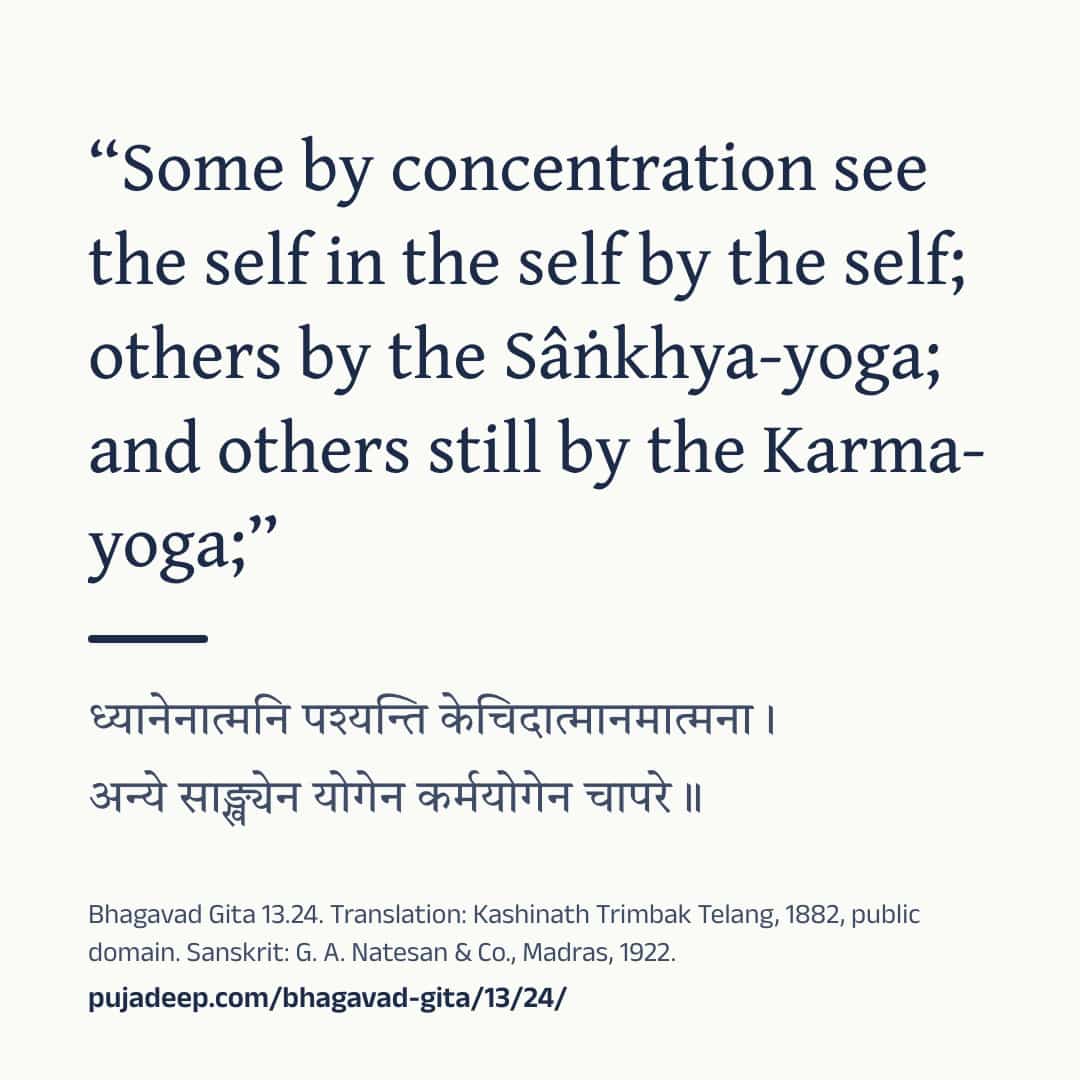
Drawing the picture
See the words
Bhagavad Gita 13.24

ध्यानेनात्मनि पश्यन्ति केचिदात्मानमात्मना ।
अन्ये साङ्ख्येन योगेन कर्मयोगेन चापरे ॥

“Some by concentration see the self in the self by the self; others by the Sâṅkhya-yoga; and others still by the Karma-yoga;”
(K. T. Telang, The Bhagavadgîtâ (The Sacred Books of the East, vol. VIII, Oxford: Clarendon Press, 1882), p. 105, public domain)
This sentence goes on in 13.25.

“Some by meditation behold the SELF in the Self by the SELF; others by the Sânkhya Yoga, and others by the Yoga of action;”
(Annie Besant, The Bhagavad Gîtâ, or The Lord's Song (London: Theosophical Publishing Society, 1895), p. 126, public domain)
This sentence goes on in 13.25.

“Some by meditation behold the Self in their own intelligence by the purified heart, others by the path of knowledge, others again by Karma Yoga.”
(Swami Swarupananda, Srimad-Bhagavad-Gita (Mayavati: Prabuddha Bharata Press, 1909; first printed in Prabuddha Bharata, 1907–1909), p. 264, public domain)

Sanskrit: G. A. Natesan & Co., Madras, 1922.
https://pujadeep.com/bhagavad-gita/13/24/ Nothing is sent from this site. Your own app sends it, to the chat you choose. The picture quotes the translation you chose on this page, with its name and year.
Sanskrit text: The Bhagavad-Gita, or The Lord's Song, with the text in Devanagari and an English translation, 1922. Meanings: written for Pujadeep and checked against the cited edition. Source and changes
Questions families ask
Who speaks Bhagavad Gita 13.24?
Krishna speaks this verse, in chapter 13 (Kshetra Kshetrajna Vibhaga Yoga).
Where does the Sanskrit text come from?
Sanskrit text: The Bhagavad-Gita, or The Lord's Song, with the text in Devanagari and an English translation, 1922. Meanings: written for Pujadeep and checked against the cited edition. See the source
Is the meaning on this page a translation?
Explanation written for this site from the sources listed here, and checked against the cited edition. It is not a translation and not the only way to read the text. Free to quote with credit.
Source and licence
- Sanskrit text
- The Bhagavad-Gita, or The Lord's Song, with the text in Devanagari and an English translation (Annie Besant, G. A. Natesan & Co., Madras, 1922). Public domain. The Sanskrit on these pages was read from this printing’s page images.
- Translation
- The Bhagavadgîtâ with the Sanatsugâtîya and the Anugîtâ, translated by Kâshinâth Trimbak Telang (The Sacred Books of the East, vol. VIII, ed. F. Max Müller) (Kashinath Trimbak Telang, F. Max Müller, Clarendon Press, Oxford, 1882). Public domain. Shown verbatim, as printed.
- Translation
- The Bhagavad Gîtâ, or The Lord's Song, translated by Annie Besant (Annie Besant, Theosophical Publishing Society, London, 1895). Public domain. Shown verbatim, as printed.
- Translation
- Srimad-Bhagavad-Gita, with Sanskrit Text; Paraphrase with Word-by-word Literal Translation; English Rendering and Comments, Index, &c., by the Swami Swarupananda (Himalayan Series, No. XX) (Swami Swarupananda, The Editors and Publishers, Advaita Ashrama, Mayavati, Prabuddha Bharata Press, Mayavati, Almora, Himalayas, 1909). Public domain. Shown verbatim, as printed.
- Common wording
- In this text, 32 words follow today's common wording, checked against sanskritdocuments.org; Sanskrit Wikisource; Gita Press, Gorakhpur; GRETIL, Göttingen and Bhaktivedanta Book Trust.
- Our explanation
- Explanation written for this site from the sources listed here, and checked against the cited edition. It is not a translation and not the only way to read the text. Free to quote with credit.
- Checked
- Checked against the cited edition, October 15, 2026.
- Updated
- October 25, 2026