Bhagavad Gita 13.14: meaning and translation
Chapter 13: Kshetra Kshetrajna Vibhaga Yoga. Krishna says
Krishna goes on.
Click or tap a word for its meaning and its dictionary page.
Text and layers
Text and layers
These choices stay in this browser.
Bhagavad Gita 13.14
सर्वेन्द्रियगुणाभासं सर्वेन्द्रियविवर्जितम् ।असक्तं सर्वभृच्चैव निर्गुणं गुणभोक्तृ च ॥
Sarvendriyagunabhasam sarvendriyavivarjitamAsaktam sarvabhrichchaiva nirgunam gunabhoktri cha
sarvendriyaguṇābhāsaṃ sarvendriyavivarjitam |asaktaṃ sarvabhṛccaiva nirguṇaṃ guṇabhoktṛ ca ||
Our explanation Krishna goes on. It shines through the workings of all the senses, he says, yet has no senses. It is unattached, yet supports all. It is free of the qualities (guṇas), yet it experiences them. The verse holds these opposites together to show that it is not like any thing we know.
हिंदी अर्थ कृष्ण आगे बताते हैं कि वह सब इंद्रियों के कार्यों में चमकता है, फिर भी उसकी कोई इंद्रिय नहीं। वह अनासक्त है, फिर भी सबको धारण करता है। वह गुणों से रहित है, फिर भी गुणों का अनुभव करता है। श्लोक इन उलटी बातों को साथ रखकर बताता है कि वह किसी जानी-पहचानी वस्तु जैसा नहीं।
Word by word
Every word, with its dictionary page
Word by word
- सर्वेन्द्रियगुणाभासम् sarvendriyaguṇābhāsam · shining through the workings of all the senses (compound (neuter), nominative singular) Dictionary: sarva, Monier-Williams 1899, p. 1184, col. 3 “whole, entire, all, every”; indriya, Monier-Williams 1899, p. 167, col. 2 “faculty of sense, sense, organ of sense”; guṇa, Monier-Williams 1899, p. 357, col. 1 “a quality, peculiarity, attribute or property”; ā-bhāsa, Monier-Williams 1899, p. 145, col. 2 “colour, appearance”
- सर्वेन्द्रियविवर्जितम् sarvendriyavivarjitam · without any of the senses (compound (neuter), nominative singular) Dictionary: sarva, Monier-Williams 1899, p. 1184, col. 3 “whole, entire, all, every”; indriya, Monier-Williams 1899, p. 167, col. 2 “faculty of sense, sense, organ of sense”; vi-varjita, Monier-Williams 1899, p. 988, col. 3 “avoided, left, abandoned by, destitute or deprived of, free or exempt from”
- असक्तम् asaktam · unattached (adjective (neuter), nominative singular) Dictionary: a-sakta, Monier-Williams 1899, p. 118, col. 1 “detached from worldly feelings or passions, unattached”
- सर्वभृत् sarvabhṛt · supporting all (compound (neuter), nominative singular) Dictionary: sarva-bhṛt, Monier-Williams 1899, p. 1186, col. 3 “all-sustaining or all-supporting”
- च ca · and (indeclinable) Dictionary: 2. ca, Monier-Williams 1899, p. 380, col. 1 “and, both, also, moreover, as well as”
- एव eva · also (indeclinable) Dictionary: 1. eva, Monier-Williams 1899, p. 232, col. 2 “just, exactly, very, same, only, even, alone, merely”
- निर्गुणम् nirguṇam · free of the qualities (guṇas) (adjective (neuter), nominative singular) Dictionary: nir-guṇa, Monier-Williams 1899, p. 541, col. 1 “devoid of all qualities or properties”
- गुणभोक्तृ guṇabhoktṛ · experiencer of the qualities (compound (neuter), nominative singular) Dictionary: guṇa, Monier-Williams 1899, p. 357, col. 1 “a quality, peculiarity, attribute or property”; bhoktṛ, Monier-Williams 1899, p. 760, col. 1 “one who enjoys or eats, enjoyer, eater, experiencer, feeler, sufferer”
- च ca · and (indeclinable) Dictionary: 2. ca, Monier-Williams 1899, p. 380, col. 1 “and, both, also, moreover, as well as”
Old translations
Kashinath Trimbak Telang, 1882. Public domain. Page 104.
Possessed of the qualities of all the senses, (but) devoid of all senses1, unattached, it supports all, is devoid of qualities, and the enjoyer2 of qualities.
Footnotes (the translator’s own) Compare 3 translations
Kashinath Trimbak Telang, 1882. Public domain. Page 104.
Possessed of the qualities of all the senses, (but) devoid of all senses1, unattached, it supports all, is devoid of qualities, and the enjoyer2 of qualities.
Footnotes (the translator’s own) You are reading this one
Annie Besant, 1895. Public domain. Page 124.
Shining with all sense-faculties without any senses; unattached supporting everything; and free from properties enjoying properties.
You are reading this one
Swami Swarupananda, 1909 (first printed 1907). Public domain. Page 259.
Shining by the functions of all the senses, yet without the senses; Absolute, yet sustaining all; devoid of Gunas, yet their experiencer.
You are reading this one
Cite this verse
The translation: K. T. Telang, The Bhagavadgîtâ (The Sacred Books of the East, vol. VIII, Oxford: Clarendon Press, 1882), p. 104. Bhagavad Gita 13.14.
The translation: Annie Besant, The Bhagavad Gîtâ, or The Lord's Song (London: Theosophical Publishing Society, 1895), p. 124. Bhagavad Gita 13.14.
The translation: Swami Swarupananda, Srimad-Bhagavad-Gita (Mayavati: Prabuddha Bharata Press, 1909; first printed in Prabuddha Bharata, 1907–1909), p. 259. Bhagavad Gita 13.14.
Our explanation: “Bhagavad Gita 13.14: meaning and translation.” Pujadeep. Updated October 25, 2026. https://pujadeep.com/bhagavad-gita/13/14/
Pujadeep’s explanations are free to quote with credit: name Pujadeep and link to the page. How to credit
Classical readings, by school
No readings by school on this verse yet.
Share
Show the ways to share
Send one picture or the text to one chat. The picture names its source and the address of this page.
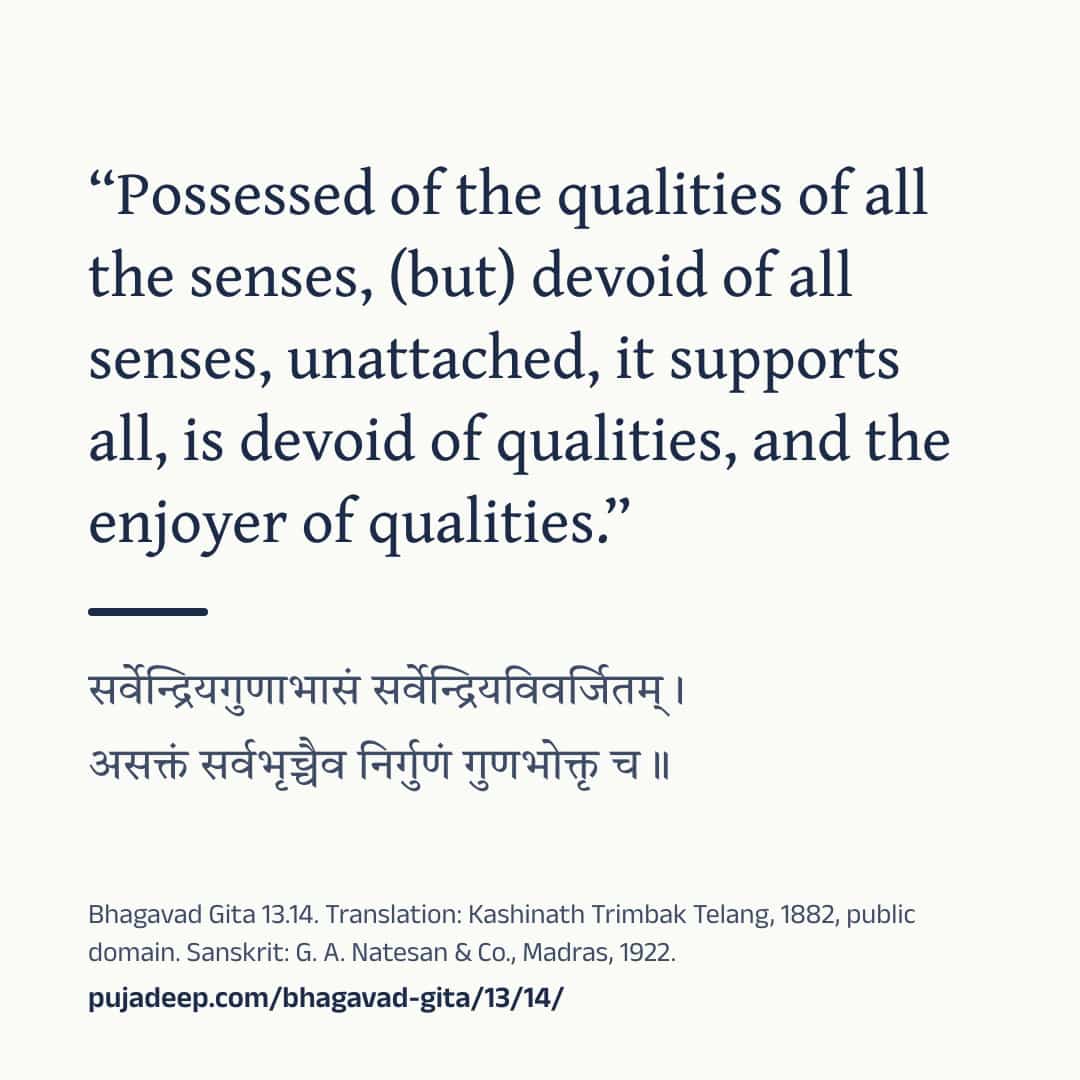
Drawing the picture
See the words
Bhagavad Gita 13.14

सर्वेन्द्रियगुणाभासं सर्वेन्द्रियविवर्जितम् ।
असक्तं सर्वभृच्चैव निर्गुणं गुणभोक्तृ च ॥

“Possessed of the qualities of all the senses, (but) devoid of all senses, unattached, it supports all, is devoid of qualities, and the enjoyer of qualities.”
(K. T. Telang, The Bhagavadgîtâ (The Sacred Books of the East, vol. VIII, Oxford: Clarendon Press, 1882), p. 104, public domain)

“Shining with all sense-faculties without any senses; unattached supporting everything; and free from properties enjoying properties.”
(Annie Besant, The Bhagavad Gîtâ, or The Lord's Song (London: Theosophical Publishing Society, 1895), p. 124, public domain)

“Shining by the functions of all the senses, yet without the senses; Absolute, yet sustaining all; devoid of Gunas, yet their experiencer.”
(Swami Swarupananda, Srimad-Bhagavad-Gita (Mayavati: Prabuddha Bharata Press, 1909; first printed in Prabuddha Bharata, 1907–1909), p. 259, public domain)

Sanskrit: G. A. Natesan & Co., Madras, 1922.
https://pujadeep.com/bhagavad-gita/13/14/ Nothing is sent from this site. Your own app sends it, to the chat you choose. The picture quotes the translation you chose on this page, with its name and year.
Sanskrit text: The Bhagavad-Gita, or The Lord's Song, with the text in Devanagari and an English translation, 1922. Meanings: written for Pujadeep and checked against the cited edition. Source and changes
Questions families ask
Who speaks Bhagavad Gita 13.14?
Krishna speaks this verse, in chapter 13 (Kshetra Kshetrajna Vibhaga Yoga).
Where does the Sanskrit text come from?
Sanskrit text: The Bhagavad-Gita, or The Lord's Song, with the text in Devanagari and an English translation, 1922. Meanings: written for Pujadeep and checked against the cited edition. See the source
Is the meaning on this page a translation?
Explanation written for this site from the sources listed here, and checked against the cited edition. It is not a translation and not the only way to read the text. Free to quote with credit.
Source and licence
- Sanskrit text
- The Bhagavad-Gita, or The Lord's Song, with the text in Devanagari and an English translation (Annie Besant, G. A. Natesan & Co., Madras, 1922). Public domain. The Sanskrit on these pages was read from this printing’s page images.
- Translation
- The Bhagavadgîtâ with the Sanatsugâtîya and the Anugîtâ, translated by Kâshinâth Trimbak Telang (The Sacred Books of the East, vol. VIII, ed. F. Max Müller) (Kashinath Trimbak Telang, F. Max Müller, Clarendon Press, Oxford, 1882). Public domain. Shown verbatim, as printed.
- Translation
- The Bhagavad Gîtâ, or The Lord's Song, translated by Annie Besant (Annie Besant, Theosophical Publishing Society, London, 1895). Public domain. Shown verbatim, as printed.
- Translation
- Srimad-Bhagavad-Gita, with Sanskrit Text; Paraphrase with Word-by-word Literal Translation; English Rendering and Comments, Index, &c., by the Swami Swarupananda (Himalayan Series, No. XX) (Swami Swarupananda, The Editors and Publishers, Advaita Ashrama, Mayavati, Prabuddha Bharata Press, Mayavati, Almora, Himalayas, 1909). Public domain. Shown verbatim, as printed.
- Common wording
- In this text, 32 words follow today's common wording, checked against sanskritdocuments.org; Sanskrit Wikisource; Gita Press, Gorakhpur; GRETIL, Göttingen and Bhaktivedanta Book Trust.
- Our explanation
- Explanation written for this site from the sources listed here, and checked against the cited edition. It is not a translation and not the only way to read the text. Free to quote with credit.
- Checked
- Checked against the cited edition, October 15, 2026.
- Updated
- October 25, 2026