Bhagavad Gita 13.7: meaning and translation
Chapter 13: Kshetra Kshetrajna Vibhaga Yoga. Krishna says
Krishna now lists what he calls knowledge.
Click or tap a word for its meaning and its dictionary page.
Text and layers
Text and layers
These choices stay in this browser.
Bhagavad Gita 13.7
अमानित्वमदम्भित्वमहिंसा क्षान्तिरार्जवम् ।आचार्योपासनं शौचं स्थैर्यमात्मविनिग्रहः ॥
Amanitvamadambhitvamahinsa kshantirarjavamAcharyopasanam shaucham sthairyamatmavinigrahah
amānitvamadambhitvamahiṃsā kṣāntirārjavam |ācāryopāsanaṃ śaucaṃ sthairyamātmavinigrahaḥ ||
Our explanation Krishna now lists what he calls knowledge. It begins with humility, freedom from pretence, not harming (ahiṃsā), patience, straightforwardness, service of the teacher, purity, steadiness and self-control. The list runs on to 13.11.
हिंदी अर्थ अब कृष्ण वह बताते हैं जिसे वे ज्ञान कहते हैं। इसकी शुरुआत होती है: अभिमान न होना, दिखावा न करना, अहिंसा, क्षमा, सरलता, गुरु की सेवा, पवित्रता, स्थिरता और अपने मन को वश में रखना। यह सूची 13.11 तक चलती है।
Word by word
Every word, with its dictionary page
Word by word
- अमानित्वम् amānitvam · humility (noun (neuter), nominative singular) Dictionary: amāni-tva, Monier-Williams 1899, p. 81, col. 2 “modesty, humility”
- अदम्भित्वम् adambhitvam · freedom from pretence (noun (neuter), nominative singular) Dictionary: a-dambhi-tva, Monier-Williams 1899, p. 18, col. 1 “sincerity”
- अहिंसा ahiṃsā · not harming (ahiṃsā) (noun (feminine), nominative singular) Dictionary: a-hiṃsā, Monier-Williams 1899, p. 125, col. 2 “not injuring anything, harmlessness”
- क्षान्तिः kṣāntiḥ · patience (noun (feminine), nominative singular) Dictionary: kṣānti, Monier-Williams 1899, p. 326, col. 3 “patience, forbearance, endurance”
- आर्जवम् ārjavam · straightforwardness (noun (neuter), nominative singular) Dictionary: ārjava, Monier-Williams 1899, p. 151, col. 3 “honesty, frankness, sincerity”
- आचार्योपासनम् ācāryopāsanam · service of the teacher (compound (neuter), nominative singular) Dictionary: ācārya, Monier-Williams 1899, p. 131, col. 3 “a spiritual guide or teacher”; 2. upāsana, Monier-Williams 1899, p. 215, col. 1 “serving, waiting upon, service, attendance, respect”
- शौचम् śaucam · purity (noun (neuter), nominative singular) Dictionary: śauca, Monier-Williams 1899, p. 1092, col. 3 “cleanness, purity, purification”
- स्थैर्यम् sthairyam · steadiness (noun (neuter), nominative singular) Dictionary: sthairya, Monier-Williams 1899, p. 1265, col. 2 “steadfastness, constancy, perseverance, patience”
- आत्मविनिग्रहः ātmavinigrahaḥ · self-control (compound (masculine), nominative singular) Dictionary: ātman, Monier-Williams 1899, p. 135, col. 1 “the individual soul, self”; vi-nigraha, Monier-Williams 1899, p. 970, col. 1 “restraining, checking, stopping, subduing, controlling”
Old translations
Kashinath Trimbak Telang, 1882. Public domain. Page 103.
Absence of vanity, absence of ostentatiousness, absence of hurtfulness, forgiveness, straightforwardness, devotion to a preceptor, purity1, steadiness, self-restraint,
This sentence goes on in 13.8.
Footnotes (the translator’s own) - Internal as well as external; as to devotion to a preceptor, cf. Âpastamba, p. 11 (p. 23 in this series); Taittirîya-upanishad, p. 38; Svetâsvatara, p. 117; and Sutta Nipâta, p. 87; as to egoism, see p. 52 supra. ↩
Compare 3 translations
Kashinath Trimbak Telang, 1882. Public domain. Page 103.
Absence of vanity, absence of ostentatiousness, absence of hurtfulness, forgiveness, straightforwardness, devotion to a preceptor, purity1, steadiness, self-restraint,
This sentence goes on in 13.8.
Footnotes (the translator’s own) - Internal as well as external; as to devotion to a preceptor, cf. Âpastamba, p. 11 (p. 23 in this series); Taittirîya-upanishad, p. 38; Svetâsvatara, p. 117; and Sutta Nipâta, p. 87; as to egoism, see p. 52 supra. ↩
You are reading this one
Annie Besant, 1895. Public domain. Page 123.
Humility, honesty, harmlessness, endurance, rectitude, service of the teacher, purity, steadfastness, self-control,
This sentence goes on in 13.8.
You are reading this one
Swami Swarupananda, 1909 (first printed 1907). Public domain. Page 256.
Humility, unpretentiousness, non-injuriousness, forbearance, uprightness, service of the teacher, purity, steadiness, self-control;
This sentence goes on in 13.8.
You are reading this one
Cite this verse
The translation: K. T. Telang, The Bhagavadgîtâ (The Sacred Books of the East, vol. VIII, Oxford: Clarendon Press, 1882), p. 103. Bhagavad Gita 13.7.
The translation: Annie Besant, The Bhagavad Gîtâ, or The Lord's Song (London: Theosophical Publishing Society, 1895), p. 123. Bhagavad Gita 13.7.
The translation: Swami Swarupananda, Srimad-Bhagavad-Gita (Mayavati: Prabuddha Bharata Press, 1909; first printed in Prabuddha Bharata, 1907–1909), p. 256. Bhagavad Gita 13.7.
Our explanation: “Bhagavad Gita 13.7: meaning and translation.” Pujadeep. Updated October 25, 2026. https://pujadeep.com/bhagavad-gita/13/7/
Pujadeep’s explanations are free to quote with credit: name Pujadeep and link to the page. How to credit
Classical readings, by school
No readings by school on this verse yet.
Share
Show the ways to share
Send one picture or the text to one chat. The picture names its source and the address of this page.
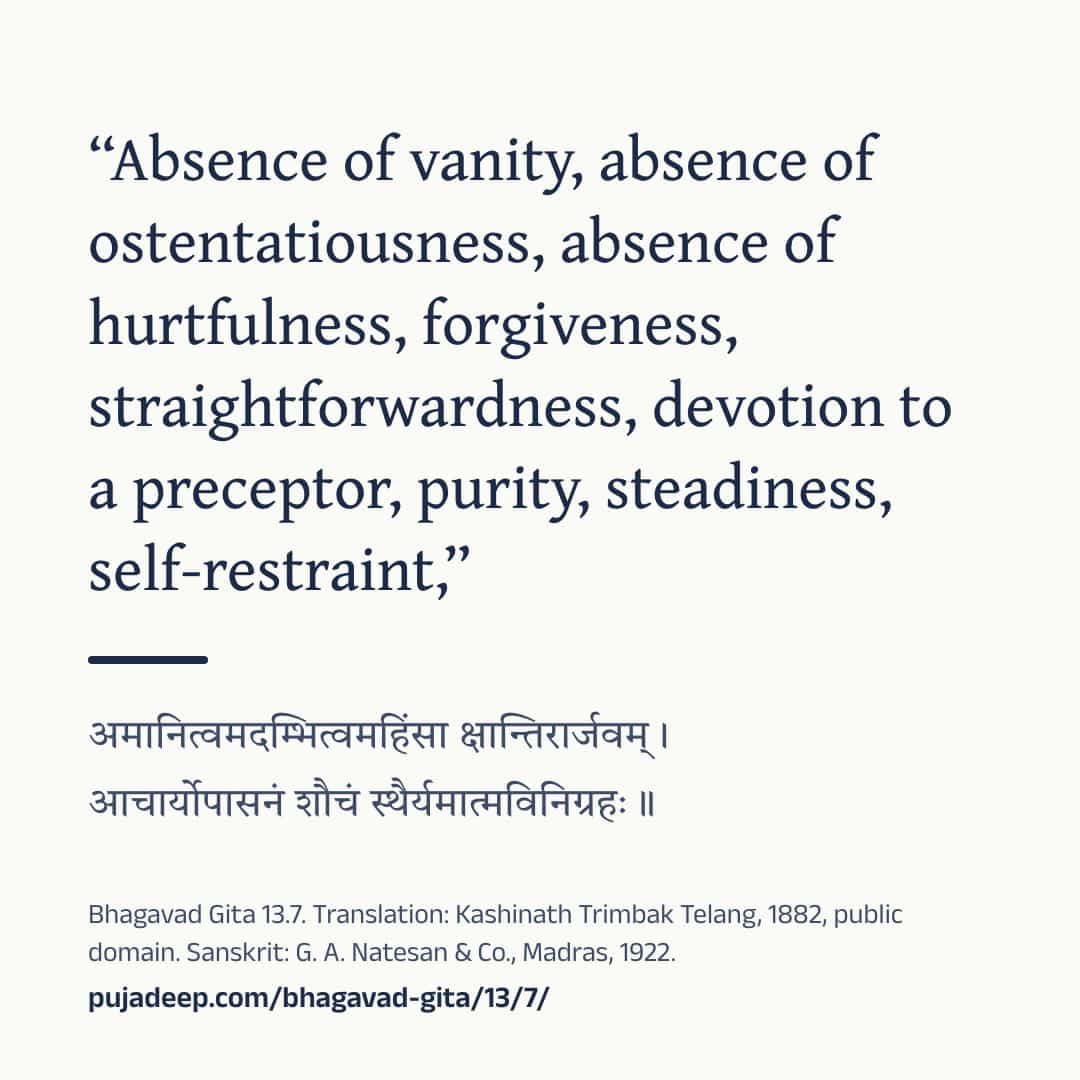
Drawing the picture
See the words
Bhagavad Gita 13.7

अमानित्वमदम्भित्वमहिंसा क्षान्तिरार्जवम् ।
आचार्योपासनं शौचं स्थैर्यमात्मविनिग्रहः ॥

“Absence of vanity, absence of ostentatiousness, absence of hurtfulness, forgiveness, straightforwardness, devotion to a preceptor, purity, steadiness, self-restraint,”
(K. T. Telang, The Bhagavadgîtâ (The Sacred Books of the East, vol. VIII, Oxford: Clarendon Press, 1882), p. 103, public domain)
This sentence goes on in 13.8.

“Humility, honesty, harmlessness, endurance, rectitude, service of the teacher, purity, steadfastness, self-control,”
(Annie Besant, The Bhagavad Gîtâ, or The Lord's Song (London: Theosophical Publishing Society, 1895), p. 123, public domain)
This sentence goes on in 13.8.

“Humility, unpretentiousness, non-injuriousness, forbearance, uprightness, service of the teacher, purity, steadiness, self-control;”
(Swami Swarupananda, Srimad-Bhagavad-Gita (Mayavati: Prabuddha Bharata Press, 1909; first printed in Prabuddha Bharata, 1907–1909), p. 256, public domain)
This sentence goes on in 13.8.

Sanskrit: G. A. Natesan & Co., Madras, 1922.
https://pujadeep.com/bhagavad-gita/13/7/ Nothing is sent from this site. Your own app sends it, to the chat you choose. The picture quotes the translation you chose on this page, with its name and year.
Sanskrit text: The Bhagavad-Gita, or The Lord's Song, with the text in Devanagari and an English translation, 1922. Meanings: written for Pujadeep and checked against the cited edition. Source and changes
Questions families ask
Who speaks Bhagavad Gita 13.7?
Krishna speaks this verse, in chapter 13 (Kshetra Kshetrajna Vibhaga Yoga).
Where does the Sanskrit text come from?
Sanskrit text: The Bhagavad-Gita, or The Lord's Song, with the text in Devanagari and an English translation, 1922. Meanings: written for Pujadeep and checked against the cited edition. See the source
Is the meaning on this page a translation?
Explanation written for this site from the sources listed here, and checked against the cited edition. It is not a translation and not the only way to read the text. Free to quote with credit.
Source and licence
- Sanskrit text
- The Bhagavad-Gita, or The Lord's Song, with the text in Devanagari and an English translation (Annie Besant, G. A. Natesan & Co., Madras, 1922). Public domain. The Sanskrit on these pages was read from this printing’s page images.
- Translation
- The Bhagavadgîtâ with the Sanatsugâtîya and the Anugîtâ, translated by Kâshinâth Trimbak Telang (The Sacred Books of the East, vol. VIII, ed. F. Max Müller) (Kashinath Trimbak Telang, F. Max Müller, Clarendon Press, Oxford, 1882). Public domain. Shown verbatim, as printed.
- Translation
- The Bhagavad Gîtâ, or The Lord's Song, translated by Annie Besant (Annie Besant, Theosophical Publishing Society, London, 1895). Public domain. Shown verbatim, as printed.
- Translation
- Srimad-Bhagavad-Gita, with Sanskrit Text; Paraphrase with Word-by-word Literal Translation; English Rendering and Comments, Index, &c., by the Swami Swarupananda (Himalayan Series, No. XX) (Swami Swarupananda, The Editors and Publishers, Advaita Ashrama, Mayavati, Prabuddha Bharata Press, Mayavati, Almora, Himalayas, 1909). Public domain. Shown verbatim, as printed.
- Common wording
- In this text, 32 words follow today's common wording, checked against sanskritdocuments.org; Sanskrit Wikisource; Gita Press, Gorakhpur; GRETIL, Göttingen and Bhaktivedanta Book Trust.
- Our explanation
- Explanation written for this site from the sources listed here, and checked against the cited edition. It is not a translation and not the only way to read the text. Free to quote with credit.
- Checked
- Checked against the cited edition, October 15, 2026.
- Updated
- October 25, 2026