Bhagavad Gita 13.11: meaning and translation
Chapter 13: Kshetra Kshetrajna Vibhaga Yoga. Krishna says
Krishna: Finally: steady attention to knowledge of the self (adhyātma) and keeping in view the aim of knowing the truth.
Click or tap a word for its meaning and its dictionary page.
Text and layers
Text and layers
These choices stay in this browser.
Bhagavad Gita 13.11
अध्यात्मज्ञाननित्यत्वं तत्त्वज्ञानार्थदर्शनम् ।एतज्ज्ञानमिति प्रोक्तमज्ञानं यदतोऽन्यथा ॥
Adhyatmajnananityatvam tattvajnanarthadarshanamEtajjnanamiti proktamajnanam yadatonyatha
adhyātmajñānanityatvaṃ tattvajñānārthadarśanam |etajjñānamiti proktamajñānaṃ yadato’nyathā ||
Our explanation Finally: steady attention to knowledge of the self (adhyātma) and keeping in view the aim of knowing the truth. Krishna says that all this is called knowledge, and whatever is opposed to it is ignorance. So what Krishna calls knowledge here is a way of living, not only a set of facts.
हिंदी अर्थ अंत में: आत्मा के ज्ञान (अध्यात्म) में सदा लगे रहना और तत्त्व-ज्ञान के लक्ष्य को सदा सामने रखना। कृष्ण कहते हैं कि यह सब ज्ञान कहलाता है, और जो इससे उलटा है वह अज्ञान है। इसलिए यहाँ कृष्ण जिसे ज्ञान कहते हैं, वह केवल जानकारी नहीं, बल्कि जीने का एक ढंग है।
Word by word
Every word, with its dictionary page
Word by word
- अध्यात्मज्ञाननित्यत्वम् adhyātmajñānanityatvam · steady attention to knowledge of the self (compound (neuter), nominative singular) Dictionary: adhy-ātma, Monier-Williams 1899, p. 23, col. 2 “the Supreme Spirit”; jñāna, Monier-Williams 1899, p. 426, col. 1 “knowing, becoming acquainted with, knowledge”; nitya, Monier-Williams 1899, p. 547, col. 2 “ifc. constantly dwelling or engaged in”
- तत्त्वज्ञानार्थदर्शनम् tattvajñānārthadarśanam · seeing the goal of knowing the truth (compound (neuter), nominative singular) Dictionary: tattva-jñāna, Monier-Williams 1899, p. 433, col. 1 “knowledge of truth, thorough knowledge”; artha, Monier-Williams 1899, p. 90, col. 3 “aim, purpose”; darśana, Monier-Williams 1899, p. 470, col. 3 “seeing, observing, looking, noticing, observation, perception”
- एतत् etat · this (pronoun (neuter), nominative singular) Dictionary: etad, Monier-Williams 1899, p. 231, col. 2 “this, this here, here”
- ज्ञानम् jñānam · knowledge (noun (neuter), nominative singular) Dictionary: jñāna, Monier-Williams 1899, p. 426, col. 1 “knowing, becoming acquainted with, knowledge”
- इति iti · so (it is called) (indeclinable) Dictionary: 2. iti, Monier-Williams 1899, p. 165, col. 1 “in this manner, thus”
- प्रोक्तम् proktam · is called (past participle (neuter), nominative singular) Dictionary: pra-vac, Monier-Williams 1899, p. 690, col. 1 “to proclaim, announce, praise, commend, mention, teach, impart, explain”
- अज्ञानम् ajñānam · ignorance (noun (neuter), nominative singular) Dictionary: a-jñāna, Monier-Williams 1899, p. 10, col. 3 “non-cognizance; ignorance”
- यत् yat · what (relative pronoun (neuter), nominative singular) Dictionary: yad, Monier-Williams 1899, p. 844, col. 2 “who, which, what, whichever, whatever, that”
- अतः ataḥ · to this (indeclinable) Dictionary: atas, Monier-Williams 1899, p. 12, col. 1 “from this, than this; hence; henceforth”
- अन्यथा anyathā · opposed, otherwise (indeclinable) Dictionary: anya-thā, Monier-Williams 1899, p. 45, col. 3 “otherwise, in a different manner”
Old translations
Kashinath Trimbak Telang, 1882. Public domain. Page 103.
constancy in knowledge of the relation of the individual self to the supreme, perception of the object1 of knowledge of the truth, this is called knowledge; that is ignorance which is opposed to this.
This sentence begins in 13.7.
Footnotes (the translator’s own) - Viz. removal of ignorance and acquisition of happiness. ↩
Compare 3 translations
Kashinath Trimbak Telang, 1882. Public domain. Page 103.
constancy in knowledge of the relation of the individual self to the supreme, perception of the object1 of knowledge of the truth, this is called knowledge; that is ignorance which is opposed to this.
This sentence begins in 13.7.
Footnotes (the translator’s own) - Viz. removal of ignorance and acquisition of happiness. ↩
You are reading this one
Annie Besant, 1895. Public domain. Page 124.
Constancy in the Adhyâtmâ-wisdom, understanding of the object of essential wisdom; that is declared to be wisdom; all against it is ignorance.
This sentence begins in 13.7.
You are reading this one
Swami Swarupananda, 1909 (first printed 1907). Public domain. Page 258.
Constant application to spiritual knowledge, understanding the end of the knowledge of Truth; this is declared to be knowledge, and what is opposed to it is ignorance.
This sentence begins in 13.10.
You are reading this one
Cite this verse
The translation: K. T. Telang, The Bhagavadgîtâ (The Sacred Books of the East, vol. VIII, Oxford: Clarendon Press, 1882), p. 103. Bhagavad Gita 13.11.
The translation: Annie Besant, The Bhagavad Gîtâ, or The Lord's Song (London: Theosophical Publishing Society, 1895), p. 124. Bhagavad Gita 13.11.
The translation: Swami Swarupananda, Srimad-Bhagavad-Gita (Mayavati: Prabuddha Bharata Press, 1909; first printed in Prabuddha Bharata, 1907–1909), p. 258. Bhagavad Gita 13.11.
Our explanation: “Bhagavad Gita 13.11: meaning and translation.” Pujadeep. Updated October 25, 2026. https://pujadeep.com/bhagavad-gita/13/11/
Pujadeep’s explanations are free to quote with credit: name Pujadeep and link to the page. How to credit
Classical readings, by school
No readings by school on this verse yet.
Share
Show the ways to share
Send one picture or the text to one chat. The picture names its source and the address of this page.
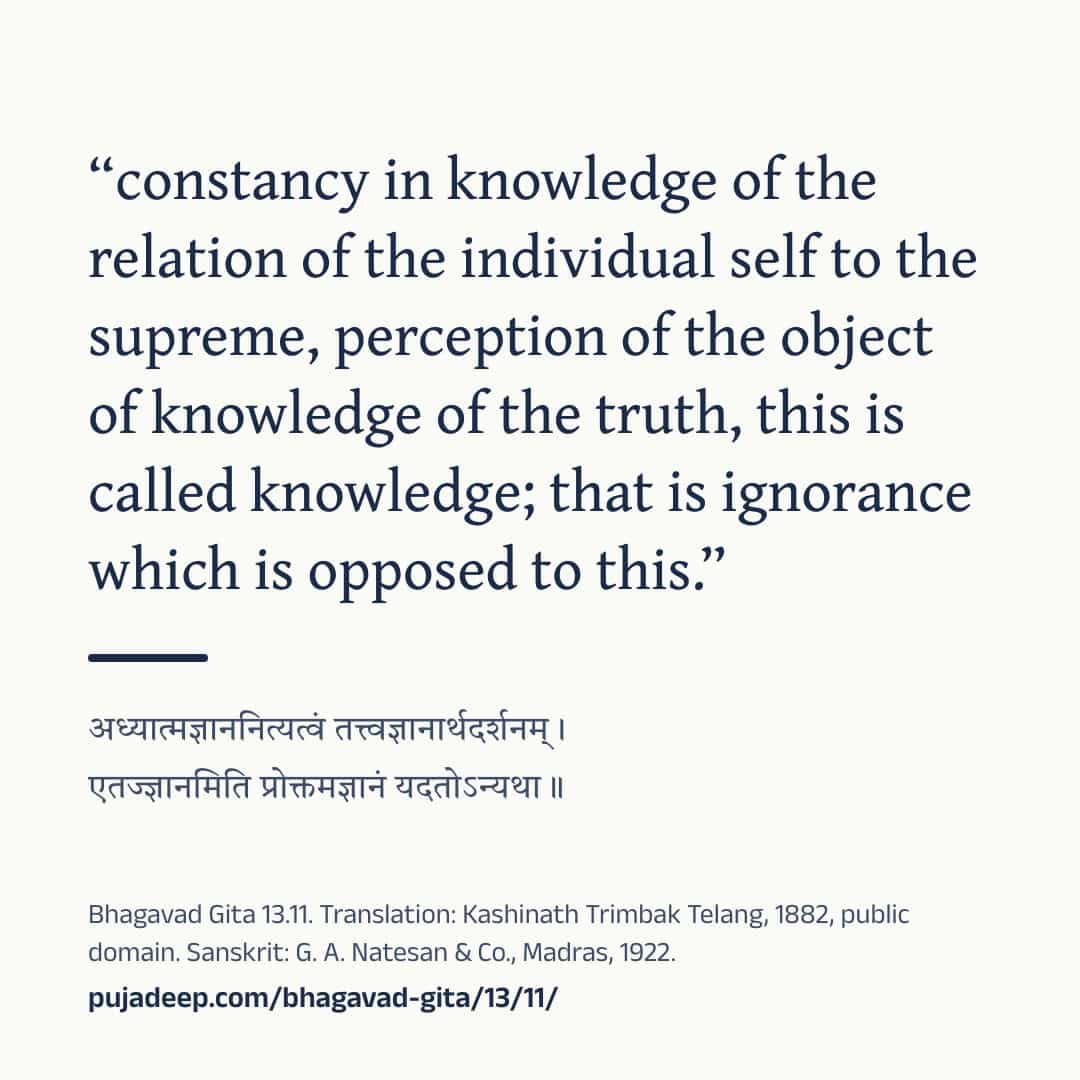
Drawing the picture
See the words
Bhagavad Gita 13.11

अध्यात्मज्ञाननित्यत्वं तत्त्वज्ञानार्थदर्शनम् ।
एतज्ज्ञानमिति प्रोक्तमज्ञानं यदतोऽन्यथा ॥

“constancy in knowledge of the relation of the individual self to the supreme, perception of the object of knowledge of the truth, this is called knowledge; that is ignorance which is opposed to this.”
(K. T. Telang, The Bhagavadgîtâ (The Sacred Books of the East, vol. VIII, Oxford: Clarendon Press, 1882), p. 103, public domain)
This sentence begins in 13.7.

“Constancy in the Adhyâtmâ-wisdom, understanding of the object of essential wisdom; that is declared to be wisdom; all against it is ignorance.”
(Annie Besant, The Bhagavad Gîtâ, or The Lord's Song (London: Theosophical Publishing Society, 1895), p. 124, public domain)
This sentence begins in 13.7.

“Constant application to spiritual knowledge, understanding the end of the knowledge of Truth; this is declared to be knowledge, and what is opposed to it is ignorance.”
(Swami Swarupananda, Srimad-Bhagavad-Gita (Mayavati: Prabuddha Bharata Press, 1909; first printed in Prabuddha Bharata, 1907–1909), p. 258, public domain)
This sentence begins in 13.10.

Sanskrit: G. A. Natesan & Co., Madras, 1922.
https://pujadeep.com/bhagavad-gita/13/11/ Nothing is sent from this site. Your own app sends it, to the chat you choose. The picture quotes the translation you chose on this page, with its name and year.
Sanskrit text: The Bhagavad-Gita, or The Lord's Song, with the text in Devanagari and an English translation, 1922. Meanings: written for Pujadeep and checked against the cited edition. Source and changes
Questions families ask
Who speaks Bhagavad Gita 13.11?
Krishna speaks this verse, in chapter 13 (Kshetra Kshetrajna Vibhaga Yoga).
Where does the Sanskrit text come from?
Sanskrit text: The Bhagavad-Gita, or The Lord's Song, with the text in Devanagari and an English translation, 1922. Meanings: written for Pujadeep and checked against the cited edition. See the source
Is the meaning on this page a translation?
Explanation written for this site from the sources listed here, and checked against the cited edition. It is not a translation and not the only way to read the text. Free to quote with credit.
Source and licence
- Sanskrit text
- The Bhagavad-Gita, or The Lord's Song, with the text in Devanagari and an English translation (Annie Besant, G. A. Natesan & Co., Madras, 1922). Public domain. The Sanskrit on these pages was read from this printing’s page images.
- Translation
- The Bhagavadgîtâ with the Sanatsugâtîya and the Anugîtâ, translated by Kâshinâth Trimbak Telang (The Sacred Books of the East, vol. VIII, ed. F. Max Müller) (Kashinath Trimbak Telang, F. Max Müller, Clarendon Press, Oxford, 1882). Public domain. Shown verbatim, as printed.
- Translation
- The Bhagavad Gîtâ, or The Lord's Song, translated by Annie Besant (Annie Besant, Theosophical Publishing Society, London, 1895). Public domain. Shown verbatim, as printed.
- Translation
- Srimad-Bhagavad-Gita, with Sanskrit Text; Paraphrase with Word-by-word Literal Translation; English Rendering and Comments, Index, &c., by the Swami Swarupananda (Himalayan Series, No. XX) (Swami Swarupananda, The Editors and Publishers, Advaita Ashrama, Mayavati, Prabuddha Bharata Press, Mayavati, Almora, Himalayas, 1909). Public domain. Shown verbatim, as printed.
- Common wording
- In this text, 32 words follow today's common wording, checked against sanskritdocuments.org; Sanskrit Wikisource; Gita Press, Gorakhpur; GRETIL, Göttingen and Bhaktivedanta Book Trust.
- Our explanation
- Explanation written for this site from the sources listed here, and checked against the cited edition. It is not a translation and not the only way to read the text. Free to quote with credit.
- Checked
- Checked against the cited edition, October 15, 2026.
- Updated
- October 25, 2026