Bhagavad Gita 13.10: meaning and translation
Chapter 13: Kshetra Kshetrajna Vibhaga Yoga. Krishna says
Further: unwavering devotion to Krishna, with a yoga that turns to nothing else; a liking for quiet, solitary places; and no taste for crowds.
Click or tap a word for its meaning and its dictionary page.
Text and layers
Text and layers
These choices stay in this browser.
Bhagavad Gita 13.10
मयि चानन्ययोगेन भक्तिरव्यभिचारिणी ।विविक्तदेशसेवित्वमरतिर्जनसंसदि ॥
Mayi chananyayogena bhaktiravyabhichariniViviktadeshasevitvamaratirjanasansadi
mayi cānanyayogena bhaktiravyabhicāriṇī |viviktadeśasevitvamaratirjanasaṃsadi ||
Our explanation Further: unwavering devotion to Krishna, with a yoga that turns to nothing else; a liking for quiet, solitary places; and no taste for crowds.
हिंदी अर्थ आगे: अनन्य योग के साथ, यानी किसी और की ओर न जाकर, कृष्ण के प्रति अटल भक्ति; एकांत और शांत स्थानों में रहना; और भीड़ में रुचि न होना।
Word by word
Every word, with its dictionary page
Word by word
- मयि mayi · in "me" (Krishna) (pronoun, locative singular) Dictionary: 1. mad, Monier-Williams 1899, p. 777, col. 2 “base of the first pers. pron. in the sg. number (esp. in comp.)”
- च ca · and (indeclinable) Dictionary: 2. ca, Monier-Williams 1899, p. 380, col. 1 “and, both, also, moreover, as well as”
- अनन्ययोगेन ananyayogena · with a yoga that turns to nothing else (compound (masculine), instrumental singular) Dictionary: an-anya, Monier-Williams 1899, p. 25, col. 2 “having no other (object), undistracted”; yoga, Monier-Williams 1899, p. 856, col. 3 “application or concentration of the thoughts, abstract contemplation, meditation”
- भक्तिः bhaktiḥ · devotion (noun (feminine), nominative singular) Dictionary: bhakti, Monier-Williams 1899, p. 743, col. 2 “attachment, devotion, fondness for, devotion to”
- अव्यभिचारिणी avyabhicāriṇī · unwavering (adjective (feminine), nominative singular) Dictionary: a-vyabhicārin, Monier-Williams 1899, p. 111, col. 3 “steady, permanent”
- विविक्तदेशसेवित्वम् viviktadeśasevitvam · liking for quiet, solitary places (compound (neuter), nominative singular) Dictionary: vi-vikta, Monier-Williams 1899, p. 987, col. 3 “isolated, alone, solitary”; deśa, Monier-Williams 1899, p. 496, col. 2 “point, region, spot, place”; sevi-tva, Monier-Williams 1899, p. 1247, col. 2 “seeking, resorting to”
- अरतिः aratiḥ · no taste (for) (noun (feminine), nominative singular) Dictionary: 1. a-rati, Monier-Williams 1899, p. 86, col. 3 “dissatisfaction, discontent”
- जनसंसदि janasaṃsadi · for crowds of people (compound (feminine), locative singular) Dictionary: jana, Monier-Williams 1899, p. 410, col. 1 “creature, living being, man, person, race”; saṃ-sad, Monier-Williams 1899, p. 1119, col. 1 “an assembly, meeting, congress”
Old translations
Kashinath Trimbak Telang, 1882. Public domain. Page 103.
unswerving devotion to me, without meditation on any one else; resorting to clean places, distaste for assemblages of men1,
This sentence begins in 13.7. This sentence goes on in 13.11.
Footnotes (the translator’s own) - Cf. Sutta Nipâta, p. 11. ↩
Compare 3 translations
Kashinath Trimbak Telang, 1882. Public domain. Page 103.
unswerving devotion to me, without meditation on any one else; resorting to clean places, distaste for assemblages of men1,
This sentence begins in 13.7. This sentence goes on in 13.11.
Footnotes (the translator’s own) - Cf. Sutta Nipâta, p. 11. ↩
You are reading this one
Annie Besant, 1895. Public domain. Page 124.
Unflinching devotion to Me, without union with another, resort to sequestered places, absence of pleasure in the company of men,
This sentence begins in 13.7. This sentence goes on in 13.11.
You are reading this one
Swami Swarupananda, 1909 (first printed 1907). Public domain. Page 257.
Unswerving devotion to Me by the Yoga of non-separation, resort to sequestered places, distaste for the society of men;
This sentence goes on in 13.11.
You are reading this one
Cite this verse
The translation: K. T. Telang, The Bhagavadgîtâ (The Sacred Books of the East, vol. VIII, Oxford: Clarendon Press, 1882), p. 103. Bhagavad Gita 13.10.
The translation: Annie Besant, The Bhagavad Gîtâ, or The Lord's Song (London: Theosophical Publishing Society, 1895), p. 124. Bhagavad Gita 13.10.
The translation: Swami Swarupananda, Srimad-Bhagavad-Gita (Mayavati: Prabuddha Bharata Press, 1909; first printed in Prabuddha Bharata, 1907–1909), p. 257. Bhagavad Gita 13.10.
Our explanation: “Bhagavad Gita 13.10: meaning and translation.” Pujadeep. Updated October 25, 2026. https://pujadeep.com/bhagavad-gita/13/10/
Pujadeep’s explanations are free to quote with credit: name Pujadeep and link to the page. How to credit
Classical readings, by school
No readings by school on this verse yet.
Share
Show the ways to share
Send one picture or the text to one chat. The picture names its source and the address of this page.
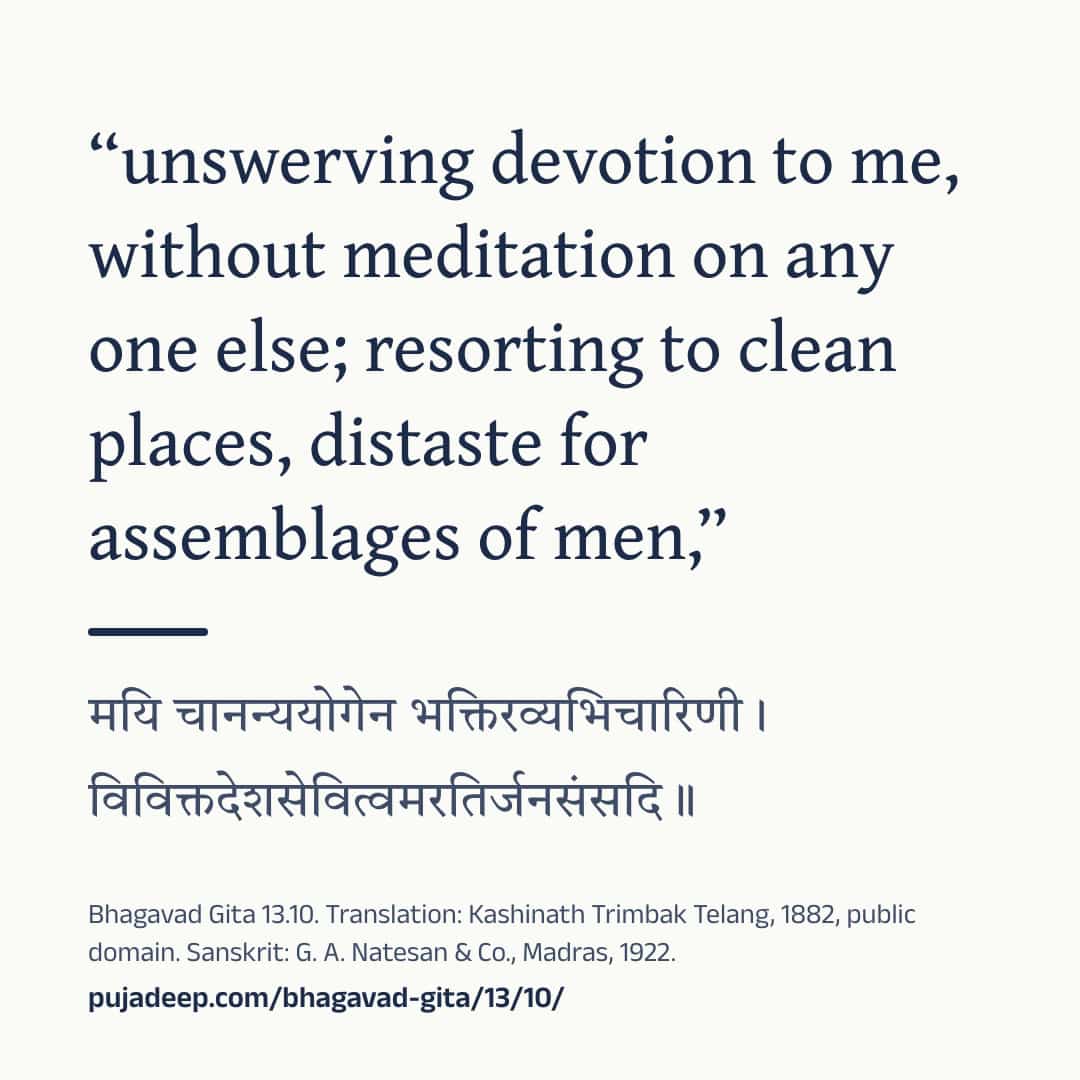
Drawing the picture
See the words
Bhagavad Gita 13.10

मयि चानन्ययोगेन भक्तिरव्यभिचारिणी ।
विविक्तदेशसेवित्वमरतिर्जनसंसदि ॥

“unswerving devotion to me, without meditation on any one else; resorting to clean places, distaste for assemblages of men,”
(K. T. Telang, The Bhagavadgîtâ (The Sacred Books of the East, vol. VIII, Oxford: Clarendon Press, 1882), p. 103, public domain)
This sentence begins in 13.7. This sentence goes on in 13.11.

“Unflinching devotion to Me, without union with another, resort to sequestered places, absence of pleasure in the company of men,”
(Annie Besant, The Bhagavad Gîtâ, or The Lord's Song (London: Theosophical Publishing Society, 1895), p. 124, public domain)
This sentence begins in 13.7. This sentence goes on in 13.11.

“Unswerving devotion to Me by the Yoga of non-separation, resort to sequestered places, distaste for the society of men;”
(Swami Swarupananda, Srimad-Bhagavad-Gita (Mayavati: Prabuddha Bharata Press, 1909; first printed in Prabuddha Bharata, 1907–1909), p. 257, public domain)
This sentence goes on in 13.11.

Sanskrit: G. A. Natesan & Co., Madras, 1922.
https://pujadeep.com/bhagavad-gita/13/10/ Nothing is sent from this site. Your own app sends it, to the chat you choose. The picture quotes the translation you chose on this page, with its name and year.
Sanskrit text: The Bhagavad-Gita, or The Lord's Song, with the text in Devanagari and an English translation, 1922. Meanings: written for Pujadeep and checked against the cited edition. Source and changes
Questions families ask
Who speaks Bhagavad Gita 13.10?
Krishna speaks this verse, in chapter 13 (Kshetra Kshetrajna Vibhaga Yoga).
Where does the Sanskrit text come from?
Sanskrit text: The Bhagavad-Gita, or The Lord's Song, with the text in Devanagari and an English translation, 1922. Meanings: written for Pujadeep and checked against the cited edition. See the source
Is the meaning on this page a translation?
Explanation written for this site from the sources listed here, and checked against the cited edition. It is not a translation and not the only way to read the text. Free to quote with credit.
Source and licence
- Sanskrit text
- The Bhagavad-Gita, or The Lord's Song, with the text in Devanagari and an English translation (Annie Besant, G. A. Natesan & Co., Madras, 1922). Public domain. The Sanskrit on these pages was read from this printing’s page images.
- Translation
- The Bhagavadgîtâ with the Sanatsugâtîya and the Anugîtâ, translated by Kâshinâth Trimbak Telang (The Sacred Books of the East, vol. VIII, ed. F. Max Müller) (Kashinath Trimbak Telang, F. Max Müller, Clarendon Press, Oxford, 1882). Public domain. Shown verbatim, as printed.
- Translation
- The Bhagavad Gîtâ, or The Lord's Song, translated by Annie Besant (Annie Besant, Theosophical Publishing Society, London, 1895). Public domain. Shown verbatim, as printed.
- Translation
- Srimad-Bhagavad-Gita, with Sanskrit Text; Paraphrase with Word-by-word Literal Translation; English Rendering and Comments, Index, &c., by the Swami Swarupananda (Himalayan Series, No. XX) (Swami Swarupananda, The Editors and Publishers, Advaita Ashrama, Mayavati, Prabuddha Bharata Press, Mayavati, Almora, Himalayas, 1909). Public domain. Shown verbatim, as printed.
- Common wording
- In this text, 32 words follow today's common wording, checked against sanskritdocuments.org; Sanskrit Wikisource; Gita Press, Gorakhpur; GRETIL, Göttingen and Bhaktivedanta Book Trust.
- Our explanation
- Explanation written for this site from the sources listed here, and checked against the cited edition. It is not a translation and not the only way to read the text. Free to quote with credit.
- Checked
- Checked against the cited edition, October 15, 2026.
- Updated
- October 25, 2026