Bhagavad Gita 13.3: meaning and translation
Chapter 13: Kshetra Kshetrajna Vibhaga Yoga. Krishna says
Krishna asks Arjuna to hear in brief what the field is, what it is like, how it changes and where it comes from, and who its knower is and what powers it has.
Click or tap a word for its meaning and its dictionary page.
Text and layers
Text and layers
These choices stay in this browser.
Bhagavad Gita 13.3
तत्क्षेत्रं यच्च यादृक् च यद्विकारि यतश्च यत् ।स च यो यत्प्रभावश्च तत्समासेन मे शृणु ॥
Tatkshetram yachcha yadrik cha yadvikari yatashcha yatSa cha yo yatprabhavashcha tatsamasena me shrinu
tatkṣetraṃ yacca yādṛk ca yadvikāri yataśca yat |sa ca yo yatprabhāvaśca tatsamāsena me śṛṇu ||
Our explanation Krishna asks Arjuna to hear in brief what the field is, what it is like, how it changes and where it comes from, and who its knower is and what powers it has.
हिंदी अर्थ कृष्ण अर्जुन से कहते हैं कि संक्षेप में सुनो कि वह क्षेत्र क्या है, कैसा है, उसमें क्या विकार (बदलाव) होते हैं और वह कहाँ से आता है; और उसका जानने वाला कौन है और उसकी क्या शक्तियाँ हैं।
Word by word
Every word, with its dictionary page
Word by word
- तत् tat · that (pronoun (neuter), nominative singular) Dictionary: tad, Monier-Williams 1899, p. 434, col. 1 “m. he, f. she, n. it, that, this”
- क्षेत्रम् kṣetram · the field (noun (neuter), nominative singular) Dictionary: kṣetra, Monier-Williams 1899, p. 332, col. 1 “a field”
- यत् yat · what (it is) (relative pronoun (neuter), nominative singular) Dictionary: yad, Monier-Williams 1899, p. 844, col. 2 “who, which, what, whichever, whatever, that”
- च ca · and (indeclinable) Dictionary: 2. ca, Monier-Williams 1899, p. 380, col. 1 “and, both, also, moreover, as well as”
- यादृक् yādṛk · of what kind (adjective (neuter), nominative singular) Dictionary: yādṛś, Monier-Williams 1899, p. 851, col. 2 “which like, as like, of whatever kind or nature”
- च ca · and (indeclinable) Dictionary: 2. ca, Monier-Williams 1899, p. 380, col. 1 “and, both, also, moreover, as well as”
- यद्विकारि yadvikāri · with what changes (compound (neuter), nominative singular) Dictionary: yad, Monier-Williams 1899, p. 844, col. 2 “who, which, what, whichever, whatever, that”; vi-kārin, Monier-Williams 1899, p. 954, col. 3 “liable to change, changeable, variable”
- यतः yataḥ · from what (indeclinable) Dictionary: yatas, Monier-Williams 1899, p. 841, col. 2 “from which or what, whence, whereof, wherefrom”
- च ca · and (indeclinable) Dictionary: 2. ca, Monier-Williams 1899, p. 380, col. 1 “and, both, also, moreover, as well as”
- यत् yat · what (it comes from) (relative pronoun (neuter), nominative singular) Dictionary: yad, Monier-Williams 1899, p. 844, col. 2 “who, which, what, whichever, whatever, that”
- सः saḥ · he (the knower) (pronoun (masculine), nominative singular) Dictionary: tad, Monier-Williams 1899, p. 434, col. 1 “m. he, f. she, n. it, that, this”
- च ca · and (indeclinable) Dictionary: 2. ca, Monier-Williams 1899, p. 380, col. 1 “and, both, also, moreover, as well as”
- यः yaḥ · who (relative pronoun (masculine), nominative singular) Dictionary: yad, Monier-Williams 1899, p. 844, col. 2 “who, which, what, whichever, whatever, that”
- यत्प्रभावः yatprabhāvaḥ · with what powers (compound (masculine), nominative singular) Dictionary: yad, Monier-Williams 1899, p. 844, col. 2 “who, which, what, whichever, whatever, that”; pra-bhāva, Monier-Williams 1899, p. 684, col. 2 “might, power”
- च ca · and (indeclinable) Dictionary: 2. ca, Monier-Williams 1899, p. 380, col. 1 “and, both, also, moreover, as well as”
- तत् tat · that (pronoun (neuter), accusative singular) Dictionary: tad, Monier-Williams 1899, p. 434, col. 1 “m. he, f. she, n. it, that, this”
- समासेन samāsena · in brief (noun (masculine), instrumental singular) Dictionary: 1. sam-āsa, Monier-Williams 1899, p. 1158, col. 2 “succinctness, conciseness, condensation”
- मे me · from "me" (Krishna) (pronoun, genitive singular) Dictionary: 1. mad, Monier-Williams 1899, p. 777, col. 2 “base of the first pers. pron. in the sg. number (esp. in comp.)”
- शृणु śṛṇu · hear (imperative, 2nd person singular) Dictionary: 1. śru, Monier-Williams 1899, p. 1100, col. 3 “to hear, listen or attend to anything”
1 printing differs
Edition differences. Another printing or text reads this place differently.
- Spelling A digital text reads Same words. The e-text joins यादृक्च; the 1922 edition prints यादृक् च as two words, as another digital text does (yādṛk ca).
Old translations
Kashinath Trimbak Telang, 1882. Public domain. Page 102.
Now hear from me in brief what that Kshetra (is), what (it is) like, what changes (it undergoes), and whence (it comes), and what is he1, and what his powers,
This sentence goes on in 13.4.
Footnotes (the translator’s own) - I. e. the Kshetragña. ↩
Compare 3 translations
Kashinath Trimbak Telang, 1882. Public domain. Page 102.
Now hear from me in brief what that Kshetra (is), what (it is) like, what changes (it undergoes), and whence (it comes), and what is he1, and what his powers,
This sentence goes on in 13.4.
Footnotes (the translator’s own) - I. e. the Kshetragña. ↩
You are reading this one
Annie Besant, 1895. Public domain. Page 122.
What the Field is and of what nature, its changes and whence it is, and what He1 is and what His powers, hear that now briefly from Me.
Footnotes (the translator’s own) - Kshetragnya, the Knower of the Field. ↩
You are reading this one
Swami Swarupananda, 1909 (first printed 1907). Public domain. Page 254.
What the Kshetra is, what its properties are, what are its modifications, what effects arise from what causes, and also who He is and what are His powers, that hear from Me in brief.
You are reading this one
Cite this verse
The translation: K. T. Telang, The Bhagavadgîtâ (The Sacred Books of the East, vol. VIII, Oxford: Clarendon Press, 1882), p. 102. Bhagavad Gita 13.3.
The translation: Annie Besant, The Bhagavad Gîtâ, or The Lord's Song (London: Theosophical Publishing Society, 1895), p. 122. Bhagavad Gita 13.3.
The translation: Swami Swarupananda, Srimad-Bhagavad-Gita (Mayavati: Prabuddha Bharata Press, 1909; first printed in Prabuddha Bharata, 1907–1909), p. 254. Bhagavad Gita 13.3.
Our explanation: “Bhagavad Gita 13.3: meaning and translation.” Pujadeep. Updated October 25, 2026. https://pujadeep.com/bhagavad-gita/13/3/
Pujadeep’s explanations are free to quote with credit: name Pujadeep and link to the page. How to credit
Classical readings, by school
No readings by school on this verse yet.
Share
Show the ways to share
Send one picture or the text to one chat. The picture names its source and the address of this page.
Drawing the picture
See the words
Bhagavad Gita 13.3

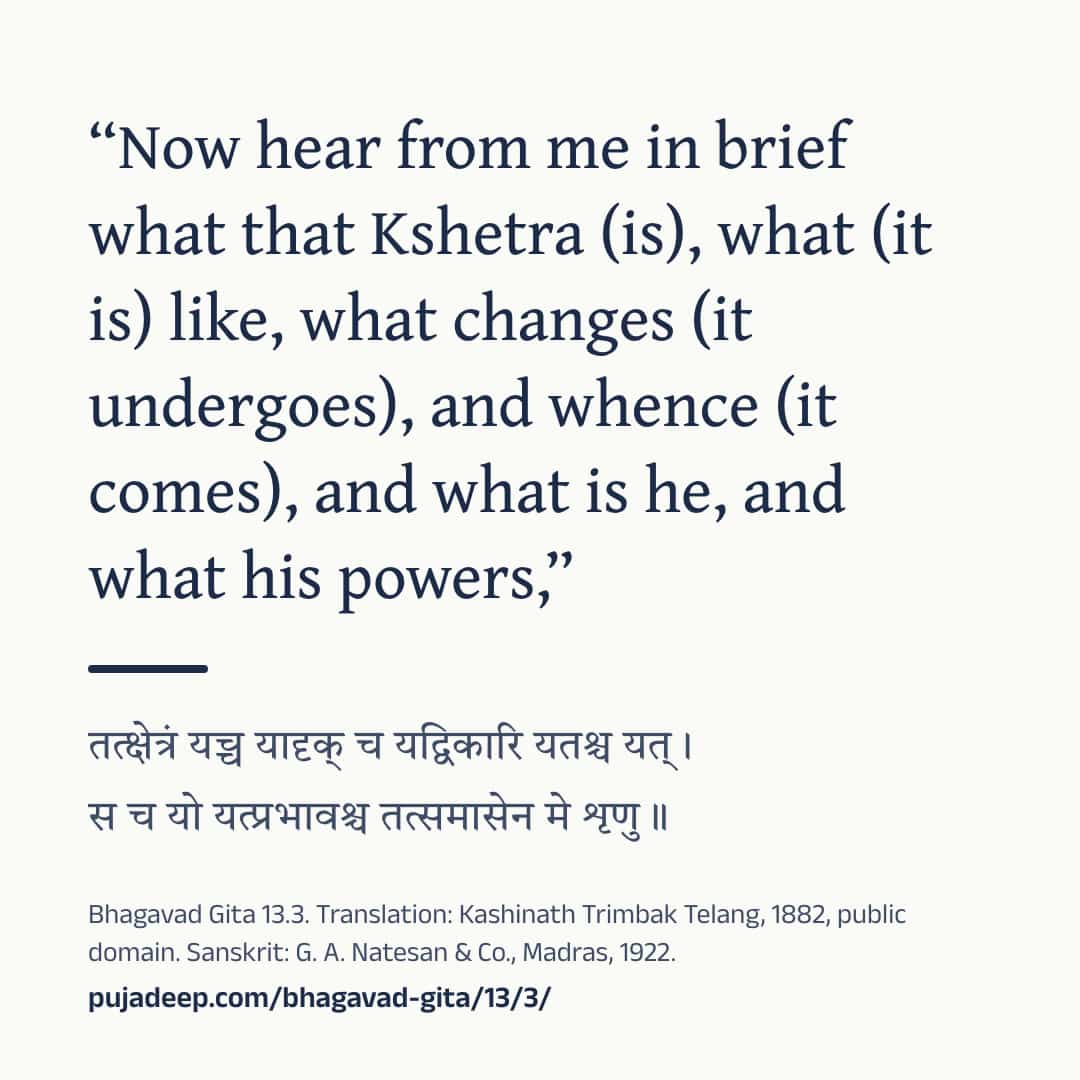
तत्क्षेत्रं यच्च यादृक् च यद्विकारि यतश्च यत् ।
स च यो यत्प्रभावश्च तत्समासेन मे शृणु ॥

“Now hear from me in brief what that Kshetra (is), what (it is) like, what changes (it undergoes), and whence (it comes), and what is he, and what his powers,”
(K. T. Telang, The Bhagavadgîtâ (The Sacred Books of the East, vol. VIII, Oxford: Clarendon Press, 1882), p. 102, public domain)
This sentence goes on in 13.4.

“What the Field is and of what nature, its changes and whence it is, and what He is and what His powers, hear that now briefly from Me.”
(Annie Besant, The Bhagavad Gîtâ, or The Lord's Song (London: Theosophical Publishing Society, 1895), p. 122, public domain)

“What the Kshetra is, what its properties are, what are its modifications, what effects arise from what causes, and also who He is and what are His powers, that hear from Me in brief.”
(Swami Swarupananda, Srimad-Bhagavad-Gita (Mayavati: Prabuddha Bharata Press, 1909; first printed in Prabuddha Bharata, 1907–1909), p. 254, public domain)

Sanskrit: G. A. Natesan & Co., Madras, 1922.
https://pujadeep.com/bhagavad-gita/13/3/ Nothing is sent from this site. Your own app sends it, to the chat you choose. The picture quotes the translation you chose on this page, with its name and year.
Sanskrit text: The Bhagavad-Gita, or The Lord's Song, with the text in Devanagari and an English translation, 1922. Meanings: written for Pujadeep and checked against the cited edition. Source and changes
Questions families ask
Who speaks Bhagavad Gita 13.3?
Krishna speaks this verse, in chapter 13 (Kshetra Kshetrajna Vibhaga Yoga).
Where does the Sanskrit text come from?
Sanskrit text: The Bhagavad-Gita, or The Lord's Song, with the text in Devanagari and an English translation, 1922. Meanings: written for Pujadeep and checked against the cited edition. See the source
Is the meaning on this page a translation?
Explanation written for this site from the sources listed here, and checked against the cited edition. It is not a translation and not the only way to read the text. Free to quote with credit.
Source and licence
- Sanskrit text
- The Bhagavad-Gita, or The Lord's Song, with the text in Devanagari and an English translation (Annie Besant, G. A. Natesan & Co., Madras, 1922). Public domain. The Sanskrit on these pages was read from this printing’s page images.
- Translation
- The Bhagavadgîtâ with the Sanatsugâtîya and the Anugîtâ, translated by Kâshinâth Trimbak Telang (The Sacred Books of the East, vol. VIII, ed. F. Max Müller) (Kashinath Trimbak Telang, F. Max Müller, Clarendon Press, Oxford, 1882). Public domain. Shown verbatim, as printed.
- Translation
- The Bhagavad Gîtâ, or The Lord's Song, translated by Annie Besant (Annie Besant, Theosophical Publishing Society, London, 1895). Public domain. Shown verbatim, as printed.
- Translation
- Srimad-Bhagavad-Gita, with Sanskrit Text; Paraphrase with Word-by-word Literal Translation; English Rendering and Comments, Index, &c., by the Swami Swarupananda (Himalayan Series, No. XX) (Swami Swarupananda, The Editors and Publishers, Advaita Ashrama, Mayavati, Prabuddha Bharata Press, Mayavati, Almora, Himalayas, 1909). Public domain. Shown verbatim, as printed.
- Common wording
- In this text, 32 words follow today's common wording, checked against sanskritdocuments.org; Sanskrit Wikisource; Gita Press, Gorakhpur; GRETIL, Göttingen and Bhaktivedanta Book Trust.
- Our explanation
- Explanation written for this site from the sources listed here, and checked against the cited edition. It is not a translation and not the only way to read the text. Free to quote with credit.
- Checked
- Checked against the cited edition, October 15, 2026.
- Updated
- October 25, 2026