Bhagavad Gita 13.15: meaning and translation
Chapter 13: Kshetra Kshetrajna Vibhaga Yoga. Krishna says
Krishna says it is outside and inside all beings; it is what moves and what does not move.
Click or tap a word for its meaning and its dictionary page.
Text and layers
Text and layers
These choices stay in this browser.
Bhagavad Gita 13.15
बहिरन्तश्च भूतानामचरं चरमेव च ।सूक्ष्मत्वात्तदविज्ञेयं दूरस्थं चान्तिके च तत् ॥
Bahirantashcha bhutanamacharam charameva chaSukshmatvattadavijneyam durastham chantike cha tat
bahirantaśca bhūtānāmacaraṃ carameva ca |sūkṣmatvāttadavijñeyaṃ dūrasthaṃ cāntike ca tat ||
Our explanation Krishna says it is outside and inside all beings; it is what moves and what does not move. Because it is so subtle, it cannot be grasped. It is far away, and it is near.
हिंदी अर्थ कृष्ण कहते हैं कि वह सब प्राणियों के बाहर भी है और भीतर भी; वह चर भी है और अचर भी। सूक्ष्म होने के कारण उसे जाना नहीं जा सकता। वह दूर भी है और पास भी।
Word by word
Every word, with its dictionary page
Word by word
- बहिः bahiḥ · outside (indeclinable) Dictionary: bahis, Monier-Williams 1899, p. 726, col. 3 “out, forth, outwards, outside”
- अन्तः antaḥ · inside (indeclinable) Dictionary: antar, Monier-Williams 1899, p. 43, col. 2 “within, between, amongst, in the middle or interior”
- च ca · and (indeclinable) Dictionary: 2. ca, Monier-Williams 1899, p. 380, col. 1 “and, both, also, moreover, as well as”
- भूतानाम् bhūtānām · of beings (noun (neuter), genitive plural) Dictionary: bhūta, Monier-Williams 1899, p. 761, col. 3 “that which is or exists, any living being”
- अचरम् acaram · what does not move (adjective (neuter), nominative singular) Dictionary: a-cara, Monier-Williams 1899, p. 8, col. 3 “immovable”
- चरम् caram · what moves (adjective (neuter), nominative singular) Dictionary: cara, Monier-Williams 1899, p. 389, col. 2 “moving, locomotive”
- एव eva · also (indeclinable) Dictionary: 1. eva, Monier-Williams 1899, p. 232, col. 2 “just, exactly, very, same, only, even, alone, merely”
- च ca · and (indeclinable) Dictionary: 2. ca, Monier-Williams 1899, p. 380, col. 1 “and, both, also, moreover, as well as”
- सूक्ष्मत्वात् sūkṣmatvāt · because it is so subtle (noun (neuter), ablative singular) Dictionary: sūkṣma, Monier-Williams 1899, p. 1240, col. 3 “subtle, atomic, intangible”
- तत् tat · that (pronoun (neuter), nominative singular) Dictionary: tad, Monier-Williams 1899, p. 434, col. 1 “m. he, f. she, n. it, that, this”
- अविज्ञेयम् avijñeyam · cannot be grasped (gerundive (negative) (neuter), nominative singular) Dictionary: a-vijñeya, Monier-Williams 1899, p. 108, col. 2 “undistinguishable, undiscernible”
- दूरस्थम् dūrastham · far away (compound (neuter), nominative singular) Dictionary: dūra, Monier-Williams 1899, p. 489, col. 2 “distant, far, remote”; stha, Monier-Williams 1899, p. 1262, col. 3 “standing, staying, abiding, being situated in”
- च ca · and (indeclinable) Dictionary: 2. ca, Monier-Williams 1899, p. 380, col. 1 “and, both, also, moreover, as well as”
- अन्तिके antike · near (adjective, locative singular (as adverb)) Dictionary: 1. antika, Monier-Williams 1899, p. 44, col. 2 “near, proximate”
- च ca · and (indeclinable) Dictionary: 2. ca, Monier-Williams 1899, p. 380, col. 1 “and, both, also, moreover, as well as”
- तत् tat · that (pronoun (neuter), nominative singular) Dictionary: tad, Monier-Williams 1899, p. 434, col. 1 “m. he, f. she, n. it, that, this”
Old translations
Kashinath Trimbak Telang, 1882. Public domain. Page 104.
It is within all things and without them; it is movable and also immovable; it is unknowable through (its) subtlety; it stands afar and near1.
Footnotes (the translator’s own) - Îsopanishad, p. 12; Mundaka, p. 313. ↩
Compare 3 translations
Kashinath Trimbak Telang, 1882. Public domain. Page 104.
It is within all things and without them; it is movable and also immovable; it is unknowable through (its) subtlety; it stands afar and near1.
Footnotes (the translator’s own) - Îsopanishad, p. 12; Mundaka, p. 313. ↩
You are reading this one
Annie Besant, 1895. Public domain. Page 124–125.
Without and within all beings, immovable and also movable; from His subtlety indistinguishable; at hand and far away is THAT.
You are reading this one
Swami Swarupananda, 1909 (first printed 1907). Public domain. Page 260.
Without and within (all) beings; the unmoving and also the moving; because subtle, It is incomprehensible; and It is far and near.
You are reading this one
Cite this verse
The translation: K. T. Telang, The Bhagavadgîtâ (The Sacred Books of the East, vol. VIII, Oxford: Clarendon Press, 1882), p. 104. Bhagavad Gita 13.15.
The translation: Annie Besant, The Bhagavad Gîtâ, or The Lord's Song (London: Theosophical Publishing Society, 1895), pp. 124–125. Bhagavad Gita 13.15.
The translation: Swami Swarupananda, Srimad-Bhagavad-Gita (Mayavati: Prabuddha Bharata Press, 1909; first printed in Prabuddha Bharata, 1907–1909), p. 260. Bhagavad Gita 13.15.
Our explanation: “Bhagavad Gita 13.15: meaning and translation.” Pujadeep. Updated October 25, 2026. https://pujadeep.com/bhagavad-gita/13/15/
Pujadeep’s explanations are free to quote with credit: name Pujadeep and link to the page. How to credit
Classical readings, by school
No readings by school on this verse yet.
Share
Show the ways to share
Send one picture or the text to one chat. The picture names its source and the address of this page.
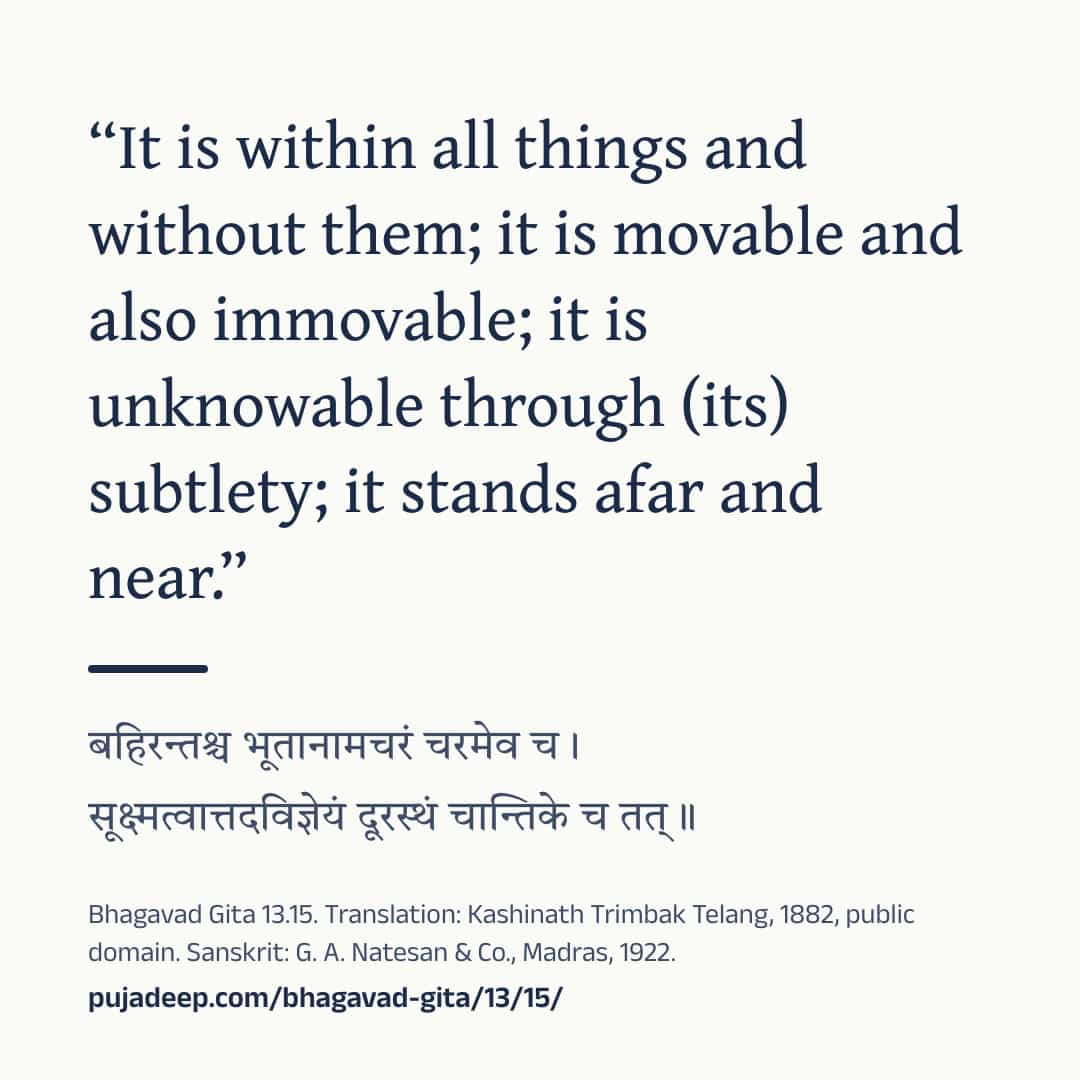
Drawing the picture
See the words
Bhagavad Gita 13.15

बहिरन्तश्च भूतानामचरं चरमेव च ।
सूक्ष्मत्वात्तदविज्ञेयं दूरस्थं चान्तिके च तत् ॥

“It is within all things and without them; it is movable and also immovable; it is unknowable through (its) subtlety; it stands afar and near.”
(K. T. Telang, The Bhagavadgîtâ (The Sacred Books of the East, vol. VIII, Oxford: Clarendon Press, 1882), p. 104, public domain)

“Without and within all beings, immovable and also movable; from His subtlety indistinguishable; at hand and far away is THAT.”
(Annie Besant, The Bhagavad Gîtâ, or The Lord's Song (London: Theosophical Publishing Society, 1895), pp. 124–125, public domain)

“Without and within (all) beings; the unmoving and also the moving; because subtle, It is incomprehensible; and It is far and near.”
(Swami Swarupananda, Srimad-Bhagavad-Gita (Mayavati: Prabuddha Bharata Press, 1909; first printed in Prabuddha Bharata, 1907–1909), p. 260, public domain)

Sanskrit: G. A. Natesan & Co., Madras, 1922.
https://pujadeep.com/bhagavad-gita/13/15/ Nothing is sent from this site. Your own app sends it, to the chat you choose. The picture quotes the translation you chose on this page, with its name and year.
Sanskrit text: The Bhagavad-Gita, or The Lord's Song, with the text in Devanagari and an English translation, 1922. Meanings: written for Pujadeep and checked against the cited edition. Source and changes
Questions families ask
Who speaks Bhagavad Gita 13.15?
Krishna speaks this verse, in chapter 13 (Kshetra Kshetrajna Vibhaga Yoga).
Where does the Sanskrit text come from?
Sanskrit text: The Bhagavad-Gita, or The Lord's Song, with the text in Devanagari and an English translation, 1922. Meanings: written for Pujadeep and checked against the cited edition. See the source
Is the meaning on this page a translation?
Explanation written for this site from the sources listed here, and checked against the cited edition. It is not a translation and not the only way to read the text. Free to quote with credit.
Source and licence
- Sanskrit text
- The Bhagavad-Gita, or The Lord's Song, with the text in Devanagari and an English translation (Annie Besant, G. A. Natesan & Co., Madras, 1922). Public domain. The Sanskrit on these pages was read from this printing’s page images.
- Translation
- The Bhagavadgîtâ with the Sanatsugâtîya and the Anugîtâ, translated by Kâshinâth Trimbak Telang (The Sacred Books of the East, vol. VIII, ed. F. Max Müller) (Kashinath Trimbak Telang, F. Max Müller, Clarendon Press, Oxford, 1882). Public domain. Shown verbatim, as printed.
- Translation
- The Bhagavad Gîtâ, or The Lord's Song, translated by Annie Besant (Annie Besant, Theosophical Publishing Society, London, 1895). Public domain. Shown verbatim, as printed.
- Translation
- Srimad-Bhagavad-Gita, with Sanskrit Text; Paraphrase with Word-by-word Literal Translation; English Rendering and Comments, Index, &c., by the Swami Swarupananda (Himalayan Series, No. XX) (Swami Swarupananda, The Editors and Publishers, Advaita Ashrama, Mayavati, Prabuddha Bharata Press, Mayavati, Almora, Himalayas, 1909). Public domain. Shown verbatim, as printed.
- Common wording
- In this text, 32 words follow today's common wording, checked against sanskritdocuments.org; Sanskrit Wikisource; Gita Press, Gorakhpur; GRETIL, Göttingen and Bhaktivedanta Book Trust.
- Our explanation
- Explanation written for this site from the sources listed here, and checked against the cited edition. It is not a translation and not the only way to read the text. Free to quote with credit.
- Checked
- Checked against the cited edition, October 15, 2026.
- Updated
- October 25, 2026