Bhagavad Gita 13.16: meaning and translation
Chapter 13: Kshetra Kshetrajna Vibhaga Yoga. Krishna says
Krishna says it is undivided, yet it seems to stand divided among beings.
Click or tap a word for its meaning and its dictionary page.
Text and layers
Text and layers
These choices stay in this browser.
Bhagavad Gita 13.16
अविभक्तं च भूतेषु विभक्तमिव च स्थितम् ।भूतभर्तृ च तज्ज्ञेयं ग्रसिष्णु प्रभविष्णु च ॥
Avibhaktam cha bhuteshu vibhaktamiva cha sthitamBhutabhartri cha tajjneyam grasishnu prabhavishnu cha
avibhaktaṃ ca bhūteṣu vibhaktamiva ca sthitam |bhūtabhartṛ ca tajjñeyaṃ grasiṣṇu prabhaviṣṇu ca ||
Our explanation Krishna says it is undivided, yet it seems to stand divided among beings. It is to be known as the one who sustains beings, who takes them back into itself and who brings them forth.
हिंदी अर्थ कृष्ण कहते हैं कि वह अविभाजित है, फिर भी प्राणियों में बँटा हुआ-सा दिखता है। उसे प्राणियों का भरण करने वाला, उन्हें अपने में लीन करने वाला और उन्हें उत्पन्न करने वाला जानना चाहिए।
Word by word
Every word, with its dictionary page
Word by word
- अविभक्तम् avibhaktam · undivided (adjective (neuter), nominative singular) Dictionary: a-vibhakta, Monier-Williams 1899, p. 109, col. 2 “undivided”
- च ca · and (indeclinable) Dictionary: 2. ca, Monier-Williams 1899, p. 380, col. 1 “and, both, also, moreover, as well as”
- भूतेषु bhūteṣu · among beings (noun (neuter), locative plural) Dictionary: bhūta, Monier-Williams 1899, p. 761, col. 3 “that which is or exists, any living being”
- विभक्तम् vibhaktam · divided (past participle (neuter), nominative singular) Dictionary: vi-bhakta, Monier-Williams 1899, p. 977, col. 2 “divided, distributed among”
- इव iva · as if (indeclinable) Dictionary: iva, Monier-Williams 1899, p. 168, col. 3 “like, in the same manner as”
- च ca · and (indeclinable) Dictionary: 2. ca, Monier-Williams 1899, p. 380, col. 1 “and, both, also, moreover, as well as”
- स्थितम् sthitam · standing (past participle (neuter), nominative singular) Dictionary: sthita, Monier-Williams 1899, p. 1264, col. 1 “standing, staying, situated, resting or abiding or remaining in”
- भूतभर्तृ bhūtabhartṛ · sustainer of beings (compound (neuter), nominative singular) Dictionary: bhūta, Monier-Williams 1899, p. 761, col. 3 “that which is or exists, any living being”; bhartṛ, Monier-Williams 1899, p. 748, col. 1 “a preserver, protector, maintainer, chief, lord, master”
- च ca · and (indeclinable) Dictionary: 2. ca, Monier-Williams 1899, p. 380, col. 1 “and, both, also, moreover, as well as”
- तत् tat · that (pronoun (neuter), nominative singular) Dictionary: tad, Monier-Williams 1899, p. 434, col. 1 “m. he, f. she, n. it, that, this”
- ज्ञेयम् jñeyam · what is to be known (gerundive (to be done) (neuter), nominative singular) Dictionary: jñeya, Monier-Williams 1899, p. 426, col. 2 “to be known”
- ग्रसिष्णु grasiṣṇu · who takes them back (adjective (neuter), nominative singular) Dictionary: grasiṣṇu, Monier-Williams 1899, p. 371, col. 2 “accustomed to swallow or absorb”
- प्रभविष्णु prabhaviṣṇu · who brings them forth (adjective (neuter), nominative singular) Dictionary: pra-bhaviṣṇu, Monier-Williams 1899, p. 684, col. 2; pra-bhavitṛ, Monier-Williams 1899, p. 684, col. 2 “powerful, potent”
- च ca · and (indeclinable) Dictionary: 2. ca, Monier-Williams 1899, p. 380, col. 1 “and, both, also, moreover, as well as”
Old translations
Kashinath Trimbak Telang, 1882. Public domain. Page 104.
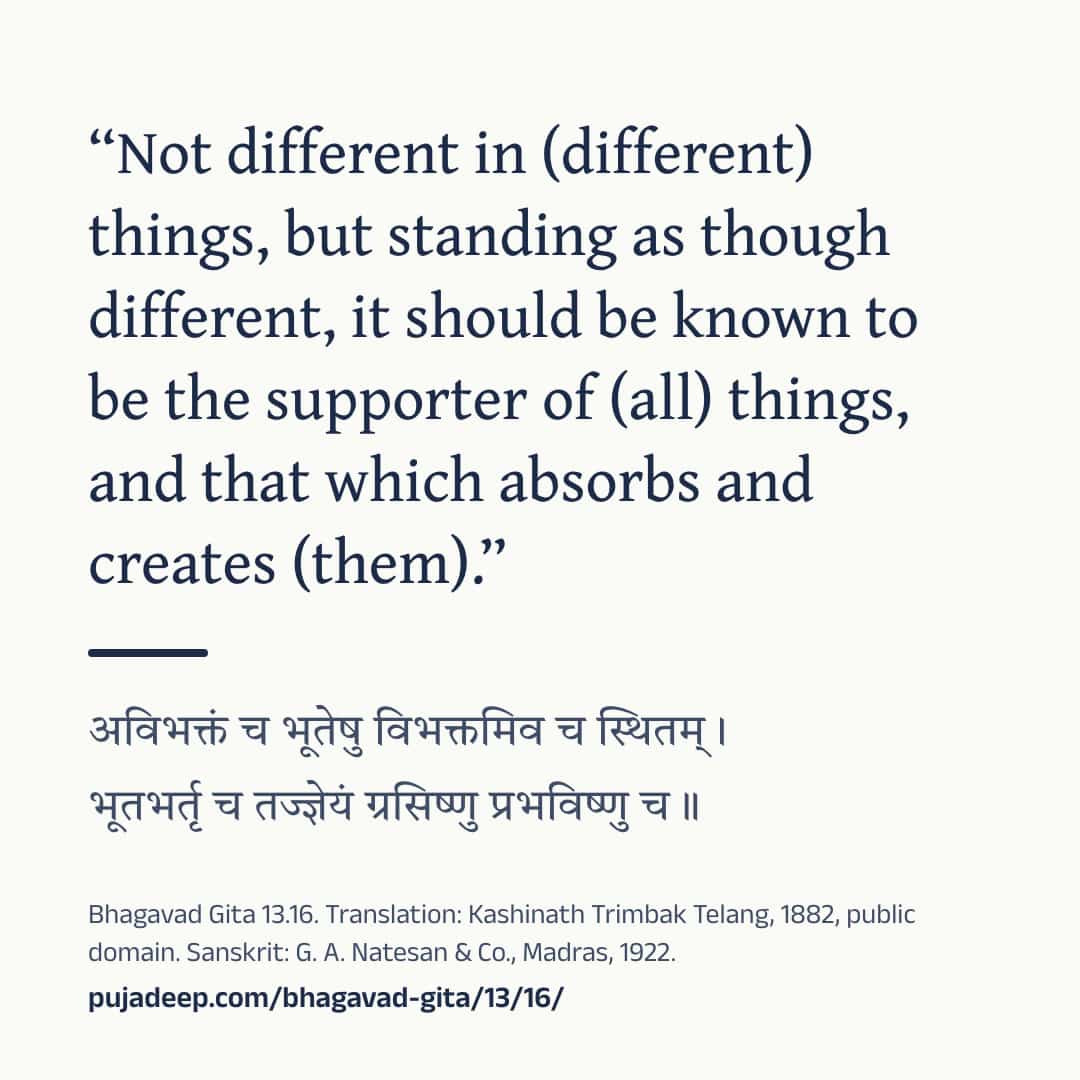
Not different in (different) things1, but standing as though different, it should be known to be the supporter of (all) things, and that which absorbs and creates (them).
Footnotes (the translator’s own) - Everything being really one. Cf. inter alia, p. 124 infra. The various manifestations of the Brahman are really one in essence, though apparently different, like foam and water. ↩
Compare 3 translations
Kashinath Trimbak Telang, 1882. Public domain. Page 104.
Not different in (different) things1, but standing as though different, it should be known to be the supporter of (all) things, and that which absorbs and creates (them).
Footnotes (the translator’s own) - Everything being really one. Cf. inter alia, p. 124 infra. The various manifestations of the Brahman are really one in essence, though apparently different, like foam and water. ↩
You are reading this one
Annie Besant, 1895. Public domain. Page 125.
Not divided amid beings, and yet seated distributively; THAT is to be known as the Supporter of beings; He devours and He generates.
You are reading this one
Swami Swarupananda, 1909 (first printed 1907). Public domain. Page 260.
Impartible, yet It exists as if divided in beings: It is to be known as sustaining beings; (and) devouring, as well as generating (them).
You are reading this one
Cite this verse
The translation: K. T. Telang, The Bhagavadgîtâ (The Sacred Books of the East, vol. VIII, Oxford: Clarendon Press, 1882), p. 104. Bhagavad Gita 13.16.
The translation: Annie Besant, The Bhagavad Gîtâ, or The Lord's Song (London: Theosophical Publishing Society, 1895), p. 125. Bhagavad Gita 13.16.
The translation: Swami Swarupananda, Srimad-Bhagavad-Gita (Mayavati: Prabuddha Bharata Press, 1909; first printed in Prabuddha Bharata, 1907–1909), p. 260. Bhagavad Gita 13.16.
Our explanation: “Bhagavad Gita 13.16: meaning and translation.” Pujadeep. Updated October 25, 2026. https://pujadeep.com/bhagavad-gita/13/16/
Pujadeep’s explanations are free to quote with credit: name Pujadeep and link to the page. How to credit
Classical readings, by school
No readings by school on this verse yet.
Share
Show the ways to share
Send one picture or the text to one chat. The picture names its source and the address of this page.
Drawing the picture
See the words
Bhagavad Gita 13.16

अविभक्तं च भूतेषु विभक्तमिव च स्थितम् ।
भूतभर्तृ च तज्ज्ञेयं ग्रसिष्णु प्रभविष्णु च ॥

“Not different in (different) things, but standing as though different, it should be known to be the supporter of (all) things, and that which absorbs and creates (them).”
(K. T. Telang, The Bhagavadgîtâ (The Sacred Books of the East, vol. VIII, Oxford: Clarendon Press, 1882), p. 104, public domain)

“Not divided amid beings, and yet seated distributively; THAT is to be known as the Supporter of beings; He devours and He generates.”
(Annie Besant, The Bhagavad Gîtâ, or The Lord's Song (London: Theosophical Publishing Society, 1895), p. 125, public domain)

“Impartible, yet It exists as if divided in beings: It is to be known as sustaining beings; (and) devouring, as well as generating (them).”
(Swami Swarupananda, Srimad-Bhagavad-Gita (Mayavati: Prabuddha Bharata Press, 1909; first printed in Prabuddha Bharata, 1907–1909), p. 260, public domain)

Sanskrit: G. A. Natesan & Co., Madras, 1922.
https://pujadeep.com/bhagavad-gita/13/16/ Nothing is sent from this site. Your own app sends it, to the chat you choose. The picture quotes the translation you chose on this page, with its name and year.
Sanskrit text: The Bhagavad-Gita, or The Lord's Song, with the text in Devanagari and an English translation, 1922. Meanings: written for Pujadeep and checked against the cited edition. Source and changes
Questions families ask
Who speaks Bhagavad Gita 13.16?
Krishna speaks this verse, in chapter 13 (Kshetra Kshetrajna Vibhaga Yoga).
Where does the Sanskrit text come from?
Sanskrit text: The Bhagavad-Gita, or The Lord's Song, with the text in Devanagari and an English translation, 1922. Meanings: written for Pujadeep and checked against the cited edition. See the source
Is the meaning on this page a translation?
Explanation written for this site from the sources listed here, and checked against the cited edition. It is not a translation and not the only way to read the text. Free to quote with credit.
Source and licence
- Sanskrit text
- The Bhagavad-Gita, or The Lord's Song, with the text in Devanagari and an English translation (Annie Besant, G. A. Natesan & Co., Madras, 1922). Public domain. The Sanskrit on these pages was read from this printing’s page images.
- Translation
- The Bhagavadgîtâ with the Sanatsugâtîya and the Anugîtâ, translated by Kâshinâth Trimbak Telang (The Sacred Books of the East, vol. VIII, ed. F. Max Müller) (Kashinath Trimbak Telang, F. Max Müller, Clarendon Press, Oxford, 1882). Public domain. Shown verbatim, as printed.
- Translation
- The Bhagavad Gîtâ, or The Lord's Song, translated by Annie Besant (Annie Besant, Theosophical Publishing Society, London, 1895). Public domain. Shown verbatim, as printed.
- Translation
- Srimad-Bhagavad-Gita, with Sanskrit Text; Paraphrase with Word-by-word Literal Translation; English Rendering and Comments, Index, &c., by the Swami Swarupananda (Himalayan Series, No. XX) (Swami Swarupananda, The Editors and Publishers, Advaita Ashrama, Mayavati, Prabuddha Bharata Press, Mayavati, Almora, Himalayas, 1909). Public domain. Shown verbatim, as printed.
- Common wording
- In this text, 32 words follow today's common wording, checked against sanskritdocuments.org; Sanskrit Wikisource; Gita Press, Gorakhpur; GRETIL, Göttingen and Bhaktivedanta Book Trust.
- Our explanation
- Explanation written for this site from the sources listed here, and checked against the cited edition. It is not a translation and not the only way to read the text. Free to quote with credit.
- Checked
- Checked against the cited edition, October 15, 2026.
- Updated
- October 25, 2026