Bhagavad Gita 13.30: meaning and translation
Chapter 13: Kshetra Kshetrajna Vibhaga Yoga. Krishna says
Krishna says that when a person sees the separate existence of beings as resting in the One, and their spreading out as coming from it, then that person attains Brahman.
Click or tap a word for its meaning and its dictionary page.
Text and layers
Text and layers
These choices stay in this browser.
Bhagavad Gita 13.30
यदा भूतपृथग्भावमेकस्थमनुपश्यति ।तत एव च विस्तारं ब्रह्म संपद्यते तदा ॥
Yada bhutaprithagbhavamekasthamanupashyatiTata eva cha vistaram brahma sampadyate tada
yadā bhūtapṛthagbhāvamekasthamanupaśyati |tata eva ca vistāraṃ brahma saṃpadyate tadā ||
Our explanation Krishna says that when a person sees the separate existence of beings as resting in the One, and their spreading out as coming from it, then that person attains Brahman.
हिंदी अर्थ कृष्ण कहते हैं कि जब व्यक्ति प्राणियों के अलग-अलग अस्तित्व को एक में स्थित देखता है, और उनके विस्तार को उसी से होता देखता है, तब वह ब्रह्म को प्राप्त होता है।
Word by word
Every word, with its dictionary page
Word by word
- यदा yadā · when (indeclinable) Dictionary: yadā, Monier-Williams 1899, p. 844, col. 1 “when, at what time, whenever”
- भूतपृथग्भावम् bhūtapṛthagbhāvam · the separate existence of beings (compound (masculine), accusative singular) Dictionary: bhūta, Monier-Williams 1899, p. 761, col. 3 “that which is or exists, any living being”; pṛthag-bhāva, Monier-Williams 1899, p. 646, col. 1 “separate state or condition, difference, distinctness, individuality”
- एकस्थम् ekastham · resting in the One (compound (masculine), accusative singular) Dictionary: eka-stha, Monier-Williams 1899, p. 229, col. 3 “standing together, remaining in the same place”
- अनुपश्यति anupaśyati · sees (present, 3rd person singular) Dictionary: anu-paś, Monier-Williams 1899, p. 35, col. 1 “to look at, perceive, notice, discover”
- ततः tataḥ · from it (indeclinable) Dictionary: tatas, Monier-Williams 1899, p. 432, col. 2 “thereupon, then, after that, afterwards”
- एव eva · also (indeclinable) Dictionary: 1. eva, Monier-Williams 1899, p. 232, col. 2 “just, exactly, very, same, only, even, alone, merely”
- च ca · and (indeclinable) Dictionary: 2. ca, Monier-Williams 1899, p. 380, col. 1 “and, both, also, moreover, as well as”
- विस्तारम् vistāram · the spreading out (noun (masculine), accusative singular) Dictionary: vi-stāra, Monier-Williams 1899, p. 1001, col. 3 “spreading, expansion, extent, width”
- ब्रह्म brahma · Brahman (noun (neuter), accusative singular) Dictionary: brahman, Monier-Williams 1899, p. 738, col. 1 “one self-existent impersonal Spirit, the one universal Soul”
- संपद्यते saṃpadyate · attains (present (middle), 3rd person singular) Dictionary: sam-pad, Monier-Williams 1899, p. 1171, col. 3 “to fall together, meet or unite with, obtain, get into”
- तदा tadā · then (indeclinable) Dictionary: tadā, Monier-Williams 1899, p. 434, col. 3 “at that time, then, in that case”
1 printing differs
Edition differences. Another printing or text reads this place differently.
- Spelling A digital text reads Same word. The e-text writes the class nasal (सम्पद्यते); the 1922 edition writes anusvara (संपद्यते).
Old translations
Kashinath Trimbak Telang, 1882. Public domain. Page 106.
When a man sees all the variety of entities as existing in one1, and (all as) emanating from that, then he becomes (one with) the Brahman.
Footnotes (the translator’s own) - I. e. absorbed at the time of the deluge in nature, one of the energies of the supreme; 'emanating,' i. e. at the time of creation. ↩
Compare 3 translations
Kashinath Trimbak Telang, 1882. Public domain. Page 106.
When a man sees all the variety of entities as existing in one1, and (all as) emanating from that, then he becomes (one with) the Brahman.
Footnotes (the translator’s own) - I. e. absorbed at the time of the deluge in nature, one of the energies of the supreme; 'emanating,' i. e. at the time of creation. ↩
You are reading this one
Annie Besant, 1895. Public domain. Page 127.
When he perceiveth that the varied natures of beings are rooted in One, and proceed from it, then he reacheth Brahman.
You are reading this one
Swami Swarupananda, 1909 (first printed 1907). Public domain. Page 267.
When he sees the separate existence of all beings inherent in the One, and their expansion from That (One) alone, he then becomes Brahman.
You are reading this one
Cite this verse
The translation: K. T. Telang, The Bhagavadgîtâ (The Sacred Books of the East, vol. VIII, Oxford: Clarendon Press, 1882), p. 106. Bhagavad Gita 13.30.
The translation: Annie Besant, The Bhagavad Gîtâ, or The Lord's Song (London: Theosophical Publishing Society, 1895), p. 127. Bhagavad Gita 13.30.
The translation: Swami Swarupananda, Srimad-Bhagavad-Gita (Mayavati: Prabuddha Bharata Press, 1909; first printed in Prabuddha Bharata, 1907–1909), p. 267. Bhagavad Gita 13.30.
Our explanation: “Bhagavad Gita 13.30: meaning and translation.” Pujadeep. Updated October 25, 2026. https://pujadeep.com/bhagavad-gita/13/30/
Pujadeep’s explanations are free to quote with credit: name Pujadeep and link to the page. How to credit
Classical readings, by school
No readings by school on this verse yet.
Share
Show the ways to share
Send one picture or the text to one chat. The picture names its source and the address of this page.
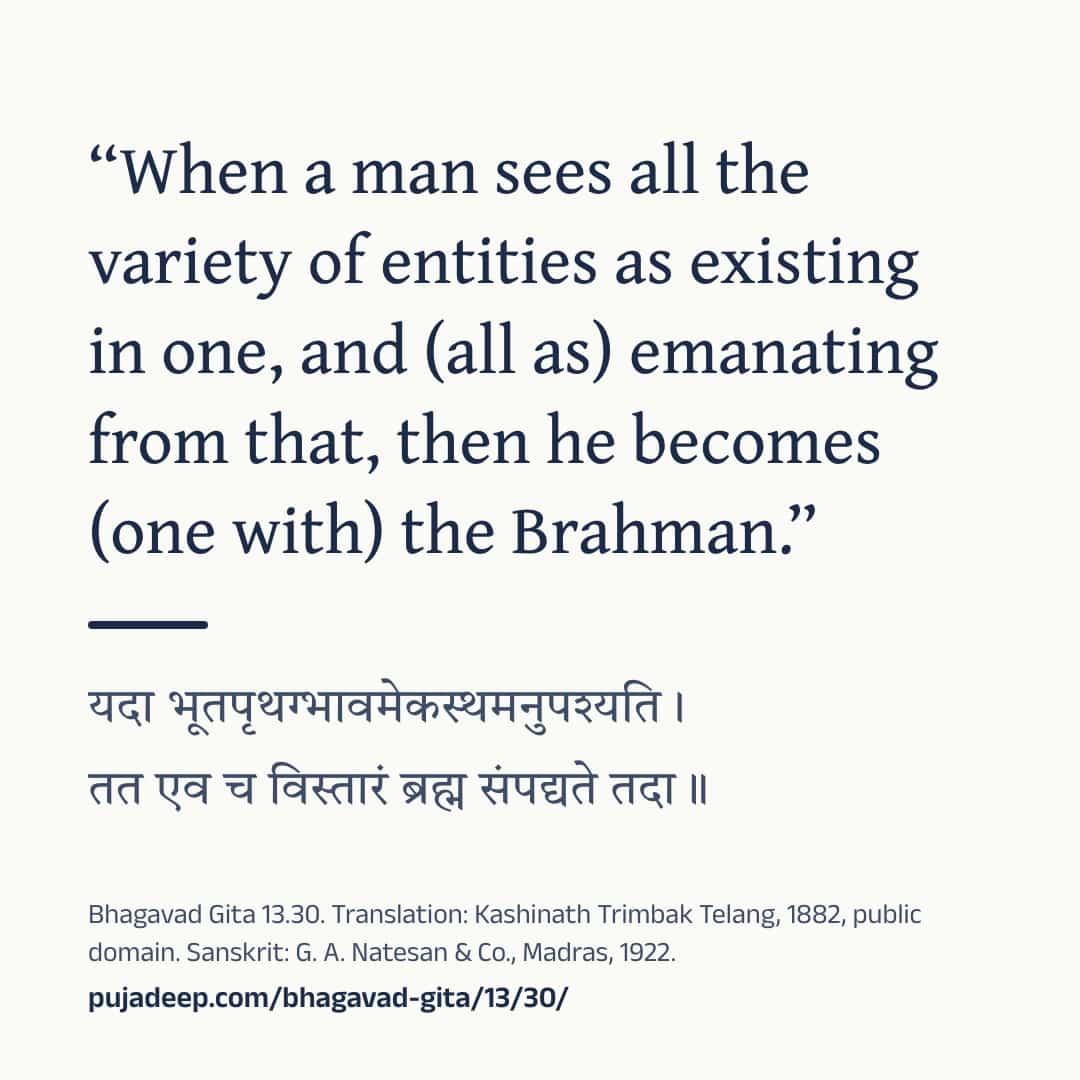
Drawing the picture
See the words
Bhagavad Gita 13.30

यदा भूतपृथग्भावमेकस्थमनुपश्यति ।
तत एव च विस्तारं ब्रह्म संपद्यते तदा ॥

“When a man sees all the variety of entities as existing in one, and (all as) emanating from that, then he becomes (one with) the Brahman.”
(K. T. Telang, The Bhagavadgîtâ (The Sacred Books of the East, vol. VIII, Oxford: Clarendon Press, 1882), p. 106, public domain)

“When he perceiveth that the varied natures of beings are rooted in One, and proceed from it, then he reacheth Brahman.”
(Annie Besant, The Bhagavad Gîtâ, or The Lord's Song (London: Theosophical Publishing Society, 1895), p. 127, public domain)

“When he sees the separate existence of all beings inherent in the One, and their expansion from That (One) alone, he then becomes Brahman.”
(Swami Swarupananda, Srimad-Bhagavad-Gita (Mayavati: Prabuddha Bharata Press, 1909; first printed in Prabuddha Bharata, 1907–1909), p. 267, public domain)

Sanskrit: G. A. Natesan & Co., Madras, 1922.
https://pujadeep.com/bhagavad-gita/13/30/ Nothing is sent from this site. Your own app sends it, to the chat you choose. The picture quotes the translation you chose on this page, with its name and year.
Sanskrit text: The Bhagavad-Gita, or The Lord's Song, with the text in Devanagari and an English translation, 1922. Meanings: written for Pujadeep and checked against the cited edition. Source and changes
Questions families ask
Who speaks Bhagavad Gita 13.30?
Krishna speaks this verse, in chapter 13 (Kshetra Kshetrajna Vibhaga Yoga).
Where does the Sanskrit text come from?
Sanskrit text: The Bhagavad-Gita, or The Lord's Song, with the text in Devanagari and an English translation, 1922. Meanings: written for Pujadeep and checked against the cited edition. See the source
Is the meaning on this page a translation?
Explanation written for this site from the sources listed here, and checked against the cited edition. It is not a translation and not the only way to read the text. Free to quote with credit.
Source and licence
- Sanskrit text
- The Bhagavad-Gita, or The Lord's Song, with the text in Devanagari and an English translation (Annie Besant, G. A. Natesan & Co., Madras, 1922). Public domain. The Sanskrit on these pages was read from this printing’s page images.
- Translation
- The Bhagavadgîtâ with the Sanatsugâtîya and the Anugîtâ, translated by Kâshinâth Trimbak Telang (The Sacred Books of the East, vol. VIII, ed. F. Max Müller) (Kashinath Trimbak Telang, F. Max Müller, Clarendon Press, Oxford, 1882). Public domain. Shown verbatim, as printed.
- Translation
- The Bhagavad Gîtâ, or The Lord's Song, translated by Annie Besant (Annie Besant, Theosophical Publishing Society, London, 1895). Public domain. Shown verbatim, as printed.
- Translation
- Srimad-Bhagavad-Gita, with Sanskrit Text; Paraphrase with Word-by-word Literal Translation; English Rendering and Comments, Index, &c., by the Swami Swarupananda (Himalayan Series, No. XX) (Swami Swarupananda, The Editors and Publishers, Advaita Ashrama, Mayavati, Prabuddha Bharata Press, Mayavati, Almora, Himalayas, 1909). Public domain. Shown verbatim, as printed.
- Common wording
- In this text, 32 words follow today's common wording, checked against sanskritdocuments.org; Sanskrit Wikisource; Gita Press, Gorakhpur; GRETIL, Göttingen and Bhaktivedanta Book Trust.
- Our explanation
- Explanation written for this site from the sources listed here, and checked against the cited edition. It is not a translation and not the only way to read the text. Free to quote with credit.
- Checked
- Checked against the cited edition, October 15, 2026.
- Updated
- October 25, 2026