Bhagavad Gita 13.31: meaning and translation
Chapter 13: Kshetra Kshetrajna Vibhaga Yoga. Krishna says
Krishna says that this imperishable supreme self, being without beginning and without qualities, neither acts nor is stained, even though it dwells in the body.
Click or tap a word for its meaning and its dictionary page.
Text and layers
Text and layers
These choices stay in this browser.
Bhagavad Gita 13.31
अनादित्वान्निर्गुणत्वात्परमात्माऽयमव्ययः ।शरीरस्थोऽपि कौन्तेय न करोति न लिप्यते ॥
AnaditvannirgunatvatparamatmayamavyayahSharirasthopi kaunteya na karoti na lipyate
anāditvānnirguṇatvātparamātmā’yamavyayaḥ |śarīrastho’pi kaunteya na karoti na lipyate ||
Our explanation Krishna says that this imperishable supreme self, being without beginning and without qualities, neither acts nor is stained, even though it dwells in the body. He calls Arjuna Kaunteya, son of Kunti.
हिंदी अर्थ कृष्ण कहते हैं कि यह अविनाशी परमात्मा अनादि और गुणों से रहित होने के कारण, शरीर में रहते हुए भी, न कर्म करता है न लिप्त होता है। वे अर्जुन को कौन्तेय (कुंती के पुत्र) कहकर पुकारते हैं।
Word by word
Every word, with its dictionary page
Word by word
- अनादित्वात् anāditvāt · being without beginning (noun (neuter), ablative singular) Dictionary: an-ādi-tva, Monier-Williams 1899, p. 28, col. 1 “state of having no beginning”
- निर्गुणत्वात् nirguṇatvāt · being without qualities (noun (neuter), ablative singular) Dictionary: nir-guṇa, Monier-Williams 1899, p. 541, col. 1 “devoid of all qualities or properties”
- परमात्मा paramātmā · the supreme self (noun (masculine), nominative singular) Dictionary: paramātman, Monier-Williams 1899, p. 588, col. 2 “the Supreme Spirit”
- अयम् ayam · this (pronoun (masculine), nominative singular) Dictionary: 1. idam, Monier-Williams 1899, p. 165, col. 2 “this, this here, referring to something near the speaker”
- अव्ययः avyayaḥ · imperishable (adjective (masculine), nominative singular) Dictionary: 2. a-vyaya, Monier-Williams 1899, p. 111, col. 3 “not liable to change, imperishable, undecaying”
- शरीरस्थः śarīrasthaḥ · dwelling in the body (compound (masculine), nominative singular) Dictionary: śarīra-stha, Monier-Williams 1899, p. 1058, col. 1 “existing in the b°”
- अपि api · even though (indeclinable) Dictionary: api, Monier-Williams 1899, p. 55, col. 1 “in the sense of even, also, very”
- कौन्तेय kaunteya · O son of Kunti (noun (masculine), vocative singular) Dictionary: kaunteya, Monier-Williams 1899, p. 316, col. 2 “metron. fr. Kuntī”
- न na · not (indeclinable) Dictionary: 2. na, Monier-Williams 1899, p. 523, col. 1 “ind. not, no, nor, neither”
- करोति karoti · acts (present, 3rd person singular) Dictionary: 1. kṛ, Monier-Williams 1899, p. 301, col. 1 “to do, make, perform, accomplish, cause, effect”
- न na · not (indeclinable) Dictionary: 2. na, Monier-Williams 1899, p. 523, col. 1 “ind. not, no, nor, neither”
- लिप्यते lipyate · is stained (present passive, 3rd person singular) Dictionary: lip, Monier-Williams 1899, p. 902, col. 2 “to smear or anoint anything”
1 printing differs
Edition differences. Another printing or text reads this place differently.
- Spelling A digital text reads Same words. The 1922 edition marks the merged vowel with avagraha (परमात्माऽयम्); the e-text writes परमात्मायम्, as another digital text does.
Old translations
Kashinath Trimbak Telang, 1882. Public domain. Page 106.
This inexhaustible supreme self, being without beginning and without qualities, does not act, and is not tainted, O son of Kuntî! though stationed in the body.
Compare 3 translations
Kashinath Trimbak Telang, 1882. Public domain. Page 106.
This inexhaustible supreme self, being without beginning and without qualities, does not act, and is not tainted, O son of Kuntî! though stationed in the body.
You are reading this one
Annie Besant, 1895. Public domain. Page 127.
Beginningless, without qualities, the Supreme SELF, imperishable, though seated in the body, O Kaunteya, worketh not nor is soiled.
You are reading this one
Swami Swarupananda, 1909 (first printed 1907). Public domain. Page 268.
Being without beginning, and devoid of Gunas, this Supreme Self, immutable, O son of Kunti, though existing in the body neither acts, nor is affected.
You are reading this one
Cite this verse
The translation: K. T. Telang, The Bhagavadgîtâ (The Sacred Books of the East, vol. VIII, Oxford: Clarendon Press, 1882), p. 106. Bhagavad Gita 13.31.
The translation: Annie Besant, The Bhagavad Gîtâ, or The Lord's Song (London: Theosophical Publishing Society, 1895), p. 127. Bhagavad Gita 13.31.
The translation: Swami Swarupananda, Srimad-Bhagavad-Gita (Mayavati: Prabuddha Bharata Press, 1909; first printed in Prabuddha Bharata, 1907–1909), p. 268. Bhagavad Gita 13.31.
Our explanation: “Bhagavad Gita 13.31: meaning and translation.” Pujadeep. Updated October 25, 2026. https://pujadeep.com/bhagavad-gita/13/31/
Pujadeep’s explanations are free to quote with credit: name Pujadeep and link to the page. How to credit
Classical readings, by school
No readings by school on this verse yet.
Share
Show the ways to share
Send one picture or the text to one chat. The picture names its source and the address of this page.
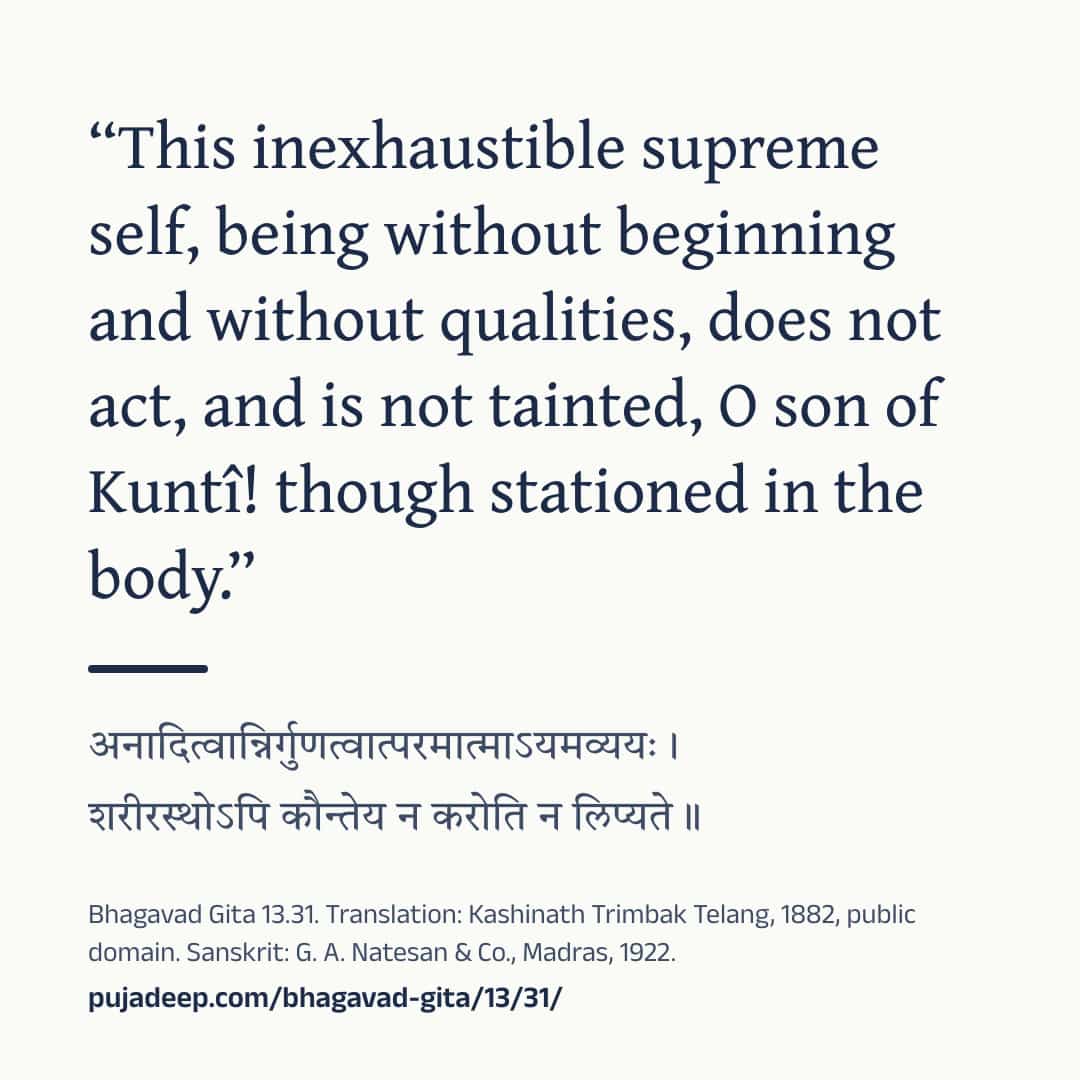
Drawing the picture
See the words
Bhagavad Gita 13.31

अनादित्वान्निर्गुणत्वात्परमात्माऽयमव्ययः ।
शरीरस्थोऽपि कौन्तेय न करोति न लिप्यते ॥

“This inexhaustible supreme self, being without beginning and without qualities, does not act, and is not tainted, O son of Kuntî! though stationed in the body.”
(K. T. Telang, The Bhagavadgîtâ (The Sacred Books of the East, vol. VIII, Oxford: Clarendon Press, 1882), p. 106, public domain)

“Beginningless, without qualities, the Supreme SELF, imperishable, though seated in the body, O Kaunteya, worketh not nor is soiled.”
(Annie Besant, The Bhagavad Gîtâ, or The Lord's Song (London: Theosophical Publishing Society, 1895), p. 127, public domain)

“Being without beginning, and devoid of Gunas, this Supreme Self, immutable, O son of Kunti, though existing in the body neither acts, nor is affected.”
(Swami Swarupananda, Srimad-Bhagavad-Gita (Mayavati: Prabuddha Bharata Press, 1909; first printed in Prabuddha Bharata, 1907–1909), p. 268, public domain)

Sanskrit: G. A. Natesan & Co., Madras, 1922.
https://pujadeep.com/bhagavad-gita/13/31/ Nothing is sent from this site. Your own app sends it, to the chat you choose. The picture quotes the translation you chose on this page, with its name and year.
Sanskrit text: The Bhagavad-Gita, or The Lord's Song, with the text in Devanagari and an English translation, 1922. Meanings: written for Pujadeep and checked against the cited edition. Source and changes
Questions families ask
Who speaks Bhagavad Gita 13.31?
Krishna speaks this verse, in chapter 13 (Kshetra Kshetrajna Vibhaga Yoga).
Where does the Sanskrit text come from?
Sanskrit text: The Bhagavad-Gita, or The Lord's Song, with the text in Devanagari and an English translation, 1922. Meanings: written for Pujadeep and checked against the cited edition. See the source
Is the meaning on this page a translation?
Explanation written for this site from the sources listed here, and checked against the cited edition. It is not a translation and not the only way to read the text. Free to quote with credit.
Source and licence
- Sanskrit text
- The Bhagavad-Gita, or The Lord's Song, with the text in Devanagari and an English translation (Annie Besant, G. A. Natesan & Co., Madras, 1922). Public domain. The Sanskrit on these pages was read from this printing’s page images.
- Translation
- The Bhagavadgîtâ with the Sanatsugâtîya and the Anugîtâ, translated by Kâshinâth Trimbak Telang (The Sacred Books of the East, vol. VIII, ed. F. Max Müller) (Kashinath Trimbak Telang, F. Max Müller, Clarendon Press, Oxford, 1882). Public domain. Shown verbatim, as printed.
- Translation
- The Bhagavad Gîtâ, or The Lord's Song, translated by Annie Besant (Annie Besant, Theosophical Publishing Society, London, 1895). Public domain. Shown verbatim, as printed.
- Translation
- Srimad-Bhagavad-Gita, with Sanskrit Text; Paraphrase with Word-by-word Literal Translation; English Rendering and Comments, Index, &c., by the Swami Swarupananda (Himalayan Series, No. XX) (Swami Swarupananda, The Editors and Publishers, Advaita Ashrama, Mayavati, Prabuddha Bharata Press, Mayavati, Almora, Himalayas, 1909). Public domain. Shown verbatim, as printed.
- Common wording
- In this text, 32 words follow today's common wording, checked against sanskritdocuments.org; Sanskrit Wikisource; Gita Press, Gorakhpur; GRETIL, Göttingen and Bhaktivedanta Book Trust.
- Our explanation
- Explanation written for this site from the sources listed here, and checked against the cited edition. It is not a translation and not the only way to read the text. Free to quote with credit.
- Checked
- Checked against the cited edition, October 15, 2026.
- Updated
- October 25, 2026