Bhagavad Gita 13.21: meaning and translation
Chapter 13: Kshetra Kshetrajna Vibhaga Yoga. Krishna says
Krishna says that the spirit, seated in nature, experiences the qualities born of nature.
Click or tap a word for its meaning and its dictionary page.
Text and layers
Text and layers
These choices stay in this browser.
Bhagavad Gita 13.21
पुरुषः प्रकृतिस्थो हि भुङ्क्ते प्रकृतिजान्गुणान् ।कारणं गुणसङ्गोऽस्य सदसद्योनिजन्मसु ॥
Purushah prakritistho hi bhunkte prakritijangunanKaranam gunasangosya sadasadyonijanmasu
puruṣaḥ prakṛtistho hi bhuṅkte prakṛtijānguṇān |kāraṇaṃ guṇasaṅgo’sya sadasadyonijanmasu ||
Our explanation Krishna says that the spirit, seated in nature, experiences the qualities born of nature. Its attachment to those qualities, he says, is the cause of its births in higher and lower forms of life.
हिंदी अर्थ कृष्ण कहते हैं कि प्रकृति में स्थित पुरुष प्रकृति से उत्पन्न गुणों का भोग (अनुभव) करता है। वे कहते हैं कि उन गुणों में उसकी आसक्ति ही ऊँची और नीची योनियों में उसके जन्म का कारण है।
Word by word
Every word, with its dictionary page
Word by word
- पुरुषः puruṣaḥ · spirit (puruṣa) (noun (masculine), nominative singular) Dictionary: puruṣa, Monier-Williams 1899, p. 637, col. 1 “the personal and animating principle in men and other beings, the soul or spirit”
- प्रकृतिस्थः prakṛtisthaḥ · seated in nature (compound (masculine), nominative singular) Dictionary: prakṛti-stha, Monier-Williams 1899, p. 654, col. 2 “inherent, innate, incidental to nature”
- हि hi · for (indeclinable) Dictionary: 2. hi, Monier-Williams 1899, p. 1297, col. 3 “for, because, on account of”
- भुङ्क्ते bhuṅkte · experiences (present (middle), 3rd person singular) Dictionary: 3. bhuj, Monier-Williams 1899, p. 759, col. 3 “to suffer, experience, undergo”
- प्रकृतिजान् prakṛtijān · born of nature (compound (masculine), accusative plural) Dictionary: prakṛti-ja, Monier-Williams 1899, p. 654, col. 1 “springing from nature, inborn, innate”
- गुणान् guṇān · the qualities (guṇas) (noun (masculine), accusative plural) Dictionary: guṇa, Monier-Williams 1899, p. 357, col. 1 “a quality, peculiarity, attribute or property”
- कारणम् kāraṇam · the cause (noun (neuter), nominative singular) Dictionary: 1. kāraṇa, Monier-Williams 1899, p. 274, col. 2 “cause, reason”
- गुणसङ्गः guṇasaṅgaḥ · attachment to the qualities (compound (masculine), nominative singular) Dictionary: guṇa, Monier-Williams 1899, p. 357, col. 1 “a quality, peculiarity, attribute or property”; saṅga, Monier-Williams 1899, p. 1132, col. 3 “(esp.) worldly or selfish attachment or affection, desire”
- अस्य asya · its (pronoun (masculine), genitive singular) Dictionary: 1. idam, Monier-Williams 1899, p. 165, col. 2 “this, this here, referring to something near the speaker”
- सदसद्योनिजन्मसु sadasadyonijanmasu · of births in higher and lower wombs (compound (neuter), locative plural) Dictionary: sad-asat, Monier-Williams 1899, p. 1137, col. 1 “good and bad”; yoni, Monier-Williams 1899, p. 858, col. 2 “the womb”; janman, Monier-Williams 1899, p. 411, col. 3 “birth, production”
Old translations
Kashinath Trimbak Telang, 1882. Public domain. Page 105.
For spirit with nature joined, enjoys the qualities born of nature. And the cause of its birth in good or evil wombs is the connexion with the qualities1.
Footnotes (the translator’s own) - I. e. 'the senses,' says Srîdhara; good=gods, &c.; evil=beasts, &c. ↩
Compare 3 translations
Kashinath Trimbak Telang, 1882. Public domain. Page 105.
For spirit with nature joined, enjoys the qualities born of nature. And the cause of its birth in good or evil wombs is the connexion with the qualities1.
Footnotes (the translator’s own) - I. e. 'the senses,' says Srîdhara; good=gods, &c.; evil=beasts, &c. ↩
You are reading this one
Annie Besant, 1895. Public domain. Page 125–126.
Purusha seated in Prakriti useth the qualities born of Prakriti; the attachment to the qualities is the cause of births in good and evil wombs.
You are reading this one
Swami Swarupananda, 1909 (first printed 1907). Public domain. Page 263.
Purusha seated in Prakriti, experiences the Gunas born of Prakriti; the reason of the birth in good and evil wombs is its attachment to the Gunas.
You are reading this one
Cite this verse
The translation: K. T. Telang, The Bhagavadgîtâ (The Sacred Books of the East, vol. VIII, Oxford: Clarendon Press, 1882), p. 105. Bhagavad Gita 13.21.
The translation: Annie Besant, The Bhagavad Gîtâ, or The Lord's Song (London: Theosophical Publishing Society, 1895), pp. 125–126. Bhagavad Gita 13.21.
The translation: Swami Swarupananda, Srimad-Bhagavad-Gita (Mayavati: Prabuddha Bharata Press, 1909; first printed in Prabuddha Bharata, 1907–1909), p. 263. Bhagavad Gita 13.21.
Our explanation: “Bhagavad Gita 13.21: meaning and translation.” Pujadeep. Updated October 25, 2026. https://pujadeep.com/bhagavad-gita/13/21/
Pujadeep’s explanations are free to quote with credit: name Pujadeep and link to the page. How to credit
Classical readings, by school
Each reading is named by its school. None is presented as the only meaning.
What Advaita, Vishishtadvaita and Dvaita teach, in short
Shankara Advaita
Shankara says the puruṣa is “seated in prakṛti” when, through ignorance, it takes the body and senses to be itself and thinks “I am happy, I am miserable”. Ignorance together with attachment to what it experiences is the cause of birth; knowledge with detachment and renunciation removes both.
Source: The Bhagavad-Gita, with the commentary of Sri Sankaracharya, translated by A. Mahadeva Sastri (2nd ed., Mysore: G. T. A. Printing Works, 1901), commentary on 13.21, pp. 320–321. Summarised in our own words; none of its text is reproduced.
Ramanuja Vishishtadvaita
Ramanuja says the soul is by its own nature fit for the bliss of the self, but, joined with matter, it experiences joys and griefs that come from the guṇas. Attached to them, it acts to get more of them and is born again to reap the fruits; this circling stops only when it cultivates the virtues of 13.7–11.
Source: Sri Bhagavad-Gita with Sri Ramanujacharya's Visishtadvaita commentary, translated by A. Govindacharya (Madras, 1898), commentary on 13.21, pp. 430–431. Summarised in our own words; none of its text is reproduced.
Share
Show the ways to share
Send one picture or the text to one chat. The picture names its source and the address of this page.
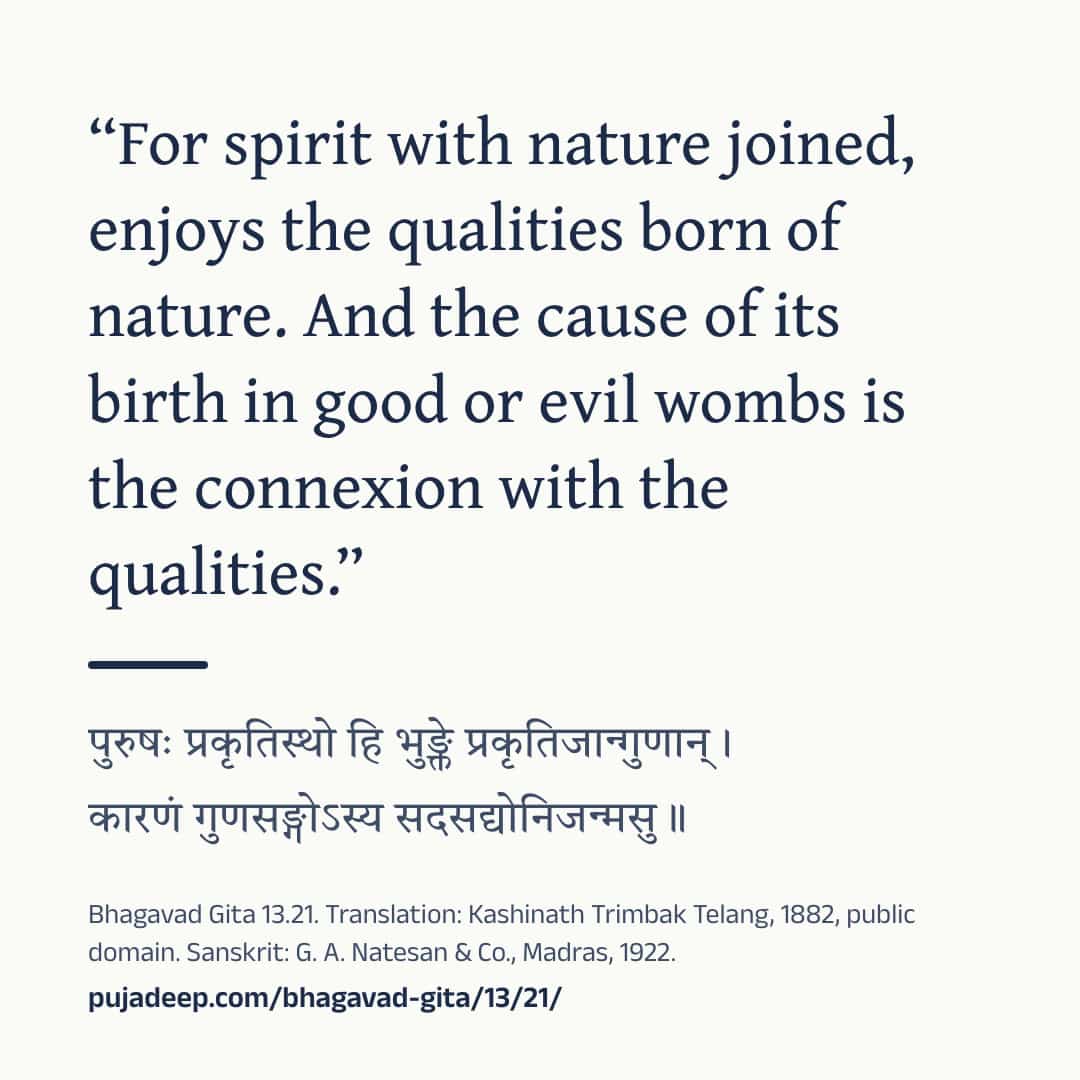
Drawing the picture
See the words
Bhagavad Gita 13.21

पुरुषः प्रकृतिस्थो हि भुङ्क्ते प्रकृतिजान्गुणान् ।
कारणं गुणसङ्गोऽस्य सदसद्योनिजन्मसु ॥

“For spirit with nature joined, enjoys the qualities born of nature. And the cause of its birth in good or evil wombs is the connexion with the qualities.”
(K. T. Telang, The Bhagavadgîtâ (The Sacred Books of the East, vol. VIII, Oxford: Clarendon Press, 1882), p. 105, public domain)

“Purusha seated in Prakriti useth the qualities born of Prakriti; the attachment to the qualities is the cause of births in good and evil wombs.”
(Annie Besant, The Bhagavad Gîtâ, or The Lord's Song (London: Theosophical Publishing Society, 1895), pp. 125–126, public domain)

“Purusha seated in Prakriti, experiences the Gunas born of Prakriti; the reason of the birth in good and evil wombs is its attachment to the Gunas.”
(Swami Swarupananda, Srimad-Bhagavad-Gita (Mayavati: Prabuddha Bharata Press, 1909; first printed in Prabuddha Bharata, 1907–1909), p. 263, public domain)

Sanskrit: G. A. Natesan & Co., Madras, 1922.
https://pujadeep.com/bhagavad-gita/13/21/ Nothing is sent from this site. Your own app sends it, to the chat you choose. The picture quotes the translation you chose on this page, with its name and year.
Sanskrit text: The Bhagavad-Gita, or The Lord's Song, with the text in Devanagari and an English translation, 1922. Meanings: written for Pujadeep and checked against the cited edition. Source and changes
Questions families ask
Who speaks Bhagavad Gita 13.21?
Krishna speaks this verse, in chapter 13 (Kshetra Kshetrajna Vibhaga Yoga).
Where does the Sanskrit text come from?
Sanskrit text: The Bhagavad-Gita, or The Lord's Song, with the text in Devanagari and an English translation, 1922. Meanings: written for Pujadeep and checked against the cited edition. See the source
Is the meaning on this page a translation?
Explanation written for this site from the sources listed here, and checked against the cited edition. It is not a translation and not the only way to read the text. Free to quote with credit.
Source and licence
- Sanskrit text
- The Bhagavad-Gita, or The Lord's Song, with the text in Devanagari and an English translation (Annie Besant, G. A. Natesan & Co., Madras, 1922). Public domain. The Sanskrit on these pages was read from this printing’s page images.
- Translation
- The Bhagavadgîtâ with the Sanatsugâtîya and the Anugîtâ, translated by Kâshinâth Trimbak Telang (The Sacred Books of the East, vol. VIII, ed. F. Max Müller) (Kashinath Trimbak Telang, F. Max Müller, Clarendon Press, Oxford, 1882). Public domain. Shown verbatim, as printed.
- Translation
- The Bhagavad Gîtâ, or The Lord's Song, translated by Annie Besant (Annie Besant, Theosophical Publishing Society, London, 1895). Public domain. Shown verbatim, as printed.
- Translation
- Srimad-Bhagavad-Gita, with Sanskrit Text; Paraphrase with Word-by-word Literal Translation; English Rendering and Comments, Index, &c., by the Swami Swarupananda (Himalayan Series, No. XX) (Swami Swarupananda, The Editors and Publishers, Advaita Ashrama, Mayavati, Prabuddha Bharata Press, Mayavati, Almora, Himalayas, 1909). Public domain. Shown verbatim, as printed.
- Commentary
- The Bhagavad-Gita, with the commentary of Sri Sankaracharya, translated by A. Mahadeva Sastri (2nd ed., Mysore: G. T. A. Printing Works, 1901) (Public-domain scan, University of California Libraries). Summarised in our own words; none of its text is reproduced.
- Commentary
- Sri Bhagavad-Gita with Sri Ramanujacharya's Visishtadvaita commentary, translated by A. Govindacharya (Madras, 1898) (Scan uploaded to archive.org (folkscanomy collection)). Summarised in our own words; none of its text is reproduced.
- Common wording
- In this text, 32 words follow today's common wording, checked against sanskritdocuments.org; Sanskrit Wikisource; Gita Press, Gorakhpur; GRETIL, Göttingen and Bhaktivedanta Book Trust.
- Our explanation
- Explanation written for this site from the sources listed here, and checked against the cited edition. It is not a translation and not the only way to read the text. Free to quote with credit.
- Checked
- Checked against the cited edition, October 15, 2026.
- Updated
- October 25, 2026