Bhagavad Gita 13.19: meaning and translation
Chapter 13: Kshetra Kshetrajna Vibhaga Yoga. Krishna says
Krishna tells Arjuna to know that nature (prakṛti) and spirit (puruṣa) are both without beginning, and that all changes (vikāras) and qualities (guṇas) are born of nature.
Click or tap a word for its meaning and its dictionary page.
Text and layers
Text and layers
These choices stay in this browser.
Bhagavad Gita 13.19
प्रकृतिं पुरुषं चैव विद्ध्यनादी उभावपि ।विकारांश्च गुणांश्चैव विद्धि प्रकृतिसंभवान् ॥
Prakritim purusham chaiva viddhyanadi ubhavapiVikaranshcha gunanshchaiva viddhi prakritisambhavan
prakṛtiṃ puruṣaṃ caiva viddhyanādī ubhāvapi |vikārāṃśca guṇāṃścaiva viddhi prakṛtisaṃbhavān ||
Our explanation Krishna tells Arjuna to know that nature (prakṛti) and spirit (puruṣa) are both without beginning, and that all changes (vikāras) and qualities (guṇas) are born of nature. The schools explain the “changes” and “qualities” differently (see the views).
हिंदी अर्थ कृष्ण अर्जुन से कहते हैं कि प्रकृति और पुरुष, दोनों को अनादि जानो, और यह जानो कि सब विकार और गुण प्रकृति से उत्पन्न होते हैं। “विकार” और “गुण” को परंपराएँ अलग-अलग ढंग से समझाती हैं।
Word by word
Every word, with its dictionary page
Word by word
- प्रकृतिम् prakṛtim · nature (prakṛti) (noun (feminine), accusative singular) Dictionary: pra-kṛti, Monier-Williams 1899, p. 654, col. 1 “the original producer of (or rather passive power of creating) the material world”
- पुरुषम् puruṣam · spirit (puruṣa) (noun (masculine), accusative singular) Dictionary: puruṣa, Monier-Williams 1899, p. 637, col. 1 “the personal and animating principle in men and other beings, the soul or spirit”
- च ca · and (indeclinable) Dictionary: 2. ca, Monier-Williams 1899, p. 380, col. 1 “and, both, also, moreover, as well as”
- एव eva · also (indeclinable) Dictionary: 1. eva, Monier-Williams 1899, p. 232, col. 2 “just, exactly, very, same, only, even, alone, merely”
- विद्धि viddhi · know (imperative, 2nd person singular) Dictionary: 1. vid, Monier-Williams 1899, p. 963, col. 2 “to know, understand, perceive, learn”
- अनादी anādī · without beginning (adjective (masculine), accusative dual) Dictionary: an-ādi, Monier-Williams 1899, p. 28, col. 1 “having no beginning, existing from eternity”
- उभौ ubhau · both (pronoun (masculine), accusative dual) Dictionary: ubha, Monier-Williams 1899, p. 216, col. 2 “both”
- अपि api · also (indeclinable) Dictionary: api, Monier-Williams 1899, p. 55, col. 1 “in the sense of even, also, very”
- विकारान् vikārān · the changes (noun (masculine), accusative plural) Dictionary: 2. vi-kāra, Monier-Williams 1899, p. 954, col. 2 “change of form or nature, alteration or deviation from any natural state”
- च ca · and (indeclinable) Dictionary: 2. ca, Monier-Williams 1899, p. 380, col. 1 “and, both, also, moreover, as well as”
- गुणान् guṇān · the qualities (guṇas) (noun (masculine), accusative plural) Dictionary: guṇa, Monier-Williams 1899, p. 357, col. 1 “a quality, peculiarity, attribute or property”
- च ca · and (indeclinable) Dictionary: 2. ca, Monier-Williams 1899, p. 380, col. 1 “and, both, also, moreover, as well as”
- एव eva · also (indeclinable) Dictionary: 1. eva, Monier-Williams 1899, p. 232, col. 2 “just, exactly, very, same, only, even, alone, merely”
- विद्धि viddhi · know (imperative, 2nd person singular) Dictionary: 1. vid, Monier-Williams 1899, p. 963, col. 2 “to know, understand, perceive, learn”
- प्रकृतिसंभवान् prakṛtisaṃbhavān · born of nature (compound (masculine), accusative plural) Dictionary: pra-kṛti, Monier-Williams 1899, p. 654, col. 1 “the original producer of (or rather passive power of creating) the material world”; sam-bhava, Monier-Williams 1899, p. 1179, col. 1 “birth, production, origin, source”
1 printing differs
Edition differences. Another printing or text reads this place differently.
- Spelling A digital text reads Same word. The e-text writes the class nasal (सम्भवान्); the 1922 edition writes anusvara (संभवान्).
Old translations
Kashinath Trimbak Telang, 1882. Public domain. Page 104.
Know nature and spirit both (to be) without beginning, and know all developments and qualities1 (to be) produced from nature.
Footnotes (the translator’s own) - Developments=body, senses, &c. Qualities=pleasure, pain, &c.; altogether the expression means the body and feelings and so forth. ↩
Compare 3 translations
Kashinath Trimbak Telang, 1882. Public domain. Page 104.
Know nature and spirit both (to be) without beginning, and know all developments and qualities1 (to be) produced from nature.
Footnotes (the translator’s own) - Developments=body, senses, &c. Qualities=pleasure, pain, &c.; altogether the expression means the body and feelings and so forth. ↩
You are reading this one
Annie Besant, 1895. Public domain. Page 125.
Know thou that Prakriti and Purusha are both without beginning; and know thou also that varieties and qualities are all Prakriti-born.
You are reading this one
Swami Swarupananda, 1909 (first printed 1907). Public domain. Page 262.
Know thou that Prakriti and Purusha are both beginningless; and know thou also that all modifications and Gunas are born of Prakriti.
You are reading this one
Cite this verse
The translation: K. T. Telang, The Bhagavadgîtâ (The Sacred Books of the East, vol. VIII, Oxford: Clarendon Press, 1882), p. 104. Bhagavad Gita 13.19.
The translation: Annie Besant, The Bhagavad Gîtâ, or The Lord's Song (London: Theosophical Publishing Society, 1895), p. 125. Bhagavad Gita 13.19.
The translation: Swami Swarupananda, Srimad-Bhagavad-Gita (Mayavati: Prabuddha Bharata Press, 1909; first printed in Prabuddha Bharata, 1907–1909), p. 262. Bhagavad Gita 13.19.
Our explanation: “Bhagavad Gita 13.19: meaning and translation.” Pujadeep. Updated October 25, 2026. https://pujadeep.com/bhagavad-gita/13/19/
Pujadeep’s explanations are free to quote with credit: name Pujadeep and link to the page. How to credit
Classical readings, by school
Each reading is named by its school. None is presented as the only meaning.
What Advaita, Vishishtadvaita and Dvaita teach, in short
Shankara Advaita
Shankara says prakṛti and puruṣa are the Lord's two natures (the lower and the higher of 7.4–5), and both are beginningless; the Lord's lordship consists in having them. The changes are everything from the intellect down to the body, and the qualities are pleasure, pain and delusion; all spring from prakṛti, the Lord's māyā made of the three guṇas.
Source: The Bhagavad-Gita, with the commentary of Sri Sankaracharya, translated by A. Mahadeva Sastri (2nd ed., Mysore: G. T. A. Printing Works, 1901), commentary on 13.19, pp. 316–318. Summarised in our own words; none of its text is reproduced.
Ramanuja Vishishtadvaita
Ramanuja says matter and the soul have been joined together from beginningless time. He reads the “changes” as the passions, desire, hatred and the like, that bind the soul, and the “qualities” as the virtues of 13.7–11, humility and the rest, that free it. Both arise from matter, which can thus bind or help to free.
Source: Sri Bhagavad-Gita with Sri Ramanujacharya's Visishtadvaita commentary, translated by A. Govindacharya (Madras, 1898), commentary on 13.19, p. 429. Summarised in our own words; none of its text is reproduced.
Share
Show the ways to share
Send one picture or the text to one chat. The picture names its source and the address of this page.
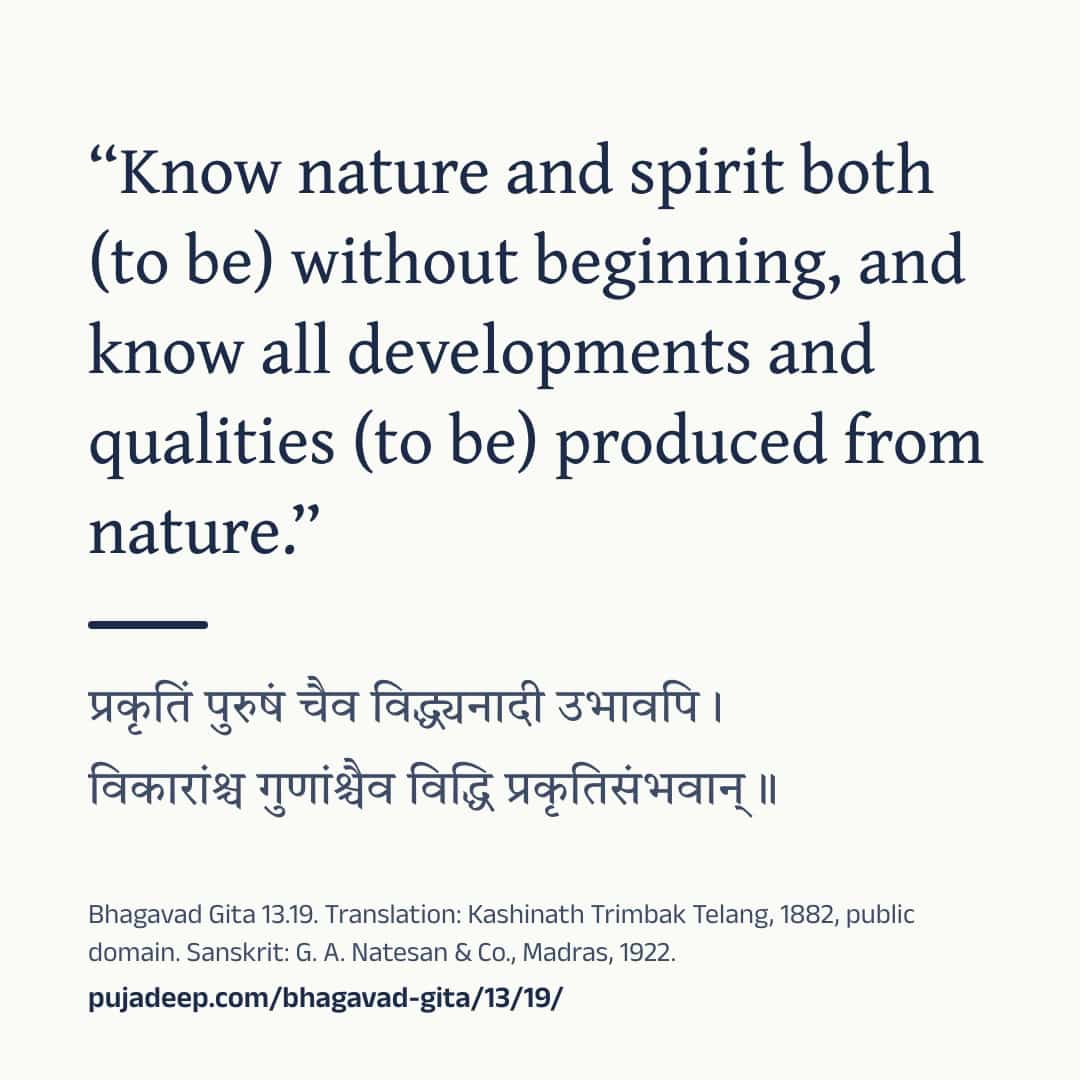
Drawing the picture
See the words
Bhagavad Gita 13.19

प्रकृतिं पुरुषं चैव विद्ध्यनादी उभावपि ।
विकारांश्च गुणांश्चैव विद्धि प्रकृतिसंभवान् ॥

“Know nature and spirit both (to be) without beginning, and know all developments and qualities (to be) produced from nature.”
(K. T. Telang, The Bhagavadgîtâ (The Sacred Books of the East, vol. VIII, Oxford: Clarendon Press, 1882), p. 104, public domain)

“Know thou that Prakriti and Purusha are both without beginning; and know thou also that varieties and qualities are all Prakriti-born.”
(Annie Besant, The Bhagavad Gîtâ, or The Lord's Song (London: Theosophical Publishing Society, 1895), p. 125, public domain)

“Know thou that Prakriti and Purusha are both beginningless; and know thou also that all modifications and Gunas are born of Prakriti.”
(Swami Swarupananda, Srimad-Bhagavad-Gita (Mayavati: Prabuddha Bharata Press, 1909; first printed in Prabuddha Bharata, 1907–1909), p. 262, public domain)

Sanskrit: G. A. Natesan & Co., Madras, 1922.
https://pujadeep.com/bhagavad-gita/13/19/ Nothing is sent from this site. Your own app sends it, to the chat you choose. The picture quotes the translation you chose on this page, with its name and year.
Sanskrit text: The Bhagavad-Gita, or The Lord's Song, with the text in Devanagari and an English translation, 1922. Meanings: written for Pujadeep and checked against the cited edition. Source and changes
Questions families ask
Who speaks Bhagavad Gita 13.19?
Krishna speaks this verse, in chapter 13 (Kshetra Kshetrajna Vibhaga Yoga).
Where does the Sanskrit text come from?
Sanskrit text: The Bhagavad-Gita, or The Lord's Song, with the text in Devanagari and an English translation, 1922. Meanings: written for Pujadeep and checked against the cited edition. See the source
Is the meaning on this page a translation?
Explanation written for this site from the sources listed here, and checked against the cited edition. It is not a translation and not the only way to read the text. Free to quote with credit.
Source and licence
- Sanskrit text
- The Bhagavad-Gita, or The Lord's Song, with the text in Devanagari and an English translation (Annie Besant, G. A. Natesan & Co., Madras, 1922). Public domain. The Sanskrit on these pages was read from this printing’s page images.
- Translation
- The Bhagavadgîtâ with the Sanatsugâtîya and the Anugîtâ, translated by Kâshinâth Trimbak Telang (The Sacred Books of the East, vol. VIII, ed. F. Max Müller) (Kashinath Trimbak Telang, F. Max Müller, Clarendon Press, Oxford, 1882). Public domain. Shown verbatim, as printed.
- Translation
- The Bhagavad Gîtâ, or The Lord's Song, translated by Annie Besant (Annie Besant, Theosophical Publishing Society, London, 1895). Public domain. Shown verbatim, as printed.
- Translation
- Srimad-Bhagavad-Gita, with Sanskrit Text; Paraphrase with Word-by-word Literal Translation; English Rendering and Comments, Index, &c., by the Swami Swarupananda (Himalayan Series, No. XX) (Swami Swarupananda, The Editors and Publishers, Advaita Ashrama, Mayavati, Prabuddha Bharata Press, Mayavati, Almora, Himalayas, 1909). Public domain. Shown verbatim, as printed.
- Commentary
- The Bhagavad-Gita, with the commentary of Sri Sankaracharya, translated by A. Mahadeva Sastri (2nd ed., Mysore: G. T. A. Printing Works, 1901) (Public-domain scan, University of California Libraries). Summarised in our own words; none of its text is reproduced.
- Commentary
- Sri Bhagavad-Gita with Sri Ramanujacharya's Visishtadvaita commentary, translated by A. Govindacharya (Madras, 1898) (Scan uploaded to archive.org (folkscanomy collection)). Summarised in our own words; none of its text is reproduced.
- Common wording
- In this text, 32 words follow today's common wording, checked against sanskritdocuments.org; Sanskrit Wikisource; Gita Press, Gorakhpur; GRETIL, Göttingen and Bhaktivedanta Book Trust.
- Our explanation
- Explanation written for this site from the sources listed here, and checked against the cited edition. It is not a translation and not the only way to read the text. Free to quote with credit.
- Checked
- Checked against the cited edition, October 15, 2026.
- Updated
- October 25, 2026