Bhagavad Gita 13.29: meaning and translation
Chapter 13: Kshetra Kshetrajna Vibhaga Yoga. Krishna says
Krishna says that the one who sees that all actions are done in every way by nature alone, and that the self is not the doer, truly sees.
Click or tap a word for its meaning and its dictionary page.
Text and layers
Text and layers
These choices stay in this browser.
Bhagavad Gita 13.29
प्रकृत्यैव च कर्माणि क्रियमाणानि सर्वशः ।यः पश्यति तथाऽऽत्मानमकर्तारं स पश्यति ॥
Prakrityaiva cha karmani kriyamanani sarvashahYah pashyati tathatmanamakartaram sa pashyati
prakṛtyaiva ca karmāṇi kriyamāṇāni sarvaśaḥ |yaḥ paśyati tathā’’tmānamakartāraṃ sa paśyati ||
Our explanation Krishna says that the one who sees that all actions are done in every way by nature alone, and that the self is not the doer, truly sees.
हिंदी अर्थ कृष्ण कहते हैं कि जो देखता है कि सब कर्म हर प्रकार से प्रकृति ही करती है, और आत्मा कर्ता नहीं, वही सच में देखता है।
Word by word
Every word, with its dictionary page
Word by word
- प्रकृत्या prakṛtyā · by nature (noun (feminine), instrumental singular) Dictionary: pra-kṛti, Monier-Williams 1899, p. 654, col. 1 “the original producer of (or rather passive power of creating) the material world”
- एव eva · alone (indeclinable) Dictionary: 1. eva, Monier-Williams 1899, p. 232, col. 2 “just, exactly, very, same, only, even, alone, merely”
- च ca · and (indeclinable) Dictionary: 2. ca, Monier-Williams 1899, p. 380, col. 1 “and, both, also, moreover, as well as”
- कर्माणि karmāṇi · actions (noun (neuter), accusative plural) Dictionary: karman, Monier-Williams 1899, p. 258, col. 2 “act, action, performance, business”
- क्रियमाणानि kriyamāṇāni · being done (present passive participle (neuter), accusative plural) Dictionary: 1. kṛ, Monier-Williams 1899, p. 301, col. 1 “to do, make, perform, accomplish, cause, effect”
- सर्वशः sarvaśaḥ · in every way (indeclinable) Dictionary: sarvaśas, Monier-Williams 1899, p. 1189, col. 2 “wholly, completely, entirely, thoroughly, collectively, altogether”
- यः yaḥ · who (relative pronoun (masculine), nominative singular) Dictionary: yad, Monier-Williams 1899, p. 844, col. 2 “who, which, what, whichever, whatever, that”
- पश्यति paśyati · sees (present, 3rd person singular) Dictionary: 1. paś, Monier-Williams 1899, p. 611, col. 2 “behold, look at, observe, perceive, notice”
- तथा tathā · likewise (indeclinable) Dictionary: tathā, Monier-Williams 1899, p. 433, col. 3 “in that manner, so, thus”
- आत्मानम् ātmānam · the self (noun (masculine), accusative singular) Dictionary: ātman, Monier-Williams 1899, p. 135, col. 1 “the individual soul, self”
- अकर्तारम् akartāram · not the doer (noun (masculine), accusative singular) Dictionary: a-kartṛ, Monier-Williams 1899, p. 1, col. 3 “not an agent”
- सः saḥ · he (pronoun (masculine), nominative singular) Dictionary: tad, Monier-Williams 1899, p. 434, col. 1 “m. he, f. she, n. it, that, this”
- पश्यति paśyati · sees (present, 3rd person singular) Dictionary: 1. paś, Monier-Williams 1899, p. 611, col. 2 “behold, look at, observe, perceive, notice”
3 printings differ
Edition differences. Another printing or text reads this place differently.
- The printed edition reads: प्रकृत्यव च कर्माणि क्रियंमाणानि सर्वशः ।
यः पश्यति तथाऽऽत्मानमकर्तारं स पश्यति ॥ The print has no ai-sign on त्य (प्रकृत्यव); shown as प्रकृत्यैव ('by nature alone'), a dropped sort. The print shows an anusvara over य (क्रियंमाणानि); read as a stray sort and not shown, because kriyamāṇāni has no nasal there. - Spelling The 1922 Madras printing reads: प्रकृत्यव च कर्माणि क्रियंमाणानि सर्वशः The 1922 base printing (leaf n205) drops the ai-sign of प्रकृत्यैव and sets a stray anusvara in क्रियमाणानि; see normalisations.
- Spelling A digital text reads Same words. The 1922 edition marks the merged vowel with avagraha (तथाऽऽत्मानम्); the e-text writes तथात्मानम्, as another digital text does.
Old translations
Kashinath Trimbak Telang, 1882. Public domain. Page 106.
He sees (truly), who sees (all) actions (to be) in every way done by nature alone, and likewise the self (to be) not the doer.
Compare 3 translations
Kashinath Trimbak Telang, 1882. Public domain. Page 106.
He sees (truly), who sees (all) actions (to be) in every way done by nature alone, and likewise the self (to be) not the doer.
You are reading this one
Annie Besant, 1895. Public domain. Page 127.
He who seeth that Prakriti verily performeth actions everywhere, and that the SELF is actionless, he seeth.
You are reading this one
Swami Swarupananda, 1909 (first printed 1907). Public domain. Page 267.
And he sees, who sees Prakriti alone doing all actions, and that the Self is actionless.
You are reading this one
Cite this verse
The translation: K. T. Telang, The Bhagavadgîtâ (The Sacred Books of the East, vol. VIII, Oxford: Clarendon Press, 1882), p. 106. Bhagavad Gita 13.29.
The translation: Annie Besant, The Bhagavad Gîtâ, or The Lord's Song (London: Theosophical Publishing Society, 1895), p. 127. Bhagavad Gita 13.29.
The translation: Swami Swarupananda, Srimad-Bhagavad-Gita (Mayavati: Prabuddha Bharata Press, 1909; first printed in Prabuddha Bharata, 1907–1909), p. 267. Bhagavad Gita 13.29.
Our explanation: “Bhagavad Gita 13.29: meaning and translation.” Pujadeep. Updated October 25, 2026. https://pujadeep.com/bhagavad-gita/13/29/
Pujadeep’s explanations are free to quote with credit: name Pujadeep and link to the page. How to credit
Classical readings, by school
No readings by school on this verse yet.
Share
Show the ways to share
Send one picture or the text to one chat. The picture names its source and the address of this page.
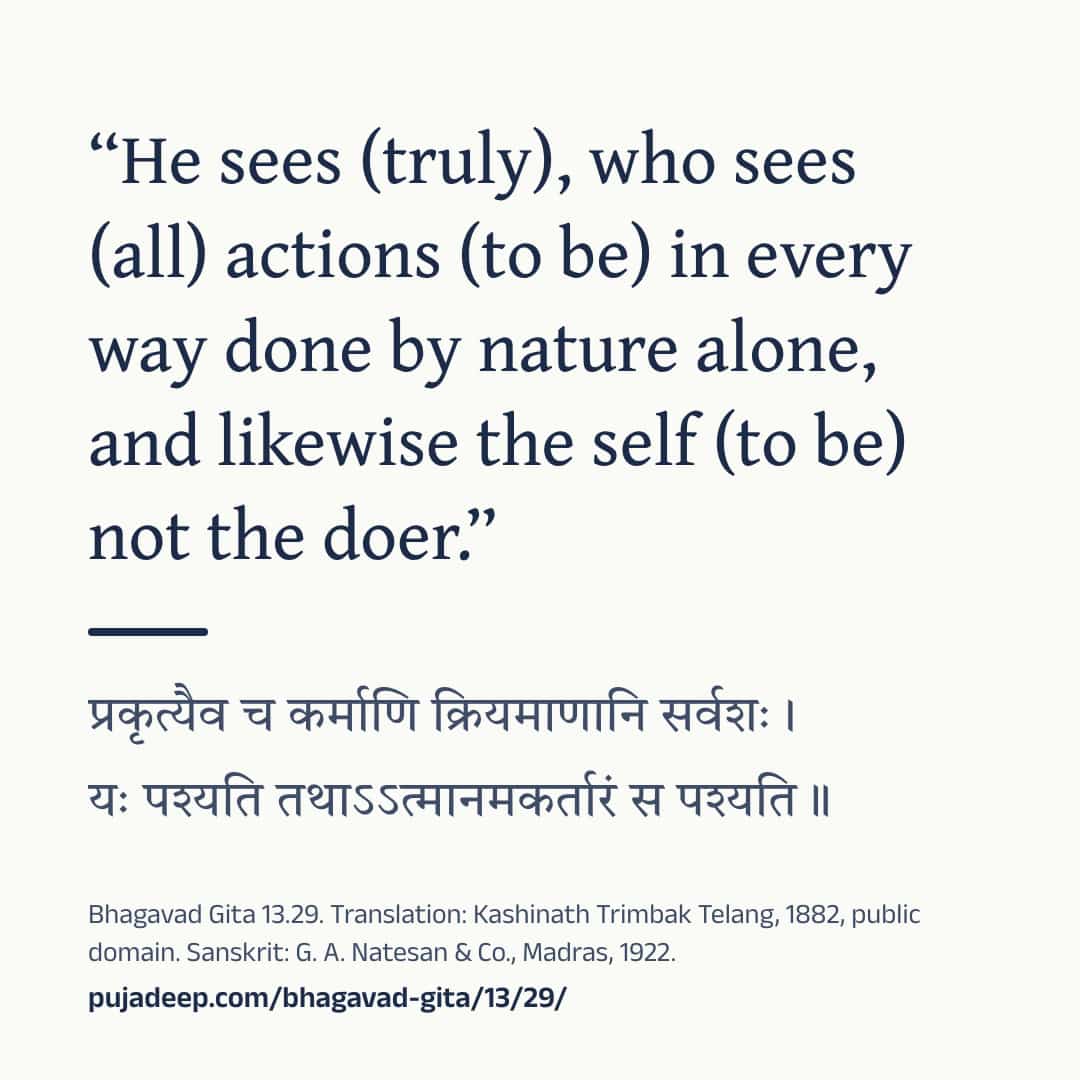
Drawing the picture
See the words
Bhagavad Gita 13.29

प्रकृत्यैव च कर्माणि क्रियमाणानि सर्वशः ।
यः पश्यति तथाऽऽत्मानमकर्तारं स पश्यति ॥

“He sees (truly), who sees (all) actions (to be) in every way done by nature alone, and likewise the self (to be) not the doer.”
(K. T. Telang, The Bhagavadgîtâ (The Sacred Books of the East, vol. VIII, Oxford: Clarendon Press, 1882), p. 106, public domain)

“He who seeth that Prakriti verily performeth actions everywhere, and that the SELF is actionless, he seeth.”
(Annie Besant, The Bhagavad Gîtâ, or The Lord's Song (London: Theosophical Publishing Society, 1895), p. 127, public domain)

“And he sees, who sees Prakriti alone doing all actions, and that the Self is actionless.”
(Swami Swarupananda, Srimad-Bhagavad-Gita (Mayavati: Prabuddha Bharata Press, 1909; first printed in Prabuddha Bharata, 1907–1909), p. 267, public domain)

Sanskrit: G. A. Natesan & Co., Madras, 1922.
https://pujadeep.com/bhagavad-gita/13/29/ Nothing is sent from this site. Your own app sends it, to the chat you choose. The picture quotes the translation you chose on this page, with its name and year.
Sanskrit text: The Bhagavad-Gita, or The Lord's Song, with the text in Devanagari and an English translation, 1922. Meanings: written for Pujadeep and checked against the cited edition. Source and changes
Questions families ask
Who speaks Bhagavad Gita 13.29?
Krishna speaks this verse, in chapter 13 (Kshetra Kshetrajna Vibhaga Yoga).
Where does the Sanskrit text come from?
Sanskrit text: The Bhagavad-Gita, or The Lord's Song, with the text in Devanagari and an English translation, 1922. Meanings: written for Pujadeep and checked against the cited edition. See the source
Is the meaning on this page a translation?
Explanation written for this site from the sources listed here, and checked against the cited edition. It is not a translation and not the only way to read the text. Free to quote with credit.
Source and licence
- Sanskrit text
- The Bhagavad-Gita, or The Lord's Song, with the text in Devanagari and an English translation (Annie Besant, G. A. Natesan & Co., Madras, 1922). Public domain. The Sanskrit on these pages was read from this printing’s page images.
- Translation
- The Bhagavadgîtâ with the Sanatsugâtîya and the Anugîtâ, translated by Kâshinâth Trimbak Telang (The Sacred Books of the East, vol. VIII, ed. F. Max Müller) (Kashinath Trimbak Telang, F. Max Müller, Clarendon Press, Oxford, 1882). Public domain. Shown verbatim, as printed.
- Translation
- The Bhagavad Gîtâ, or The Lord's Song, translated by Annie Besant (Annie Besant, Theosophical Publishing Society, London, 1895). Public domain. Shown verbatim, as printed.
- Translation
- Srimad-Bhagavad-Gita, with Sanskrit Text; Paraphrase with Word-by-word Literal Translation; English Rendering and Comments, Index, &c., by the Swami Swarupananda (Himalayan Series, No. XX) (Swami Swarupananda, The Editors and Publishers, Advaita Ashrama, Mayavati, Prabuddha Bharata Press, Mayavati, Almora, Himalayas, 1909). Public domain. Shown verbatim, as printed.
- Common wording
- In this text, 32 words follow today's common wording, checked against sanskritdocuments.org; Sanskrit Wikisource; Gita Press, Gorakhpur; GRETIL, Göttingen and Bhaktivedanta Book Trust.
- Our explanation
- Explanation written for this site from the sources listed here, and checked against the cited edition. It is not a translation and not the only way to read the text. Free to quote with credit.
- Checked
- Checked against the cited edition, October 15, 2026.
- Updated
- October 25, 2026