Bhagavad Gita 13.2: meaning and translation
Chapter 13: Kshetra Kshetrajna Vibhaga Yoga. Krishna says
Krishna tells Arjuna to know him as the knower of the field in all fields.
Click or tap a word for its meaning and its dictionary page.
Text and layers
Text and layers
These choices stay in this browser.
Bhagavad Gita 13.2
क्षेत्रज्ञं चापि मां विद्धि सर्वक्षेत्रेषु भारत ।क्षेत्रक्षेत्रज्ञयोर्ज्ञानं यत्तज्ज्ञानं मतं मम ॥
Kshetrajnam chapi mam viddhi sarvakshetreshu bharataKshetrakshetrajnayorjnanam yattajjnanam matam mama
kṣetrajñaṃ cāpi māṃ viddhi sarvakṣetreṣu bhārata |kṣetrakṣetrajñayorjñānaṃ yattajjñānaṃ mataṃ mama ||
Our explanation Krishna tells Arjuna to know him as the knower of the field in all fields. Knowledge of the field and of its knower, he says, is in his view true knowledge. The schools read “know Me as the knower of the field” very differently (see the views).
हिंदी अर्थ कृष्ण अर्जुन से कहते हैं कि सब क्षेत्रों में उन्हें भी क्षेत्रज्ञ जानो। वे कहते हैं कि क्षेत्र और क्षेत्रज्ञ का ज्ञान ही उनके मत में सच्चा ज्ञान है। “मुझे क्षेत्रज्ञ जानो” को परंपराएँ बहुत अलग-अलग ढंग से समझती हैं।
Word by word
Every word, with its dictionary page
Word by word
- क्षेत्रज्ञम् kṣetrajñam · the knower of the field (noun (masculine), accusative singular) Dictionary: kṣetra-jña, Monier-Williams 1899, p. 332, col. 2 “'knowing the body,' i.e. the soul, the conscious principle in the corporeal frame”
- च ca · and (indeclinable) Dictionary: 2. ca, Monier-Williams 1899, p. 380, col. 1 “and, both, also, moreover, as well as”
- अपि api · also (indeclinable) Dictionary: api, Monier-Williams 1899, p. 55, col. 1 “in the sense of even, also, very”
- माम् mām · "me" (Krishna) (pronoun, accusative singular) Dictionary: 1. mad, Monier-Williams 1899, p. 777, col. 2 “base of the first pers. pron. in the sg. number (esp. in comp.)”
- विद्धि viddhi · know (imperative, 2nd person singular) Dictionary: 1. vid, Monier-Williams 1899, p. 963, col. 2 “to know, understand, perceive, learn”
- सर्वक्षेत्रेषु sarvakṣetreṣu · in all fields (compound (neuter), locative plural) Dictionary: sarva, Monier-Williams 1899, p. 1184, col. 3 “whole, entire, all, every”; kṣetra, Monier-Williams 1899, p. 332, col. 1 “a field”
- भारत bhārata · O Bharata (Arjuna) (noun (masculine), vocative singular) Dictionary: bhārata, Monier-Williams 1899, p. 753, col. 1
- क्षेत्रक्षेत्रज्ञयोः kṣetrakṣetrajñayoḥ · of the field and its knower (compound (masculine), genitive dual) Dictionary: kṣetra, Monier-Williams 1899, p. 332, col. 1 “a field”; kṣetra-jña, Monier-Williams 1899, p. 332, col. 2 “'knowing the body,' i.e. the soul, the conscious principle in the corporeal frame”
- ज्ञानम् jñānam · knowledge (noun (neuter), nominative singular) Dictionary: jñāna, Monier-Williams 1899, p. 426, col. 1 “knowing, becoming acquainted with, knowledge”
- यत् yat · which (relative pronoun (neuter), nominative singular) Dictionary: yad, Monier-Williams 1899, p. 844, col. 2 “who, which, what, whichever, whatever, that”
- तत् tat · that (pronoun (neuter), nominative singular) Dictionary: tad, Monier-Williams 1899, p. 434, col. 1 “m. he, f. she, n. it, that, this”
- ज्ञानम् jñānam · knowledge (noun (neuter), nominative singular) Dictionary: jñāna, Monier-Williams 1899, p. 426, col. 1 “knowing, becoming acquainted with, knowledge”
- मतम् matam · is held to be (past participle (neuter), nominative singular) Dictionary: mata, Monier-Williams 1899, p. 783, col. 1 “thought, believed, imagined, supposed, understood; regarded or considered as”
- मम mama · by "me" (Krishna) (pronoun, genitive singular) Dictionary: 1. mad, Monier-Williams 1899, p. 777, col. 2 “base of the first pers. pron. in the sg. number (esp. in comp.)”
Old translations
Kashinath Trimbak Telang, 1882. Public domain. Page 102.
And know me also, O descendant of Bharata! to be the Kshetragña in all Kshetras. The knowledge of Kshetra and Kshetragña is deemed by me (to be real) knowledge.
Compare 3 translations
Kashinath Trimbak Telang, 1882. Public domain. Page 102.
And know me also, O descendant of Bharata! to be the Kshetragña in all Kshetras. The knowledge of Kshetra and Kshetragña is deemed by me (to be real) knowledge.
You are reading this one
Annie Besant, 1895. Public domain. Page 122.
Understand me as the Knower of the Field in all Fields, O Bhârata. Wisdom as to the Field and the Knower of the Field, that in My opinion is wisdom.
You are reading this one
Swami Swarupananda, 1909 (first printed 1907). Public domain. Page 253.
Me do thou also know, O descendant of Bharata, to be the Kshetrajna in all Kshetras. The knowledge of Kshetra and Kshetrajna is considered by Me to be the knowledge.
You are reading this one
Cite this verse
The translation: K. T. Telang, The Bhagavadgîtâ (The Sacred Books of the East, vol. VIII, Oxford: Clarendon Press, 1882), p. 102. Bhagavad Gita 13.2.
The translation: Annie Besant, The Bhagavad Gîtâ, or The Lord's Song (London: Theosophical Publishing Society, 1895), p. 122. Bhagavad Gita 13.2.
The translation: Swami Swarupananda, Srimad-Bhagavad-Gita (Mayavati: Prabuddha Bharata Press, 1909; first printed in Prabuddha Bharata, 1907–1909), p. 253. Bhagavad Gita 13.2.
Our explanation: “Bhagavad Gita 13.2: meaning and translation.” Pujadeep. Updated October 25, 2026. https://pujadeep.com/bhagavad-gita/13/2/
Pujadeep’s explanations are free to quote with credit: name Pujadeep and link to the page. How to credit
Classical readings, by school
Each reading is named by its school. None is presented as the only meaning.
What Advaita, Vishishtadvaita and Dvaita teach, in short
Shankara Advaita
Shankara says the knower in every body, from Brahmā down to a blade of grass, is the Lord himself, free of all limiting conditions (upādhi). It only appears to be many, and to suffer saṃsāra, through ignorance (avidyā), as a pillar in the dark is mistaken for a man. To know the field and its knower in this way is right knowledge.
Source: The Bhagavad-Gita, with the commentary of Sri Sankaracharya, translated by A. Mahadeva Sastri (2nd ed., Mysore: G. T. A. Printing Works, 1901), commentary on 13.2, pp. 278–282. Summarised in our own words; none of its text is reproduced.
Ramanuja Vishishtadvaita
Ramanuja says the knower of the field in every body is “Mine”: it has the Lord as its inner self, as the body has the soul. The “also” shows that the field too belongs to him. Both the field and its knower are the Lord's body, and he, the Supreme Person, remains distinct from the souls, bound or freed (he cites 15.16–18).
Source: Sri Bhagavad-Gita with Sri Ramanujacharya's Visishtadvaita commentary, translated by A. Govindacharya (Madras, 1898), commentary on 13.2, pp. 400–401. Summarised in our own words; none of its text is reproduced.
Share
Show the ways to share
Send one picture or the text to one chat. The picture names its source and the address of this page.
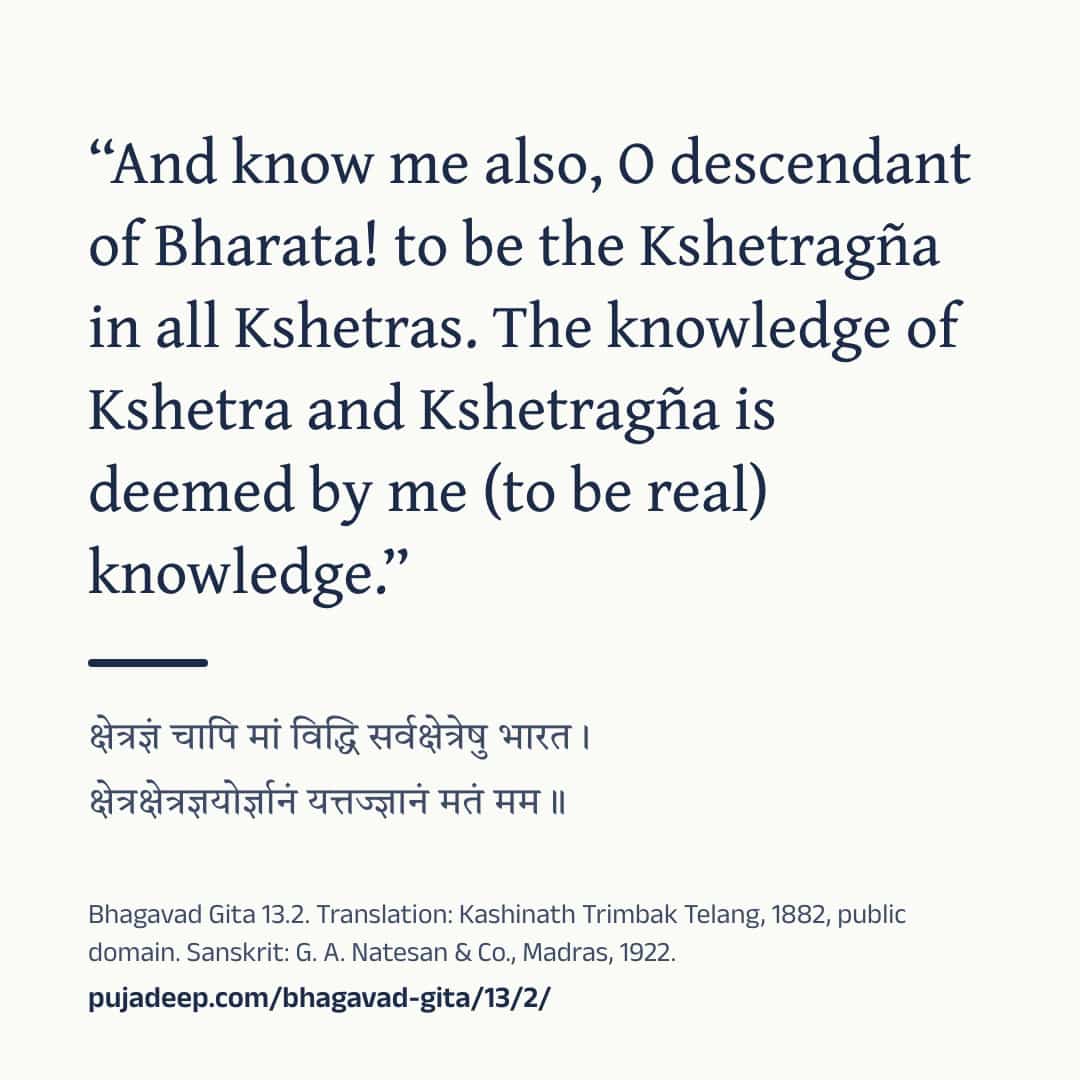
Drawing the picture
See the words
Bhagavad Gita 13.2

क्षेत्रज्ञं चापि मां विद्धि सर्वक्षेत्रेषु भारत ।
क्षेत्रक्षेत्रज्ञयोर्ज्ञानं यत्तज्ज्ञानं मतं मम ॥

“And know me also, O descendant of Bharata! to be the Kshetragña in all Kshetras. The knowledge of Kshetra and Kshetragña is deemed by me (to be real) knowledge.”
(K. T. Telang, The Bhagavadgîtâ (The Sacred Books of the East, vol. VIII, Oxford: Clarendon Press, 1882), p. 102, public domain)

“Understand me as the Knower of the Field in all Fields, O Bhârata. Wisdom as to the Field and the Knower of the Field, that in My opinion is wisdom.”
(Annie Besant, The Bhagavad Gîtâ, or The Lord's Song (London: Theosophical Publishing Society, 1895), p. 122, public domain)

“Me do thou also know, O descendant of Bharata, to be the Kshetrajna in all Kshetras. The knowledge of Kshetra and Kshetrajna is considered by Me to be the knowledge.”
(Swami Swarupananda, Srimad-Bhagavad-Gita (Mayavati: Prabuddha Bharata Press, 1909; first printed in Prabuddha Bharata, 1907–1909), p. 253, public domain)

Sanskrit: G. A. Natesan & Co., Madras, 1922.
https://pujadeep.com/bhagavad-gita/13/2/ Nothing is sent from this site. Your own app sends it, to the chat you choose. The picture quotes the translation you chose on this page, with its name and year.
Sanskrit text: The Bhagavad-Gita, or The Lord's Song, with the text in Devanagari and an English translation, 1922. Meanings: written for Pujadeep and checked against the cited edition. Source and changes
Questions families ask
Who speaks Bhagavad Gita 13.2?
Krishna speaks this verse, in chapter 13 (Kshetra Kshetrajna Vibhaga Yoga).
Where does the Sanskrit text come from?
Sanskrit text: The Bhagavad-Gita, or The Lord's Song, with the text in Devanagari and an English translation, 1922. Meanings: written for Pujadeep and checked against the cited edition. See the source
Is the meaning on this page a translation?
Explanation written for this site from the sources listed here, and checked against the cited edition. It is not a translation and not the only way to read the text. Free to quote with credit.
Source and licence
- Sanskrit text
- The Bhagavad-Gita, or The Lord's Song, with the text in Devanagari and an English translation (Annie Besant, G. A. Natesan & Co., Madras, 1922). Public domain. The Sanskrit on these pages was read from this printing’s page images.
- Translation
- The Bhagavadgîtâ with the Sanatsugâtîya and the Anugîtâ, translated by Kâshinâth Trimbak Telang (The Sacred Books of the East, vol. VIII, ed. F. Max Müller) (Kashinath Trimbak Telang, F. Max Müller, Clarendon Press, Oxford, 1882). Public domain. Shown verbatim, as printed.
- Translation
- The Bhagavad Gîtâ, or The Lord's Song, translated by Annie Besant (Annie Besant, Theosophical Publishing Society, London, 1895). Public domain. Shown verbatim, as printed.
- Translation
- Srimad-Bhagavad-Gita, with Sanskrit Text; Paraphrase with Word-by-word Literal Translation; English Rendering and Comments, Index, &c., by the Swami Swarupananda (Himalayan Series, No. XX) (Swami Swarupananda, The Editors and Publishers, Advaita Ashrama, Mayavati, Prabuddha Bharata Press, Mayavati, Almora, Himalayas, 1909). Public domain. Shown verbatim, as printed.
- Commentary
- The Bhagavad-Gita, with the commentary of Sri Sankaracharya, translated by A. Mahadeva Sastri (2nd ed., Mysore: G. T. A. Printing Works, 1901) (Public-domain scan, University of California Libraries). Summarised in our own words; none of its text is reproduced.
- Commentary
- Sri Bhagavad-Gita with Sri Ramanujacharya's Visishtadvaita commentary, translated by A. Govindacharya (Madras, 1898) (Scan uploaded to archive.org (folkscanomy collection)). Summarised in our own words; none of its text is reproduced.
- Common wording
- In this text, 32 words follow today's common wording, checked against sanskritdocuments.org; Sanskrit Wikisource; Gita Press, Gorakhpur; GRETIL, Göttingen and Bhaktivedanta Book Trust.
- Our explanation
- Explanation written for this site from the sources listed here, and checked against the cited edition. It is not a translation and not the only way to read the text. Free to quote with credit.
- Checked
- Checked against the cited edition, October 15, 2026.
- Updated
- October 25, 2026