Bhagavad Gita 12.10: meaning and translation
Chapter 12: Bhakti Yoga. Krishna says
If Arjuna is not able even to practise, Krishna says, he should make work done for Krishna's sake his highest aim.
Click or tap a word for its meaning and its dictionary page.
Text and layers
Text and layers
These choices stay in this browser.
Bhagavad Gita 12.10
अभ्यासेऽप्यसमर्थोऽसि मत्कर्मपरमो भव ।मदर्थमपि कर्माणि कुर्वन्सिद्धिमवाप्स्यसि ॥
Abhyasepyasamarthosi matkarmaparamo bhavaMadarthamapi karmani kurvansiddhimavapsyasi
abhyāse’pyasamartho’si matkarmaparamo bhava |madarthamapi karmāṇi kurvansiddhimavāpsyasi ||
Our explanation If Arjuna is not able even to practise, Krishna says, he should make work done for Krishna's sake his highest aim. Even by doing actions for Krishna's sake, he will reach perfection (siddhi).
हिंदी अर्थ कृष्ण कहते हैं कि यदि अर्जुन अभ्यास में भी समर्थ नहीं हैं, तो कृष्ण के लिए कर्म करने को ही अपना परम लक्ष्य बना लें। कृष्ण के लिए कर्म करते हुए भी वे सिद्धि (पूर्णता) पा लेंगे।
Word by word
Every word, with its dictionary page
Word by word
- अभ्यासे abhyāse · in practice (locative singular) Dictionary: 2. abhy-āsa, Monier-Williams 1899, p. 76, col. 3 “repeated or permanent exercise”
- अपि api · even (indeclinable) Dictionary: api, Monier-Williams 1899, p. 55, col. 1 “and, also, moreover, besides”
- असमर्थः asamarthaḥ · unable (nominative singular) Dictionary: a-samartha, Monier-Williams 1899, p. 119, col. 1 “unable to (Inf., dat., loc., or in comp.)”
- असि asi · you are (present, 2nd person singular) Dictionary: 1. as, Monier-Williams 1899, p. 117, col. 2 “to be, live, exist, be present”
- मत्कर्मपरमः matkarmaparamaḥ · devoted to work for "me" (compound, nominative singular) Dictionary: 1. mad, Monier-Williams 1899, p. 777, col. 2 “base of the first pers. pron. in the sg. number (esp. in comp.)”; karman, Monier-Williams 1899, p. 258, col. 2 “act, action, performance, business”; parama, Monier-Williams 1899, p. 588, col. 1 “chief, highest, primary, most prominent or conspicuous”
- भव bhava · be (imperative, 2nd person singular) Dictionary: 1. bhū, Monier-Williams 1899, p. 760, col. 2 “to become, be”
- मदर्थम् madartham · for "my" sake (Krishna's) (adverb) Dictionary: mad-artha, Monier-Williams 1899, p. 777, col. 2 “for the sake of me”
- अपि api · even (indeclinable) Dictionary: api, Monier-Williams 1899, p. 55, col. 1 “and, also, moreover, besides”
- कर्माणि karmāṇi · actions (accusative plural) Dictionary: karman, Monier-Williams 1899, p. 258, col. 2 “act, action, performance, business”
- कुर्वन् kurvan · doing (present participle, nominative singular) Dictionary: 1. kṛ, Monier-Williams 1899, p. 301, col. 1 “to do, make, perform, accomplish, cause, effect”
- सिद्धिम् siddhim · fulfilment, success (accusative singular) Dictionary: 2. siddhi, Monier-Williams 1899, p. 1216, col. 2 “accomplishment, performance, fulfilment, complete attainment (of any object), success”
- अवाप्स्यसि avāpsyasi · you will reach (future, 2nd person singular) Dictionary: avāp, Monier-Williams 1899, p. 107, col. 1 “to reach, attain, obtain, gain, get”
Old translations
Kashinath Trimbak Telang, 1882. Public domain. Page 100.
If you are unequal even to continuous meditation, then let acts for (propitiating) me be your highest (aim). Even performing actions for (propitiating) me, you will attain perfection.
Compare 3 translations
Kashinath Trimbak Telang, 1882. Public domain. Page 100.
If you are unequal even to continuous meditation, then let acts for (propitiating) me be your highest (aim). Even performing actions for (propitiating) me, you will attain perfection.
You are reading this one
Annie Besant, 1895. Public domain. Page 119.
If also thou art not equal to constant practice, perform actions for My sake; performing actions with Me for object, thou shalt attain perfection.
You are reading this one
Swami Swarupananda, 1909 (first printed 1907). Public domain. Page 246–247.
If also thou art unable to practise Abhyâsa, be thou intent on doing actions for My sake. Even by doing actions for My sake, thou shalt attain perfection.
You are reading this one
Cite this verse
The translation: K. T. Telang, The Bhagavadgîtâ (The Sacred Books of the East, vol. VIII, Oxford: Clarendon Press, 1882), p. 100. Bhagavad Gita 12.10.
The translation: Annie Besant, The Bhagavad Gîtâ, or The Lord's Song (London: Theosophical Publishing Society, 1895), p. 119. Bhagavad Gita 12.10.
The translation: Swami Swarupananda, Srimad-Bhagavad-Gita (Mayavati: Prabuddha Bharata Press, 1909; first printed in Prabuddha Bharata, 1907–1909), pp. 246–247. Bhagavad Gita 12.10.
Our explanation: “Bhagavad Gita 12.10: meaning and translation.” Pujadeep. Updated October 27, 2026. https://pujadeep.com/bhagavad-gita/12/10/
Pujadeep’s explanations are free to quote with credit: name Pujadeep and link to the page. How to credit
Classical readings, by school
No readings by school on this verse yet.
Share
Show the ways to share
Send one picture or the text to one chat. The picture names its source and the address of this page.
Drawing the picture
See the words
Bhagavad Gita 12.10

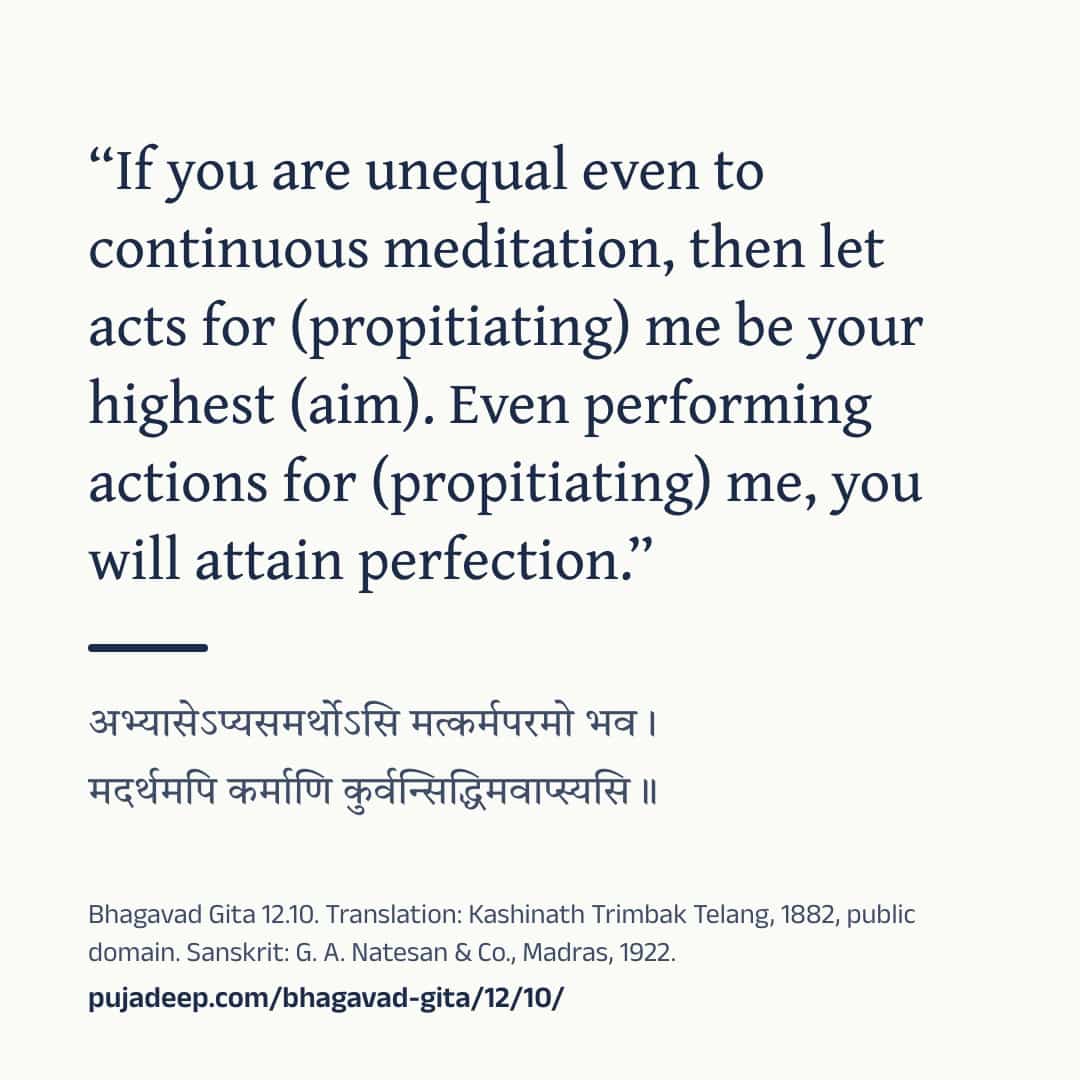
अभ्यासेऽप्यसमर्थोऽसि मत्कर्मपरमो भव ।
मदर्थमपि कर्माणि कुर्वन्सिद्धिमवाप्स्यसि ॥

“If you are unequal even to continuous meditation, then let acts for (propitiating) me be your highest (aim). Even performing actions for (propitiating) me, you will attain perfection.”
(K. T. Telang, The Bhagavadgîtâ (The Sacred Books of the East, vol. VIII, Oxford: Clarendon Press, 1882), p. 100, public domain)

“If also thou art not equal to constant practice, perform actions for My sake; performing actions with Me for object, thou shalt attain perfection.”
(Annie Besant, The Bhagavad Gîtâ, or The Lord's Song (London: Theosophical Publishing Society, 1895), p. 119, public domain)

“If also thou art unable to practise Abhyâsa, be thou intent on doing actions for My sake. Even by doing actions for My sake, thou shalt attain perfection.”
(Swami Swarupananda, Srimad-Bhagavad-Gita (Mayavati: Prabuddha Bharata Press, 1909; first printed in Prabuddha Bharata, 1907–1909), pp. 246–247, public domain)

Sanskrit: G. A. Natesan & Co., Madras, 1922.
https://pujadeep.com/bhagavad-gita/12/10/ Nothing is sent from this site. Your own app sends it, to the chat you choose. The picture quotes the translation you chose on this page, with its name and year.
Sanskrit text: The Bhagavad-Gita, or The Lord's Song, with the text in Devanagari and an English translation, 1922. Meanings: written for Pujadeep and checked against the cited edition. Source and changes
Questions families ask
Who speaks Bhagavad Gita 12.10?
Krishna speaks this verse, in chapter 12 (Bhakti Yoga).
Where does the Sanskrit text come from?
Sanskrit text: The Bhagavad-Gita, or The Lord's Song, with the text in Devanagari and an English translation, 1922. Meanings: written for Pujadeep and checked against the cited edition. See the source
Is the meaning on this page a translation?
Explanation written for this site from the sources listed here, and checked against the cited edition. It is not a translation and not the only way to read the text. Free to quote with credit.
Source and licence
- Sanskrit text
- The Bhagavad-Gita, or The Lord's Song, with the text in Devanagari and an English translation (Annie Besant, G. A. Natesan & Co., Madras, 1922). Public domain. The Sanskrit on these pages was read from this printing’s page images.
- Translation
- The Bhagavadgîtâ with the Sanatsugâtîya and the Anugîtâ, translated by Kâshinâth Trimbak Telang (The Sacred Books of the East, vol. VIII, ed. F. Max Müller) (Kashinath Trimbak Telang, F. Max Müller, Clarendon Press, Oxford, 1882). Public domain. Shown verbatim, as printed.
- Translation
- The Bhagavad Gîtâ, or The Lord's Song, translated by Annie Besant (Annie Besant, Theosophical Publishing Society, London, 1895). Public domain. Shown verbatim, as printed.
- Translation
- Srimad-Bhagavad-Gita, with Sanskrit Text; Paraphrase with Word-by-word Literal Translation; English Rendering and Comments, Index, &c., by the Swami Swarupananda (Himalayan Series, No. XX) (Swami Swarupananda, The Editors and Publishers, Advaita Ashrama, Mayavati, Prabuddha Bharata Press, Mayavati, Almora, Himalayas, 1909). Public domain. Shown verbatim, as printed.
- Common wording
- In this text, 32 words follow today's common wording, checked against sanskritdocuments.org; Sanskrit Wikisource; Gita Press, Gorakhpur; GRETIL, Göttingen and Bhaktivedanta Book Trust.
- Our explanation
- Explanation written for this site from the sources listed here, and checked against the cited edition. It is not a translation and not the only way to read the text. Free to quote with credit.
- Checked
- Checked against the cited edition, October 27, 2026.