Bhagavad Gita 12.7: meaning and translation
Chapter 12: Bhakti Yoga. Krishna says
Krishna says that for these people, whose minds are fixed on him, he soon becomes the one who lifts them out of the ocean of death and repeated birth (saṃsāra).
Click or tap a word for its meaning and its dictionary page.
Text and layers
Text and layers
These choices stay in this browser.
Bhagavad Gita 12.7
तेषामहं समुद्धर्ता मृत्युसंसारसागरात् ।भवामि न चिरात्पार्थ मय्यावेशितचेतसाम् ॥
Teshamaham samuddharta mrityusansarasagaratBhavami na chiratpartha mayyaveshitachetasam
teṣāmahaṃ samuddhartā mṛtyusaṃsārasāgarāt |bhavāmi na cirātpārtha mayyāveśitacetasām ||
Our explanation Krishna says that for these people, whose minds are fixed on him, he soon becomes the one who lifts them out of the ocean of death and repeated birth (saṃsāra). He calls Arjuna Partha, son of Pritha.
हिंदी अर्थ कृष्ण कहते हैं कि जिनका चित्त उनमें लगा है, उनके लिए वे शीघ्र ही मृत्यु से भरे संसार-सागर (बार-बार जन्म और मृत्यु) से उद्धार करने वाले बनते हैं। वे अर्जुन को पार्थ (पृथा के पुत्र) कहकर पुकारते हैं।
Word by word
Every word, with its dictionary page
Word by word
- तेषाम् teṣām · for them (pronoun, genitive plural) Dictionary: tad, Monier-Williams 1899, p. 434, col. 1 “m. he, f. she, n. it, that, this”
- अहम् aham · "I" (Krishna) (pronoun, nominative singular) Dictionary: aham, Monier-Williams 1899, p. 124, col. 2 “nom. sg. ‘I,’”
- समुद्धर्ता samuddhartā · the one who lifts out, rescuer (nominative singular) Dictionary: sam-uddhartṛ, Monier-Williams 1899, p. 1168, col. 1 “one who lifts up or raises or extricates from (abl.)”
- मृत्युसंसारसागरात् mṛtyusaṃsārasāgarāt · from the sea of death and rebirth (compound, ablative singular) Dictionary: mṛtyu, Monier-Williams 1899, p. 827, col. 3 “death, dying”; saṃ-sāra, Monier-Williams 1899, p. 1119, col. 2 “going or wandering through, undergoing transmigration”; sāgara, Monier-Williams 1899, p. 1198, col. 2 “the ocean”
- भवामि bhavāmi · become, am (present, 1st person singular) Dictionary: 1. bhū, Monier-Williams 1899, p. 760, col. 2 “to become, be”
- न na · not (indeclinable) Dictionary: 2. na, Monier-Williams 1899, p. 523, col. 1 “not, no, nor, neither”
- चिरात् cirāt · after long, late (adverb) Dictionary: cira, Monier-Williams 1899, p. 398, col. 2 “long, lasting a long time”
- पार्थ pārtha · O son of Pritha (Arjuna) (vocative singular) Dictionary: 2. pārtha, Monier-Williams 1899, p. 621, col. 3 “metron. of Yudhi-shṭhira or Bhīma-sena or Arjuna”
- मयि mayi · on "me" (Krishna) (pronoun, locative singular) Dictionary: 1. mad, Monier-Williams 1899, p. 777, col. 2 “base of the first pers. pron. in the sg. number (esp. in comp.)”
- आवेशितचेतसाम् āveśitacetasām · whose minds are set (compound, genitive plural) Dictionary: ā-viś, Monier-Williams 1899, p. 155, col. 3 “Caus. -veśayati, to cause to enter or approach”; cetas, Monier-Williams 1899, p. 398, col. 1 “consciousness, intelligence, thinking soul, heart, mind”
1 printing differs
Edition differences. Another printing or text reads this place differently.
- Spelling A digital text reads Same letters. This e-text joins नचिरात् ('soon') into one word; the 1922 edition prints न चिरात् as two words, as another digital text does (na cirāt).
Old translations
Kashinath Trimbak Telang, 1882. Public domain.
Telang translates verses 6–7 as one sentence; see 12.6. Read it at 12.6
Compare 3 translations
Kashinath Trimbak Telang, 1882. Public domain.
Telang translates verses 6–7 as one sentence; see 12.6. Read it at 12.6
You are reading this one
Annie Besant, 1895. Public domain. Page 119.
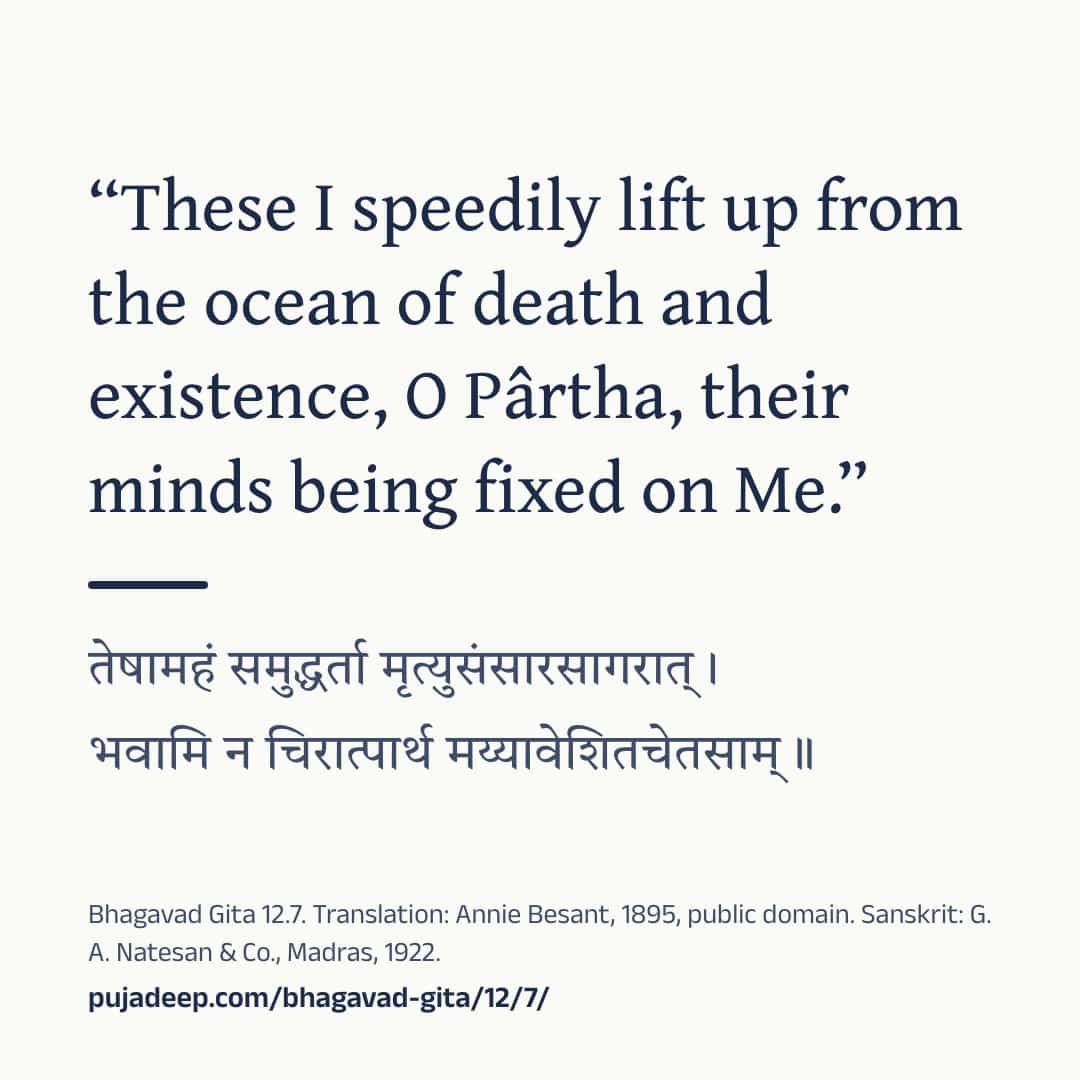
These I speedily lift up from the ocean of death and existence, O Pârtha, their minds being fixed on Me.
This sentence begins in 12.6.
You are reading this one
Swami Swarupananda, 1909 (first printed 1907). Public domain.
Swarupananda renders verses 6–7 together; see 12.6. Read it at 12.6
You are reading this one
Cite this verse
The translation: K. T. Telang, The Bhagavadgîtâ (The Sacred Books of the East, vol. VIII, Oxford: Clarendon Press, 1882), p. 100. Bhagavad Gita 12.6–7.
The translation: Annie Besant, The Bhagavad Gîtâ, or The Lord's Song (London: Theosophical Publishing Society, 1895), p. 119. Bhagavad Gita 12.7.
The translation: Swami Swarupananda, Srimad-Bhagavad-Gita (Mayavati: Prabuddha Bharata Press, 1909; first printed in Prabuddha Bharata, 1907–1909), p. 245. Bhagavad Gita 12.6–7.
Our explanation: “Bhagavad Gita 12.7: meaning and translation.” Pujadeep. Updated October 27, 2026. https://pujadeep.com/bhagavad-gita/12/7/
Pujadeep’s explanations are free to quote with credit: name Pujadeep and link to the page. How to credit
Classical readings, by school
Each reading is named by its school. None is presented as the only meaning.
What Advaita, Vishishtadvaita and Dvaita teach, in short
Shankara Advaita
Shankara says that 12.3–4 show the worshippers of the Imperishable as independent in reaching liberation, while this verse shows the worshippers of the Lord as depending on him to deliver them. He concludes that the two paths are not for the same person at the same time.
Source: The Bhagavad-Gita, with the commentary of Sri Sankaracharya, translated by A. Mahadeva Sastri (2nd ed., Mysore: G. T. A. Printing Works, 1901), commentary on 12.6–7 and the passage after 12.12, pp. 269, 272–273. Summarised in our own words; none of its text is reproduced.
Ramanuja Vishishtadvaita
Ramanuja says the Lord himself very soon delivers these devotees from saṃsāra, the ocean that keeps souls from reaching him. This, he says, is what makes them “better versed in yoga” (12.1), because they reach their goal sooner.
Source: Sri Bhagavad-Gita with Sri Ramanujacharya's Visishtadvaita commentary, translated by A. Govindacharya (Madras, 1898), commentary on 12.1 and 12.6–7, pp. 381, 384. Summarised in our own words; none of its text is reproduced.
Madhva Dvaita
Madhva says 'before long' shows that with the same effort, or less, than seeing the goddess directly would need, one can see the Lord. As the one who lifts up (samuddhartā), the Lord himself helps the devotee to complete the means and reach the goal, even without that same strict control of the senses. When the Lord is worshipped together with Lakṣmī, liberation comes soon; worshipping her apart is, for him, a long and winding way, and devotion to the Lord a short one.
Source: The Bhagavad-Gita: translation and commentaries in English according to Sri Madhwacharya's Bhashyas, by S. Subba Rau (Madras, 1906), commentary on 12.6–12.7, pp. 238–239 (leaves n236–n237). Summarised in our own words; none of its text is reproduced.
Share
Show the ways to share
Send one picture or the text to one chat. The picture names its source and the address of this page.
Drawing the picture
See the words
Bhagavad Gita 12.7

तेषामहं समुद्धर्ता मृत्युसंसारसागरात् ।
भवामि न चिरात्पार्थ मय्यावेशितचेतसाम् ॥

“These I speedily lift up from the ocean of death and existence, O Pârtha, their minds being fixed on Me.”
(Annie Besant, The Bhagavad Gîtâ, or The Lord's Song (London: Theosophical Publishing Society, 1895), p. 119, public domain)
This sentence begins in 12.6.

Sanskrit: G. A. Natesan & Co., Madras, 1922.
https://pujadeep.com/bhagavad-gita/12/7/ Nothing is sent from this site. Your own app sends it, to the chat you choose. The picture quotes the translation you chose on this page, with its name and year.
Sanskrit text: The Bhagavad-Gita, or The Lord's Song, with the text in Devanagari and an English translation, 1922. Meanings: written for Pujadeep and checked against the cited edition. Source and changes
Questions families ask
Who speaks Bhagavad Gita 12.7?
Krishna speaks this verse, in chapter 12 (Bhakti Yoga).
Where does the Sanskrit text come from?
Sanskrit text: The Bhagavad-Gita, or The Lord's Song, with the text in Devanagari and an English translation, 1922. Meanings: written for Pujadeep and checked against the cited edition. See the source
Is the meaning on this page a translation?
Explanation written for this site from the sources listed here, and checked against the cited edition. It is not a translation and not the only way to read the text. Free to quote with credit.
Source and licence
- Sanskrit text
- The Bhagavad-Gita, or The Lord's Song, with the text in Devanagari and an English translation (Annie Besant, G. A. Natesan & Co., Madras, 1922). Public domain. The Sanskrit on these pages was read from this printing’s page images.
- Translation
- The Bhagavadgîtâ with the Sanatsugâtîya and the Anugîtâ, translated by Kâshinâth Trimbak Telang (The Sacred Books of the East, vol. VIII, ed. F. Max Müller) (Kashinath Trimbak Telang, F. Max Müller, Clarendon Press, Oxford, 1882). Public domain. Shown verbatim, as printed.
- Translation
- The Bhagavad Gîtâ, or The Lord's Song, translated by Annie Besant (Annie Besant, Theosophical Publishing Society, London, 1895). Public domain. Shown verbatim, as printed.
- Translation
- Srimad-Bhagavad-Gita, with Sanskrit Text; Paraphrase with Word-by-word Literal Translation; English Rendering and Comments, Index, &c., by the Swami Swarupananda (Himalayan Series, No. XX) (Swami Swarupananda, The Editors and Publishers, Advaita Ashrama, Mayavati, Prabuddha Bharata Press, Mayavati, Almora, Himalayas, 1909). Public domain. Shown verbatim, as printed.
- Commentary
- The Bhagavad-Gita, with the commentary of Sri Sankaracharya, translated by A. Mahadeva Sastri (2nd ed., Mysore: G. T. A. Printing Works, 1901) (Public-domain scan, University of California Libraries). Summarised in our own words; none of its text is reproduced.
- Commentary
- Sri Bhagavad-Gita with Sri Ramanujacharya's Visishtadvaita commentary, translated by A. Govindacharya (Madras, 1898) (Scan uploaded to archive.org (folkscanomy collection)). Summarised in our own words; none of its text is reproduced.
- Commentary
- The Bhagavad-Gita: translation and commentaries in English according to Sri Madhwacharya's Bhashyas, by S. Subba Rau (Madras, 1906) (Scan uploaded to archive.org (folkscanomy collection)). Summarised in our own words; none of its text is reproduced.
- Common wording
- In this text, 32 words follow today's common wording, checked against sanskritdocuments.org; Sanskrit Wikisource; Gita Press, Gorakhpur; GRETIL, Göttingen and Bhaktivedanta Book Trust.
- Our explanation
- Explanation written for this site from the sources listed here, and checked against the cited edition. It is not a translation and not the only way to read the text. Free to quote with credit.
- Checked
- Checked against the cited edition, October 27, 2026.