Bhagavad Gita 12.1: meaning and translation
Chapter 12: Bhakti Yoga. Arjuna says
Arjuna asks a question.
Click or tap a word for its meaning and its dictionary page.
Text and layers
Text and layers
These choices stay in this browser.
Bhagavad Gita 12.1
अर्जुन उवाच ।
एवं सततयुक्ता ये भक्तास्त्वां पर्युपासते ।ये चाप्यक्षरमव्यक्तं तेषां के योगवित्तमाः ॥
Evam satatayukta ye bhaktastvam paryupasateYe chapyaksharamavyaktam tesham ke yogavittamah
evaṃ satatayuktā ye bhaktāstvāṃ paryupāsate |ye cāpyakṣaramavyaktaṃ teṣāṃ ke yogavittamāḥ ||
Our explanation Arjuna asks a question. Some devotees are always joined to Krishna in this way, as described at the end of chapter 11, and worship him. Others worship the Imperishable (akṣara), the Unmanifest (avyakta). Which of the two knows yoga better? The commentators explain the two groups in different ways (see the views).
हिंदी अर्थ अर्जुन एक प्रश्न पूछते हैं। कुछ भक्त इसी प्रकार, जैसा अध्याय 11 के अंत में बताया गया, सदा कृष्ण से जुड़े रहकर उनकी उपासना करते हैं। दूसरे लोग अक्षर (अविनाशी) और अव्यक्त (जो इंद्रियों से न दिखे) की उपासना करते हैं। इन दोनों में योग को अधिक अच्छी तरह कौन जानता है? प्राचीन टीकाकार इन दोनों समूहों को अलग-अलग ढंग से समझाते हैं।
Word by word
Every word, with its dictionary page
Word by word
- एवम् evam · thus, in this way (indeclinable) Dictionary: evam, Monier-Williams 1899, p. 232, col. 2 “thus, in this way, in such a manner, such”
- सततयुक्ताः satatayuktāḥ · ever joined, always devoted (compound, nominative plural) Dictionary: satata-yukta, Monier-Williams 1899, p. 1138, col. 1 “constantly devoted”
- ये ye · those who (relative pronoun, nominative plural) Dictionary: yad, Monier-Williams 1899, p. 844, col. 2 “who, which, what, whichever, whatever, that”
- भक्ताः bhaktāḥ · devotees (nominative plural) Dictionary: bhakta, Monier-Williams 1899, p. 743, col. 1 “attached or devoted to, loyal, faithful, honouring, worshipping, serving”
- त्वाम् tvām · you (Krishna) (pronoun, accusative singular) Dictionary: yuṣmad, Monier-Williams 1899, p. 855, col. 3 “the base of the 2nd pers. pron. as used in comp.”
- पर्युपासते paryupāsate · worship, attend on (present, 3rd person plural) Dictionary: pary-upās, Monier-Williams 1899, p. 608, col. 3 “to approach respectfully, attend upon, worship”
- ये ye · those who (relative pronoun, nominative plural) Dictionary: yad, Monier-Williams 1899, p. 844, col. 2 “who, which, what, whichever, whatever, that”
- च ca · and (indeclinable) Dictionary: 2. ca, Monier-Williams 1899, p. 380, col. 1 “and, both, also, moreover, as well as”
- अपि api · also (indeclinable) Dictionary: api, Monier-Williams 1899, p. 55, col. 1 “and, also, moreover, besides”
- अक्षरम् akṣaram · the Imperishable (accusative singular) Dictionary: a-kṣara, Monier-Williams 1899, p. 3, col. 2 “imperishable; unalterable”
- अव्यक्तम् avyaktam · the Unmanifest (accusative singular) Dictionary: a-vyakta, Monier-Williams 1899, p. 111, col. 2 “not manifest, unapparent, indistinct, invisible, imperceptible”
- तेषाम् teṣām · of them (pronoun, genitive plural) Dictionary: tad, Monier-Williams 1899, p. 434, col. 1 “m. he, f. she, n. it, that, this”
- के ke · which (of them) (interrogative pronoun, nominative plural) Dictionary: kim, Monier-Williams 1899, p. 282, col. 2 “what? how? whence? wherefore? why?”
- योगवित्तमाः yogavittamāḥ · the best knowers of yoga (compound, superlative, nominative plural) Dictionary: yoga-vid, Monier-Williams 1899, p. 857, col. 2 “conversant with the Yoga”; 2. tama, Monier-Williams 1899, p. 438, col. 2 “an affix forming the superl. degree of adjectives”
Old translations
Kashinath Trimbak Telang, 1882. Public domain. Page 99.
Arguna said:
Of the worshippers, who thus, constantly devoted, meditate on you, and those who (meditate) on the unperceived and indestructible, which best know devotion?
Compare 3 translations
Kashinath Trimbak Telang, 1882. Public domain. Page 99.
Arguna said:
Of the worshippers, who thus, constantly devoted, meditate on you, and those who (meditate) on the unperceived and indestructible, which best know devotion?
You are reading this one
Annie Besant, 1895. Public domain. Page 118.
Arjuna said:
Those devotees who ever harmonised worship Thee, and those also (who worship) the Indestructible, the Unmanifested, whether of these is the more learned in Yoga?
You are reading this one
Swami Swarupananda, 1909 (first printed 1907). Public domain. Page 242.
Arjuna said:
Those devotees who, ever-steadfast, thus worship Thee, and those also who worship the Imperishable, the Unmanifested,—which of them are better versed in Yoga?
You are reading this one
Cite this verse
The translation: K. T. Telang, The Bhagavadgîtâ (The Sacred Books of the East, vol. VIII, Oxford: Clarendon Press, 1882), p. 99. Bhagavad Gita 12.1.
The translation: Annie Besant, The Bhagavad Gîtâ, or The Lord's Song (London: Theosophical Publishing Society, 1895), p. 118. Bhagavad Gita 12.1.
The translation: Swami Swarupananda, Srimad-Bhagavad-Gita (Mayavati: Prabuddha Bharata Press, 1909; first printed in Prabuddha Bharata, 1907–1909), p. 242. Bhagavad Gita 12.1.
Our explanation: “Bhagavad Gita 12.1: meaning and translation.” Pujadeep. Updated October 27, 2026. https://pujadeep.com/bhagavad-gita/12/1/
Pujadeep’s explanations are free to quote with credit: name Pujadeep and link to the page. How to credit
Classical readings, by school
Each reading is named by its school. None is presented as the only meaning.
What Advaita, Vishishtadvaita and Dvaita teach, in short
Shankara Advaita
Shankara says the first group are devotees who keep working for the Lord and meditate on him in the universal form just shown in chapter 11. The second group are renunciates who have given up all desires and actions and meditate on the Imperishable, Brahman free of all limiting conditions (upādhi), which the senses cannot grasp.
Source: The Bhagavad-Gita, with the commentary of Sri Sankaracharya, translated by A. Mahadeva Sastri (2nd ed., Mysore: G. T. A. Printing Works, 1901), commentary on 12.1, pp. 265–266. Summarised in our own words; none of its text is reproduced.
Ramanuja Vishishtadvaita
Ramanuja says the first group worship the Lord himself, full of countless good qualities, as their highest goal. The second group meditate on the individual self (pratyag-ātman), which is called imperishable and unmanifest because no sense can perceive it. “Better versed in yoga” asks which group reaches its goal sooner.
Source: Sri Bhagavad-Gita with Sri Ramanujacharya's Visishtadvaita commentary, translated by A. Govindacharya (Madras, 1898), commentary on 12.1, pp. 380–381. Summarised in our own words; none of its text is reproduced.
Madhva Dvaita
Madhva reads the chapter as a comparison between worship of the Lord and worship of the goddess Lakṣmī (Śrī), and he holds the Lord's worship to be the higher. For him the Imperishable, the Unmanifest (avyakta), is Śrī: Prakṛti as a conscious being, always blissful and never caught in saṃsāra. The word 'imperishable' sets her apart from Brahmā and the other gods, who perish and so cannot grant liberation. That is why, in his reading, Arjuna's question arises at all.
Source: The Bhagavad-Gita: translation and commentaries in English according to Sri Madhwacharya's Bhashyas, by S. Subba Rau (Madras, 1906), commentary on 12.1, pp. 235–236 (leaves n233–n234). Summarised in our own words; none of its text is reproduced.
This verse is on our page of well-known Gita verses, by theme
Share
Show the ways to share
Send one picture or the text to one chat. The picture names its source and the address of this page.
Drawing the picture
See the words
Bhagavad Gita 12.1

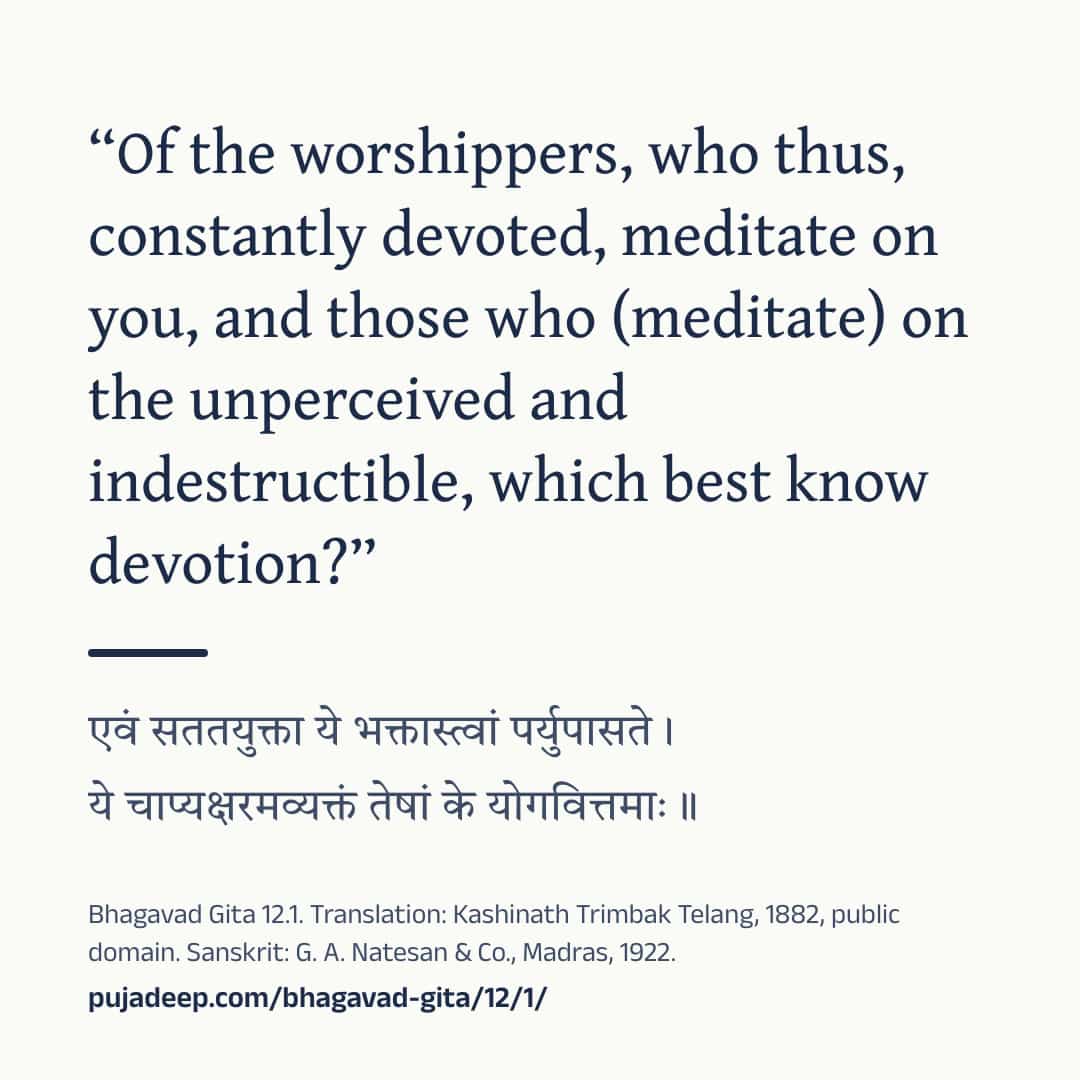
एवं सततयुक्ता ये भक्तास्त्वां पर्युपासते ।
ये चाप्यक्षरमव्यक्तं तेषां के योगवित्तमाः ॥

“Of the worshippers, who thus, constantly devoted, meditate on you, and those who (meditate) on the unperceived and indestructible, which best know devotion?”
(K. T. Telang, The Bhagavadgîtâ (The Sacred Books of the East, vol. VIII, Oxford: Clarendon Press, 1882), p. 99, public domain)

“Those devotees who ever harmonised worship Thee, and those also (who worship) the Indestructible, the Unmanifested, whether of these is the more learned in Yoga?”
(Annie Besant, The Bhagavad Gîtâ, or The Lord's Song (London: Theosophical Publishing Society, 1895), p. 118, public domain)

“Those devotees who, ever-steadfast, thus worship Thee, and those also who worship the Imperishable, the Unmanifested,—which of them are better versed in Yoga?”
(Swami Swarupananda, Srimad-Bhagavad-Gita (Mayavati: Prabuddha Bharata Press, 1909; first printed in Prabuddha Bharata, 1907–1909), p. 242, public domain)

Sanskrit: G. A. Natesan & Co., Madras, 1922.
https://pujadeep.com/bhagavad-gita/12/1/ Nothing is sent from this site. Your own app sends it, to the chat you choose. The picture quotes the translation you chose on this page, with its name and year.
Sanskrit text: The Bhagavad-Gita, or The Lord's Song, with the text in Devanagari and an English translation, 1922. Meanings: written for Pujadeep and checked against the cited edition. Source and changes
Questions families ask
Who speaks Bhagavad Gita 12.1?
Arjuna speaks this verse, in chapter 12 (Bhakti Yoga).
Where does the Sanskrit text come from?
Sanskrit text: The Bhagavad-Gita, or The Lord's Song, with the text in Devanagari and an English translation, 1922. Meanings: written for Pujadeep and checked against the cited edition. See the source
Is the meaning on this page a translation?
Explanation written for this site from the sources listed here, and checked against the cited edition. It is not a translation and not the only way to read the text. Free to quote with credit.
Source and licence
- Sanskrit text
- The Bhagavad-Gita, or The Lord's Song, with the text in Devanagari and an English translation (Annie Besant, G. A. Natesan & Co., Madras, 1922). Public domain. The Sanskrit on these pages was read from this printing’s page images.
- Translation
- The Bhagavadgîtâ with the Sanatsugâtîya and the Anugîtâ, translated by Kâshinâth Trimbak Telang (The Sacred Books of the East, vol. VIII, ed. F. Max Müller) (Kashinath Trimbak Telang, F. Max Müller, Clarendon Press, Oxford, 1882). Public domain. Shown verbatim, as printed.
- Translation
- The Bhagavad Gîtâ, or The Lord's Song, translated by Annie Besant (Annie Besant, Theosophical Publishing Society, London, 1895). Public domain. Shown verbatim, as printed.
- Translation
- Srimad-Bhagavad-Gita, with Sanskrit Text; Paraphrase with Word-by-word Literal Translation; English Rendering and Comments, Index, &c., by the Swami Swarupananda (Himalayan Series, No. XX) (Swami Swarupananda, The Editors and Publishers, Advaita Ashrama, Mayavati, Prabuddha Bharata Press, Mayavati, Almora, Himalayas, 1909). Public domain. Shown verbatim, as printed.
- Commentary
- The Bhagavad-Gita, with the commentary of Sri Sankaracharya, translated by A. Mahadeva Sastri (2nd ed., Mysore: G. T. A. Printing Works, 1901) (Public-domain scan, University of California Libraries). Summarised in our own words; none of its text is reproduced.
- Commentary
- Sri Bhagavad-Gita with Sri Ramanujacharya's Visishtadvaita commentary, translated by A. Govindacharya (Madras, 1898) (Scan uploaded to archive.org (folkscanomy collection)). Summarised in our own words; none of its text is reproduced.
- Commentary
- The Bhagavad-Gita: translation and commentaries in English according to Sri Madhwacharya's Bhashyas, by S. Subba Rau (Madras, 1906) (Scan uploaded to archive.org (folkscanomy collection)). Summarised in our own words; none of its text is reproduced.
- Common wording
- In this text, 32 words follow today's common wording, checked against sanskritdocuments.org; Sanskrit Wikisource; Gita Press, Gorakhpur; GRETIL, Göttingen and Bhaktivedanta Book Trust.
- Our explanation
- Explanation written for this site from the sources listed here, and checked against the cited edition. It is not a translation and not the only way to read the text. Free to quote with credit.
- Checked
- Checked against the cited edition, October 27, 2026.