Bhagavad Gita 11.55: meaning and translation
Chapter 11: Vishvarupa Darshana Yoga. Krishna says
Krishna closes the chapter.
Click or tap a word for its meaning and its dictionary page.
Text and layers
Text and layers
These choices stay in this browser.
Bhagavad Gita 11.55
मत्कर्मकृन्मत्परमो मद्भक्तः सङ्गवर्जितः ।निर्वैरः सर्वभूतेषु यः स मामेति पाण्डव ॥
Matkarmakrinmatparamo madbhaktah sangavarjitahNirvairah sarvabhuteshu yah sa mameti pandava
matkarmakṛnmatparamo madbhaktaḥ saṅgavarjitaḥ |nirvairaḥ sarvabhūteṣu yaḥ sa māmeti pāṇḍava ||
Our explanation Krishna closes the chapter. He says that whoever does his work for him, holds him as the highest, is devoted to him, is free from attachment and bears no enmity towards any being, comes to him, Pāṇḍava. Shankara calls this verse the essence of the whole Gita's teaching.
हिंदी अर्थ कृष्ण अध्याय पूरा करते हैं। वे कहते हैं कि हे पांडव, जो उनके लिए कर्म करता है, उन्हें परम मानता है, उनका भक्त है, आसक्ति से रहित है और किसी भी प्राणी से वैर नहीं रखता, वह उन्हें प्राप्त होता है। शंकराचार्य इस श्लोक को पूरी गीता के उपदेश का सार कहते हैं।
Word by word
Every word, with its dictionary page
Word by word
- मत्कर्मकृत् matkarmakṛt · doing work for "me" (Krishna) (compound (masculine), nominative singular) Dictionary: 1. mad, Monier-Williams 1899, p. 777, col. 2 “base of the first pers. pron. in the sg. number (esp. in comp.)”; karman, Monier-Williams 1899, p. 258, col. 2 “act, action, performance, business”; 1. kṛt, Monier-Williams 1899, p. 301, col. 3
- मत्परमः matparamaḥ · holding "me" (Krishna) supreme (compound (masculine), nominative singular) Dictionary: mat-para, Monier-Williams 1899, p. 777, col. 2 “devoted to me”
- मद्भक्तः madbhaktaḥ · devoted to "me" (Krishna) (compound (masculine), nominative singular) Dictionary: mad-bhakta, Monier-Williams 1899, p. 777, col. 2 “devoted to me”
- सङ्गवर्जितः saṅgavarjitaḥ · free from attachment (compound (masculine), nominative singular) Dictionary: saṅga-varjita, Monier-Williams 1899, p. 1132, col. 3 “free from attachment, indifferent, unworldly”
- निर्वैरः nirvairaḥ · without enmity (adjective (masculine), nominative singular) Dictionary: nir-vaira, Monier-Williams 1899, p. 542, col. 2 “free from enmity, peaceable, amicable”
- सर्वभूतेषु sarvabhūteṣu · toward all beings (compound (neuter), locative plural) Dictionary: sarva-bhūta, Monier-Williams 1899, p. 1186, col. 2 “all beings”
- यः yaḥ · who (pronoun (masculine), nominative singular) Dictionary: yad, Monier-Williams 1899, p. 844, col. 2 “who, which, what, whichever, whatever, that”
- सः saḥ · he (pronoun (masculine), nominative singular) Dictionary: tad, Monier-Williams 1899, p. 434, col. 1 “m. he, f. she, n. it, that, this”
- माम् mām · to "me" (Krishna) (pronoun, accusative singular) Dictionary: 1. mad, Monier-Williams 1899, p. 777, col. 2 “base of the first pers. pron. in the sg. number (esp. in comp.)”
- एति eti · comes (present, 3rd person singular) Dictionary: 5. i, Monier-Williams 1899, p. 163, col. 3 “to arrive at, reach, obtain”
- पाण्डव pāṇḍava · O Pandava (Arjuna) (noun (masculine), vocative singular) Dictionary: pāṇḍava, Monier-Williams 1899, p. 616, col. 2 “a son or descendant of Pāṇḍu”
Old translations
Kashinath Trimbak Telang, 1882. Public domain. Page 99.
He who performs acts for (propitiating) me, to whom I am the highest (object), who is my devotee, who is free from attachment, and who has no enmity towards any being, he, O son of Pându! comes to me.
Compare 3 translations
Kashinath Trimbak Telang, 1882. Public domain. Page 99.
He who performs acts for (propitiating) me, to whom I am the highest (object), who is my devotee, who is free from attachment, and who has no enmity towards any being, he, O son of Pându! comes to me.
You are reading this one
Annie Besant, 1895. Public domain. Page 116–117.
He who doeth actions for Me, whose supreme Good I am, My devotee, freed from attachment, without hatred of any being, he cometh unto Me, O Pândava.
You are reading this one
Swami Swarupananda, 1909 (first printed 1907). Public domain. Page 241.
He who does work for Me alone and has Me for his goal, is devoted to Me, is freed from attachment, and bears enmity towards no creature—he entereth into Me, O Pándava.
You are reading this one
Cite this verse
The translation: K. T. Telang, The Bhagavadgîtâ (The Sacred Books of the East, vol. VIII, Oxford: Clarendon Press, 1882), p. 99. Bhagavad Gita 11.55.
The translation: Annie Besant, The Bhagavad Gîtâ, or The Lord's Song (London: Theosophical Publishing Society, 1895), pp. 116–117. Bhagavad Gita 11.55.
The translation: Swami Swarupananda, Srimad-Bhagavad-Gita (Mayavati: Prabuddha Bharata Press, 1909; first printed in Prabuddha Bharata, 1907–1909), p. 241. Bhagavad Gita 11.55.
Our explanation: “Bhagavad Gita 11.55: meaning and translation.” Pujadeep. Updated October 27, 2026. https://pujadeep.com/bhagavad-gita/11/55/
Pujadeep’s explanations are free to quote with credit: name Pujadeep and link to the page. How to credit
Classical readings, by school
No readings by school on this verse yet.
Share
Show the ways to share
Send one picture or the text to one chat. The picture names its source and the address of this page.
Drawing the picture
See the words
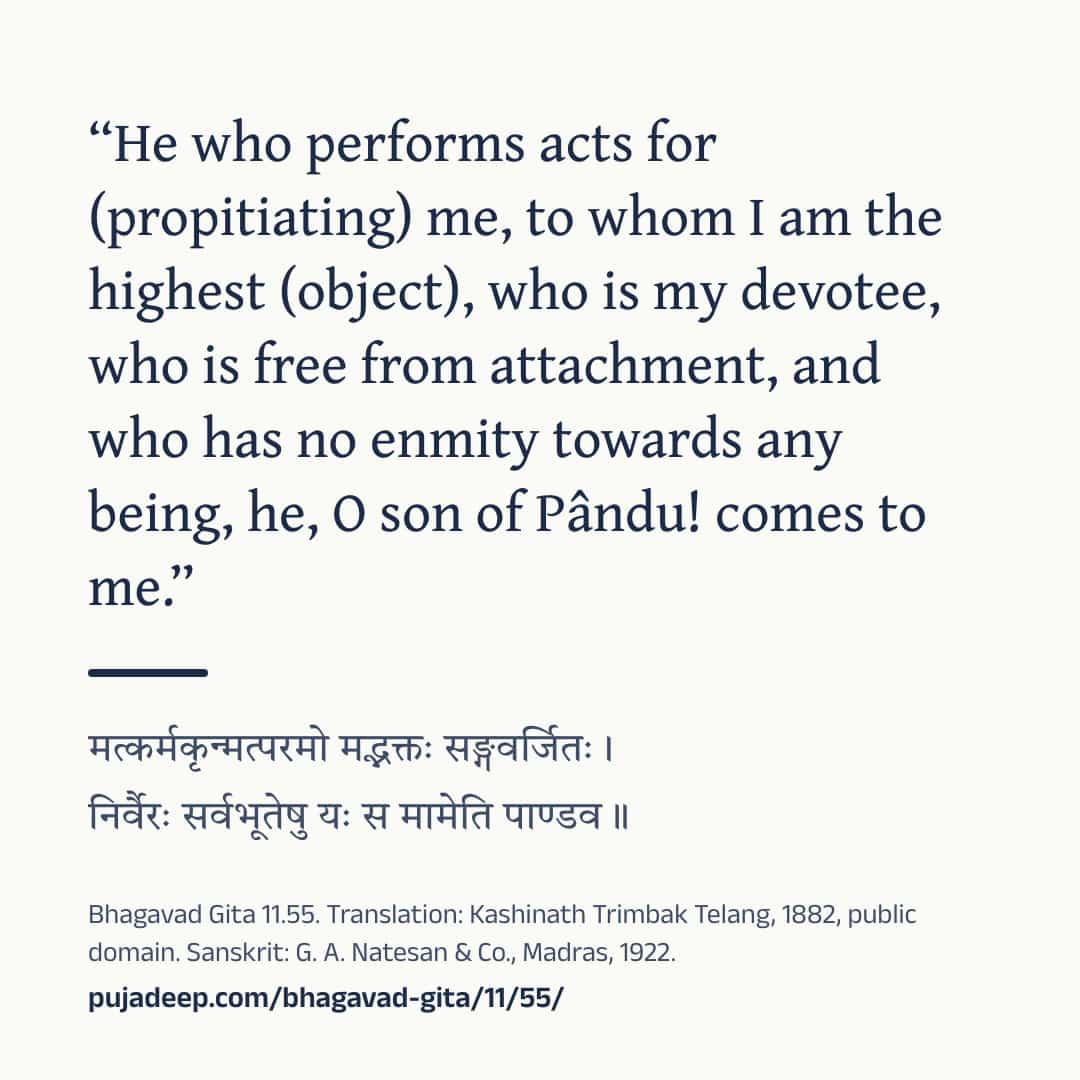
Bhagavad Gita 11.55

मत्कर्मकृन्मत्परमो मद्भक्तः सङ्गवर्जितः ।
निर्वैरः सर्वभूतेषु यः स मामेति पाण्डव ॥

“He who performs acts for (propitiating) me, to whom I am the highest (object), who is my devotee, who is free from attachment, and who has no enmity towards any being, he, O son of Pându! comes to me.”
(K. T. Telang, The Bhagavadgîtâ (The Sacred Books of the East, vol. VIII, Oxford: Clarendon Press, 1882), p. 99, public domain)

“He who doeth actions for Me, whose supreme Good I am, My devotee, freed from attachment, without hatred of any being, he cometh unto Me, O Pândava.”
(Annie Besant, The Bhagavad Gîtâ, or The Lord's Song (London: Theosophical Publishing Society, 1895), pp. 116–117, public domain)

“He who does work for Me alone and has Me for his goal, is devoted to Me, is freed from attachment, and bears enmity towards no creature—he entereth into Me, O Pándava.”
(Swami Swarupananda, Srimad-Bhagavad-Gita (Mayavati: Prabuddha Bharata Press, 1909; first printed in Prabuddha Bharata, 1907–1909), p. 241, public domain)

Sanskrit: G. A. Natesan & Co., Madras, 1922.
https://pujadeep.com/bhagavad-gita/11/55/ Nothing is sent from this site. Your own app sends it, to the chat you choose. The picture quotes the translation you chose on this page, with its name and year.
Sanskrit text: The Bhagavad-Gita, or The Lord's Song, with the text in Devanagari and an English translation, 1922. Meanings: written for Pujadeep and checked against the cited edition. Source and changes
Questions families ask
Who speaks Bhagavad Gita 11.55?
Krishna speaks this verse, in chapter 11 (Vishvarupa Darshana Yoga).
Where does the Sanskrit text come from?
Sanskrit text: The Bhagavad-Gita, or The Lord's Song, with the text in Devanagari and an English translation, 1922. Meanings: written for Pujadeep and checked against the cited edition. See the source
Is the meaning on this page a translation?
Explanation written for this site from the sources listed here, and checked against the cited edition. It is not a translation and not the only way to read the text. Free to quote with credit.
Source and licence
- Sanskrit text
- The Bhagavad-Gita, or The Lord's Song, with the text in Devanagari and an English translation (Annie Besant, G. A. Natesan & Co., Madras, 1922). Public domain. The Sanskrit on these pages was read from this printing’s page images.
- Translation
- The Bhagavadgîtâ with the Sanatsugâtîya and the Anugîtâ, translated by Kâshinâth Trimbak Telang (The Sacred Books of the East, vol. VIII, ed. F. Max Müller) (Kashinath Trimbak Telang, F. Max Müller, Clarendon Press, Oxford, 1882). Public domain. Shown verbatim, as printed.
- Translation
- The Bhagavad Gîtâ, or The Lord's Song, translated by Annie Besant (Annie Besant, Theosophical Publishing Society, London, 1895). Public domain. Shown verbatim, as printed.
- Translation
- Srimad-Bhagavad-Gita, with Sanskrit Text; Paraphrase with Word-by-word Literal Translation; English Rendering and Comments, Index, &c., by the Swami Swarupananda (Himalayan Series, No. XX) (Swami Swarupananda, The Editors and Publishers, Advaita Ashrama, Mayavati, Prabuddha Bharata Press, Mayavati, Almora, Himalayas, 1909). Public domain. Shown verbatim, as printed.
- Common wording
- In this text, 32 words follow today's common wording, checked against sanskritdocuments.org; Sanskrit Wikisource; Gita Press, Gorakhpur; GRETIL, Göttingen and Bhaktivedanta Book Trust.
- Our explanation
- Explanation written for this site from the sources listed here, and checked against the cited edition. It is not a translation and not the only way to read the text. Free to quote with credit.
- Checked
- Checked against the cited edition, October 27, 2026.