Bhagavad Gita 11.52: meaning and translation
Chapter 11: Vishvarupa Darshana Yoga. Krishna says
Krishna speaks.
Click or tap a word for its meaning and its dictionary page.
Text and layers
Text and layers
These choices stay in this browser.
Bhagavad Gita 11.52
श्रीभगवानुवाच ।
सुदुर्दर्शमिदं रूपं दृष्टवानसि यन्मम ।देवा अप्यस्य रूपस्य नित्यं दर्शनकाङ्क्षिणः ॥
Sudurdarshamidam rupam drishtavanasi yanmamaDeva apyasya rupasya nityam darshanakankshinah
sudurdarśamidaṃ rūpaṃ dṛṣṭavānasi yanmama |devā apyasya rūpasya nityaṃ darśanakāṅkṣiṇaḥ ||
Our explanation Krishna speaks. He says this form of his that Arjuna has seen is very hard to see; even the gods always long to see it. The schools read this verse differently (see the views).
हिंदी अर्थ कृष्ण बोलते हैं। वे कहते हैं कि उनका यह रूप, जो अर्जुन ने देखा है, देख पाना बहुत कठिन है; देवता भी सदा इसे देखने की इच्छा रखते हैं। इस श्लोक को परंपराएँ अलग-अलग ढंग से पढ़ती हैं।
Word by word
Every word, with its dictionary page
Word by word
- सुदुर्दर्शम् sudurdarśam · very hard to see (adjective (neuter), accusative singular) Dictionary: su-durdarśa, Monier-Williams 1899, p. 1225, col. 1 “very d° to be discerned or seen”
- इदम् idam · this (pronoun (neuter), accusative singular) Dictionary: 1. idam, Monier-Williams 1899, p. 165, col. 2 “this, this here”
- रूपम् rūpam · form (noun (neuter), accusative singular) Dictionary: rūpa, Monier-Williams 1899, p. 885, col. 3 “form, shape, figure”
- दृष्टवान् dṛṣṭavān · have seen (past active participle (masculine), nominative singular) Dictionary: dṛṣṭa-vat, Monier-Williams 1899, p. 491, col. 3 “having seen or beheld”
- असि asi · (you) are (present, 2nd person singular) Dictionary: 1. as, Monier-Williams 1899, p. 117, col. 2 “to be, live, exist, be present”
- यत् yat · which (pronoun (neuter), accusative singular) Dictionary: yad, Monier-Williams 1899, p. 844, col. 2 “who, which, what, whichever, whatever, that”
- मम mama · "my" (Krishna's) (pronoun, genitive singular) Dictionary: 1. mad, Monier-Williams 1899, p. 777, col. 2 “base of the first pers. pron. in the sg. number (esp. in comp.)”
- देवाः devāḥ · the gods (noun (masculine), nominative plural) Dictionary: deva, Monier-Williams 1899, p. 492, col. 2 “a deity, god”
- अपि api · even (indeclinable) Dictionary: api, Monier-Williams 1899, p. 55, col. 1 “even, also, very”
- अस्य asya · of this (pronoun (neuter), genitive singular) Dictionary: 1. idam, Monier-Williams 1899, p. 165, col. 2 “this, this here”
- रूपस्य rūpasya · of the form (noun (neuter), genitive singular) Dictionary: rūpa, Monier-Williams 1899, p. 885, col. 3 “form, shape, figure”
- नित्यम् nityam · always (indeclinable) Dictionary: nitya, Monier-Williams 1899, p. 547, col. 2 “(am), ind. always, constantly, regularly”
- दर्शनकाङ्क्षिणः darśanakāṅkṣiṇaḥ · longing to see (compound (masculine), nominative plural) Dictionary: darśana-kāṅkṣin, Monier-Williams 1899, p. 1328, col. 3 “longing for the sight of (comp.)”
Old translations
Kashinath Trimbak Telang, 1882. Public domain. Page 99.
The Deity said:
Even the gods are always desiring to see this form of mine, which it is difficult to get a sight of, and which you have seen.
Compare 3 translations
Kashinath Trimbak Telang, 1882. Public domain. Page 99.
The Deity said:
Even the gods are always desiring to see this form of mine, which it is difficult to get a sight of, and which you have seen.
You are reading this one
Annie Besant, 1895. Public domain. Page 116.
The Blessed Lord said:
This Form of Mine beholden by thee is very hard to see. Verily the Gods ever long to behold this Form.
You are reading this one
Swami Swarupananda, 1909 (first printed 1907). Public domain. Page 240.
The Blessed Lord said:
Very hard indeed it is to see this Form of Mine which thou hast seen. Even the Devas ever long to behold this Form.
You are reading this one
Cite this verse
The translation: K. T. Telang, The Bhagavadgîtâ (The Sacred Books of the East, vol. VIII, Oxford: Clarendon Press, 1882), p. 99. Bhagavad Gita 11.52.
The translation: Annie Besant, The Bhagavad Gîtâ, or The Lord's Song (London: Theosophical Publishing Society, 1895), p. 116. Bhagavad Gita 11.52.
The translation: Swami Swarupananda, Srimad-Bhagavad-Gita (Mayavati: Prabuddha Bharata Press, 1909; first printed in Prabuddha Bharata, 1907–1909), p. 240. Bhagavad Gita 11.52.
Our explanation: “Bhagavad Gita 11.52: meaning and translation.” Pujadeep. Updated October 27, 2026. https://pujadeep.com/bhagavad-gita/11/52/
Pujadeep’s explanations are free to quote with credit: name Pujadeep and link to the page. How to credit
Classical readings, by school
Each reading is named by its school. None is presented as the only meaning.
What Advaita, Vishishtadvaita and Dvaita teach, in short
Shankara Advaita
Shankara says the gods long to see this form, yet they have not seen it as Arjuna has, and never will.
Source: The Bhagavad-Gita, with the commentary of Sri Sankaracharya, translated by A. Mahadeva Sastri (2nd ed., Mysore: G. T. A. Printing Works, 1901), commentary on 11.52, p. 263. Summarised in our own words; none of its text is reproduced.
Ramanuja Vishishtadvaita
Ramanuja says this form shows the Lord as the director, refuge and cause of all; even the gods, who always long to see it, have not seen it.
Source: Sri Bhagavad-Gita with Sri Ramanujacharya's Visishtadvaita commentary, translated by A. Govindacharya (Madras, 1898), commentary on 11.52, p. 374. Summarised in our own words; none of its text is reproduced.
Madhva Dvaita
Madhva divides sudurdarśa into su-darśa, a joy to see, and dur-darśa, hard and fearsome to see. In his reading devotees reach the sight easily and find joy in it, while for others it stays out of reach and brings fear. He also reads the gods as having seen the form, not only longing to.
Source: The Bhagavad-Gita: translation and commentaries in English according to Sri Madhwacharya's Bhashyas, by S. Subba Rau (Madras, 1906), commentary on 11.52, p. 234 (leaf n232). Summarised in our own words; none of its text is reproduced.
Share
Show the ways to share
Send one picture or the text to one chat. The picture names its source and the address of this page.
Drawing the picture
See the words
Bhagavad Gita 11.52

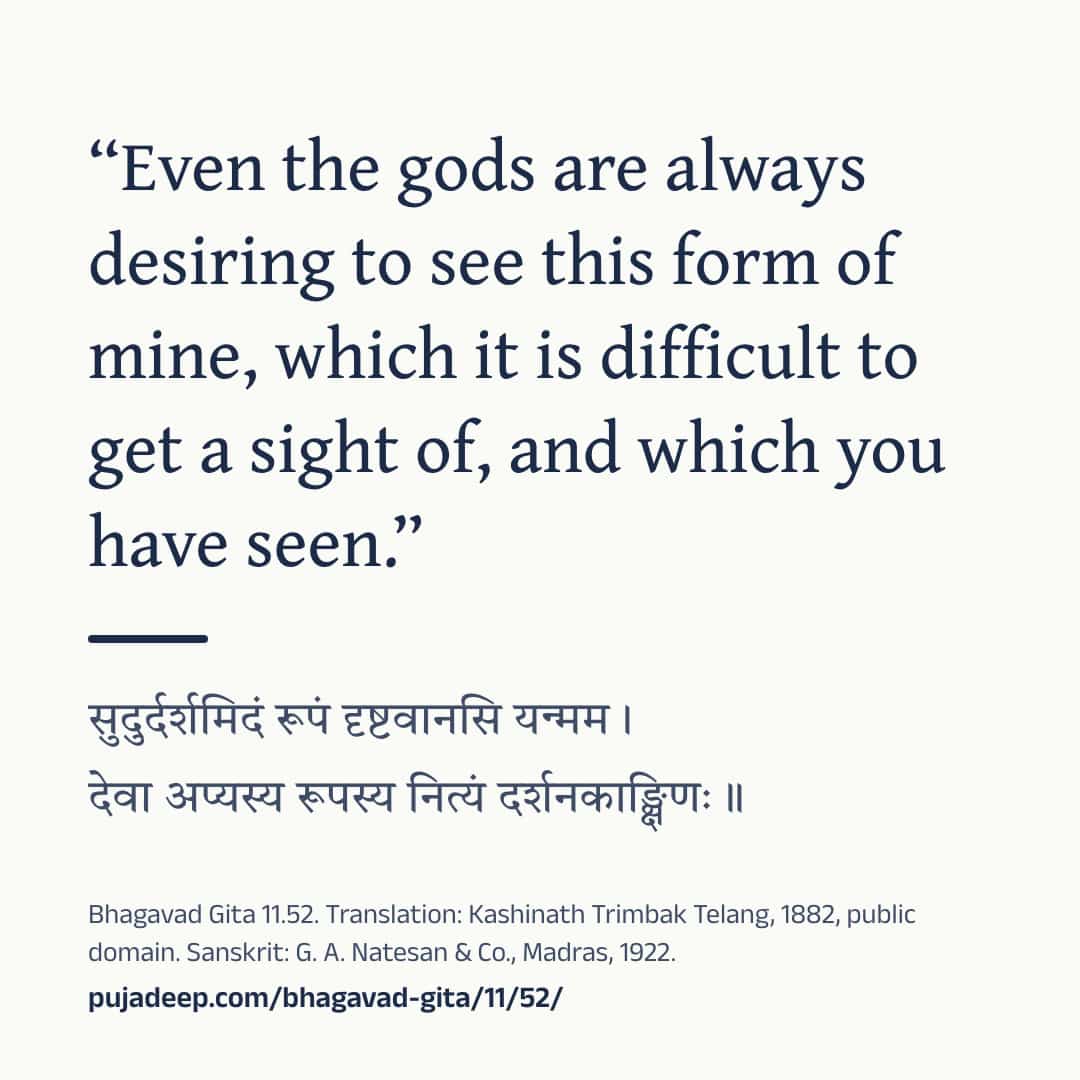
सुदुर्दर्शमिदं रूपं दृष्टवानसि यन्मम ।
देवा अप्यस्य रूपस्य नित्यं दर्शनकाङ्क्षिणः ॥

“Even the gods are always desiring to see this form of mine, which it is difficult to get a sight of, and which you have seen.”
(K. T. Telang, The Bhagavadgîtâ (The Sacred Books of the East, vol. VIII, Oxford: Clarendon Press, 1882), p. 99, public domain)

“This Form of Mine beholden by thee is very hard to see. Verily the Gods ever long to behold this Form.”
(Annie Besant, The Bhagavad Gîtâ, or The Lord's Song (London: Theosophical Publishing Society, 1895), p. 116, public domain)

“Very hard indeed it is to see this Form of Mine which thou hast seen. Even the Devas ever long to behold this Form.”
(Swami Swarupananda, Srimad-Bhagavad-Gita (Mayavati: Prabuddha Bharata Press, 1909; first printed in Prabuddha Bharata, 1907–1909), p. 240, public domain)

Sanskrit: G. A. Natesan & Co., Madras, 1922.
https://pujadeep.com/bhagavad-gita/11/52/ Nothing is sent from this site. Your own app sends it, to the chat you choose. The picture quotes the translation you chose on this page, with its name and year.
Sanskrit text: The Bhagavad-Gita, or The Lord's Song, with the text in Devanagari and an English translation, 1922. Meanings: written for Pujadeep and checked against the cited edition. Source and changes
Questions families ask
Who speaks Bhagavad Gita 11.52?
Krishna speaks this verse, in chapter 11 (Vishvarupa Darshana Yoga).
Where does the Sanskrit text come from?
Sanskrit text: The Bhagavad-Gita, or The Lord's Song, with the text in Devanagari and an English translation, 1922. Meanings: written for Pujadeep and checked against the cited edition. See the source
Is the meaning on this page a translation?
Explanation written for this site from the sources listed here, and checked against the cited edition. It is not a translation and not the only way to read the text. Free to quote with credit.
Source and licence
- Sanskrit text
- The Bhagavad-Gita, or The Lord's Song, with the text in Devanagari and an English translation (Annie Besant, G. A. Natesan & Co., Madras, 1922). Public domain. The Sanskrit on these pages was read from this printing’s page images.
- Translation
- The Bhagavadgîtâ with the Sanatsugâtîya and the Anugîtâ, translated by Kâshinâth Trimbak Telang (The Sacred Books of the East, vol. VIII, ed. F. Max Müller) (Kashinath Trimbak Telang, F. Max Müller, Clarendon Press, Oxford, 1882). Public domain. Shown verbatim, as printed.
- Translation
- The Bhagavad Gîtâ, or The Lord's Song, translated by Annie Besant (Annie Besant, Theosophical Publishing Society, London, 1895). Public domain. Shown verbatim, as printed.
- Translation
- Srimad-Bhagavad-Gita, with Sanskrit Text; Paraphrase with Word-by-word Literal Translation; English Rendering and Comments, Index, &c., by the Swami Swarupananda (Himalayan Series, No. XX) (Swami Swarupananda, The Editors and Publishers, Advaita Ashrama, Mayavati, Prabuddha Bharata Press, Mayavati, Almora, Himalayas, 1909). Public domain. Shown verbatim, as printed.
- Commentary
- The Bhagavad-Gita, with the commentary of Sri Sankaracharya, translated by A. Mahadeva Sastri (2nd ed., Mysore: G. T. A. Printing Works, 1901) (Public-domain scan, University of California Libraries). Summarised in our own words; none of its text is reproduced.
- Commentary
- Sri Bhagavad-Gita with Sri Ramanujacharya's Visishtadvaita commentary, translated by A. Govindacharya (Madras, 1898) (Scan uploaded to archive.org (folkscanomy collection)). Summarised in our own words; none of its text is reproduced.
- Commentary
- The Bhagavad-Gita: translation and commentaries in English according to Sri Madhwacharya's Bhashyas, by S. Subba Rau (Madras, 1906) (Scan uploaded to archive.org (folkscanomy collection)). Summarised in our own words; none of its text is reproduced.
- Common wording
- In this text, 32 words follow today's common wording, checked against sanskritdocuments.org; Sanskrit Wikisource; Gita Press, Gorakhpur; GRETIL, Göttingen and Bhaktivedanta Book Trust.
- Our explanation
- Explanation written for this site from the sources listed here, and checked against the cited edition. It is not a translation and not the only way to read the text. Free to quote with credit.
- Checked
- Checked against the cited edition, October 27, 2026.