Bhagavad Gita 11.50: meaning and translation
Chapter 11: Vishvarupa Darshana Yoga. Sanjaya says
Sanjaya speaks.
Click or tap a word for its meaning and its dictionary page.
Text and layers
Text and layers
These choices stay in this browser.
Bhagavad Gita 11.50
सञ्जय उवाच ।
इत्यर्जुनं वासुदेवस्तथोक्त्वा स्वकं रूपं दर्शयामास भूयः ।आश्वासयामास च भीतमेनम् भूत्वा पुनः सौम्यवपुर्महात्मा ॥
Ityarjunam vasudevastathoktva svakam rupam darshayamasa bhuyahAshvasayamasa cha bhitamenam bhutva punah saumyavapurmahatma
ityarjunaṃ vāsudevastathoktvā svakaṃ rūpaṃ darśayāmāsa bhūyaḥ |āśvāsayāmāsa ca bhītamenam bhūtvā punaḥ saumyavapurmahātmā ||
Our explanation Sanjaya speaks. Having spoken so to Arjuna, he says, Vāsudeva showed his own form again; and the great one (mahātmā), taking a gentle form once more, comforted Arjuna, who had been afraid.
हिंदी अर्थ संजय बोलते हैं। वे कहते हैं कि अर्जुन से ऐसा कहकर वासुदेव ने फिर अपना रूप दिखाया; और महात्मा ने फिर से सौम्य रूप धारण करके डरे हुए अर्जुन को धीरज बँधाया।
Word by word
Every word, with its dictionary page
Word by word
- इति iti · thus (indeclinable) Dictionary: 2. iti, Monier-Williams 1899, p. 165, col. 1 “in this manner, thus”
- अर्जुनम् arjunam · to Arjuna (noun (masculine), accusative singular) Dictionary: arjuna, Monier-Williams 1899, p. 90, col. 1
- वासुदेवः vāsudevaḥ · Vasudeva (Krishna) (noun (masculine), nominative singular) Dictionary: vāsudeva, Monier-Williams 1899, p. 948, col. 2 “(fr. vasu-d°) patr. of Kṛishṇa”
- तथा tathā · so (indeclinable) Dictionary: tathā, Monier-Williams 1899, p. 433, col. 3 “in that manner, so, thus”
- उक्त्वा uktvā · having said (absolutive (having done)) Dictionary: vac, Monier-Williams 1899, p. 912, col. 1 “to speak, say, tell, utter, announce”
- स्वकम् svakam · his own (adjective (neuter), accusative singular) Dictionary: svaka, Monier-Williams 1899, p. 1278, col. 1 “one's own”
- रूपम् rūpam · form (noun (neuter), accusative singular) Dictionary: rūpa, Monier-Williams 1899, p. 885, col. 3 “form, shape, figure”
- दर्शयामास darśayāmāsa · showed (causative periphrastic perfect, 3rd person singular) Dictionary: 1. dṛś, Monier-Williams 1899, p. 491, col. 2 “to see, behold, look at, regard, consider”
- भूयः bhūyaḥ · again (indeclinable) Dictionary: bhūyas, Monier-Williams 1899, p. 763, col. 3 “once more, again, anew”
- आश्वासयामास āśvāsayāmāsa · comforted (causative periphrastic perfect, 3rd person singular) Dictionary: ā-śvas, Monier-Williams 1899, p. 159, col. 2 “to encourage, comfort; to calm, console, cheer up”
- च ca · and (indeclinable) Dictionary: 2. ca, Monier-Williams 1899, p. 380, col. 1 “and, both, also, moreover, as well as”
- भीतम् bhītam · the frightened one (past participle (masculine), accusative singular) Dictionary: bhīta, Monier-Williams 1899, p. 758, col. 1 “frightened, alarmed, terrified, timid”
- एनम् enam · him (pronoun (masculine), accusative singular) Dictionary: 1. ena, Monier-Williams 1899, p. 232, col. 1 “he, she, it; this, that”
- भूत्वा bhūtvā · having become (absolutive (having done)) Dictionary: 1. bhū, Monier-Williams 1899, p. 760, col. 2 “to become, be”
- पुनः punaḥ · again (indeclinable) Dictionary: punar, Monier-Williams 1899, p. 633, col. 2 “again, once more”
- सौम्यवपुः saumyavapuḥ · of gentle form (compound (masculine), nominative singular) Dictionary: saumya-vapus, Monier-Williams 1899, p. 1254, col. 1 “having an agreeable form”
- महात्मा mahātmā · the great-souled one (compound (masculine), nominative singular) Dictionary: mahātman, Monier-Williams 1899, p. 796, col. 1 “‘high-souled,’ magnanimous, having gr° or noble nature, high-minded, noble”
1 printing differs
Edition differences. Another printing or text reads this place differently.
- Spelling A digital text reads Same words. At the printed line end the 1922 edition writes भीतमेनम्; the e-text writes भीतमेनं.
Old translations
Kashinath Trimbak Telang, 1882. Public domain. Page 98.
Sañgaya said:
Having thus spoken to Arguna, Vâsudeva again showed his own form, and the high-souled one becoming again of a mild form, comforted him who had been affrighted.
Compare 3 translations
Kashinath Trimbak Telang, 1882. Public domain. Page 98.
Sañgaya said:
Having thus spoken to Arguna, Vâsudeva again showed his own form, and the high-souled one becoming again of a mild form, comforted him who had been affrighted.
You are reading this one
Annie Besant, 1895. Public domain. Page 115–116.
Sanjaya said:
Vâsudeva, having thus spoken to Arjuna, again manifested His own Form, and consoled the terrified one, the Mahâtmâ again assuming a gentle form.
You are reading this one
Swami Swarupananda, 1909 (first printed 1907). Public domain. Page 239.
Sanjaya said:
So Vâsudeva, having thus spoken to Arjuna, showed again His own Form, and the Great-souled One, assuming His gentle Form, pacified him who was terrified.
You are reading this one
Cite this verse
The translation: K. T. Telang, The Bhagavadgîtâ (The Sacred Books of the East, vol. VIII, Oxford: Clarendon Press, 1882), p. 98. Bhagavad Gita 11.50.
The translation: Annie Besant, The Bhagavad Gîtâ, or The Lord's Song (London: Theosophical Publishing Society, 1895), pp. 115–116. Bhagavad Gita 11.50.
The translation: Swami Swarupananda, Srimad-Bhagavad-Gita (Mayavati: Prabuddha Bharata Press, 1909; first printed in Prabuddha Bharata, 1907–1909), p. 239. Bhagavad Gita 11.50.
Our explanation: “Bhagavad Gita 11.50: meaning and translation.” Pujadeep. Updated October 27, 2026. https://pujadeep.com/bhagavad-gita/11/50/
Pujadeep’s explanations are free to quote with credit: name Pujadeep and link to the page. How to credit
Classical readings, by school
No readings by school on this verse yet.
Share
Show the ways to share
Send one picture or the text to one chat. The picture names its source and the address of this page.
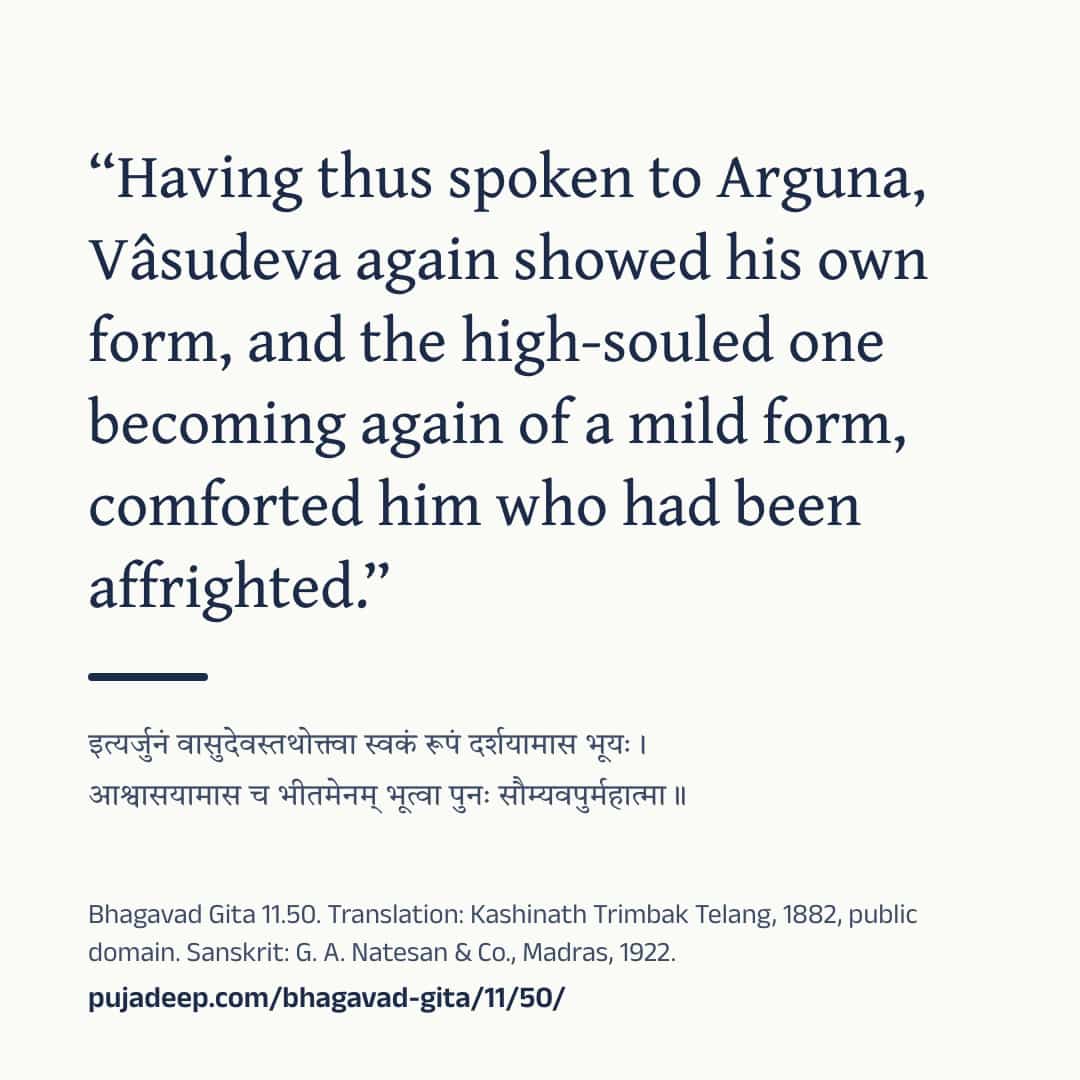
Drawing the picture
See the words
Bhagavad Gita 11.50

इत्यर्जुनं वासुदेवस्तथोक्त्वा स्वकं रूपं दर्शयामास भूयः ।
आश्वासयामास च भीतमेनम् भूत्वा पुनः सौम्यवपुर्महात्मा ॥

“Having thus spoken to Arguna, Vâsudeva again showed his own form, and the high-souled one becoming again of a mild form, comforted him who had been affrighted.”
(K. T. Telang, The Bhagavadgîtâ (The Sacred Books of the East, vol. VIII, Oxford: Clarendon Press, 1882), p. 98, public domain)

“Vâsudeva, having thus spoken to Arjuna, again manifested His own Form, and consoled the terrified one, the Mahâtmâ again assuming a gentle form.”
(Annie Besant, The Bhagavad Gîtâ, or The Lord's Song (London: Theosophical Publishing Society, 1895), pp. 115–116, public domain)

“So Vâsudeva, having thus spoken to Arjuna, showed again His own Form, and the Great-souled One, assuming His gentle Form, pacified him who was terrified.”
(Swami Swarupananda, Srimad-Bhagavad-Gita (Mayavati: Prabuddha Bharata Press, 1909; first printed in Prabuddha Bharata, 1907–1909), p. 239, public domain)

Sanskrit: G. A. Natesan & Co., Madras, 1922.
https://pujadeep.com/bhagavad-gita/11/50/ Nothing is sent from this site. Your own app sends it, to the chat you choose. The picture quotes the translation you chose on this page, with its name and year.
Sanskrit text: The Bhagavad-Gita, or The Lord's Song, with the text in Devanagari and an English translation, 1922. Meanings: written for Pujadeep and checked against the cited edition. Source and changes
Questions families ask
Who speaks Bhagavad Gita 11.50?
Sanjaya speaks this verse, in chapter 11 (Vishvarupa Darshana Yoga).
Where does the Sanskrit text come from?
Sanskrit text: The Bhagavad-Gita, or The Lord's Song, with the text in Devanagari and an English translation, 1922. Meanings: written for Pujadeep and checked against the cited edition. See the source
Is the meaning on this page a translation?
Explanation written for this site from the sources listed here, and checked against the cited edition. It is not a translation and not the only way to read the text. Free to quote with credit.
Source and licence
- Sanskrit text
- The Bhagavad-Gita, or The Lord's Song, with the text in Devanagari and an English translation (Annie Besant, G. A. Natesan & Co., Madras, 1922). Public domain. The Sanskrit on these pages was read from this printing’s page images.
- Translation
- The Bhagavadgîtâ with the Sanatsugâtîya and the Anugîtâ, translated by Kâshinâth Trimbak Telang (The Sacred Books of the East, vol. VIII, ed. F. Max Müller) (Kashinath Trimbak Telang, F. Max Müller, Clarendon Press, Oxford, 1882). Public domain. Shown verbatim, as printed.
- Translation
- The Bhagavad Gîtâ, or The Lord's Song, translated by Annie Besant (Annie Besant, Theosophical Publishing Society, London, 1895). Public domain. Shown verbatim, as printed.
- Translation
- Srimad-Bhagavad-Gita, with Sanskrit Text; Paraphrase with Word-by-word Literal Translation; English Rendering and Comments, Index, &c., by the Swami Swarupananda (Himalayan Series, No. XX) (Swami Swarupananda, The Editors and Publishers, Advaita Ashrama, Mayavati, Prabuddha Bharata Press, Mayavati, Almora, Himalayas, 1909). Public domain. Shown verbatim, as printed.
- Common wording
- In this text, 32 words follow today's common wording, checked against sanskritdocuments.org; Sanskrit Wikisource; Gita Press, Gorakhpur; GRETIL, Göttingen and Bhaktivedanta Book Trust.
- Our explanation
- Explanation written for this site from the sources listed here, and checked against the cited edition. It is not a translation and not the only way to read the text. Free to quote with credit.
- Checked
- Checked against the cited edition, October 27, 2026.