Bhagavad Gita 11.42: meaning and translation
Chapter 11: Vishvarupa Darshana Yoga. Arjuna says
... and for any disrespect shown in jest, at play, at rest, while sitting or at meals, alone or in front of others, Arjuna asks Krishna, the unfallen one (Acyuta), who is beyond measure, to forgive him.
Click or tap a word for its meaning and its dictionary page.
Text and layers
Text and layers
These choices stay in this browser.
Bhagavad Gita 11.42
यच्चाऽवहासार्थमसत्कृतोऽसि विहारशय्यासनभोजनेषु ।एकोऽथवाऽप्यच्युत तत्समक्षम् तत्क्षामये त्वामहमप्रमेयम् ॥
Yachchavahasarthamasatkritosi viharashayyasanabhojaneshuEkothavapyachyuta tatsamaksham tatkshamaye tvamahamaprameyam
yaccā’vahāsārthamasatkṛto’si vihāraśayyāsanabhojaneṣu |eko’thavā’pyacyuta tatsamakṣam tatkṣāmaye tvāmahamaprameyam ||
Our explanation ... and for any disrespect shown in jest, at play, at rest, while sitting or at meals, alone or in front of others, Arjuna asks Krishna, the unfallen one (Acyuta), who is beyond measure, to forgive him.
हिंदी अर्थ … और हँसी-मज़ाक में, खेलते, सोते, बैठते या भोजन करते समय, अकेले में या दूसरों के सामने, जो भी अनादर हुआ हो, उसके लिए अर्जुन अपार अच्युत कृष्ण से क्षमा माँगते हैं।
Word by word
Every word, with its dictionary page
Word by word
- यत् yat · and whatever (way) (indeclinable) Dictionary: yad, Monier-Williams 1899, p. 844, col. 2 “who, which, what, whichever, whatever, that”
- च ca · and (indeclinable) Dictionary: 2. ca, Monier-Williams 1899, p. 380, col. 1 “and, both, also, moreover, as well as”
- अवहासार्थम् avahāsārtham · for a joke (compound used as an adverb (for the sake of)) Dictionary: ava-hāsa, Monier-Williams 1899, p. 106, col. 2 “jest, joke”; artha, Monier-Williams 1899, p. 90, col. 3 “aim, purpose”
- असत्कृतः asatkṛtaḥ · treated without respect (past participle (masculine), nominative singular) Dictionary: a-sat-kṛta, Monier-Williams 1899, p. 118, col. 2 “badly treated”
- असि asi · you were (present, 2nd person singular) Dictionary: 1. as, Monier-Williams 1899, p. 117, col. 2 “to be, live, exist, be present”
- विहारशय्यासनभोजनेषु vihāraśayyāsanabhojaneṣu · at play, rest, sitting or meals (compound (neuter), locative plural) Dictionary: vi-hāra, Monier-Williams 1899, p. 1003, col. 3 “sport, play, pastime, diversion, enjoyment, pleasure”; śayyā, Monier-Williams 1899, p. 1056, col. 1 “lying, reposing, sleeping”; 1. āsana, Monier-Williams 1899, p. 159, col. 3 “seat, place, stool”; bhojana, Monier-Williams 1899, p. 768, col. 1 “a meal, food ...; anything enjoyed or used”
- एकः ekaḥ · alone (adjective (masculine), nominative singular) Dictionary: eka, Monier-Williams 1899, p. 227, col. 3 “alone, solitary, single”
- अथवा athavā · or (indeclinable) Dictionary: atha, Monier-Williams 1899, p. 17, col. 3 “or; (when repeated) either or; or rather; or perhaps”
- अपि api · even (indeclinable) Dictionary: api, Monier-Williams 1899, p. 55, col. 1 “even, also, very”
- अच्युत acyuta · O Achyuta (Krishna) (noun (masculine), vocative singular) Dictionary: a-cyuta, Monier-Williams 1899, p. 9, col. 2 “not fallen; firm, solid; imperishable”
- तत्समक्षम् tatsamakṣam · in their presence (compound used as an adverb) Dictionary: tad, Monier-Williams 1899, p. 434, col. 1 “m. he, f. she, n. it, that, this”; sam-akṣa, Monier-Williams 1899, p. 1153, col. 2 “being within sight or before the eyes”
- तत् tat · for that (pronoun (neuter), accusative singular) Dictionary: tad, Monier-Williams 1899, p. 434, col. 1 “m. he, f. she, n. it, that, this”
- क्षामये kṣāmaye · ask forgiveness (causative present, 1st person singular) Dictionary: 1. kṣam, Monier-Williams 1899, p. 326, col. 2 “pardon, forgive anything”
- त्वाम् tvām · of you (pronoun, accusative singular) Dictionary: yuṣmad, Monier-Williams 1899, p. 855, col. 3 “the base of the 2nd pers. pron. as used in comp.”
- अहम् aham · "I" (Arjuna) (pronoun, nominative singular) Dictionary: aham, Monier-Williams 1899, p. 124, col. 2 “nom. sg. ‘I,’”
- अप्रमेयम् aprameyam · the immeasurable one (adjective (masculine), accusative singular) Dictionary: a-prameya, Monier-Williams 1899, p. 58, col. 3 “immeasurable, unlimited, unfathomable”
1 printing differs
Edition differences. Another printing or text reads this place differently.
- Spelling A digital text reads Same words. The 1922 edition marks the merged vowels with avagrahas (यच्चाऽवहास, अथवाऽपि) and writes समक्षम् at the printed line end; the e-text writes यच्चावहास, अथवापि and समक्षं.
Old translations
Kashinath Trimbak Telang, 1882. Public domain. Page 97.
and whatever disrespect I have shown you for purposes of merriment, on (occasions of) play, sleep, dinner, or sitting (together), whether alone or in the presence (of friends),—for all that, O undegraded one! I ask pardon of you who are indefinable1.
This sentence begins in 11.41.
Footnotes (the translator’s own) - I. e. of whom it is impossible to ascertain whether he is such or such. Cf. p. 94 supra. ↩
Compare 3 translations
Kashinath Trimbak Telang, 1882. Public domain. Page 97.
and whatever disrespect I have shown you for purposes of merriment, on (occasions of) play, sleep, dinner, or sitting (together), whether alone or in the presence (of friends),—for all that, O undegraded one! I ask pardon of you who are indefinable1.
This sentence begins in 11.41.
Footnotes (the translator’s own) - I. e. of whom it is impossible to ascertain whether he is such or such. Cf. p. 94 supra. ↩
You are reading this one
Annie Besant, 1895. Public domain. Page 113.
If jesting, I irreverence showed to Thee,
At play, reposing, sitting or at meals,
Alone, O sinless One, or with my friends,
Forgive my error, O Thou Boundless One.
This sentence begins in 11.41.
You are reading this one
Swami Swarupananda, 1909 (first printed 1907). Public domain.
Swarupananda renders verses 41–42 together; see 11.41. Read it at 11.41
You are reading this one
Cite this verse
The translation: K. T. Telang, The Bhagavadgîtâ (The Sacred Books of the East, vol. VIII, Oxford: Clarendon Press, 1882), p. 97. Bhagavad Gita 11.42.
The translation: Annie Besant, The Bhagavad Gîtâ, or The Lord's Song (London: Theosophical Publishing Society, 1895), p. 113. Bhagavad Gita 11.42.
The translation: Swami Swarupananda, Srimad-Bhagavad-Gita (Mayavati: Prabuddha Bharata Press, 1909; first printed in Prabuddha Bharata, 1907–1909), p. 234. Bhagavad Gita 11.41–42.
Our explanation: “Bhagavad Gita 11.42: meaning and translation.” Pujadeep. Updated October 27, 2026. https://pujadeep.com/bhagavad-gita/11/42/
Pujadeep’s explanations are free to quote with credit: name Pujadeep and link to the page. How to credit
Classical readings, by school
No readings by school on this verse yet.
Share
Show the ways to share
Send one picture or the text to one chat. The picture names its source and the address of this page.
Drawing the picture
See the words
Bhagavad Gita 11.42

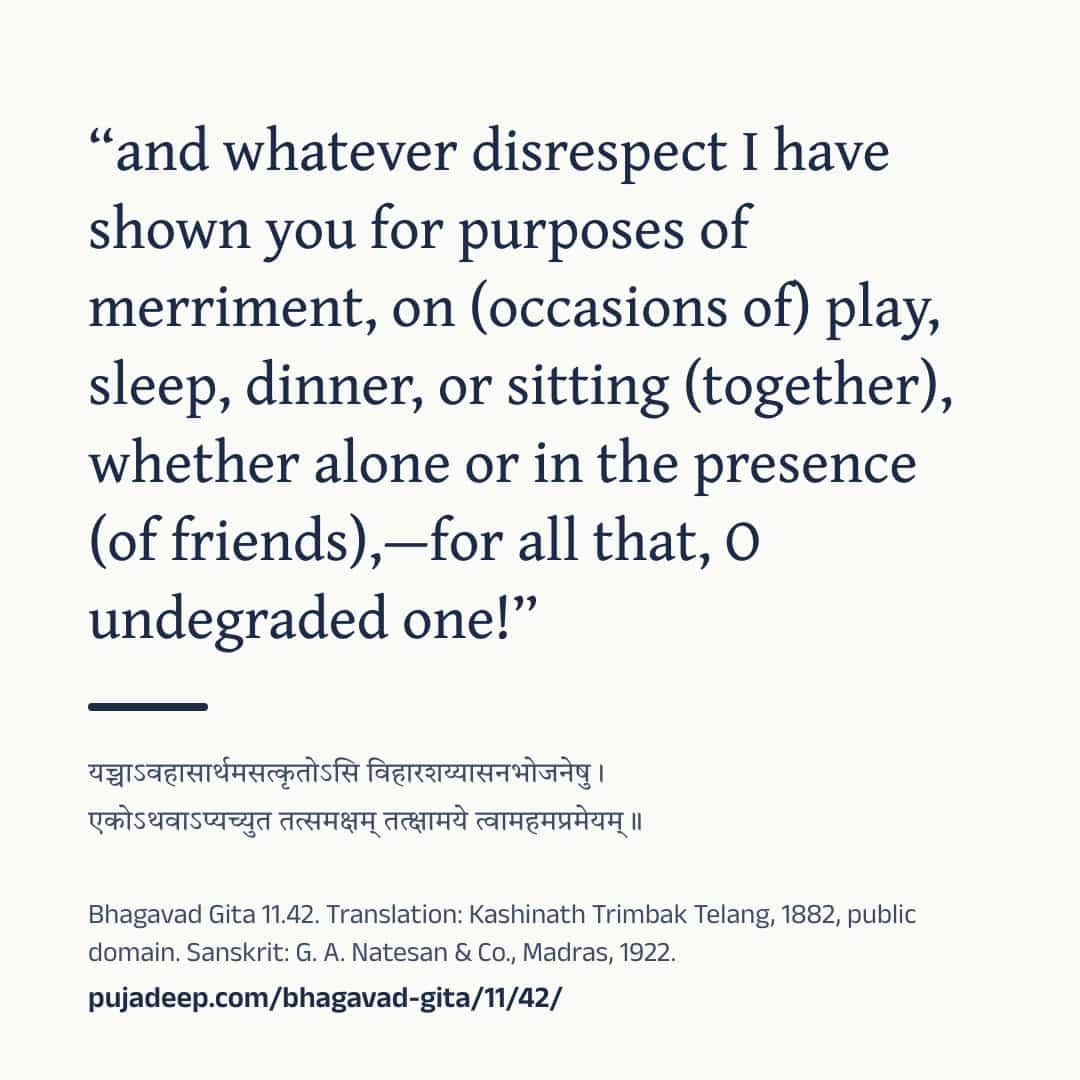
यच्चाऽवहासार्थमसत्कृतोऽसि विहारशय्यासनभोजनेषु ।
एकोऽथवाऽप्यच्युत तत्समक्षम् तत्क्षामये त्वामहमप्रमेयम् ॥

“and whatever disrespect I have shown you for purposes of merriment, on (occasions of) play, sleep, dinner, or sitting (together), whether alone or in the presence (of friends),—for all that, O undegraded one! I ask pardon of you who are indefinable.”
(K. T. Telang, The Bhagavadgîtâ (The Sacred Books of the East, vol. VIII, Oxford: Clarendon Press, 1882), p. 97, public domain)
This sentence begins in 11.41.

“If jesting, I irreverence showed to Thee, At play, reposing, sitting or at meals, Alone, O sinless One, or with my friends, Forgive my error, O Thou Boundless One.”
(Annie Besant, The Bhagavad Gîtâ, or The Lord's Song (London: Theosophical Publishing Society, 1895), p. 113, public domain)
This sentence begins in 11.41.

Sanskrit: G. A. Natesan & Co., Madras, 1922.
https://pujadeep.com/bhagavad-gita/11/42/ Nothing is sent from this site. Your own app sends it, to the chat you choose. The picture quotes the translation you chose on this page, with its name and year.
Sanskrit text: The Bhagavad-Gita, or The Lord's Song, with the text in Devanagari and an English translation, 1922. Meanings: written for Pujadeep and checked against the cited edition. Source and changes
Questions families ask
Who speaks Bhagavad Gita 11.42?
Arjuna speaks this verse, in chapter 11 (Vishvarupa Darshana Yoga).
Where does the Sanskrit text come from?
Sanskrit text: The Bhagavad-Gita, or The Lord's Song, with the text in Devanagari and an English translation, 1922. Meanings: written for Pujadeep and checked against the cited edition. See the source
Is the meaning on this page a translation?
Explanation written for this site from the sources listed here, and checked against the cited edition. It is not a translation and not the only way to read the text. Free to quote with credit.
Source and licence
- Sanskrit text
- The Bhagavad-Gita, or The Lord's Song, with the text in Devanagari and an English translation (Annie Besant, G. A. Natesan & Co., Madras, 1922). Public domain. The Sanskrit on these pages was read from this printing’s page images.
- Translation
- The Bhagavadgîtâ with the Sanatsugâtîya and the Anugîtâ, translated by Kâshinâth Trimbak Telang (The Sacred Books of the East, vol. VIII, ed. F. Max Müller) (Kashinath Trimbak Telang, F. Max Müller, Clarendon Press, Oxford, 1882). Public domain. Shown verbatim, as printed.
- Translation
- The Bhagavad Gîtâ, or The Lord's Song, translated by Annie Besant (Annie Besant, Theosophical Publishing Society, London, 1895). Public domain. Shown verbatim, as printed.
- Translation
- Srimad-Bhagavad-Gita, with Sanskrit Text; Paraphrase with Word-by-word Literal Translation; English Rendering and Comments, Index, &c., by the Swami Swarupananda (Himalayan Series, No. XX) (Swami Swarupananda, The Editors and Publishers, Advaita Ashrama, Mayavati, Prabuddha Bharata Press, Mayavati, Almora, Himalayas, 1909). Public domain. Shown verbatim, as printed.
- Common wording
- In this text, 32 words follow today's common wording, checked against sanskritdocuments.org; Sanskrit Wikisource; Gita Press, Gorakhpur; GRETIL, Göttingen and Bhaktivedanta Book Trust.
- Our explanation
- Explanation written for this site from the sources listed here, and checked against the cited edition. It is not a translation and not the only way to read the text. Free to quote with credit.
- Checked
- Checked against the cited edition, October 27, 2026.