Bhagavad Gita 11.38: meaning and translation
Chapter 11: Vishvarupa Darshana Yoga. Arjuna says
Arjuna says Krishna is the first god and the ancient Person (puruṣa), the highest resting place of this universe; the knower and what is to be known, and the highest abode.
Click or tap a word for its meaning and its dictionary page.
Text and layers
Text and layers
These choices stay in this browser.
Bhagavad Gita 11.38
त्वमादिदेवः पुरुषः पुराणस्त्वमस्य विश्वस्य परं निधानम् ।वेत्ताऽसि वेद्यं च परं च धाम त्वया ततं विश्वमनन्तरूप ॥
Tvamadidevah purushah puranastvamasya vishvasya param nidhanamVettasi vedyam cha param cha dhama tvaya tatam vishvamanantarupa
tvamādidevaḥ puruṣaḥ purāṇastvamasya viśvasya paraṃ nidhānam |vettā’si vedyaṃ ca paraṃ ca dhāma tvayā tataṃ viśvamanantarūpa ||
Our explanation Arjuna says Krishna is the first god and the ancient Person (puruṣa), the highest resting place of this universe; the knower and what is to be known, and the highest abode. The universe is pervaded by him, the one of endless forms. Telang's note: the commentators take 'resting place' to mean where the universe rests at the time of dissolution.
हिंदी अर्थ अर्जुन कहते हैं कि कृष्ण आदिदेव और पुराण पुरुष हैं, इस विश्व के परम आधार हैं; वे ही जानने वाले हैं और वे ही जानने योग्य हैं, और वे ही परम धाम हैं। अनंत रूपों वाले कृष्ण से यह विश्व व्याप्त है। तेलंग की टिप्पणी: टीकाकार “आधार” का अर्थ वह लेते हैं जिसमें प्रलय के समय विश्व टिका रहता है।
Word by word
Every word, with its dictionary page
Word by word
- त्वम् tvam · you (pronoun, nominative singular) Dictionary: yuṣmad, Monier-Williams 1899, p. 855, col. 3 “the base of the 2nd pers. pron. as used in comp.”
- आदिदेवः ādidevaḥ · the first God (compound (masculine), nominative singular) Dictionary: ādi-deva, Monier-Williams 1899, p. 137, col. 1 “‘the first god;’ N. of Brahman, Vishṇu, Śiva, Gaṇeśa, the sun”
- पुरुषः puruṣaḥ · Person (noun (masculine), nominative singular) Dictionary: puruṣa, Monier-Williams 1899, p. 637, col. 1 “the Supreme Being or Soul of the universe”
- पुराणः purāṇaḥ · ancient (adjective (masculine), nominative singular) Dictionary: purāṇa, Monier-Williams 1899, p. 635, col. 1 “belonging to ancient or olden times, ancient, old”
- त्वम् tvam · you (pronoun, nominative singular) Dictionary: yuṣmad, Monier-Williams 1899, p. 855, col. 3 “the base of the 2nd pers. pron. as used in comp.”
- अस्य asya · of this (pronoun (neuter), genitive singular) Dictionary: 1. idam, Monier-Williams 1899, p. 165, col. 2 “this, this here”
- विश्वस्य viśvasya · of the universe (noun (neuter), genitive singular) Dictionary: viśva, Monier-Williams 1899, p. 992, col. 2 “all, every, every one; whole, entire, universal”
- परम् param · highest (adjective (neuter), nominative singular) Dictionary: 1. para, Monier-Williams 1899, p. 586, col. 1 “highest, supreme, chief”
- निधानम् nidhānam · resting-place, support (noun (neuter), nominative singular) Dictionary: ni-dhāna, Monier-Williams 1899, p. 548, col. 3 “place for depositing anything, receptacle … a store, hoard, treasure”
- वेत्ता vettā · the knower (noun (masculine), nominative singular) Dictionary: 1. vettṛ, Monier-Williams 1899, p. 1015, col. 1 “one who knows or feels or witnesses or experiences, a knower”
- असि asi · are (present, 2nd person singular) Dictionary: 1. as, Monier-Williams 1899, p. 117, col. 2 “to be, live, exist, be present”
- वेद्यम् vedyam · what is to be known (gerundive (to be done) (neuter), nominative singular) Dictionary: 1. vedya, Monier-Williams 1899, p. 1017, col. 2 “to be learnt or known or understood”
- च ca · and (indeclinable) Dictionary: 2. ca, Monier-Williams 1899, p. 380, col. 1 “and, both, also, moreover, as well as”
- परम् param · highest (adjective (neuter), nominative singular) Dictionary: 1. para, Monier-Williams 1899, p. 586, col. 1 “highest, supreme, chief”
- च ca · and (indeclinable) Dictionary: 2. ca, Monier-Williams 1899, p. 380, col. 1 “and, both, also, moreover, as well as”
- धाम dhāma · abode, goal (noun (neuter), nominative singular) Dictionary: dhāman, Monier-Williams 1899, p. 514, col. 3 “dwelling-place, house, abode, domain”
- त्वया tvayā · by you (pronoun, instrumental singular) Dictionary: yuṣmad, Monier-Williams 1899, p. 855, col. 3 “the base of the 2nd pers. pron. as used in comp.”
- ततम् tatam · spread out, pervaded (past participle (neuter), nominative singular) Dictionary: 2. tata, Monier-Williams 1899, p. 435, col. 1 “extended, stretched, spread, diffused, expanded”
- विश्वम् viśvam · the universe (noun (neuter), nominative singular) Dictionary: viśva, Monier-Williams 1899, p. 992, col. 2 “all, every, every one; whole, entire, universal”
- अनन्तरूप anantarūpa · O you of endless forms (compound (masculine), vocative singular) Dictionary: an-anta-rūpa, Monier-Williams 1899, p. 25, col. 1 “having innumerable forms or shapes”
1 printing differs
Edition differences. Another printing or text reads this place differently.
- Spelling A digital text reads Same words. The 1922 edition marks the merged vowel with an avagraha (वेत्ताऽसि); this e-text does not.
Old translations
Kashinath Trimbak Telang, 1882. Public domain. Page 96–97.
You are the primal god, the ancient being, you are the highest support of this universe1. You are that which has knowledge, that which is the object of knowledge, you are the highest goal. By you is this universe pervaded, O you of infinite forms!
Footnotes (the translator’s own) - See p. 94 supra. Here the commentators say the words mean 'that in which the universe is placed at deluge-time.' ↩
Compare 3 translations
Kashinath Trimbak Telang, 1882. Public domain. Page 96–97.
You are the primal god, the ancient being, you are the highest support of this universe1. You are that which has knowledge, that which is the object of knowledge, you are the highest goal. By you is this universe pervaded, O you of infinite forms!
Footnotes (the translator’s own) - See p. 94 supra. Here the commentators say the words mean 'that in which the universe is placed at deluge-time.' ↩
You are reading this one
Annie Besant, 1895. Public domain. Page 112.
First of the Gods, most ancient Man Thou art,
Supreme Receptacle of all that lives,
Knower and Known, the Dwelling-place on high,
In Thy vast Form the universe is spread.
You are reading this one
Swami Swarupananda, 1909 (first printed 1907). Public domain. Page 232.
Thou art the Primal Deva, the ancient Purusha; Thou art the Supreme Refuge of this Universe, Thou art the Knower, and the One Thing to be known; Thou art the Supreme Goal. By Thee is the Universe pervaded, O Boundless Form.
You are reading this one
Cite this verse
The translation: K. T. Telang, The Bhagavadgîtâ (The Sacred Books of the East, vol. VIII, Oxford: Clarendon Press, 1882), pp. 96–97. Bhagavad Gita 11.38.
The translation: Annie Besant, The Bhagavad Gîtâ, or The Lord's Song (London: Theosophical Publishing Society, 1895), p. 112. Bhagavad Gita 11.38.
The translation: Swami Swarupananda, Srimad-Bhagavad-Gita (Mayavati: Prabuddha Bharata Press, 1909; first printed in Prabuddha Bharata, 1907–1909), p. 232. Bhagavad Gita 11.38.
Our explanation: “Bhagavad Gita 11.38: meaning and translation.” Pujadeep. Updated October 27, 2026. https://pujadeep.com/bhagavad-gita/11/38/
Pujadeep’s explanations are free to quote with credit: name Pujadeep and link to the page. How to credit
Classical readings, by school
No readings by school on this verse yet.
Share
Show the ways to share
Send one picture or the text to one chat. The picture names its source and the address of this page.
Drawing the picture
See the words
Bhagavad Gita 11.38

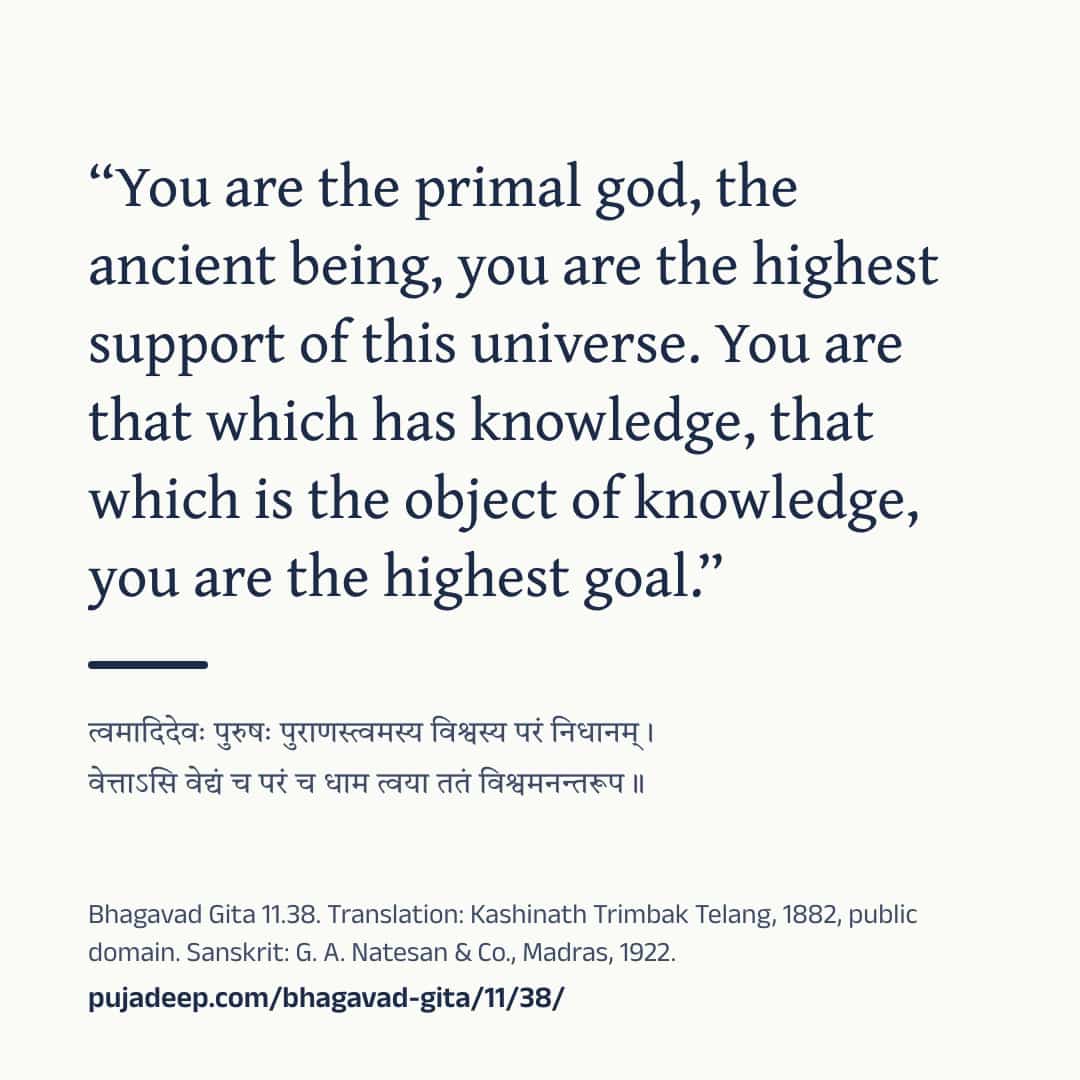
त्वमादिदेवः पुरुषः पुराणस्त्वमस्य विश्वस्य परं निधानम् ।
वेत्ताऽसि वेद्यं च परं च धाम त्वया ततं विश्वमनन्तरूप ॥

“You are the primal god, the ancient being, you are the highest support of this universe. You are that which has knowledge, that which is the object of knowledge, you are the highest goal. By you is this universe pervaded, O you of infinite forms!”
(K. T. Telang, The Bhagavadgîtâ (The Sacred Books of the East, vol. VIII, Oxford: Clarendon Press, 1882), pp. 96–97, public domain)

“First of the Gods, most ancient Man Thou art, Supreme Receptacle of all that lives, Knower and Known, the Dwelling-place on high, In Thy vast Form the universe is spread.”
(Annie Besant, The Bhagavad Gîtâ, or The Lord's Song (London: Theosophical Publishing Society, 1895), p. 112, public domain)

“Thou art the Primal Deva, the ancient Purusha; Thou art the Supreme Refuge of this Universe, Thou art the Knower, and the One Thing to be known; Thou art the Supreme Goal. By Thee is the Universe pervaded, O Boundless Form.”
(Swami Swarupananda, Srimad-Bhagavad-Gita (Mayavati: Prabuddha Bharata Press, 1909; first printed in Prabuddha Bharata, 1907–1909), p. 232, public domain)

Sanskrit: G. A. Natesan & Co., Madras, 1922.
https://pujadeep.com/bhagavad-gita/11/38/ Nothing is sent from this site. Your own app sends it, to the chat you choose. The picture quotes the translation you chose on this page, with its name and year.
Sanskrit text: The Bhagavad-Gita, or The Lord's Song, with the text in Devanagari and an English translation, 1922. Meanings: written for Pujadeep and checked against the cited edition. Source and changes
Questions families ask
Who speaks Bhagavad Gita 11.38?
Arjuna speaks this verse, in chapter 11 (Vishvarupa Darshana Yoga).
Where does the Sanskrit text come from?
Sanskrit text: The Bhagavad-Gita, or The Lord's Song, with the text in Devanagari and an English translation, 1922. Meanings: written for Pujadeep and checked against the cited edition. See the source
Is the meaning on this page a translation?
Explanation written for this site from the sources listed here, and checked against the cited edition. It is not a translation and not the only way to read the text. Free to quote with credit.
Source and licence
- Sanskrit text
- The Bhagavad-Gita, or The Lord's Song, with the text in Devanagari and an English translation (Annie Besant, G. A. Natesan & Co., Madras, 1922). Public domain. The Sanskrit on these pages was read from this printing’s page images.
- Translation
- The Bhagavadgîtâ with the Sanatsugâtîya and the Anugîtâ, translated by Kâshinâth Trimbak Telang (The Sacred Books of the East, vol. VIII, ed. F. Max Müller) (Kashinath Trimbak Telang, F. Max Müller, Clarendon Press, Oxford, 1882). Public domain. Shown verbatim, as printed.
- Translation
- The Bhagavad Gîtâ, or The Lord's Song, translated by Annie Besant (Annie Besant, Theosophical Publishing Society, London, 1895). Public domain. Shown verbatim, as printed.
- Translation
- Srimad-Bhagavad-Gita, with Sanskrit Text; Paraphrase with Word-by-word Literal Translation; English Rendering and Comments, Index, &c., by the Swami Swarupananda (Himalayan Series, No. XX) (Swami Swarupananda, The Editors and Publishers, Advaita Ashrama, Mayavati, Prabuddha Bharata Press, Mayavati, Almora, Himalayas, 1909). Public domain. Shown verbatim, as printed.
- Common wording
- In this text, 32 words follow today's common wording, checked against sanskritdocuments.org; Sanskrit Wikisource; Gita Press, Gorakhpur; GRETIL, Göttingen and Bhaktivedanta Book Trust.
- Our explanation
- Explanation written for this site from the sources listed here, and checked against the cited edition. It is not a translation and not the only way to read the text. Free to quote with credit.
- Checked
- Checked against the cited edition, October 27, 2026.