Bhagavad Gita 11.33: meaning and translation
Chapter 11: Vishvarupa Darshana Yoga. Krishna says
Therefore, Krishna tells Arjuna, he should stand up and win glory, conquer his enemies and enjoy a prosperous kingdom.
Click or tap a word for its meaning and its dictionary page.
Text and layers
Text and layers
These choices stay in this browser.
Bhagavad Gita 11.33
तस्मात्त्वमुत्तिष्ठ यशो लभस्व जित्वा शत्रून्भुङ्क्ष्व राज्यं समृद्धम् ।मयैवैते निहताः पूर्वमेव निमित्तमात्रं भव सव्यसाचिन् ॥
Tasmattvamuttishtha yasho labhasva jitva shatrunbhunkshva rajyam samriddhamMayaivaite nihatah purvameva nimittamatram bhava savyasachin
tasmāttvamuttiṣṭha yaśo labhasva jitvā śatrūnbhuṅkṣva rājyaṃ samṛddham |mayaivaite nihatāḥ pūrvameva nimittamātraṃ bhava savyasācin ||
Our explanation Therefore, Krishna tells Arjuna, he should stand up and win glory, conquer his enemies and enjoy a prosperous kingdom. Krishna says these warriors have already been slain by him, and Arjuna is to be only the instrument (nimitta-mātra). He calls Arjuna Savyasācin; Telang's note, after Śrīdhara, explains that Arjuna could shoot with the left hand as well as the right.
हिंदी अर्थ कृष्ण कहते हैं कि इसलिए अर्जुन उठें और यश पाएँ, शत्रुओं को जीतें और समृद्ध राज्य भोगें। कृष्ण कहते हैं कि ये योद्धा उनके द्वारा पहले ही मारे जा चुके हैं, और अर्जुन केवल निमित्त (साधन) बनें। वे अर्जुन को सव्यसाची कहते हैं; तेलंग की टिप्पणी, श्रीधर के अनुसार, बताती है कि अर्जुन बाएँ हाथ से भी दाएँ हाथ जैसा ही बाण चला सकते थे।
Word by word
Every word, with its dictionary page
Word by word
- तस्मात् tasmāt · therefore (indeclinable) Dictionary: tad, Monier-Williams 1899, p. 434, col. 1 “m. he, f. she, n. it, that, this”
- त्वम् tvam · you (pronoun, nominative singular) Dictionary: yuṣmad, Monier-Williams 1899, p. 855, col. 3 “the base of the 2nd pers. pron. as used in comp.”
- उत्तिष्ठ uttiṣṭha · stand up (imperative, 2nd person singular) Dictionary: ut-thā, Monier-Williams 1899, p. 179, col. 3 “to stand up, spring up, rise”
- यशः yaśaḥ · glory, fame (noun (neuter), accusative singular) Dictionary: yaśas, Monier-Williams 1899, p. 848, col. 2 “honour, glory, fame, renown”
- लभस्व labhasva · win, gain (imperative, 2nd person singular) Dictionary: labh, Monier-Williams 1899, p. 896, col. 2 “to gain possession of, obtain, receive, conceive, get”
- जित्वा jitvā · having conquered (absolutive (having done)) Dictionary: 1. ji, Monier-Williams 1899, p. 420, col. 2 “conquer (in battle), vanquish”
- शत्रून् śatrūn · enemies (noun (masculine), accusative plural) Dictionary: śatru, Monier-Williams 1899, p. 1051, col. 1 “an enemy, foe, rival”
- भुङ्क्ष्व bhuṅkṣva · enjoy (imperative, 2nd person singular) Dictionary: 3. bhuj, Monier-Williams 1899, p. 759, col. 2 “to enjoy, use, possess”
- राज्यम् rājyam · kingdom (noun (neuter), accusative singular) Dictionary: rājya, Monier-Williams 1899, p. 875, col. 1 “kingdom, country, realm”
- समृद्धम् samṛddham · prosperous (past participle (neuter), accusative singular) Dictionary: sam-ṛddha, Monier-Williams 1899, p. 1171, col. 1 “very successful or prosperous or flourishing, fortunate”
- मया mayā · by "me" (Krishna) (pronoun, instrumental singular) Dictionary: 1. mad, Monier-Williams 1899, p. 777, col. 2 “base of the first pers. pron. in the sg. number (esp. in comp.)”
- एव eva · indeed (indeclinable) Dictionary: 1. eva, Monier-Williams 1899, p. 232, col. 2 “just, exactly, very, same, only, even, alone, merely”
- एते ete · these (pronoun (masculine), nominative plural) Dictionary: etad, Monier-Williams 1899, p. 231, col. 2 “this, this here”
- निहताः nihatāḥ · slain (past participle (masculine), nominative plural) Dictionary: ni-hata, Monier-Williams 1899, p. 564, col. 3 “struck down, smitten, slain, killed”
- पूर्वम् pūrvam · before, already (indeclinable) Dictionary: pūrva, Monier-Williams 1899, p. 643, col. 1 “formerly, hitherto, previously”
- एव eva · indeed (indeclinable) Dictionary: 1. eva, Monier-Williams 1899, p. 232, col. 2 “just, exactly, very, same, only, even, alone, merely”
- निमित्तमात्रम् nimittamātram · merely the instrument (compound (neuter), nominative singular) Dictionary: nimitta-mātra, Monier-Williams 1899, p. 551, col. 1 “the mere efficient cause or instrument”
- भव bhava · be (imperative, 2nd person singular) Dictionary: 1. bhū, Monier-Williams 1899, p. 760, col. 2 “to become, be”
- सव्यसाचिन् savyasācin · O Savyasachin (Arjuna) (noun (masculine), vocative singular) Dictionary: savya-sācin, Monier-Williams 1899, p. 1191, col. 3 “drawing (a bow) with the left hand, ambidexterous”
1 printing differs
Edition differences. Another printing or text reads this place differently.
- Spelling A digital text reads Same letters. The e-text prints शत्रून् भुङ्क्ष्व as two words; the 1922 edition joins them.
Old translations
Kashinath Trimbak Telang, 1882. Public domain. Page 96.
Therefore, be up, obtain glory, and vanquishing (your) foes, enjoy a prosperous kingdom. All these have been already killed by me. Be only the instrument, O Savyasâkin1!
Footnotes (the translator’s own) - Arguna, as he could shoot with his left hand as well as the right.—Srîdhara. ↩
Compare 3 translations
Kashinath Trimbak Telang, 1882. Public domain. Page 96.
Therefore, be up, obtain glory, and vanquishing (your) foes, enjoy a prosperous kingdom. All these have been already killed by me. Be only the instrument, O Savyasâkin1!
Footnotes (the translator’s own) - Arguna, as he could shoot with his left hand as well as the right.—Srîdhara. ↩
You are reading this one
Annie Besant, 1895. Public domain. Page 111.
Therefore stand up! win for thyself renown,
Conquer thy foes, enjoy the spacious realm.
By Me they are already overcome,
Be thou the outward cause, left-handed one.
You are reading this one
Swami Swarupananda, 1909 (first printed 1907). Public domain. Page 228.
Therefore do thou arise and acquire fame. After conquering the enemies, enjoy the unrivalled dominion. Verily by Myself have they been already slain; be thou merely an apparent cause, O Savyasáchin (Arjuna.)
You are reading this one
Cite this verse
The translation: K. T. Telang, The Bhagavadgîtâ (The Sacred Books of the East, vol. VIII, Oxford: Clarendon Press, 1882), p. 96. Bhagavad Gita 11.33.
The translation: Annie Besant, The Bhagavad Gîtâ, or The Lord's Song (London: Theosophical Publishing Society, 1895), p. 111. Bhagavad Gita 11.33.
The translation: Swami Swarupananda, Srimad-Bhagavad-Gita (Mayavati: Prabuddha Bharata Press, 1909; first printed in Prabuddha Bharata, 1907–1909), p. 228. Bhagavad Gita 11.33.
Our explanation: “Bhagavad Gita 11.33: meaning and translation.” Pujadeep. Updated October 27, 2026. https://pujadeep.com/bhagavad-gita/11/33/
Pujadeep’s explanations are free to quote with credit: name Pujadeep and link to the page. How to credit
Classical readings, by school
No readings by school on this verse yet.
Share
Show the ways to share
Send one picture or the text to one chat. The picture names its source and the address of this page.
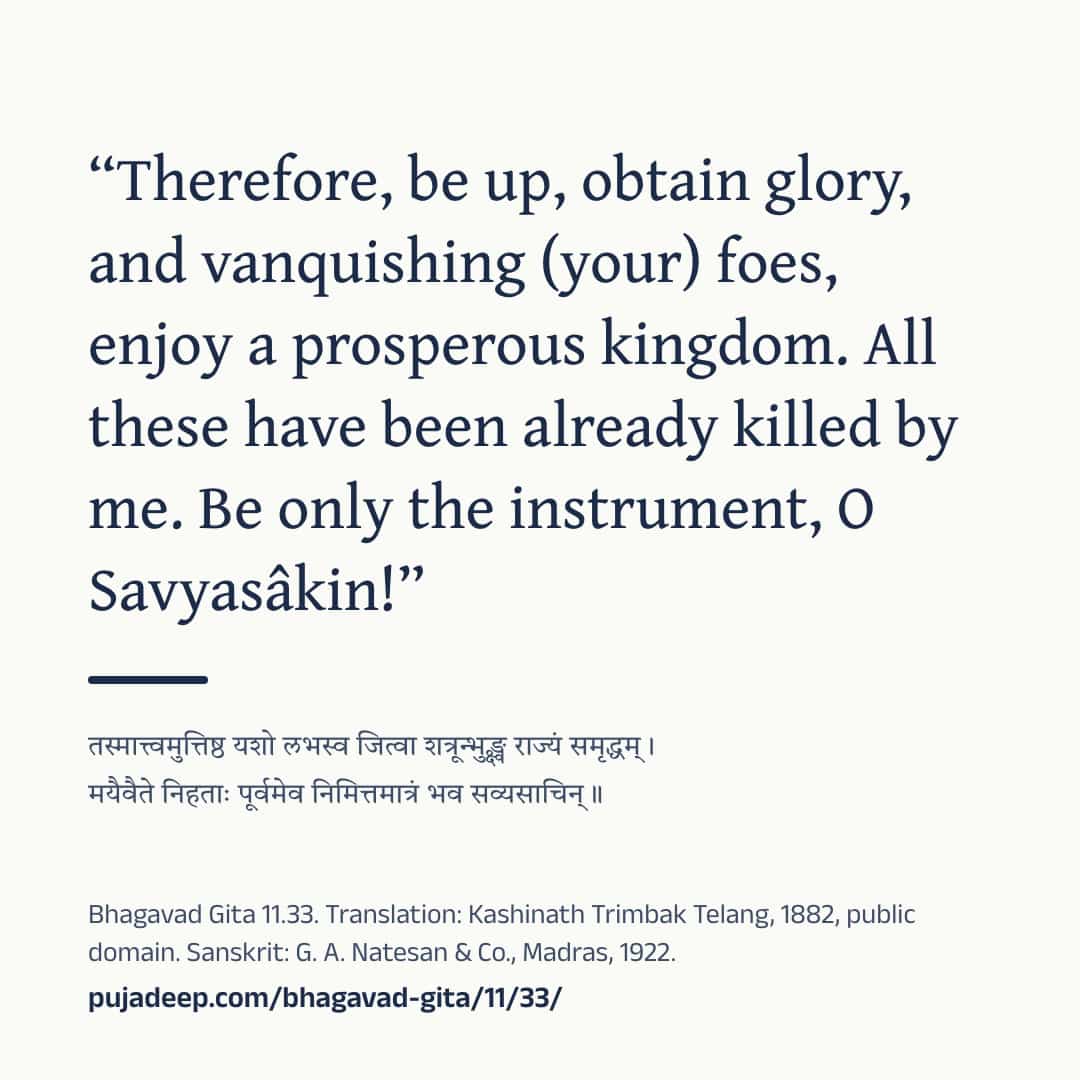
Drawing the picture
See the words
Bhagavad Gita 11.33

तस्मात्त्वमुत्तिष्ठ यशो लभस्व जित्वा शत्रून्भुङ्क्ष्व राज्यं समृद्धम् ।
मयैवैते निहताः पूर्वमेव निमित्तमात्रं भव सव्यसाचिन् ॥

“Therefore, be up, obtain glory, and vanquishing (your) foes, enjoy a prosperous kingdom. All these have been already killed by me. Be only the instrument, O Savyasâkin!”
(K. T. Telang, The Bhagavadgîtâ (The Sacred Books of the East, vol. VIII, Oxford: Clarendon Press, 1882), p. 96, public domain)

“Therefore stand up! win for thyself renown, Conquer thy foes, enjoy the spacious realm. By Me they are already overcome, Be thou the outward cause, left-handed one.”
(Annie Besant, The Bhagavad Gîtâ, or The Lord's Song (London: Theosophical Publishing Society, 1895), p. 111, public domain)

“Therefore do thou arise and acquire fame. After conquering the enemies, enjoy the unrivalled dominion. Verily by Myself have they been already slain; be thou merely an apparent cause, O Savyasáchin (Arjuna.)”
(Swami Swarupananda, Srimad-Bhagavad-Gita (Mayavati: Prabuddha Bharata Press, 1909; first printed in Prabuddha Bharata, 1907–1909), p. 228, public domain)

Sanskrit: G. A. Natesan & Co., Madras, 1922.
https://pujadeep.com/bhagavad-gita/11/33/ Nothing is sent from this site. Your own app sends it, to the chat you choose. The picture quotes the translation you chose on this page, with its name and year.
Sanskrit text: The Bhagavad-Gita, or The Lord's Song, with the text in Devanagari and an English translation, 1922. Meanings: written for Pujadeep and checked against the cited edition. Source and changes
Questions families ask
Who speaks Bhagavad Gita 11.33?
Krishna speaks this verse, in chapter 11 (Vishvarupa Darshana Yoga).
Where does the Sanskrit text come from?
Sanskrit text: The Bhagavad-Gita, or The Lord's Song, with the text in Devanagari and an English translation, 1922. Meanings: written for Pujadeep and checked against the cited edition. See the source
Is the meaning on this page a translation?
Explanation written for this site from the sources listed here, and checked against the cited edition. It is not a translation and not the only way to read the text. Free to quote with credit.
Source and licence
- Sanskrit text
- The Bhagavad-Gita, or The Lord's Song, with the text in Devanagari and an English translation (Annie Besant, G. A. Natesan & Co., Madras, 1922). Public domain. The Sanskrit on these pages was read from this printing’s page images.
- Translation
- The Bhagavadgîtâ with the Sanatsugâtîya and the Anugîtâ, translated by Kâshinâth Trimbak Telang (The Sacred Books of the East, vol. VIII, ed. F. Max Müller) (Kashinath Trimbak Telang, F. Max Müller, Clarendon Press, Oxford, 1882). Public domain. Shown verbatim, as printed.
- Translation
- The Bhagavad Gîtâ, or The Lord's Song, translated by Annie Besant (Annie Besant, Theosophical Publishing Society, London, 1895). Public domain. Shown verbatim, as printed.
- Translation
- Srimad-Bhagavad-Gita, with Sanskrit Text; Paraphrase with Word-by-word Literal Translation; English Rendering and Comments, Index, &c., by the Swami Swarupananda (Himalayan Series, No. XX) (Swami Swarupananda, The Editors and Publishers, Advaita Ashrama, Mayavati, Prabuddha Bharata Press, Mayavati, Almora, Himalayas, 1909). Public domain. Shown verbatim, as printed.
- Common wording
- In this text, 32 words follow today's common wording, checked against sanskritdocuments.org; Sanskrit Wikisource; Gita Press, Gorakhpur; GRETIL, Göttingen and Bhaktivedanta Book Trust.
- Our explanation
- Explanation written for this site from the sources listed here, and checked against the cited edition. It is not a translation and not the only way to read the text. Free to quote with credit.
- Checked
- Checked against the cited edition, October 27, 2026.