Bhagavad Gita 11.36: meaning and translation
Chapter 11: Vishvarupa Darshana Yoga. Arjuna says
Arjuna speaks again.
Click or tap a word for its meaning and its dictionary page.
Text and layers
Text and layers
These choices stay in this browser.
Bhagavad Gita 11.36
अर्जुन उवाच ।
स्थाने हृषीकेश तव प्रकीर्त्या जगत्प्रहृष्यत्यनुरज्यते च ।रक्षांसि भीतानि दिशो द्रवन्ति सर्वे नमस्यन्ति च सिद्धसङ्घाः ॥
Sthane hrishikesha tava prakirtya jagatprahrishyatyanurajyate chaRakshansi bhitani disho dravanti sarve namasyanti cha siddhasanghah
sthāne hṛṣīkeśa tava prakīrtyā jagatprahṛṣyatyanurajyate ca |rakṣāṃsi bhītāni diśo dravanti sarve namasyanti ca siddhasaṅghāḥ ||
Our explanation Arjuna speaks again. He says it is fitting (sthāne), Hṛṣīkeśa, that the world rejoices and delights in Krishna's praise (Telang: 'renown'), that the rākṣasas flee in fear in every direction, and that all the hosts of siddhas bow to him.
हिंदी अर्थ अर्जुन फिर बोलते हैं। वे कहते हैं कि हे हृषीकेश, यह उचित ही है कि कृष्ण की कीर्ति से जगत हर्षित होता है और उनमें अनुराग करता है, राक्षस भयभीत होकर सब दिशाओं में भागते हैं, और सिद्धों के सब समूह उन्हें प्रणाम करते हैं।
Word by word
Every word, with its dictionary page
Word by word
- स्थाने sthāne · rightly, fittingly (indeclinable) Dictionary: sthāna, Monier-Williams 1899, p. 1263, col. 1 “in the right place or at the right time, seasonably, justly”
- हृषीकेश hṛṣīkeśa · O Hrishikesha (Krishna) (noun (masculine), vocative singular) Dictionary: hṛṣīkeśa, Monier-Williams 1899, p. 1303, col. 2
- तव tava · your (pronoun, genitive singular) Dictionary: yuṣmad, Monier-Williams 1899, p. 855, col. 3 “the base of the 2nd pers. pron. as used in comp.”
- प्रकीर्त्या prakīrtyā · by the praise, by the fame (noun (feminine), instrumental singular) Dictionary: pra-kīrti, Monier-Williams 1899, p. 653, col. 2 “celebration, declaration”
- जगत् jagat · the world (noun (neuter), nominative singular) Dictionary: jagat, Monier-Williams 1899, p. 408, col. 1 “the world, esp. this world, earth”
- प्रहृष्यति prahṛṣyati · rejoices (present, 3rd person singular) Dictionary: pra-hṛṣ, Monier-Williams 1899, p. 701, col. 2 “to rejoice, be glad or cheerful, exult”
- अनुरज्यते anurajyate · is drawn in love (present, 3rd person singular) Dictionary: anu-rañj, Monier-Williams 1899, p. 37, col. 2 “to be attached or devoted”
- च ca · and (indeclinable) Dictionary: 2. ca, Monier-Williams 1899, p. 380, col. 1 “and, both, also, moreover, as well as”
- रक्षांसि rakṣāṃsi · the Rakshasas (noun (neuter), nominative plural) Dictionary: rakṣas, Monier-Williams 1899, p. 860, col. 1 “an evil being or demon, a Rākshasa”
- भीतानि bhītāni · afraid (past participle (neuter), nominative plural) Dictionary: bhīta, Monier-Williams 1899, p. 758, col. 1 “frightened, alarmed, terrified, timid”
- दिशः diśaḥ · to the directions (noun (feminine), accusative plural) Dictionary: 2. diś, Monier-Williams 1899, p. 480, col. 1 “quarter or region pointed at, direction, cardinal point”
- द्रवन्ति dravanti · flee (present, 3rd person plural) Dictionary: 2. dru, Monier-Williams 1899, p. 502, col. 1 “to run, hasten, flee”
- सर्वे sarve · all (pronoun (masculine), nominative plural) Dictionary: sarva, Monier-Williams 1899, p. 1184, col. 3 “whole, entire, all, every”
- नमस्यन्ति namasyanti · bow down (present, 3rd person plural) Dictionary: 1. namasya, Monier-Williams 1899, p. 528, col. 2 “to pay homage, worship, be humble or deferential”
- च ca · and (indeclinable) Dictionary: 2. ca, Monier-Williams 1899, p. 380, col. 1 “and, both, also, moreover, as well as”
- सिद्धसङ्घाः siddhasaṅghāḥ · hosts of Siddhas (compound (masculine), nominative plural) Dictionary: siddha-saṃgha, Monier-Williams 1899, p. 1215, col. 3 “a company of Siddhas, assemblage of perfected beings”
Old translations
Kashinath Trimbak Telang, 1882. Public domain. Page 96.
Arguna said:
It is quite proper, O Hrishîkesa! that the universe is delighted and charmed by your renown, that the demons run away affrighted in all directions, and that all the assemblages of Siddhas bow down (to you).
Compare 3 translations
Kashinath Trimbak Telang, 1882. Public domain. Page 96.
Arguna said:
It is quite proper, O Hrishîkesa! that the universe is delighted and charmed by your renown, that the demons run away affrighted in all directions, and that all the assemblages of Siddhas bow down (to you).
You are reading this one
Annie Besant, 1895. Public domain. Page 111–112.
Arjuna said:
Hrishîkesha! in Thy magnificence
Rightly the world rejoiceth, bound to Thee;
The Râkshasas to every quarter fly
In fear; the hosts of Siddhas prostrate fall.
You are reading this one
Swami Swarupananda, 1909 (first printed 1907). Public domain. Page 230.
Arjuna said:
It is meet, O Hrishikesha, that the world is delighted and rejoices in Thy praise, that Rákshasas fly in fear to all quarters and all the hosts of Siddhas bow down to Thee in adoration.
You are reading this one
Cite this verse
The translation: K. T. Telang, The Bhagavadgîtâ (The Sacred Books of the East, vol. VIII, Oxford: Clarendon Press, 1882), p. 96. Bhagavad Gita 11.36.
The translation: Annie Besant, The Bhagavad Gîtâ, or The Lord's Song (London: Theosophical Publishing Society, 1895), pp. 111–112. Bhagavad Gita 11.36.
The translation: Swami Swarupananda, Srimad-Bhagavad-Gita (Mayavati: Prabuddha Bharata Press, 1909; first printed in Prabuddha Bharata, 1907–1909), p. 230. Bhagavad Gita 11.36.
Our explanation: “Bhagavad Gita 11.36: meaning and translation.” Pujadeep. Updated October 27, 2026. https://pujadeep.com/bhagavad-gita/11/36/
Pujadeep’s explanations are free to quote with credit: name Pujadeep and link to the page. How to credit
Classical readings, by school
No readings by school on this verse yet.
Share
Show the ways to share
Send one picture or the text to one chat. The picture names its source and the address of this page.
Drawing the picture
See the words
Bhagavad Gita 11.36

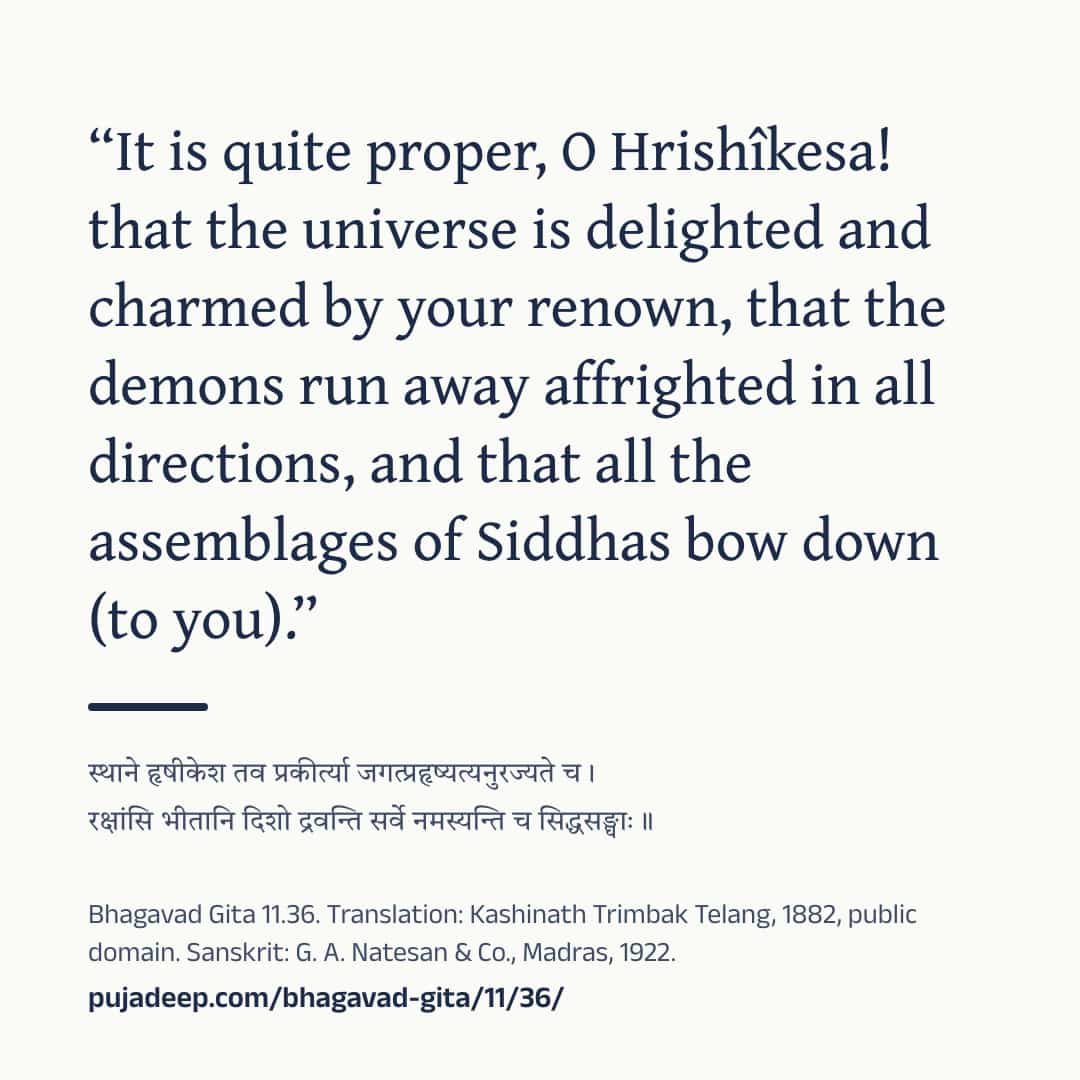
स्थाने हृषीकेश तव प्रकीर्त्या जगत्प्रहृष्यत्यनुरज्यते च ।
रक्षांसि भीतानि दिशो द्रवन्ति सर्वे नमस्यन्ति च सिद्धसङ्घाः ॥

“It is quite proper, O Hrishîkesa! that the universe is delighted and charmed by your renown, that the demons run away affrighted in all directions, and that all the assemblages of Siddhas bow down (to you).”
(K. T. Telang, The Bhagavadgîtâ (The Sacred Books of the East, vol. VIII, Oxford: Clarendon Press, 1882), p. 96, public domain)

“Hrishîkesha! in Thy magnificence Rightly the world rejoiceth, bound to Thee; The Râkshasas to every quarter fly In fear; the hosts of Siddhas prostrate fall.”
(Annie Besant, The Bhagavad Gîtâ, or The Lord's Song (London: Theosophical Publishing Society, 1895), pp. 111–112, public domain)

“It is meet, O Hrishikesha, that the world is delighted and rejoices in Thy praise, that Rákshasas fly in fear to all quarters and all the hosts of Siddhas bow down to Thee in adoration.”
(Swami Swarupananda, Srimad-Bhagavad-Gita (Mayavati: Prabuddha Bharata Press, 1909; first printed in Prabuddha Bharata, 1907–1909), p. 230, public domain)

Sanskrit: G. A. Natesan & Co., Madras, 1922.
https://pujadeep.com/bhagavad-gita/11/36/ Nothing is sent from this site. Your own app sends it, to the chat you choose. The picture quotes the translation you chose on this page, with its name and year.
Sanskrit text: The Bhagavad-Gita, or The Lord's Song, with the text in Devanagari and an English translation, 1922. Meanings: written for Pujadeep and checked against the cited edition. Source and changes
Questions families ask
Who speaks Bhagavad Gita 11.36?
Arjuna speaks this verse, in chapter 11 (Vishvarupa Darshana Yoga).
Where does the Sanskrit text come from?
Sanskrit text: The Bhagavad-Gita, or The Lord's Song, with the text in Devanagari and an English translation, 1922. Meanings: written for Pujadeep and checked against the cited edition. See the source
Is the meaning on this page a translation?
Explanation written for this site from the sources listed here, and checked against the cited edition. It is not a translation and not the only way to read the text. Free to quote with credit.
Source and licence
- Sanskrit text
- The Bhagavad-Gita, or The Lord's Song, with the text in Devanagari and an English translation (Annie Besant, G. A. Natesan & Co., Madras, 1922). Public domain. The Sanskrit on these pages was read from this printing’s page images.
- Translation
- The Bhagavadgîtâ with the Sanatsugâtîya and the Anugîtâ, translated by Kâshinâth Trimbak Telang (The Sacred Books of the East, vol. VIII, ed. F. Max Müller) (Kashinath Trimbak Telang, F. Max Müller, Clarendon Press, Oxford, 1882). Public domain. Shown verbatim, as printed.
- Translation
- The Bhagavad Gîtâ, or The Lord's Song, translated by Annie Besant (Annie Besant, Theosophical Publishing Society, London, 1895). Public domain. Shown verbatim, as printed.
- Translation
- Srimad-Bhagavad-Gita, with Sanskrit Text; Paraphrase with Word-by-word Literal Translation; English Rendering and Comments, Index, &c., by the Swami Swarupananda (Himalayan Series, No. XX) (Swami Swarupananda, The Editors and Publishers, Advaita Ashrama, Mayavati, Prabuddha Bharata Press, Mayavati, Almora, Himalayas, 1909). Public domain. Shown verbatim, as printed.
- Common wording
- In this text, 32 words follow today's common wording, checked against sanskritdocuments.org; Sanskrit Wikisource; Gita Press, Gorakhpur; GRETIL, Göttingen and Bhaktivedanta Book Trust.
- Our explanation
- Explanation written for this site from the sources listed here, and checked against the cited edition. It is not a translation and not the only way to read the text. Free to quote with credit.
- Checked
- Checked against the cited edition, October 27, 2026.