Bhagavad Gita 11.39: meaning and translation
Chapter 11: Vishvarupa Darshana Yoga. Arjuna says
Arjuna says Krishna is Vāyu (the wind), Yama, Agni (fire), Varuṇa and the moon; Prajāpati, and the great-grandfather (prapitāmaha).
Click or tap a word for its meaning and its dictionary page.
Text and layers
Text and layers
These choices stay in this browser.
Bhagavad Gita 11.39
वायुर्यमोऽग्निर्वरुणः शशाङ्कः प्रजापतिस्त्वं प्रपितामहश्च ।नमो नमस्तेऽस्तु सहस्रकृत्वः पुनश्च भूयोऽपि नमो नमस्ते ॥
Vayuryamognirvarunah shashankah prajapatistvam prapitamahashchaNamo namastestu sahasrakritvah punashcha bhuyopi namo namaste
vāyuryamo’gnirvaruṇaḥ śaśāṅkaḥ prajāpatistvaṃ prapitāmahaśca |namo namaste’stu sahasrakṛtvaḥ punaśca bhūyo’pi namo namaste ||
Our explanation Arjuna says Krishna is Vāyu (the wind), Yama, Agni (fire), Varuṇa and the moon; Prajāpati, and the great-grandfather (prapitāmaha). He bows to him a thousand times, and again and again.
हिंदी अर्थ अर्जुन कहते हैं कि कृष्ण ही वायु, यम, अग्नि, वरुण और चंद्रमा हैं; प्रजापति हैं, और प्रपितामह (परदादा) हैं। वे उन्हें हज़ार बार प्रणाम करते हैं, और फिर बार-बार प्रणाम करते हैं।
Word by word
Every word, with its dictionary page
Word by word
- वायुः vāyuḥ · Vayu, the wind (noun (masculine), nominative singular) Dictionary: 1. vāyu, Monier-Williams 1899, p. 942, col. 2 “wind, air (as one of the 5 elements; in MBh. 7 winds are reckoned)”
- यमः yamaḥ · Yama (noun (masculine), nominative singular) Dictionary: yama, Monier-Williams 1899, p. 846, col. 1 “N. of the god who presides over the Pitṛis”
- अग्निः agniḥ · Agni, fire (noun (masculine), nominative singular) Dictionary: agni, Monier-Williams 1899, p. 5, col. 1 “fire; sacrificial fire”
- वरुणः varuṇaḥ · Varuna (noun (masculine), nominative singular) Dictionary: varuṇa, Monier-Williams 1899, p. 921, col. 2 “he is often regarded as the supreme deity”
- शशाङ्कः śaśāṅkaḥ · the moon (noun (masculine), nominative singular) Dictionary: śaśāṅka, Monier-Williams 1899, p. 1060, col. 1 “‘hare-marked,’ the moon”
- प्रजापतिः prajāpatiḥ · Prajapati, lord of creatures (compound (masculine), nominative singular) Dictionary: prajā-pati, Monier-Williams 1899, p. 658, col. 2 “‘lord of creatures’”
- त्वम् tvam · you (pronoun, nominative singular) Dictionary: yuṣmad, Monier-Williams 1899, p. 855, col. 3 “the base of the 2nd pers. pron. as used in comp.”
- प्रपितामहः prapitāmahaḥ · the great-grandsire (noun (masculine), nominative singular) Dictionary: pra-pitāmaha, Monier-Williams 1899, p. 682, col. 2 “a paternal great-grandfather, VS.; TS.; (°mahá) AV. &c. &c.; N. of Kṛishṇa and Brahmā, MBh.”
- च ca · and (indeclinable) Dictionary: 2. ca, Monier-Williams 1899, p. 380, col. 1 “and, both, also, moreover, as well as”
- नमः namaḥ · salutation (noun (neuter), nominative singular) Dictionary: namas, Monier-Williams 1899, p. 528, col. 1 “bow, obeisance, reverential salutation”
- नमः namaḥ · salutation (noun (neuter), nominative singular) Dictionary: namas, Monier-Williams 1899, p. 528, col. 1 “bow, obeisance, reverential salutation”
- ते te · to you (pronoun, dative singular) Dictionary: yuṣmad, Monier-Williams 1899, p. 855, col. 3 “the base of the 2nd pers. pron. as used in comp.”
- अस्तु astu · let there be (imperative, 3rd person singular) Dictionary: 1. as, Monier-Williams 1899, p. 117, col. 2 “to be, live, exist, be present”
- सहस्रकृत्वः sahasrakṛtvaḥ · a thousand times (indeclinable) Dictionary: sahasra-kṛtvas, Monier-Williams 1899, p. 1195, col. 3 “a th° times”
- पुनः punaḥ · again (indeclinable) Dictionary: punar, Monier-Williams 1899, p. 633, col. 2 “again, once more”
- च ca · and (indeclinable) Dictionary: 2. ca, Monier-Williams 1899, p. 380, col. 1 “and, both, also, moreover, as well as”
- भूयः bhūyaḥ · once more (indeclinable) Dictionary: bhūyas, Monier-Williams 1899, p. 763, col. 3 “once more, again, anew”
- अपि api · also (indeclinable) Dictionary: api, Monier-Williams 1899, p. 55, col. 1 “even, also, very”
- नमः namaḥ · salutation (noun (neuter), nominative singular) Dictionary: namas, Monier-Williams 1899, p. 528, col. 1 “bow, obeisance, reverential salutation”
- नमः namaḥ · salutation (noun (neuter), nominative singular) Dictionary: namas, Monier-Williams 1899, p. 528, col. 1 “bow, obeisance, reverential salutation”
- ते te · to you (pronoun, dative singular) Dictionary: yuṣmad, Monier-Williams 1899, p. 855, col. 3 “the base of the 2nd pers. pron. as used in comp.”
Old translations
Kashinath Trimbak Telang, 1882. Public domain. Page 97.
You are the wind, Yama, fire, Varuna, the moon, you Pragâpati, and the great grandsire1. Obeisance be to thee a thousand times, and again and again obeisance to thee!
Footnotes (the translator’s own) - Professor Tiele mentions great-grandfather as a name for the Creator among Kaffirs (History of Religion, p. 18). Cf. p. 83 supra. ↩
Compare 3 translations
Kashinath Trimbak Telang, 1882. Public domain. Page 97.
You are the wind, Yama, fire, Varuna, the moon, you Pragâpati, and the great grandsire1. Obeisance be to thee a thousand times, and again and again obeisance to thee!
Footnotes (the translator’s own) - Professor Tiele mentions great-grandfather as a name for the Creator among Kaffirs (History of Religion, p. 18). Cf. p. 83 supra. ↩
You are reading this one
Annie Besant, 1895. Public domain. Page 112–113.
Thou art Vâyu and Yama, Agni, Moon,
Varuna, Father, Grandsire of all:
Hail, hail to Thee! a thousand times all hail!
Hail unto Thee! again, again, all hail!
You are reading this one
Swami Swarupananda, 1909 (first printed 1907). Public domain. Page 232.
Thou art Vâyu, Yama, Agni, Varuna, the moon, Prajâpati, and the Great-Grandfather. Salutation, salutation to Thee! a thousand times, and again and again salutation, salutation to Thee!
You are reading this one
Cite this verse
The translation: K. T. Telang, The Bhagavadgîtâ (The Sacred Books of the East, vol. VIII, Oxford: Clarendon Press, 1882), p. 97. Bhagavad Gita 11.39.
The translation: Annie Besant, The Bhagavad Gîtâ, or The Lord's Song (London: Theosophical Publishing Society, 1895), pp. 112–113. Bhagavad Gita 11.39.
The translation: Swami Swarupananda, Srimad-Bhagavad-Gita (Mayavati: Prabuddha Bharata Press, 1909; first printed in Prabuddha Bharata, 1907–1909), p. 232. Bhagavad Gita 11.39.
Our explanation: “Bhagavad Gita 11.39: meaning and translation.” Pujadeep. Updated October 27, 2026. https://pujadeep.com/bhagavad-gita/11/39/
Pujadeep’s explanations are free to quote with credit: name Pujadeep and link to the page. How to credit
Classical readings, by school
No readings by school on this verse yet.
Share
Show the ways to share
Send one picture or the text to one chat. The picture names its source and the address of this page.
Drawing the picture
See the words
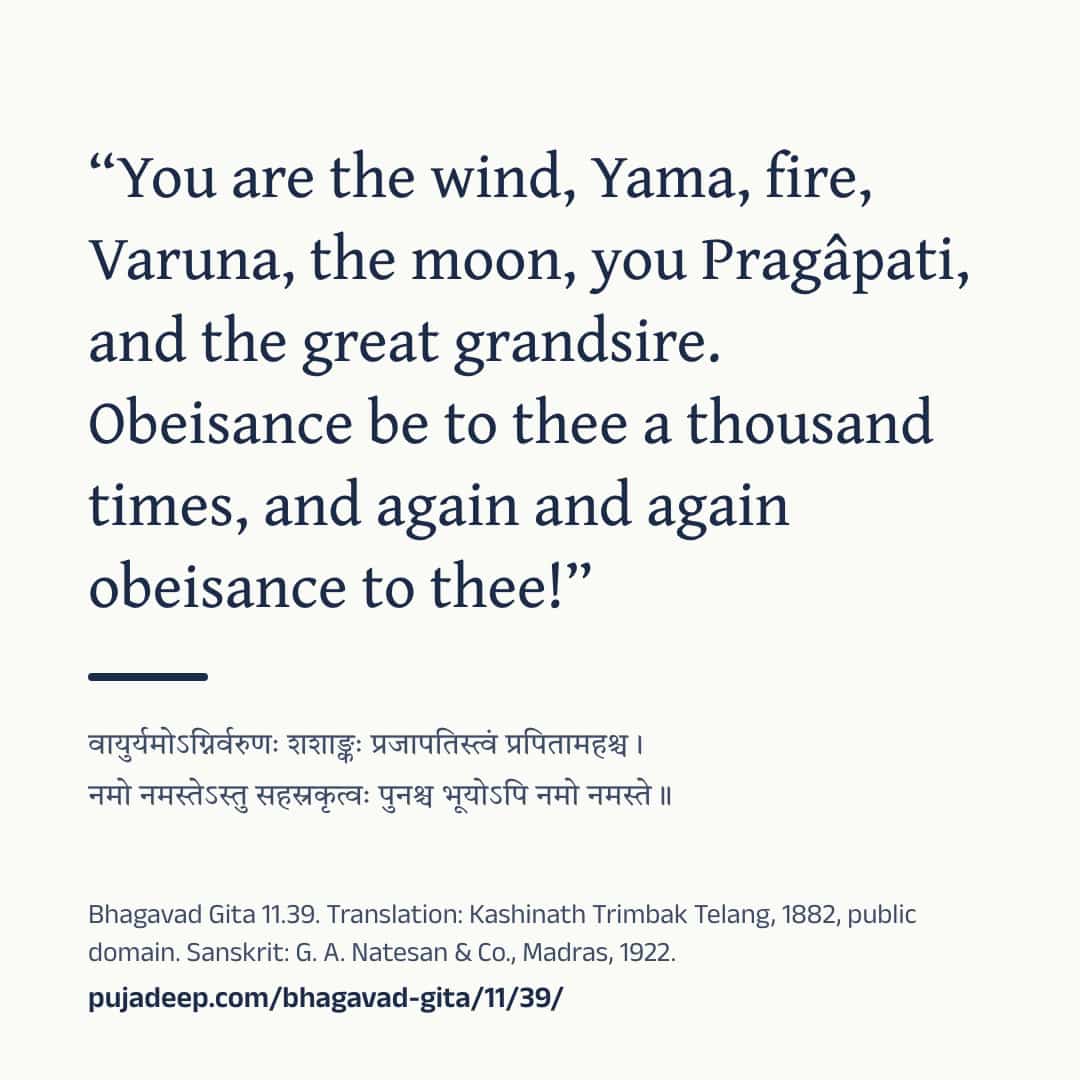
Bhagavad Gita 11.39

वायुर्यमोऽग्निर्वरुणः शशाङ्कः प्रजापतिस्त्वं प्रपितामहश्च ।
नमो नमस्तेऽस्तु सहस्रकृत्वः पुनश्च भूयोऽपि नमो नमस्ते ॥

“You are the wind, Yama, fire, Varuna, the moon, you Pragâpati, and the great grandsire. Obeisance be to thee a thousand times, and again and again obeisance to thee!”
(K. T. Telang, The Bhagavadgîtâ (The Sacred Books of the East, vol. VIII, Oxford: Clarendon Press, 1882), p. 97, public domain)

“Thou art Vâyu and Yama, Agni, Moon, Varuna, Father, Grandsire of all: Hail, hail to Thee! a thousand times all hail! Hail unto Thee! again, again, all hail!”
(Annie Besant, The Bhagavad Gîtâ, or The Lord's Song (London: Theosophical Publishing Society, 1895), pp. 112–113, public domain)

“Thou art Vâyu, Yama, Agni, Varuna, the moon, Prajâpati, and the Great-Grandfather. Salutation, salutation to Thee! a thousand times, and again and again salutation, salutation to Thee!”
(Swami Swarupananda, Srimad-Bhagavad-Gita (Mayavati: Prabuddha Bharata Press, 1909; first printed in Prabuddha Bharata, 1907–1909), p. 232, public domain)

Sanskrit: G. A. Natesan & Co., Madras, 1922.
https://pujadeep.com/bhagavad-gita/11/39/ Nothing is sent from this site. Your own app sends it, to the chat you choose. The picture quotes the translation you chose on this page, with its name and year.
Sanskrit text: The Bhagavad-Gita, or The Lord's Song, with the text in Devanagari and an English translation, 1922. Meanings: written for Pujadeep and checked against the cited edition. Source and changes
Questions families ask
Who speaks Bhagavad Gita 11.39?
Arjuna speaks this verse, in chapter 11 (Vishvarupa Darshana Yoga).
Where does the Sanskrit text come from?
Sanskrit text: The Bhagavad-Gita, or The Lord's Song, with the text in Devanagari and an English translation, 1922. Meanings: written for Pujadeep and checked against the cited edition. See the source
Is the meaning on this page a translation?
Explanation written for this site from the sources listed here, and checked against the cited edition. It is not a translation and not the only way to read the text. Free to quote with credit.
Source and licence
- Sanskrit text
- The Bhagavad-Gita, or The Lord's Song, with the text in Devanagari and an English translation (Annie Besant, G. A. Natesan & Co., Madras, 1922). Public domain. The Sanskrit on these pages was read from this printing’s page images.
- Translation
- The Bhagavadgîtâ with the Sanatsugâtîya and the Anugîtâ, translated by Kâshinâth Trimbak Telang (The Sacred Books of the East, vol. VIII, ed. F. Max Müller) (Kashinath Trimbak Telang, F. Max Müller, Clarendon Press, Oxford, 1882). Public domain. Shown verbatim, as printed.
- Translation
- The Bhagavad Gîtâ, or The Lord's Song, translated by Annie Besant (Annie Besant, Theosophical Publishing Society, London, 1895). Public domain. Shown verbatim, as printed.
- Translation
- Srimad-Bhagavad-Gita, with Sanskrit Text; Paraphrase with Word-by-word Literal Translation; English Rendering and Comments, Index, &c., by the Swami Swarupananda (Himalayan Series, No. XX) (Swami Swarupananda, The Editors and Publishers, Advaita Ashrama, Mayavati, Prabuddha Bharata Press, Mayavati, Almora, Himalayas, 1909). Public domain. Shown verbatim, as printed.
- Common wording
- In this text, 32 words follow today's common wording, checked against sanskritdocuments.org; Sanskrit Wikisource; Gita Press, Gorakhpur; GRETIL, Göttingen and Bhaktivedanta Book Trust.
- Our explanation
- Explanation written for this site from the sources listed here, and checked against the cited edition. It is not a translation and not the only way to read the text. Free to quote with credit.
- Checked
- Checked against the cited edition, October 27, 2026.