Bhagavad Gita 11.53: meaning and translation
Chapter 11: Vishvarupa Darshana Yoga. Krishna says
Krishna says he cannot be seen as Arjuna has seen him by the Vedas, nor by austerity, nor by gifts, nor by sacrifice.
Click or tap a word for its meaning and its dictionary page.
Text and layers
Text and layers
These choices stay in this browser.
Bhagavad Gita 11.53
नाहं वेदैर्न तपसा न दानेन न चेज्यया ।शक्य एवंविधो द्रष्टुं दृष्टवानसि मां यथा ॥
Naham vedairna tapasa na danena na chejyayaShakya evanvidho drashtum drishtavanasi mam yatha
nāhaṃ vedairna tapasā na dānena na cejyayā |śakya evaṃvidho draṣṭuṃ dṛṣṭavānasi māṃ yathā ||
Our explanation Krishna says he cannot be seen as Arjuna has seen him by the Vedas, nor by austerity, nor by gifts, nor by sacrifice.
हिंदी अर्थ कृष्ण कहते हैं कि जैसे अर्जुन ने उन्हें देखा है, वैसे वे न वेदों से देखे जा सकते हैं, न तप से, न दान से, न यज्ञ से।
Word by word
Every word, with its dictionary page
Word by word
- न na · not (indeclinable) Dictionary: 2. na, Monier-Williams 1899, p. 523, col. 1 “not, no, nor, neither”
- अहम् aham · "I" (Krishna) (pronoun, nominative singular) Dictionary: aham, Monier-Williams 1899, p. 124, col. 2 “nom. sg. ‘I,’”
- वेदैः vedaiḥ · by the Vedas (noun (masculine), instrumental plural) Dictionary: veda, Monier-Williams 1899, p. 1015, col. 1 “knowledge, true or sacred knowledge or lore”
- न na · nor (indeclinable) Dictionary: 2. na, Monier-Williams 1899, p. 523, col. 1 “not, no, nor, neither”
- तपसा tapasā · by austerity (noun (neuter), instrumental singular) Dictionary: tapas, Monier-Williams 1899, p. 437, col. 1 “religious austerity, bodily mortification, penance, severe meditation”
- न na · nor (indeclinable) Dictionary: 2. na, Monier-Williams 1899, p. 523, col. 1 “not, no, nor, neither”
- दानेन dānena · by giving (noun (neuter), instrumental singular) Dictionary: 1. dāna, Monier-Williams 1899, p. 474, col. 1 “the act of giving”
- न na · nor (indeclinable) Dictionary: 2. na, Monier-Williams 1899, p. 523, col. 1 “not, no, nor, neither”
- च ca · and (indeclinable) Dictionary: 2. ca, Monier-Williams 1899, p. 380, col. 1 “and, both, also, moreover, as well as”
- इज्यया ijyayā · by worship, sacrifice (noun (feminine), instrumental singular) Dictionary: ijya, Monier-Williams 1899, p. 164, col. 2 “a sacrifice, making offerings to the gods or manes”
- शक्यः śakyaḥ · can be (gerundive (to be done) (masculine), nominative singular) Dictionary: śakya, Monier-Williams 1899, p. 1045, col. 1 “able, possible, practicable”
- एवंविधः evaṃvidhaḥ · of this kind (compound (masculine), nominative singular) Dictionary: evaṃ-vidha, Monier-Williams 1899, p. 232, col. 3 “of such a kind, in such a form or manner, such”
- द्रष्टुम् draṣṭum · to be seen (infinitive (to do)) Dictionary: 1. dṛś, Monier-Williams 1899, p. 491, col. 2 “to see, behold, look at, regard, consider”
- दृष्टवान् dṛṣṭavān · have seen (past active participle (masculine), nominative singular) Dictionary: dṛṣṭa-vat, Monier-Williams 1899, p. 491, col. 3 “having seen or beheld”
- असि asi · (you) are (present, 2nd person singular) Dictionary: 1. as, Monier-Williams 1899, p. 117, col. 2 “to be, live, exist, be present”
- माम् mām · "me" (Krishna) (pronoun, accusative singular) Dictionary: 1. mad, Monier-Williams 1899, p. 777, col. 2 “base of the first pers. pron. in the sg. number (esp. in comp.)”
- यथा yathā · as (indeclinable) Dictionary: yathā, Monier-Williams 1899, p. 841, col. 2 “in which manner or way, according as, as, like”
Old translations
Kashinath Trimbak Telang, 1882. Public domain. Page 99.
I cannot be seen, as you have seen me, by (means of) the Vedas, not by penance, not by gift, nor yet by sacrifice.
Compare 3 translations
Kashinath Trimbak Telang, 1882. Public domain. Page 99.
I cannot be seen, as you have seen me, by (means of) the Vedas, not by penance, not by gift, nor yet by sacrifice.
You are reading this one
Annie Besant, 1895. Public domain. Page 116.
Nor can I be seen as thou hast seen Me by the Vedas, nor by austerities, nor by alms, nor by offerings;
This sentence goes on in 11.54.
You are reading this one
Swami Swarupananda, 1909 (first printed 1907). Public domain. Page 240.
Neither by the Vedas nor by austerity, nor by gifts, nor by Sacrifice can I be seen as thou hast seen Me.
You are reading this one
Cite this verse
The translation: K. T. Telang, The Bhagavadgîtâ (The Sacred Books of the East, vol. VIII, Oxford: Clarendon Press, 1882), p. 99. Bhagavad Gita 11.53.
The translation: Annie Besant, The Bhagavad Gîtâ, or The Lord's Song (London: Theosophical Publishing Society, 1895), p. 116. Bhagavad Gita 11.53.
The translation: Swami Swarupananda, Srimad-Bhagavad-Gita (Mayavati: Prabuddha Bharata Press, 1909; first printed in Prabuddha Bharata, 1907–1909), p. 240. Bhagavad Gita 11.53.
Our explanation: “Bhagavad Gita 11.53: meaning and translation.” Pujadeep. Updated October 27, 2026. https://pujadeep.com/bhagavad-gita/11/53/
Pujadeep’s explanations are free to quote with credit: name Pujadeep and link to the page. How to credit
Classical readings, by school
No readings by school on this verse yet.
Share
Show the ways to share
Send one picture or the text to one chat. The picture names its source and the address of this page.
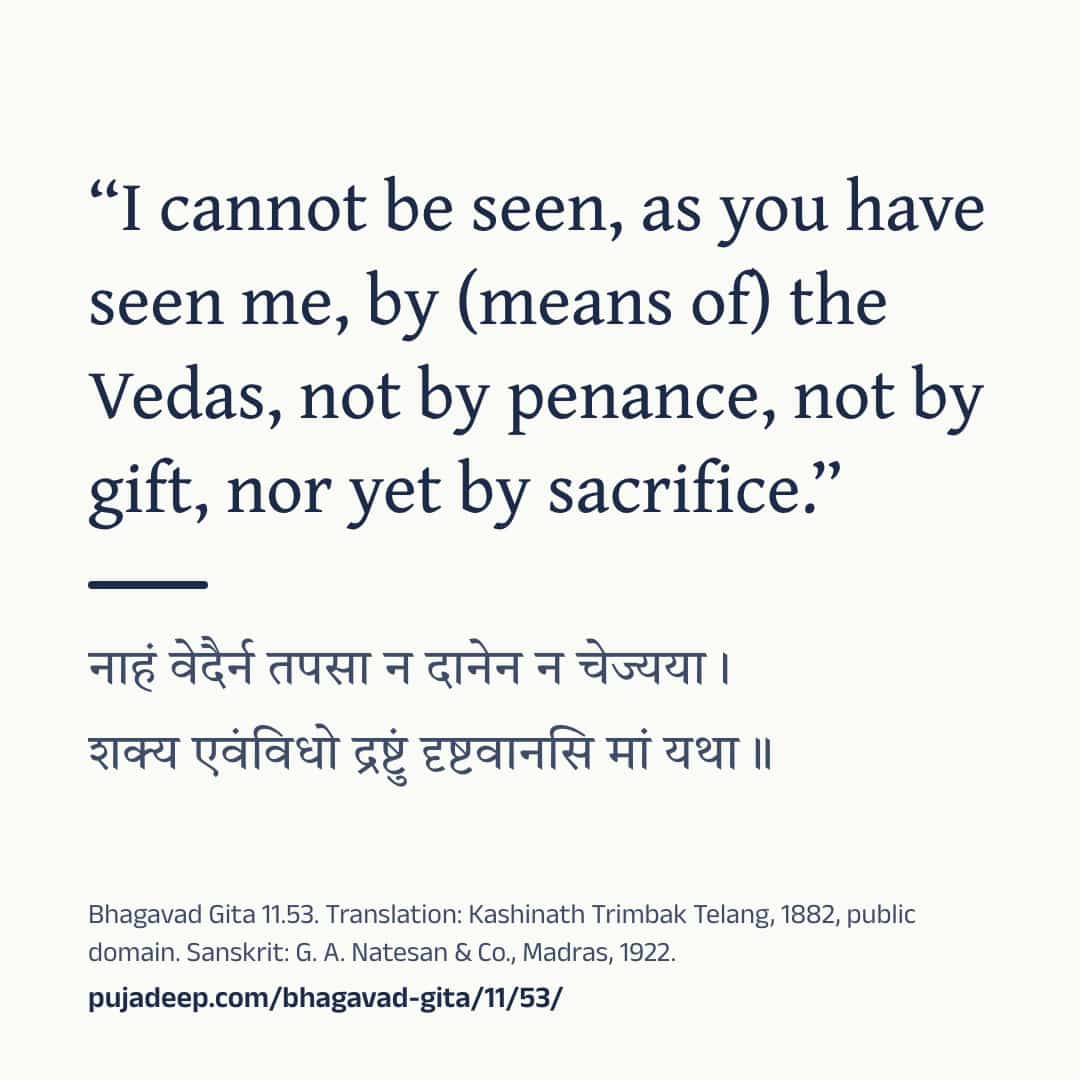
Drawing the picture
See the words
Bhagavad Gita 11.53

नाहं वेदैर्न तपसा न दानेन न चेज्यया ।
शक्य एवंविधो द्रष्टुं दृष्टवानसि मां यथा ॥

“I cannot be seen, as you have seen me, by (means of) the Vedas, not by penance, not by gift, nor yet by sacrifice.”
(K. T. Telang, The Bhagavadgîtâ (The Sacred Books of the East, vol. VIII, Oxford: Clarendon Press, 1882), p. 99, public domain)

“Nor can I be seen as thou hast seen Me by the Vedas, nor by austerities, nor by alms, nor by offerings;”
(Annie Besant, The Bhagavad Gîtâ, or The Lord's Song (London: Theosophical Publishing Society, 1895), p. 116, public domain)
This sentence goes on in 11.54.

“Neither by the Vedas nor by austerity, nor by gifts, nor by Sacrifice can I be seen as thou hast seen Me.”
(Swami Swarupananda, Srimad-Bhagavad-Gita (Mayavati: Prabuddha Bharata Press, 1909; first printed in Prabuddha Bharata, 1907–1909), p. 240, public domain)

Sanskrit: G. A. Natesan & Co., Madras, 1922.
https://pujadeep.com/bhagavad-gita/11/53/ Nothing is sent from this site. Your own app sends it, to the chat you choose. The picture quotes the translation you chose on this page, with its name and year.
Sanskrit text: The Bhagavad-Gita, or The Lord's Song, with the text in Devanagari and an English translation, 1922. Meanings: written for Pujadeep and checked against the cited edition. Source and changes
Questions families ask
Who speaks Bhagavad Gita 11.53?
Krishna speaks this verse, in chapter 11 (Vishvarupa Darshana Yoga).
Where does the Sanskrit text come from?
Sanskrit text: The Bhagavad-Gita, or The Lord's Song, with the text in Devanagari and an English translation, 1922. Meanings: written for Pujadeep and checked against the cited edition. See the source
Is the meaning on this page a translation?
Explanation written for this site from the sources listed here, and checked against the cited edition. It is not a translation and not the only way to read the text. Free to quote with credit.
Source and licence
- Sanskrit text
- The Bhagavad-Gita, or The Lord's Song, with the text in Devanagari and an English translation (Annie Besant, G. A. Natesan & Co., Madras, 1922). Public domain. The Sanskrit on these pages was read from this printing’s page images.
- Translation
- The Bhagavadgîtâ with the Sanatsugâtîya and the Anugîtâ, translated by Kâshinâth Trimbak Telang (The Sacred Books of the East, vol. VIII, ed. F. Max Müller) (Kashinath Trimbak Telang, F. Max Müller, Clarendon Press, Oxford, 1882). Public domain. Shown verbatim, as printed.
- Translation
- The Bhagavad Gîtâ, or The Lord's Song, translated by Annie Besant (Annie Besant, Theosophical Publishing Society, London, 1895). Public domain. Shown verbatim, as printed.
- Translation
- Srimad-Bhagavad-Gita, with Sanskrit Text; Paraphrase with Word-by-word Literal Translation; English Rendering and Comments, Index, &c., by the Swami Swarupananda (Himalayan Series, No. XX) (Swami Swarupananda, The Editors and Publishers, Advaita Ashrama, Mayavati, Prabuddha Bharata Press, Mayavati, Almora, Himalayas, 1909). Public domain. Shown verbatim, as printed.
- Common wording
- In this text, 32 words follow today's common wording, checked against sanskritdocuments.org; Sanskrit Wikisource; Gita Press, Gorakhpur; GRETIL, Göttingen and Bhaktivedanta Book Trust.
- Our explanation
- Explanation written for this site from the sources listed here, and checked against the cited edition. It is not a translation and not the only way to read the text. Free to quote with credit.
- Checked
- Checked against the cited edition, October 27, 2026.