Bhagavad Gita 11.47: meaning and translation
Chapter 11: Vishvarupa Darshana Yoga. Krishna says
Krishna speaks.
Click or tap a word for its meaning and its dictionary page.
Text and layers
Text and layers
These choices stay in this browser.
Bhagavad Gita 11.47
श्रीभगवानुवाच ।
मया प्रसन्नेन तवार्जुनेदम् रूपं परं दर्शितमात्मयोगात् ।तेजोमयं विश्वमनन्तमाद्यम् यन्मे त्वदन्येन न दृष्टपूर्वम् ॥
Maya prasannena tavarjunedam rupam param darshitamatmayogatTejomayam vishvamanantamadyam yanme tvadanyena na drishtapurvam
mayā prasannena tavārjunedam rūpaṃ paraṃ darśitamātmayogāt |tejomayaṃ viśvamanantamādyam yanme tvadanyena na dṛṣṭapūrvam ||
Our explanation Krishna speaks. He says that, pleased with Arjuna, he has shown him by his own power (ātma-yoga) this highest form: made of light, universal, endless and first, which no one but Arjuna has seen before. The schools explain 'no one but Arjuna' (see the views).
हिंदी अर्थ कृष्ण बोलते हैं। वे कहते हैं कि अर्जुन पर प्रसन्न होकर उन्होंने अपनी शक्ति (आत्मयोग) से उन्हें यह परम रूप दिखाया है: तेज से भरा, विश्वरूप, अनंत और आदि, जिसे अर्जुन के सिवा पहले किसी ने नहीं देखा। “अर्जुन के सिवा किसी ने नहीं” को परंपराएँ अलग-अलग ढंग से समझाती हैं।
Word by word
Every word, with its dictionary page
Word by word
- मया mayā · by "me" (Krishna) (pronoun, instrumental singular) Dictionary: 1. mad, Monier-Williams 1899, p. 777, col. 2 “base of the first pers. pron. in the sg. number (esp. in comp.)”
- प्रसन्नेन prasannena · pleased, gracious (past participle (masculine), instrumental singular) Dictionary: pra-sanna, Monier-Williams 1899, p. 696, col. 3 “gracious, kind, kindly disposed towards”
- तव tava · to you (pronoun, genitive singular) Dictionary: yuṣmad, Monier-Williams 1899, p. 855, col. 3 “the base of the 2nd pers. pron. as used in comp.”
- अर्जुन arjuna · O Arjuna (noun (masculine), vocative singular) Dictionary: arjuna, Monier-Williams 1899, p. 90, col. 1
- इदम् idam · this (pronoun (neuter), nominative singular) Dictionary: 1. idam, Monier-Williams 1899, p. 165, col. 2 “this, this here”
- रूपम् rūpam · form (noun (neuter), nominative singular) Dictionary: rūpa, Monier-Williams 1899, p. 885, col. 3 “form, shape, figure”
- परम् param · supreme (adjective (neuter), nominative singular) Dictionary: 1. para, Monier-Williams 1899, p. 586, col. 1 “highest, supreme, chief”
- दर्शितम् darśitam · shown (past participle (neuter), nominative singular) Dictionary: darśita, Monier-Williams 1899, p. 471, col. 1 “shown, displayed, exposed to view”
- आत्मयोगात् ātmayogāt · by his own power of yoga (compound (masculine), ablative singular) Dictionary: ātman, Monier-Williams 1899, p. 135, col. 1 “is used as reflexive pronoun for all three persons and all three genders”; yoga, Monier-Williams 1899, p. 856, col. 3 “application or concentration of the thoughts, abstract contemplation, meditation”
- तेजोमयम् tejomayam · full of radiance (adjective (neuter), nominative singular) Dictionary: tejo-maya, Monier-Williams 1899, p. 454, col. 3 “consisting of splendour or light, shining, brilliant”
- विश्वम् viśvam · universal (adjective (neuter), nominative singular) Dictionary: viśva, Monier-Williams 1899, p. 992, col. 2 “all, every, every one; whole, entire, universal”
- अनन्तम् anantam · endless (adjective (neuter), nominative singular) Dictionary: an-anta, Monier-Williams 1899, p. 25, col. 1 “endless, boundless, eternal, infinite”
- आद्यम् ādyam · primal (adjective (neuter), nominative singular) Dictionary: 1. ādya, Monier-Williams 1899, p. 137, col. 1 “being at the beginning, first, primitive”
- यत् yat · which (pronoun (neuter), nominative singular) Dictionary: yad, Monier-Williams 1899, p. 844, col. 2 “who, which, what, whichever, whatever, that”
- मे me · "my" (Krishna's) (pronoun, genitive singular) Dictionary: 1. mad, Monier-Williams 1899, p. 777, col. 2 “base of the first pers. pron. in the sg. number (esp. in comp.)”
- त्वदन्येन tvadanyena · by anyone other than you (compound (masculine), instrumental singular) Dictionary: tvad-anya, Monier-Williams 1899, p. 463, col. 2 “other than thee”
- न na · not (indeclinable) Dictionary: 2. na, Monier-Williams 1899, p. 523, col. 1 “not, no, nor, neither”
- दृष्टपूर्वम् dṛṣṭapūrvam · seen before (compound (neuter), nominative singular) Dictionary: dṛṣṭa-pūrva, Monier-Williams 1899, p. 491, col. 3 “seen before”
1 printing differs
Edition differences. Another printing or text reads this place differently.
- Spelling A digital text reads Same words. At the printed line ends the 1922 edition writes तवार्जुनेदम् and आद्यम्; the e-text writes तवार्जुनेदं and आद्यं.
Old translations
Kashinath Trimbak Telang, 1882. Public domain. Page 98.
The Deity said:
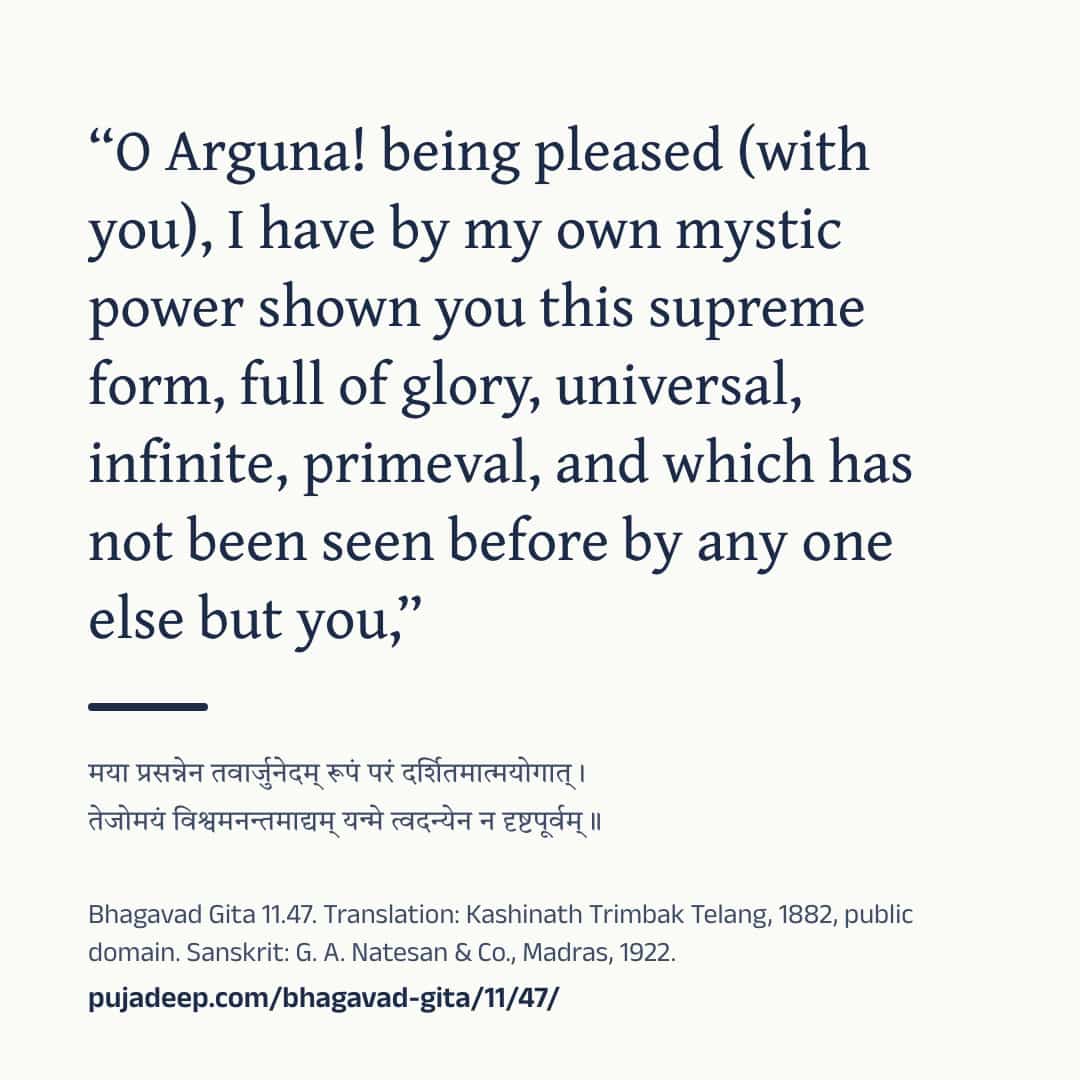
O Arguna! being pleased (with you), I have by my own mystic power shown you this supreme form, full of glory, universal, infinite, primeval, and which has not been seen before by any one else but you,
This sentence goes on in 11.48.
Compare 3 translations
Kashinath Trimbak Telang, 1882. Public domain. Page 98.
The Deity said:
O Arguna! being pleased (with you), I have by my own mystic power shown you this supreme form, full of glory, universal, infinite, primeval, and which has not been seen before by any one else but you,
This sentence goes on in 11.48.
You are reading this one
Annie Besant, 1895. Public domain. Page 115.
The Blessed Lord said:
Arjuna, by My favour thou hast seen
This loftiest Form, by Yoga's self proclaimed!
Radiant, all-penetrating, endless, first,
That none except thyself hath ever seen.
You are reading this one
Swami Swarupananda, 1909 (first printed 1907). Public domain. Page 237.
The Blessed Lord said:
Graciously have I shown to thee, O Arjuna, this Form Supreme, by My own Yoga power, this primeval, infinite, universal Form of Mine, resplendent, which hath not been seen before thee by anyone else.
You are reading this one
Cite this verse
The translation: K. T. Telang, The Bhagavadgîtâ (The Sacred Books of the East, vol. VIII, Oxford: Clarendon Press, 1882), p. 98. Bhagavad Gita 11.47.
The translation: Annie Besant, The Bhagavad Gîtâ, or The Lord's Song (London: Theosophical Publishing Society, 1895), p. 115. Bhagavad Gita 11.47.
The translation: Swami Swarupananda, Srimad-Bhagavad-Gita (Mayavati: Prabuddha Bharata Press, 1909; first printed in Prabuddha Bharata, 1907–1909), p. 237. Bhagavad Gita 11.47.
Our explanation: “Bhagavad Gita 11.47: meaning and translation.” Pujadeep. Updated October 27, 2026. https://pujadeep.com/bhagavad-gita/11/47/
Pujadeep’s explanations are free to quote with credit: name Pujadeep and link to the page. How to credit
Classical readings, by school
Each reading is named by its school. None is presented as the only meaning.
What Advaita, Vishishtadvaita and Dvaita teach, in short
Shankara Advaita
Shankara says Krishna praises the form in order to tell Arjuna that, by this vision, he should consider that all his aims have been reached.
Source: The Bhagavad-Gita, with the commentary of Sri Sankaracharya, translated by A. Mahadeva Sastri (2nd ed., Mysore: G. T. A. Printing Works, 1901), commentary on 11.47, p. 262. Summarised in our own words; none of its text is reproduced.
Madhva Dvaita
Madhva takes 'no one but you' to mean no one of lower standing than Arjuna. He adds that 'highest' is said for the sake of ordinary people. The wise, Brahmā among them, see Krishna's usual form and the universal form as equal, because the difference lies in the eyes of the one who sees, not in Krishna.
Source: The Bhagavad-Gita: translation and commentaries in English according to Sri Madhwacharya's Bhashyas, by S. Subba Rau (Madras, 1906), commentary on 11.47, p. 232 (leaf n230). Summarised in our own words; none of its text is reproduced.
Share
Show the ways to share
Send one picture or the text to one chat. The picture names its source and the address of this page.
Drawing the picture
See the words
Bhagavad Gita 11.47

मया प्रसन्नेन तवार्जुनेदम् रूपं परं दर्शितमात्मयोगात् ।
तेजोमयं विश्वमनन्तमाद्यम् यन्मे त्वदन्येन न दृष्टपूर्वम् ॥

“O Arguna! being pleased (with you), I have by my own mystic power shown you this supreme form, full of glory, universal, infinite, primeval, and which has not been seen before by any one else but you,”
(K. T. Telang, The Bhagavadgîtâ (The Sacred Books of the East, vol. VIII, Oxford: Clarendon Press, 1882), p. 98, public domain)
This sentence goes on in 11.48.

“Arjuna, by My favour thou hast seen This loftiest Form, by Yoga's self proclaimed! Radiant, all-penetrating, endless, first, That none except thyself hath ever seen.”
(Annie Besant, The Bhagavad Gîtâ, or The Lord's Song (London: Theosophical Publishing Society, 1895), p. 115, public domain)

“Graciously have I shown to thee, O Arjuna, this Form Supreme, by My own Yoga power, this primeval, infinite, universal Form of Mine, resplendent, which hath not been seen before thee by anyone else.”
(Swami Swarupananda, Srimad-Bhagavad-Gita (Mayavati: Prabuddha Bharata Press, 1909; first printed in Prabuddha Bharata, 1907–1909), p. 237, public domain)

Sanskrit: G. A. Natesan & Co., Madras, 1922.
https://pujadeep.com/bhagavad-gita/11/47/ Nothing is sent from this site. Your own app sends it, to the chat you choose. The picture quotes the translation you chose on this page, with its name and year.
Sanskrit text: The Bhagavad-Gita, or The Lord's Song, with the text in Devanagari and an English translation, 1922. Meanings: written for Pujadeep and checked against the cited edition. Source and changes
Questions families ask
Who speaks Bhagavad Gita 11.47?
Krishna speaks this verse, in chapter 11 (Vishvarupa Darshana Yoga).
Where does the Sanskrit text come from?
Sanskrit text: The Bhagavad-Gita, or The Lord's Song, with the text in Devanagari and an English translation, 1922. Meanings: written for Pujadeep and checked against the cited edition. See the source
Is the meaning on this page a translation?
Explanation written for this site from the sources listed here, and checked against the cited edition. It is not a translation and not the only way to read the text. Free to quote with credit.
Source and licence
- Sanskrit text
- The Bhagavad-Gita, or The Lord's Song, with the text in Devanagari and an English translation (Annie Besant, G. A. Natesan & Co., Madras, 1922). Public domain. The Sanskrit on these pages was read from this printing’s page images.
- Translation
- The Bhagavadgîtâ with the Sanatsugâtîya and the Anugîtâ, translated by Kâshinâth Trimbak Telang (The Sacred Books of the East, vol. VIII, ed. F. Max Müller) (Kashinath Trimbak Telang, F. Max Müller, Clarendon Press, Oxford, 1882). Public domain. Shown verbatim, as printed.
- Translation
- The Bhagavad Gîtâ, or The Lord's Song, translated by Annie Besant (Annie Besant, Theosophical Publishing Society, London, 1895). Public domain. Shown verbatim, as printed.
- Translation
- Srimad-Bhagavad-Gita, with Sanskrit Text; Paraphrase with Word-by-word Literal Translation; English Rendering and Comments, Index, &c., by the Swami Swarupananda (Himalayan Series, No. XX) (Swami Swarupananda, The Editors and Publishers, Advaita Ashrama, Mayavati, Prabuddha Bharata Press, Mayavati, Almora, Himalayas, 1909). Public domain. Shown verbatim, as printed.
- Commentary
- The Bhagavad-Gita, with the commentary of Sri Sankaracharya, translated by A. Mahadeva Sastri (2nd ed., Mysore: G. T. A. Printing Works, 1901) (Public-domain scan, University of California Libraries). Summarised in our own words; none of its text is reproduced.
- Commentary
- The Bhagavad-Gita: translation and commentaries in English according to Sri Madhwacharya's Bhashyas, by S. Subba Rau (Madras, 1906) (Scan uploaded to archive.org (folkscanomy collection)). Summarised in our own words; none of its text is reproduced.
- Common wording
- In this text, 32 words follow today's common wording, checked against sanskritdocuments.org; Sanskrit Wikisource; Gita Press, Gorakhpur; GRETIL, Göttingen and Bhaktivedanta Book Trust.
- Our explanation
- Explanation written for this site from the sources listed here, and checked against the cited edition. It is not a translation and not the only way to read the text. Free to quote with credit.
- Checked
- Checked against the cited edition, October 27, 2026.