Bhagavad Gita 11.41: meaning and translation
Chapter 11: Vishvarupa Darshana Yoga. Arjuna says
Arjuna asks for forgiveness.
Click or tap a word for its meaning and its dictionary page.
Text and layers
Text and layers
These choices stay in this browser.
Bhagavad Gita 11.41
सखेति मत्वा प्रसभं यदुक्तम् हे कृष्ण हे यादव हे सखेति ।अजानता महिमानं तवेदम् मया प्रमादात्प्रणयेन वापि ॥
Sakheti matva prasabham yaduktam he krishna he yadava he sakhetiAjanata mahimanam tavedam maya pramadatpranayena vapi
sakheti matvā prasabhaṃ yaduktam he kṛṣṇa he yādava he sakheti |ajānatā mahimānaṃ tavedam mayā pramādātpraṇayena vāpi ||
Our explanation Arjuna asks for forgiveness. Thinking of Krishna as a friend, he says, he called him rashly 'O Krishna, O Yādava, O friend', not knowing this greatness of his, out of carelessness or out of affection ... The sentence goes on in verse 42.
हिंदी अर्थ अर्जुन क्षमा माँगते हैं। वे कहते हैं कि कृष्ण को केवल मित्र मानकर, उनकी इस महिमा को न जानते हुए, असावधानी से या प्रेम से, उन्होंने बिना सोचे उन्हें “हे कृष्ण, हे यादव, हे सखा” कहकर पुकारा … यह वाक्य श्लोक 42 में आगे चलता है।
Word by word
Every word, with its dictionary page
Word by word
- सखा sakhā · friend (noun (masculine), nominative singular) Dictionary: sakhi, Monier-Williams 1899, p. 1130, col. 2 “a friend, assistant, companion”
- इति iti · thus (closes the thought) (indeclinable) Dictionary: 2. iti, Monier-Williams 1899, p. 165, col. 1 “in this manner, thus”
- मत्वा matvā · having thought (absolutive (having done)) Dictionary: man, Monier-Williams 1899, p. 783, col. 1 “to think, believe, imagine, suppose, conjecture”
- प्रसभम् prasabham · rashly (indeclinable) Dictionary: pra-sabha, Monier-Williams 1899, p. 697, col. 1 “forcibly, violently”
- यत् yat · whatever (pronoun (neuter), nominative singular) Dictionary: yad, Monier-Williams 1899, p. 844, col. 2 “who, which, what, whichever, whatever, that”
- उक्तम् uktam · said (past participle (neuter), nominative singular) Dictionary: ukta, Monier-Williams 1899, p. 171, col. 3 “uttered, said, spoken”
- हे he · O (indeclinable) Dictionary: he, Monier-Williams 1899, p. 1303, col. 3 “a vocative particle”
- कृष्ण kṛṣṇa · Krishna (noun (masculine), vocative singular) Dictionary: kṛṣṇa, Monier-Williams 1899, p. 306, col. 2 “N. of a celebrated Avatār of the god Vishṇu, or sometimes identified with Vishṇu himself”
- हे he · O (indeclinable) Dictionary: he, Monier-Williams 1899, p. 1303, col. 3 “a vocative particle”
- यादव yādava · Yadava (noun (masculine), vocative singular) Dictionary: yādava, Monier-Williams 1899, p. 851, col. 2 “a descendant of Y°”
- हे he · O (indeclinable) Dictionary: he, Monier-Williams 1899, p. 1303, col. 3 “a vocative particle”
- सखे sakhe · friend (noun (masculine), vocative singular) Dictionary: sakhi, Monier-Williams 1899, p. 1130, col. 2 “a friend, assistant, companion”
- इति iti · thus (closes the words) (indeclinable) Dictionary: 2. iti, Monier-Williams 1899, p. 165, col. 1 “in this manner, thus”
- अजानता ajānatā · not knowing (present participle (masculine), instrumental singular) Dictionary: a-jānat, Monier-Williams 1899, p. 10, col. 1 “not knowing, unaware”
- महिमानम् mahimānam · greatness (noun (masculine), accusative singular) Dictionary: mahiman, Monier-Williams 1899, p. 803, col. 1 “greatness, might, power, majesty, glory”
- तव tava · your (pronoun, genitive singular) Dictionary: yuṣmad, Monier-Williams 1899, p. 855, col. 3 “the base of the 2nd pers. pron. as used in comp.”
- इदम् idam · this (pronoun (neuter), accusative singular) Dictionary: 1. idam, Monier-Williams 1899, p. 165, col. 2 “this, this here”
- मया mayā · by "me" (Arjuna) (pronoun, instrumental singular) Dictionary: 1. mad, Monier-Williams 1899, p. 777, col. 2 “base of the first pers. pron. in the sg. number (esp. in comp.)”
- प्रमादात् pramādāt · through carelessness (noun (masculine), ablative singular) Dictionary: pra-māda, Monier-Williams 1899, p. 685, col. 2 “negligence, carelessness”
- प्रणयेन praṇayena · through affection (noun (masculine), instrumental singular) Dictionary: pra-ṇaya, Monier-Williams 1899, p. 660, col. 2 “affection, confidence in (loc.), love, attachment”
- वा vā · or (indeclinable) Dictionary: 1. vā, Monier-Williams 1899, p. 934, col. 2 “or”
- अपि api · even (indeclinable) Dictionary: api, Monier-Williams 1899, p. 55, col. 1 “even, also, very”
1 printing differs
Edition differences. Another printing or text reads this place differently.
- Spelling A digital text reads Same words. At the printed line ends the 1922 edition writes यदुक्तम् and तवेदम्; the e-text writes यदुक्तं and तवेदं.
Old translations
Kashinath Trimbak Telang, 1882. Public domain. Page 97.
Whatever I have said contemptuously,—for instance, 'O Krishna!' 'O Yâdava!' 'O friend!'—thinking you to be (my) friend, and not knowing your greatness (as shown in) this (universal form), or through friendliness, or incautiously;
This sentence goes on in 11.42.
Compare 3 translations
Kashinath Trimbak Telang, 1882. Public domain. Page 97.
Whatever I have said contemptuously,—for instance, 'O Krishna!' 'O Yâdava!' 'O friend!'—thinking you to be (my) friend, and not knowing your greatness (as shown in) this (universal form), or through friendliness, or incautiously;
This sentence goes on in 11.42.
You are reading this one
Annie Besant, 1895. Public domain. Page 113.
If, thinking Thee but friend, importunate,
O Krishna! or O Yâdava! O friend!
I cried, unknowing of Thy majesty,
And careless in the fondness of my love;
This sentence goes on in 11.42.
You are reading this one
Swami Swarupananda, 1909 (first printed 1907). Public domain. Page 234.
Whatever I have presumptuously said from carelessness or love, addressing Thee as, "O Krishna, O Yâdava, O friend," regarding Thee merely as a friend, unconscious of this Thy greatness—in whatever way I may have been disrespectful to Thee in fun, while walking, reposing, sitting, or at meals, when alone (with Thee), O Achyuta, or in company—I implore Thee, Immeasurable One, to forgive all this.
This sentence covers verses 11.41 to 11.42.
You are reading this one
Cite this verse
The translation: K. T. Telang, The Bhagavadgîtâ (The Sacred Books of the East, vol. VIII, Oxford: Clarendon Press, 1882), p. 97. Bhagavad Gita 11.41.
The translation: Annie Besant, The Bhagavad Gîtâ, or The Lord's Song (London: Theosophical Publishing Society, 1895), p. 113. Bhagavad Gita 11.41.
The translation: Swami Swarupananda, Srimad-Bhagavad-Gita (Mayavati: Prabuddha Bharata Press, 1909; first printed in Prabuddha Bharata, 1907–1909), p. 234. Bhagavad Gita 11.41–42.
Our explanation: “Bhagavad Gita 11.41: meaning and translation.” Pujadeep. Updated October 27, 2026. https://pujadeep.com/bhagavad-gita/11/41/
Pujadeep’s explanations are free to quote with credit: name Pujadeep and link to the page. How to credit
Classical readings, by school
No readings by school on this verse yet.
Share
Show the ways to share
Send one picture or the text to one chat. The picture names its source and the address of this page.
Drawing the picture
See the words
Bhagavad Gita 11.41

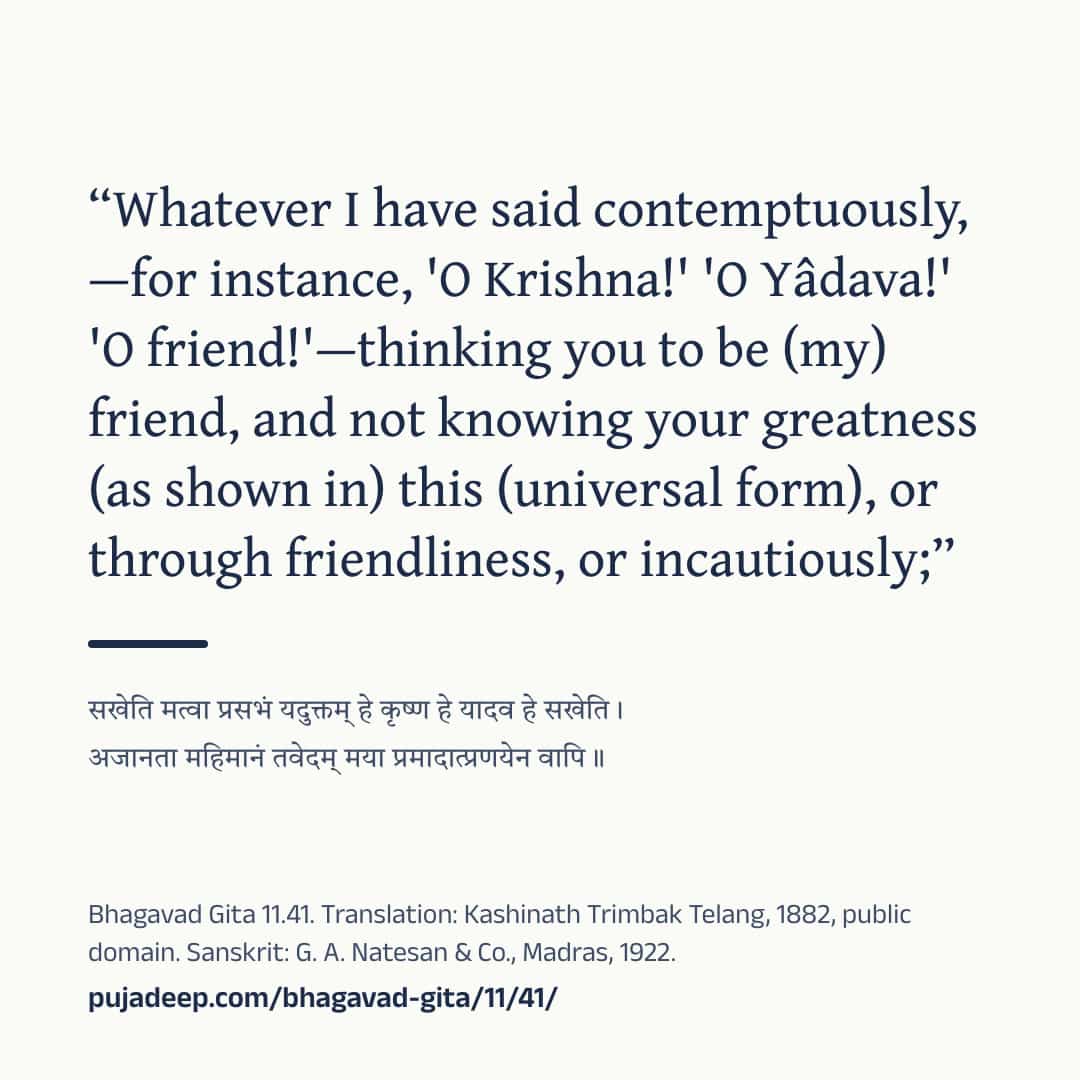
सखेति मत्वा प्रसभं यदुक्तम् हे कृष्ण हे यादव हे सखेति ।
अजानता महिमानं तवेदम् मया प्रमादात्प्रणयेन वापि ॥

“Whatever I have said contemptuously,—for instance, 'O Krishna!' 'O Yâdava!' 'O friend!'—thinking you to be (my) friend, and not knowing your greatness (as shown in) this (universal form), or through friendliness, or incautiously;”
(K. T. Telang, The Bhagavadgîtâ (The Sacred Books of the East, vol. VIII, Oxford: Clarendon Press, 1882), p. 97, public domain)
This sentence goes on in 11.42.

“If, thinking Thee but friend, importunate, O Krishna! or O Yâdava! O friend! I cried, unknowing of Thy majesty, And careless in the fondness of my love;”
(Annie Besant, The Bhagavad Gîtâ, or The Lord's Song (London: Theosophical Publishing Society, 1895), p. 113, public domain)
This sentence goes on in 11.42.

“Whatever I have presumptuously said from carelessness or love, addressing Thee as, "O Krishna, O Yâdava, O friend," regarding Thee merely as a friend, unconscious of this Thy greatness—in whatever way I may have been disrespectful to Thee in fun, while walking, reposing, sitting, or at meals, when alone (with Thee), O Achyuta, or in company—I implore Thee, Immeasurable One, to forgive all this.”
(Swami Swarupananda, Srimad-Bhagavad-Gita (Mayavati: Prabuddha Bharata Press, 1909; first printed in Prabuddha Bharata, 1907–1909), p. 234, public domain)
This sentence covers verses 11.41 to 11.42.

Sanskrit: G. A. Natesan & Co., Madras, 1922.
https://pujadeep.com/bhagavad-gita/11/41/ Nothing is sent from this site. Your own app sends it, to the chat you choose. The picture quotes the translation you chose on this page, with its name and year.
Sanskrit text: The Bhagavad-Gita, or The Lord's Song, with the text in Devanagari and an English translation, 1922. Meanings: written for Pujadeep and checked against the cited edition. Source and changes
Questions families ask
Who speaks Bhagavad Gita 11.41?
Arjuna speaks this verse, in chapter 11 (Vishvarupa Darshana Yoga).
Where does the Sanskrit text come from?
Sanskrit text: The Bhagavad-Gita, or The Lord's Song, with the text in Devanagari and an English translation, 1922. Meanings: written for Pujadeep and checked against the cited edition. See the source
Is the meaning on this page a translation?
Explanation written for this site from the sources listed here, and checked against the cited edition. It is not a translation and not the only way to read the text. Free to quote with credit.
Source and licence
- Sanskrit text
- The Bhagavad-Gita, or The Lord's Song, with the text in Devanagari and an English translation (Annie Besant, G. A. Natesan & Co., Madras, 1922). Public domain. The Sanskrit on these pages was read from this printing’s page images.
- Translation
- The Bhagavadgîtâ with the Sanatsugâtîya and the Anugîtâ, translated by Kâshinâth Trimbak Telang (The Sacred Books of the East, vol. VIII, ed. F. Max Müller) (Kashinath Trimbak Telang, F. Max Müller, Clarendon Press, Oxford, 1882). Public domain. Shown verbatim, as printed.
- Translation
- The Bhagavad Gîtâ, or The Lord's Song, translated by Annie Besant (Annie Besant, Theosophical Publishing Society, London, 1895). Public domain. Shown verbatim, as printed.
- Translation
- Srimad-Bhagavad-Gita, with Sanskrit Text; Paraphrase with Word-by-word Literal Translation; English Rendering and Comments, Index, &c., by the Swami Swarupananda (Himalayan Series, No. XX) (Swami Swarupananda, The Editors and Publishers, Advaita Ashrama, Mayavati, Prabuddha Bharata Press, Mayavati, Almora, Himalayas, 1909). Public domain. Shown verbatim, as printed.
- Common wording
- In this text, 32 words follow today's common wording, checked against sanskritdocuments.org; Sanskrit Wikisource; Gita Press, Gorakhpur; GRETIL, Göttingen and Bhaktivedanta Book Trust.
- Our explanation
- Explanation written for this site from the sources listed here, and checked against the cited edition. It is not a translation and not the only way to read the text. Free to quote with credit.
- Checked
- Checked against the cited edition, October 27, 2026.