Bhagavad Gita 11.48: meaning and translation
Chapter 11: Vishvarupa Darshana Yoga. Krishna says
Krishna tells Arjuna, the hero of the Kurus, that among humans no one except Arjuna can see this form of his.
Click or tap a word for its meaning and its dictionary page.
Text and layers
Text and layers
These choices stay in this browser.
Bhagavad Gita 11.48
न वेदयज्ञाध्ययनैर्न दानैर्न च क्रियाभिर्न तपोभिरुग्रैः ।एवंरूपः शक्य अहं नृलोके द्रष्टुं त्वदन्येन कुरुप्रवीर ॥
Na vedayajnadhyayanairna danairna cha kriyabhirna tapobhirugraihEvanrupah shakya aham nriloke drashtum tvadanyena kurupravira
na vedayajñādhyayanairna dānairna ca kriyābhirna tapobhirugraiḥ |evaṃrūpaḥ śakya ahaṃ nṛloke draṣṭuṃ tvadanyena kurupravīra ||
Our explanation Krishna tells Arjuna, the hero of the Kurus, that among humans no one except Arjuna can see this form of his. Vedas, sacrifices and study, gifts, rites and harsh austerities will not win that sight for anyone else. Telang's note says the Sanskrit joins Vedas, sacrifices and study in one compound, and that the study of the Vedas and sacrifices are probably meant.
हिंदी अर्थ कृष्ण कहते हैं कि न वेदों और यज्ञों के अध्ययन से, न दान से, न कर्मकांड से, न कठोर तप से, मनुष्य-लोक में अर्जुन के सिवा कोई उन्हें इस रूप में देख सकता है। वे अर्जुन को कुरुप्रवीर (कुरुओं में वीर) कहते हैं। तेलंग की टिप्पणी बताती है कि संस्कृत में वेद, यज्ञ और अध्ययन एक ही समास में हैं, और शायद वेदों का अध्ययन और यज्ञ, दोनों अभिप्रेत हैं।
Word by word
Every word, with its dictionary page
Word by word
- न na · not (indeclinable) Dictionary: 2. na, Monier-Williams 1899, p. 523, col. 1 “not, no, nor, neither”
- वेदयज्ञाध्ययनैः vedayajñādhyayanaiḥ · by Vedas, sacrifices, study (compound (neuter), instrumental plural) Dictionary: veda, Monier-Williams 1899, p. 1015, col. 1 “knowledge, true or sacred knowledge or lore”; yajña, Monier-Williams 1899, p. 839, col. 2 “offering, oblation, sacrifice”; adhy-ayana, Monier-Williams 1899, p. 22, col. 3 “reading, studying, especially the Vedas”
- न na · nor (indeclinable) Dictionary: 2. na, Monier-Williams 1899, p. 523, col. 1 “not, no, nor, neither”
- दानैः dānaiḥ · by gifts (noun (neuter), instrumental plural) Dictionary: 1. dāna, Monier-Williams 1899, p. 474, col. 1 “the act of giving”
- न na · nor (indeclinable) Dictionary: 2. na, Monier-Williams 1899, p. 523, col. 1 “not, no, nor, neither”
- च ca · and (indeclinable) Dictionary: 2. ca, Monier-Williams 1899, p. 380, col. 1 “and, both, also, moreover, as well as”
- क्रियाभिः kriyābhiḥ · by rites, by actions (noun (feminine), instrumental plural) Dictionary: kriyā, Monier-Williams 1899, p. 320, col. 3 “doing, performing, performance”
- न na · nor (indeclinable) Dictionary: 2. na, Monier-Williams 1899, p. 523, col. 1 “not, no, nor, neither”
- तपोभिः tapobhiḥ · by austerities (noun (neuter), instrumental plural) Dictionary: tapas, Monier-Williams 1899, p. 437, col. 1 “religious austerity, bodily mortification, penance, severe meditation”
- उग्रैः ugraiḥ · severe (adjective (neuter), instrumental plural) Dictionary: ugra, Monier-Williams 1899, p. 172, col. 2 “powerful, violent, mighty, impetuous, strong”
- एवंरूपः evaṃrūpaḥ · in such a form (compound (masculine), nominative singular) Dictionary: evaṃ-rūpa, Monier-Williams 1899, p. 232, col. 3 “of such a form or kind”
- शक्यः śakyaḥ · can be (gerundive (to be done) (masculine), nominative singular) Dictionary: śakya, Monier-Williams 1899, p. 1045, col. 1 “able, possible, practicable”
- अहम् aham · "I" (Krishna) (pronoun, nominative singular) Dictionary: aham, Monier-Williams 1899, p. 124, col. 2 “nom. sg. ‘I,’”
- नृलोके nṛloke · in the human world (compound (masculine), locative singular) Dictionary: nṛ-loka, Monier-Williams 1899, p. 568, col. 1 “the world of men, the earth”
- द्रष्टुम् draṣṭum · to be seen (infinitive (to do)) Dictionary: 1. dṛś, Monier-Williams 1899, p. 491, col. 2 “to see, behold, look at, regard, consider”
- त्वदन्येन tvadanyena · by anyone other than you (compound (masculine), instrumental singular) Dictionary: tvad-anya, Monier-Williams 1899, p. 463, col. 2 “other than thee”
- कुरुप्रवीर kurupravīra · O hero of the Kurus (compound (masculine), vocative singular) Dictionary: kuru, Monier-Williams 1899, p. 294, col. 1 “N. of a people of India and of their country”; pra-vīra, Monier-Williams 1899, p. 693, col. 1 “a hero, prince, chief among”
Old translations
Kashinath Trimbak Telang, 1882. Public domain. Page 98.
O you hero among the Kauravas! I cannot be seen in this form by any one but you, (even) by (the help of) the study of the Vedas, or of1 sacrifices, nor by gifts, nor by actions, nor by fierce penances.
This sentence begins in 11.47.
Footnotes (the translator’s own) - This is the original construction. One suspects that sacrifices and study of the Vedas are meant. Cf. the speech of Krishna on the next page. ↩
Compare 3 translations
Kashinath Trimbak Telang, 1882. Public domain. Page 98.
O you hero among the Kauravas! I cannot be seen in this form by any one but you, (even) by (the help of) the study of the Vedas, or of1 sacrifices, nor by gifts, nor by actions, nor by fierce penances.
This sentence begins in 11.47.
Footnotes (the translator’s own) - This is the original construction. One suspects that sacrifices and study of the Vedas are meant. Cf. the speech of Krishna on the next page. ↩
You are reading this one
Annie Besant, 1895. Public domain. Page 115.
Nor sacrifice nor Vedas, alms nor works,
Nor sharp austerity, nor study deep,
Can win the vision of this Form for man.
Foremost of Kurus, thou alone hast seen.
You are reading this one
Swami Swarupananda, 1909 (first printed 1907). Public domain. Page 238.
Neither by the study of the Veda and of Yajna, nor by gifts, nor by rituals, nor by severe austerities, am I in such Form visible, in the world of men, to any other than thee, O great hero of the Kurus.
You are reading this one
Cite this verse
The translation: K. T. Telang, The Bhagavadgîtâ (The Sacred Books of the East, vol. VIII, Oxford: Clarendon Press, 1882), p. 98. Bhagavad Gita 11.48.
The translation: Annie Besant, The Bhagavad Gîtâ, or The Lord's Song (London: Theosophical Publishing Society, 1895), p. 115. Bhagavad Gita 11.48.
The translation: Swami Swarupananda, Srimad-Bhagavad-Gita (Mayavati: Prabuddha Bharata Press, 1909; first printed in Prabuddha Bharata, 1907–1909), p. 238. Bhagavad Gita 11.48.
Our explanation: “Bhagavad Gita 11.48: meaning and translation.” Pujadeep. Updated October 27, 2026. https://pujadeep.com/bhagavad-gita/11/48/
Pujadeep’s explanations are free to quote with credit: name Pujadeep and link to the page. How to credit
Classical readings, by school
Each reading is named by its school. None is presented as the only meaning.
What Advaita, Vishishtadvaita and Dvaita teach, in short
Ramanuja Vishishtadvaita
Ramanuja says no one without intense, single-minded love (bhakti) for the Lord can see him in this form by the Vedas, sacrifices or the other means named.
Source: Sri Bhagavad-Gita with Sri Ramanujacharya's Visishtadvaita commentary, translated by A. Govindacharya (Madras, 1898), commentary on 11.48, p. 372. Summarised in our own words; none of its text is reproduced.
Madhva Dvaita
Madhva again limits 'by anyone but you' to those below Arjuna in fitness, and to the extent that Arjuna saw. He holds that any other reading would clash with what was said earlier.
Source: The Bhagavad-Gita: translation and commentaries in English according to Sri Madhwacharya's Bhashyas, by S. Subba Rau (Madras, 1906), commentary on 11.48, p. 233 (leaf n231). Summarised in our own words; none of its text is reproduced.
Share
Show the ways to share
Send one picture or the text to one chat. The picture names its source and the address of this page.
Drawing the picture
See the words
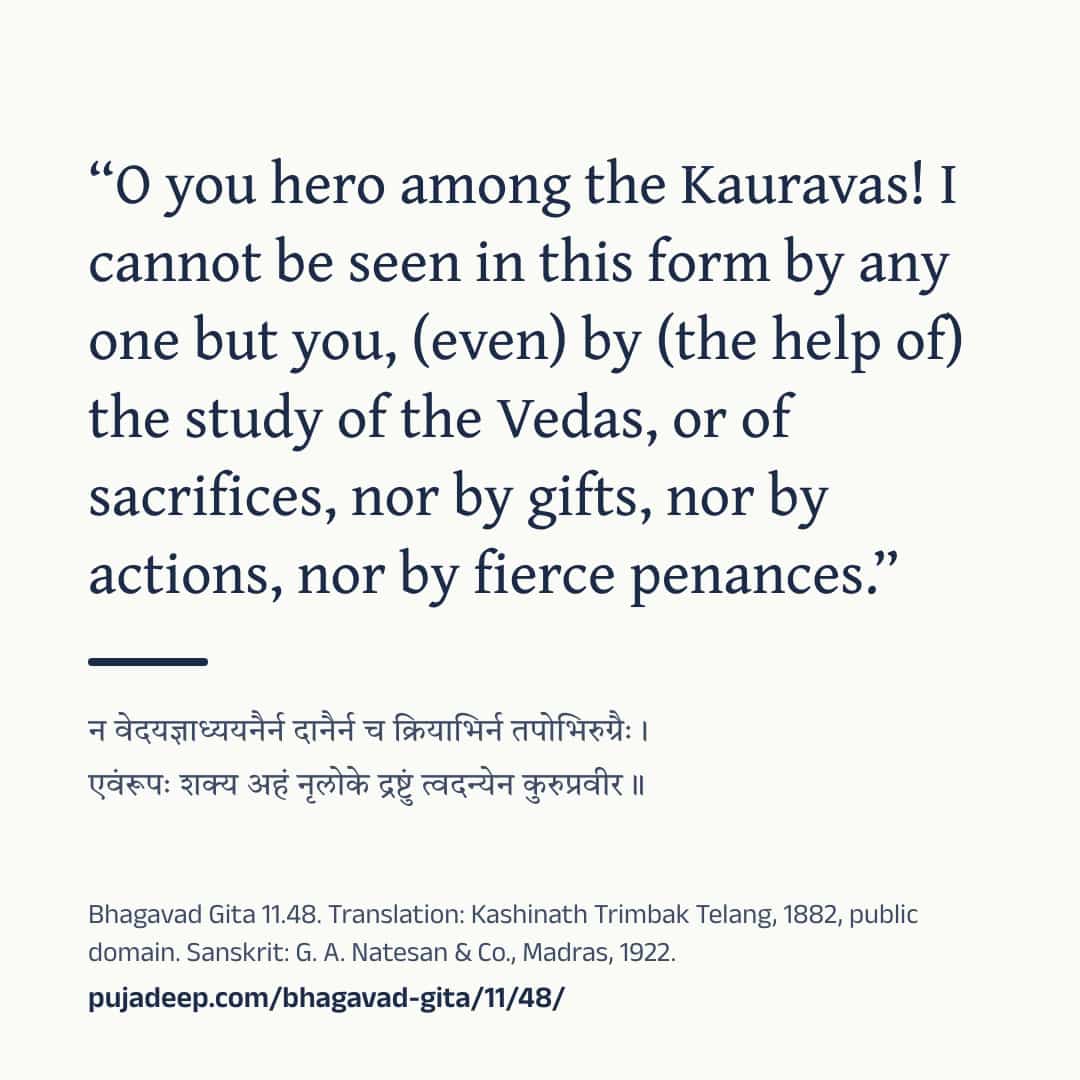
Bhagavad Gita 11.48

न वेदयज्ञाध्ययनैर्न दानैर्न च क्रियाभिर्न तपोभिरुग्रैः ।
एवंरूपः शक्य अहं नृलोके द्रष्टुं त्वदन्येन कुरुप्रवीर ॥

“O you hero among the Kauravas! I cannot be seen in this form by any one but you, (even) by (the help of) the study of the Vedas, or of sacrifices, nor by gifts, nor by actions, nor by fierce penances.”
(K. T. Telang, The Bhagavadgîtâ (The Sacred Books of the East, vol. VIII, Oxford: Clarendon Press, 1882), p. 98, public domain)
This sentence begins in 11.47.

“Nor sacrifice nor Vedas, alms nor works, Nor sharp austerity, nor study deep, Can win the vision of this Form for man. Foremost of Kurus, thou alone hast seen.”
(Annie Besant, The Bhagavad Gîtâ, or The Lord's Song (London: Theosophical Publishing Society, 1895), p. 115, public domain)

“Neither by the study of the Veda and of Yajna, nor by gifts, nor by rituals, nor by severe austerities, am I in such Form visible, in the world of men, to any other than thee, O great hero of the Kurus.”
(Swami Swarupananda, Srimad-Bhagavad-Gita (Mayavati: Prabuddha Bharata Press, 1909; first printed in Prabuddha Bharata, 1907–1909), p. 238, public domain)

Sanskrit: G. A. Natesan & Co., Madras, 1922.
https://pujadeep.com/bhagavad-gita/11/48/ Nothing is sent from this site. Your own app sends it, to the chat you choose. The picture quotes the translation you chose on this page, with its name and year.
Sanskrit text: The Bhagavad-Gita, or The Lord's Song, with the text in Devanagari and an English translation, 1922. Meanings: written for Pujadeep and checked against the cited edition. Source and changes
Questions families ask
Who speaks Bhagavad Gita 11.48?
Krishna speaks this verse, in chapter 11 (Vishvarupa Darshana Yoga).
Where does the Sanskrit text come from?
Sanskrit text: The Bhagavad-Gita, or The Lord's Song, with the text in Devanagari and an English translation, 1922. Meanings: written for Pujadeep and checked against the cited edition. See the source
Is the meaning on this page a translation?
Explanation written for this site from the sources listed here, and checked against the cited edition. It is not a translation and not the only way to read the text. Free to quote with credit.
Source and licence
- Sanskrit text
- The Bhagavad-Gita, or The Lord's Song, with the text in Devanagari and an English translation (Annie Besant, G. A. Natesan & Co., Madras, 1922). Public domain. The Sanskrit on these pages was read from this printing’s page images.
- Translation
- The Bhagavadgîtâ with the Sanatsugâtîya and the Anugîtâ, translated by Kâshinâth Trimbak Telang (The Sacred Books of the East, vol. VIII, ed. F. Max Müller) (Kashinath Trimbak Telang, F. Max Müller, Clarendon Press, Oxford, 1882). Public domain. Shown verbatim, as printed.
- Translation
- The Bhagavad Gîtâ, or The Lord's Song, translated by Annie Besant (Annie Besant, Theosophical Publishing Society, London, 1895). Public domain. Shown verbatim, as printed.
- Translation
- Srimad-Bhagavad-Gita, with Sanskrit Text; Paraphrase with Word-by-word Literal Translation; English Rendering and Comments, Index, &c., by the Swami Swarupananda (Himalayan Series, No. XX) (Swami Swarupananda, The Editors and Publishers, Advaita Ashrama, Mayavati, Prabuddha Bharata Press, Mayavati, Almora, Himalayas, 1909). Public domain. Shown verbatim, as printed.
- Commentary
- Sri Bhagavad-Gita with Sri Ramanujacharya's Visishtadvaita commentary, translated by A. Govindacharya (Madras, 1898) (Scan uploaded to archive.org (folkscanomy collection)). Summarised in our own words; none of its text is reproduced.
- Commentary
- The Bhagavad-Gita: translation and commentaries in English according to Sri Madhwacharya's Bhashyas, by S. Subba Rau (Madras, 1906) (Scan uploaded to archive.org (folkscanomy collection)). Summarised in our own words; none of its text is reproduced.
- Common wording
- In this text, 32 words follow today's common wording, checked against sanskritdocuments.org; Sanskrit Wikisource; Gita Press, Gorakhpur; GRETIL, Göttingen and Bhaktivedanta Book Trust.
- Our explanation
- Explanation written for this site from the sources listed here, and checked against the cited edition. It is not a translation and not the only way to read the text. Free to quote with credit.
- Checked
- Checked against the cited edition, October 27, 2026.