Bhagavad Gita 11.40: meaning and translation
Chapter 11: Vishvarupa Darshana Yoga. Arjuna says
Arjuna bows to Krishna in front and behind and on every side, calling him 'All' (sarva).
Click or tap a word for its meaning and its dictionary page.
Text and layers
Text and layers
These choices stay in this browser.
Bhagavad Gita 11.40
नमः पुरस्तादथ पृष्ठतस्ते नमोऽस्तु ते सर्वत एव सर्व ।अनन्तवीर्यामितविक्रमस्त्वम् सर्वं समाप्नोषि ततोऽसि सर्वः ॥
Namah purastadatha prishthataste namostu te sarvata eva sarvaAnantaviryamitavikramastvam sarvam samapnoshi tatosi sarvah
namaḥ purastādatha pṛṣṭhataste namo’stu te sarvata eva sarva |anantavīryāmitavikramastvam sarvaṃ samāpnoṣi tato’si sarvaḥ ||
Our explanation Arjuna bows to Krishna in front and behind and on every side, calling him 'All' (sarva). He says Krishna's strength is endless and his might beyond measure; he pervades all, and so he is all. The schools read 'he is all' differently (see the views).
हिंदी अर्थ अर्जुन कृष्ण को आगे से, पीछे से और हर ओर से प्रणाम करते हैं, और उन्हें “सर्व” (सब कुछ) कहकर पुकारते हैं। वे कहते हैं कि कृष्ण का बल अनंत है और उनका पराक्रम अपार; वे सबमें व्याप्त हैं, इसलिए वे सब कुछ हैं। “वे सब कुछ हैं” को परंपराएँ अलग-अलग ढंग से पढ़ती हैं।
Word by word
Every word, with its dictionary page
Word by word
- नमः namaḥ · salutation (noun (neuter), nominative singular) Dictionary: namas, Monier-Williams 1899, p. 528, col. 1 “bow, obeisance, reverential salutation”
- पुरस्तात् purastāt · in front (indeclinable) Dictionary: purastāt, Monier-Williams 1899, p. 634, col. 3 “before, forward, in or from the front”
- अथ atha · and (indeclinable) Dictionary: atha, Monier-Williams 1899, p. 17, col. 3 “now; then; moreover”
- पृष्ठतः pṛṣṭhataḥ · from behind (indeclinable) Dictionary: pṛṣṭhatas, Monier-Williams 1899, p. 647, col. 3 “from or on or behind the back, behind”
- ते te · to you (pronoun, dative singular) Dictionary: yuṣmad, Monier-Williams 1899, p. 855, col. 3 “the base of the 2nd pers. pron. as used in comp.”
- नमः namaḥ · salutation (noun (neuter), nominative singular) Dictionary: namas, Monier-Williams 1899, p. 528, col. 1 “bow, obeisance, reverential salutation”
- अस्तु astu · let there be (imperative, 3rd person singular) Dictionary: 1. as, Monier-Williams 1899, p. 117, col. 2 “to be, live, exist, be present”
- ते te · to you (pronoun, dative singular) Dictionary: yuṣmad, Monier-Williams 1899, p. 855, col. 3 “the base of the 2nd pers. pron. as used in comp.”
- सर्वतः sarvataḥ · from every side (indeclinable) Dictionary: sarvatas, Monier-Williams 1899, p. 1189, col. 1 “from all sides, in every direction, everywhere”
- एव eva · indeed (indeclinable) Dictionary: 1. eva, Monier-Williams 1899, p. 232, col. 2 “just, exactly, very, same, only, even, alone, merely”
- सर्व sarva · O All (noun (masculine), vocative singular) Dictionary: sarva, Monier-Williams 1899, p. 1184, col. 3 “whole, entire, all, every”
- अनन्तवीर्यामितविक्रमः anantavīryāmitavikramaḥ · of endless power and boundless might (compound (masculine), nominative singular) Dictionary: an-anta, Monier-Williams 1899, p. 25, col. 1 “endless, boundless, eternal, infinite”; vīrya, Monier-Williams 1899, p. 1006, col. 3 “manliness, valour, strength, power, energy”; amita-vikrama, Monier-Williams 1899, p. 81, col. 3 “'of unbounded valour,' a N. of Vishṇu”
- त्वम् tvam · you (pronoun, nominative singular) Dictionary: yuṣmad, Monier-Williams 1899, p. 855, col. 3 “the base of the 2nd pers. pron. as used in comp.”
- सर्वम् sarvam · all (pronoun (neuter), accusative singular) Dictionary: sarva, Monier-Williams 1899, p. 1184, col. 3 “whole, entire, all, every”
- समाप्नोषि samāpnoṣi · pervade, fill (present, 2nd person singular) Dictionary: sam-āp, Monier-Williams 1899, p. 1161, col. 1 “to acquire or obtain completely, gain”
- ततः tataḥ · therefore (indeclinable) Dictionary: tatas, Monier-Williams 1899, p. 432, col. 2 “thereupon, then, after that”
- असि asi · are (present, 2nd person singular) Dictionary: 1. as, Monier-Williams 1899, p. 117, col. 2 “to be, live, exist, be present”
- सर्वः sarvaḥ · all (pronoun (masculine), nominative singular) Dictionary: sarva, Monier-Williams 1899, p. 1184, col. 3 “whole, entire, all, every”
1 printing differs
Edition differences. Another printing or text reads this place differently.
- Spelling A digital text reads Same words. At the printed line end the 1922 edition writes त्वम्; the e-text writes त्वं.
Old translations
Kashinath Trimbak Telang, 1882. Public domain. Page 97.
In front and from behind obeisance to thee! Obeisance be to thee from all sides, O you who are all! You are of infinite power, of unmeasured glory; you pervade all, and therefore you are all!
Compare 3 translations
Kashinath Trimbak Telang, 1882. Public domain. Page 97.
In front and from behind obeisance to thee! Obeisance be to thee from all sides, O you who are all! You are of infinite power, of unmeasured glory; you pervade all, and therefore you are all!
You are reading this one
Annie Besant, 1895. Public domain. Page 113.
Prostrate in front of Thee, prostrate behind,
Prostrate on every side to Thee, O All.
In power boundless, measureless in strength,
Thou holdest all: then Thou Thyself art All.
You are reading this one
Swami Swarupananda, 1909 (first printed 1907). Public domain. Page 233.
Salutation to Thee before and to Thee behind, salutation to Thee on every side, O All! Thou, infinite in power and infinite in prowess, pervadest all; wherefore Thou art All.
You are reading this one
Cite this verse
The translation: K. T. Telang, The Bhagavadgîtâ (The Sacred Books of the East, vol. VIII, Oxford: Clarendon Press, 1882), p. 97. Bhagavad Gita 11.40.
The translation: Annie Besant, The Bhagavad Gîtâ, or The Lord's Song (London: Theosophical Publishing Society, 1895), p. 113. Bhagavad Gita 11.40.
The translation: Swami Swarupananda, Srimad-Bhagavad-Gita (Mayavati: Prabuddha Bharata Press, 1909; first printed in Prabuddha Bharata, 1907–1909), p. 233. Bhagavad Gita 11.40.
Our explanation: “Bhagavad Gita 11.40: meaning and translation.” Pujadeep. Updated October 27, 2026. https://pujadeep.com/bhagavad-gita/11/40/
Pujadeep’s explanations are free to quote with credit: name Pujadeep and link to the page. How to credit
Classical readings, by school
Each reading is named by its school. None is presented as the only meaning.
What Advaita, Vishishtadvaita and Dvaita teach, in short
Shankara Advaita
Shankara says Krishna pervades all by his one Self, and he is called 'All' because without him nothing exists.
Source: The Bhagavad-Gita, with the commentary of Sri Sankaracharya, translated by A. Mahadeva Sastri (2nd ed., Mysore: G. T. A. Printing Works, 1901), commentary on 11.40, pp. 259–260. Summarised in our own words; none of its text is reproduced.
Ramanuja Vishishtadvaita
Ramanuja says the Lord enters all things as their self. All conscious and non-conscious things are his body and his modes, so every name is a name of him. This is why verses 37 to 40 can call him by the names of other things.
Source: Sri Bhagavad-Gita with Sri Ramanujacharya's Visishtadvaita commentary, translated by A. Govindacharya (Madras, 1898), commentary on 11.40, pp. 368–369. Summarised in our own words; none of its text is reproduced.
Madhva Dvaita
Madhva says the Lord is called 'All' because everything lies within his reach, not because everything is the same as him. In his view this verse gives the rule for reading Upaniṣad sentences such as 'All this is Brahman'.
Source: The Bhagavad-Gita: translation and commentaries in English according to Sri Madhwacharya's Bhashyas, by S. Subba Rau (Madras, 1906), commentary on 11.40, p. 231 (leaf n229). Summarised in our own words; none of its text is reproduced.
Share
Show the ways to share
Send one picture or the text to one chat. The picture names its source and the address of this page.
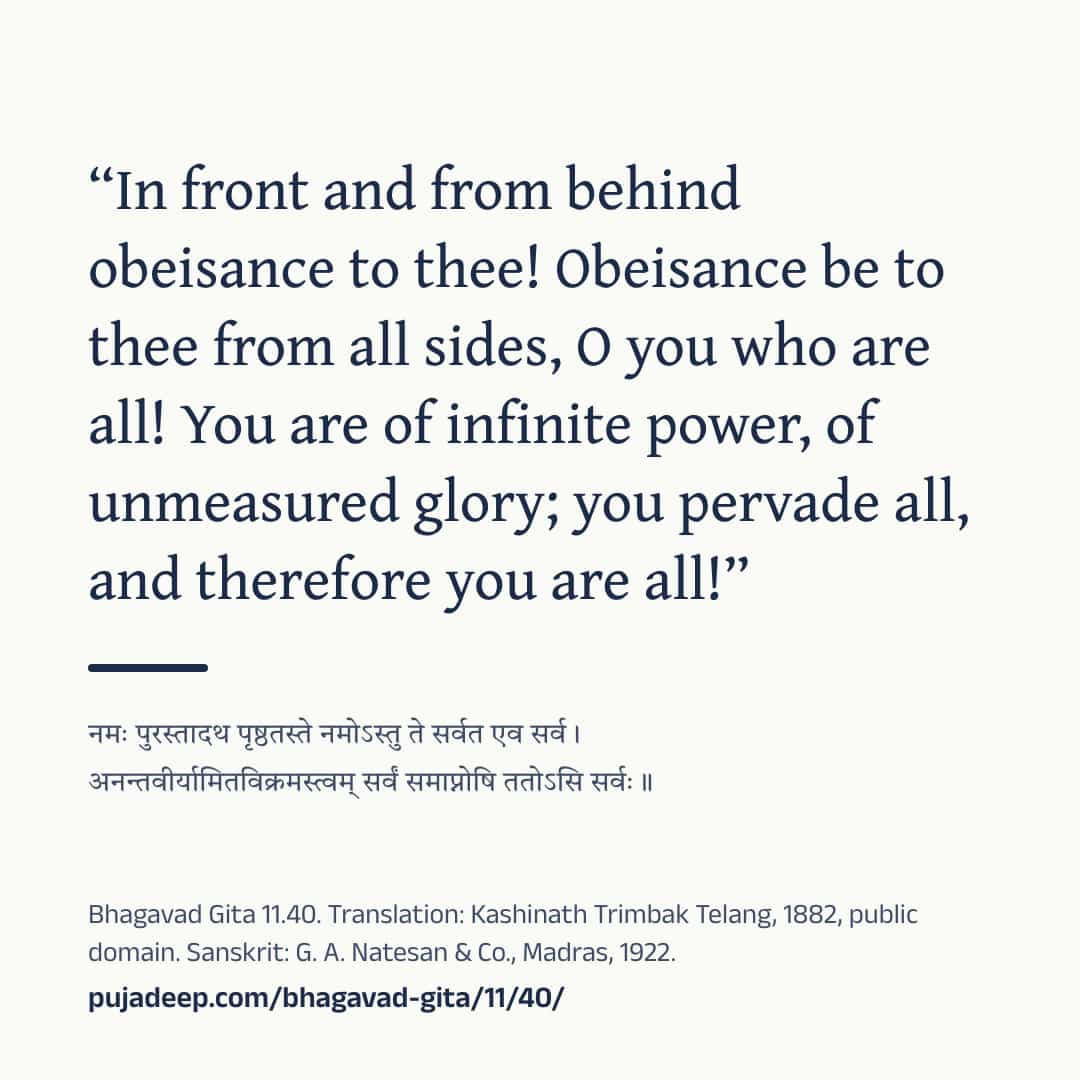
Drawing the picture
See the words
Bhagavad Gita 11.40

नमः पुरस्तादथ पृष्ठतस्ते नमोऽस्तु ते सर्वत एव सर्व ।
अनन्तवीर्यामितविक्रमस्त्वम् सर्वं समाप्नोषि ततोऽसि सर्वः ॥

“In front and from behind obeisance to thee! Obeisance be to thee from all sides, O you who are all! You are of infinite power, of unmeasured glory; you pervade all, and therefore you are all!”
(K. T. Telang, The Bhagavadgîtâ (The Sacred Books of the East, vol. VIII, Oxford: Clarendon Press, 1882), p. 97, public domain)

“Prostrate in front of Thee, prostrate behind, Prostrate on every side to Thee, O All. In power boundless, measureless in strength, Thou holdest all: then Thou Thyself art All.”
(Annie Besant, The Bhagavad Gîtâ, or The Lord's Song (London: Theosophical Publishing Society, 1895), p. 113, public domain)

“Salutation to Thee before and to Thee behind, salutation to Thee on every side, O All! Thou, infinite in power and infinite in prowess, pervadest all; wherefore Thou art All.”
(Swami Swarupananda, Srimad-Bhagavad-Gita (Mayavati: Prabuddha Bharata Press, 1909; first printed in Prabuddha Bharata, 1907–1909), p. 233, public domain)

Sanskrit: G. A. Natesan & Co., Madras, 1922.
https://pujadeep.com/bhagavad-gita/11/40/ Nothing is sent from this site. Your own app sends it, to the chat you choose. The picture quotes the translation you chose on this page, with its name and year.
Sanskrit text: The Bhagavad-Gita, or The Lord's Song, with the text in Devanagari and an English translation, 1922. Meanings: written for Pujadeep and checked against the cited edition. Source and changes
Questions families ask
Who speaks Bhagavad Gita 11.40?
Arjuna speaks this verse, in chapter 11 (Vishvarupa Darshana Yoga).
Where does the Sanskrit text come from?
Sanskrit text: The Bhagavad-Gita, or The Lord's Song, with the text in Devanagari and an English translation, 1922. Meanings: written for Pujadeep and checked against the cited edition. See the source
Is the meaning on this page a translation?
Explanation written for this site from the sources listed here, and checked against the cited edition. It is not a translation and not the only way to read the text. Free to quote with credit.
Source and licence
- Sanskrit text
- The Bhagavad-Gita, or The Lord's Song, with the text in Devanagari and an English translation (Annie Besant, G. A. Natesan & Co., Madras, 1922). Public domain. The Sanskrit on these pages was read from this printing’s page images.
- Translation
- The Bhagavadgîtâ with the Sanatsugâtîya and the Anugîtâ, translated by Kâshinâth Trimbak Telang (The Sacred Books of the East, vol. VIII, ed. F. Max Müller) (Kashinath Trimbak Telang, F. Max Müller, Clarendon Press, Oxford, 1882). Public domain. Shown verbatim, as printed.
- Translation
- The Bhagavad Gîtâ, or The Lord's Song, translated by Annie Besant (Annie Besant, Theosophical Publishing Society, London, 1895). Public domain. Shown verbatim, as printed.
- Translation
- Srimad-Bhagavad-Gita, with Sanskrit Text; Paraphrase with Word-by-word Literal Translation; English Rendering and Comments, Index, &c., by the Swami Swarupananda (Himalayan Series, No. XX) (Swami Swarupananda, The Editors and Publishers, Advaita Ashrama, Mayavati, Prabuddha Bharata Press, Mayavati, Almora, Himalayas, 1909). Public domain. Shown verbatim, as printed.
- Commentary
- The Bhagavad-Gita, with the commentary of Sri Sankaracharya, translated by A. Mahadeva Sastri (2nd ed., Mysore: G. T. A. Printing Works, 1901) (Public-domain scan, University of California Libraries). Summarised in our own words; none of its text is reproduced.
- Commentary
- Sri Bhagavad-Gita with Sri Ramanujacharya's Visishtadvaita commentary, translated by A. Govindacharya (Madras, 1898) (Scan uploaded to archive.org (folkscanomy collection)). Summarised in our own words; none of its text is reproduced.
- Commentary
- The Bhagavad-Gita: translation and commentaries in English according to Sri Madhwacharya's Bhashyas, by S. Subba Rau (Madras, 1906) (Scan uploaded to archive.org (folkscanomy collection)). Summarised in our own words; none of its text is reproduced.
- Common wording
- In this text, 32 words follow today's common wording, checked against sanskritdocuments.org; Sanskrit Wikisource; Gita Press, Gorakhpur; GRETIL, Göttingen and Bhaktivedanta Book Trust.
- Our explanation
- Explanation written for this site from the sources listed here, and checked against the cited edition. It is not a translation and not the only way to read the text. Free to quote with credit.
- Checked
- Checked against the cited edition, October 27, 2026.