Bhagavad Gita 11.34: meaning and translation
Chapter 11: Vishvarupa Darshana Yoga. Krishna says
Krishna names Drona, Bhishma, Jayadratha and Karna, and the other great warriors, and says they have been slain by him.
Click or tap a word for its meaning and its dictionary page.
Text and layers
Text and layers
These choices stay in this browser.
Bhagavad Gita 11.34
द्रोणं च भीष्मं च जयद्रथं च कर्णं तथाऽन्यानपि योधवीरान् ।मया हतांस्त्वं जहि मा व्यथिष्ठाः युध्यस्व जेतासि रणे सपत्नान् ॥
Dronam cha bhishmam cha jayadratham cha karnam tathanyanapi yodhaviranMaya hatanstvam jahi ma vyathishthah yudhyasva jetasi rane sapatnan
droṇaṃ ca bhīṣmaṃ ca jayadrathaṃ ca karṇaṃ tathā’nyānapi yodhavīrān |mayā hatāṃstvaṃ jahi mā vyathiṣṭhāḥ yudhyasva jetāsi raṇe sapatnān ||
Our explanation Krishna names Drona, Bhishma, Jayadratha and Karna, and the other great warriors, and says they have been slain by him. He tells Arjuna to slay them, not to be troubled, and to fight: Arjuna will conquer his rivals in battle, Krishna says. Shankara explains why these four are named: each had a special strength that gave Arjuna reason to fear him.
हिंदी अर्थ कृष्ण द्रोण, भीष्म, जयद्रथ, कर्ण और दूसरे वीर योद्धाओं के नाम लेकर कहते हैं कि ये उनके द्वारा मारे जा चुके हैं। वे अर्जुन से कहते हैं कि वे इन्हें मारें, व्यथित न हों, और युद्ध करें: कृष्ण कहते हैं कि अर्जुन युद्ध में अपने शत्रुओं को जीतेंगे। शंकराचार्य समझाते हैं कि इन चारों के नाम क्यों लिए गए: हर एक के पास कोई विशेष शक्ति थी, जिससे अर्जुन को उससे डरने का कारण था।
Word by word
Every word, with its dictionary page
Word by word
- द्रोणम् droṇam · Drona (noun (masculine), accusative singular) Dictionary: droṇa, Monier-Williams 1899, p. 503, col. 1 “the military preceptor of both the Kuru and Pāṇḍu princes”
- च ca · and (indeclinable) Dictionary: 2. ca, Monier-Williams 1899, p. 380, col. 1 “and, both, also, moreover, as well as”
- भीष्मम् bhīṣmam · Bhishma (noun (masculine), accusative singular) Dictionary: bhīṣma, Monier-Williams 1899, p. 758, col. 3 “N. of a son of Śāṃtanu and Gaṅgā”
- च ca · and (indeclinable) Dictionary: 2. ca, Monier-Williams 1899, p. 380, col. 1 “and, both, also, moreover, as well as”
- जयद्रथम् jayadratham · Jayadratha (noun (masculine), accusative singular) Dictionary: jayad-ratha, Monier-Williams 1899, p. 413, col. 2 “‘having victorious chariots,’ N. of a Sindhu-Sauvīra king fighting on the Kaurava's side”
- च ca · and (indeclinable) Dictionary: 2. ca, Monier-Williams 1899, p. 380, col. 1 “and, both, also, moreover, as well as”
- कर्णम् karṇam · Karna (noun (masculine), accusative singular) Dictionary: karṇa, Monier-Williams 1899, p. 256, col. 2 “N. of a king of Aṅga”
- तथा tathā · likewise (indeclinable) Dictionary: tathā, Monier-Williams 1899, p. 433, col. 3 “in that manner, so, thus”
- अन्यान् anyān · others (pronoun (masculine), accusative plural) Dictionary: 2. anya, Monier-Williams 1899, p. 45, col. 2 “other, different”
- अपि api · also (indeclinable) Dictionary: api, Monier-Williams 1899, p. 55, col. 1 “even, also, very”
- योधवीरान् yodhavīrān · heroic warriors (compound (masculine), accusative plural) Dictionary: yodha-vīra, Monier-Williams 1899, p. 858, col. 2 “a hero, warrior”
- मया mayā · by "me" (Krishna) (pronoun, instrumental singular) Dictionary: 1. mad, Monier-Williams 1899, p. 777, col. 2 “base of the first pers. pron. in the sg. number (esp. in comp.)”
- हतान् hatān · slain (past participle (masculine), accusative plural) Dictionary: hata, Monier-Williams 1899, p. 1287, col. 2 “smitten, killed, slain”
- त्वम् tvam · you (pronoun, nominative singular) Dictionary: yuṣmad, Monier-Williams 1899, p. 855, col. 3 “the base of the 2nd pers. pron. as used in comp.”
- जहि jahi · slay (imperative, 2nd person singular) Dictionary: 1. han, Monier-Williams 1899, p. 1287, col. 2 “to smite, slay, hit, kill, mar, destroy”
- मा mā · do not (indeclinable) Dictionary: 1. mā, Monier-Williams 1899, p. 804, col. 1 “a particle of prohibition or negation”
- व्यथिष्ठाः vyathiṣṭhāḥ · be troubled (aorist (with mā: do not), 2nd person singular) Dictionary: vyath, Monier-Williams 1899, p. 1031, col. 1 “to be agitated or disturbed in mind, be restless or sorrowful or unhappy”
- युध्यस्व yudhyasva · fight (imperative, 2nd person singular) Dictionary: 1. yudh, Monier-Williams 1899, p. 854, col. 3 “to fight, wage war”
- जेतासि jetāsi · will conquer (periphrastic future, 2nd person singular) Dictionary: 1. ji, Monier-Williams 1899, p. 420, col. 2 “conquer (in battle), vanquish”
- रणे raṇe · in battle (noun (masculine), locative singular) Dictionary: 1. raṇa, Monier-Williams 1899, p. 863, col. 3 “battle (as an object of delight), war, combat, fight, conflict”
- सपत्नान् sapatnān · rivals, enemies (noun (masculine), accusative plural) Dictionary: sa-patna, Monier-Williams 1899, p. 1149, col. 1 “a rival, adversary, enemy”
1 printing differs
Edition differences. Another printing or text reads this place differently.
- Spelling A digital text reads Same words. The 1922 edition marks the merged vowel in तथाऽन्यान् and keeps the visarga at the printed line end (व्यथिष्ठाः); the e-text writes तथान्यान् and व्यथिष्ठा.
Old translations
Kashinath Trimbak Telang, 1882. Public domain. Page 96.
Drona, and Bhîshma, and Gayadratha, and Karna, and likewise other valiant warriors also, whom I have killed, do you kill. Be not alarmed. Do fight. And in the battle you will conquer (your) foes.
Compare 3 translations
Kashinath Trimbak Telang, 1882. Public domain. Page 96.
Drona, and Bhîshma, and Gayadratha, and Karna, and likewise other valiant warriors also, whom I have killed, do you kill. Be not alarmed. Do fight. And in the battle you will conquer (your) foes.
You are reading this one
Annie Besant, 1895. Public domain. Page 111.
Drona and Bhîshma and Jayadratha,
Karna and all the other warriors here
Are slain by Me. Destroy then fearlessly,
Fight! thou shalt crush thy rivals in the field.
You are reading this one
Swami Swarupananda, 1909 (first printed 1907). Public domain. Page 229.
Drona and Bhishma, Jayadratha, Karna, as well as other brave warriors,—these, killed already by Me, do thou kill, and be not distressed with fear. Fight, and thou shalt conquer thy enemies in battle.
You are reading this one
Cite this verse
The translation: K. T. Telang, The Bhagavadgîtâ (The Sacred Books of the East, vol. VIII, Oxford: Clarendon Press, 1882), p. 96. Bhagavad Gita 11.34.
The translation: Annie Besant, The Bhagavad Gîtâ, or The Lord's Song (London: Theosophical Publishing Society, 1895), p. 111. Bhagavad Gita 11.34.
The translation: Swami Swarupananda, Srimad-Bhagavad-Gita (Mayavati: Prabuddha Bharata Press, 1909; first printed in Prabuddha Bharata, 1907–1909), p. 229. Bhagavad Gita 11.34.
Our explanation: “Bhagavad Gita 11.34: meaning and translation.” Pujadeep. Updated October 27, 2026. https://pujadeep.com/bhagavad-gita/11/34/
Pujadeep’s explanations are free to quote with credit: name Pujadeep and link to the page. How to credit
Classical readings, by school
No readings by school on this verse yet.
Share
Show the ways to share
Send one picture or the text to one chat. The picture names its source and the address of this page.
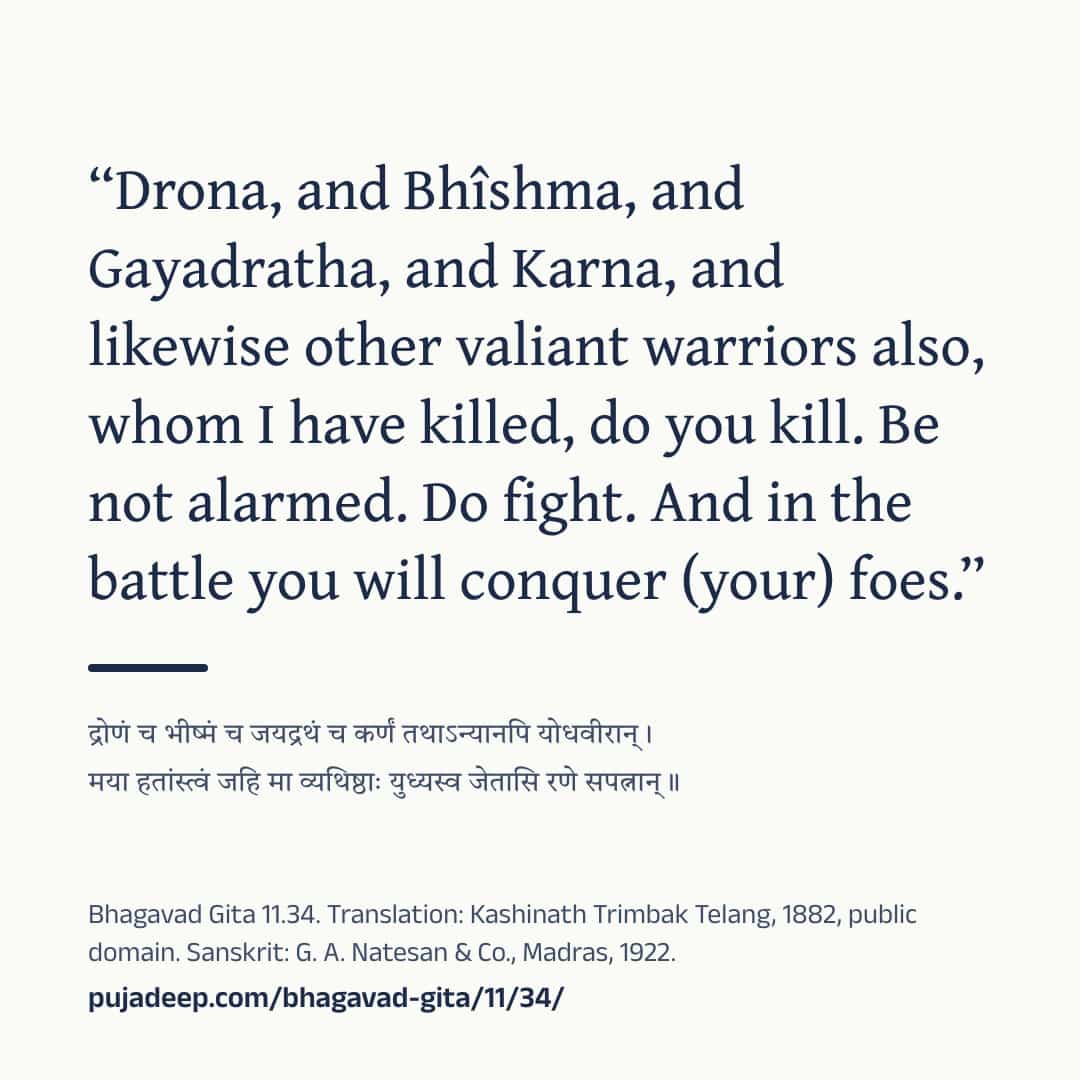
Drawing the picture
See the words
Bhagavad Gita 11.34

द्रोणं च भीष्मं च जयद्रथं च कर्णं तथाऽन्यानपि योधवीरान् ।
मया हतांस्त्वं जहि मा व्यथिष्ठाः युध्यस्व जेतासि रणे सपत्नान् ॥

“Drona, and Bhîshma, and Gayadratha, and Karna, and likewise other valiant warriors also, whom I have killed, do you kill. Be not alarmed. Do fight. And in the battle you will conquer (your) foes.”
(K. T. Telang, The Bhagavadgîtâ (The Sacred Books of the East, vol. VIII, Oxford: Clarendon Press, 1882), p. 96, public domain)

“Drona and Bhîshma and Jayadratha, Karna and all the other warriors here Are slain by Me. Destroy then fearlessly, Fight! thou shalt crush thy rivals in the field.”
(Annie Besant, The Bhagavad Gîtâ, or The Lord's Song (London: Theosophical Publishing Society, 1895), p. 111, public domain)

“Drona and Bhishma, Jayadratha, Karna, as well as other brave warriors,—these, killed already by Me, do thou kill, and be not distressed with fear. Fight, and thou shalt conquer thy enemies in battle.”
(Swami Swarupananda, Srimad-Bhagavad-Gita (Mayavati: Prabuddha Bharata Press, 1909; first printed in Prabuddha Bharata, 1907–1909), p. 229, public domain)

Sanskrit: G. A. Natesan & Co., Madras, 1922.
https://pujadeep.com/bhagavad-gita/11/34/ Nothing is sent from this site. Your own app sends it, to the chat you choose. The picture quotes the translation you chose on this page, with its name and year.
Sanskrit text: The Bhagavad-Gita, or The Lord's Song, with the text in Devanagari and an English translation, 1922. Meanings: written for Pujadeep and checked against the cited edition. Source and changes
Questions families ask
Who speaks Bhagavad Gita 11.34?
Krishna speaks this verse, in chapter 11 (Vishvarupa Darshana Yoga).
Where does the Sanskrit text come from?
Sanskrit text: The Bhagavad-Gita, or The Lord's Song, with the text in Devanagari and an English translation, 1922. Meanings: written for Pujadeep and checked against the cited edition. See the source
Is the meaning on this page a translation?
Explanation written for this site from the sources listed here, and checked against the cited edition. It is not a translation and not the only way to read the text. Free to quote with credit.
Source and licence
- Sanskrit text
- The Bhagavad-Gita, or The Lord's Song, with the text in Devanagari and an English translation (Annie Besant, G. A. Natesan & Co., Madras, 1922). Public domain. The Sanskrit on these pages was read from this printing’s page images.
- Translation
- The Bhagavadgîtâ with the Sanatsugâtîya and the Anugîtâ, translated by Kâshinâth Trimbak Telang (The Sacred Books of the East, vol. VIII, ed. F. Max Müller) (Kashinath Trimbak Telang, F. Max Müller, Clarendon Press, Oxford, 1882). Public domain. Shown verbatim, as printed.
- Translation
- The Bhagavad Gîtâ, or The Lord's Song, translated by Annie Besant (Annie Besant, Theosophical Publishing Society, London, 1895). Public domain. Shown verbatim, as printed.
- Translation
- Srimad-Bhagavad-Gita, with Sanskrit Text; Paraphrase with Word-by-word Literal Translation; English Rendering and Comments, Index, &c., by the Swami Swarupananda (Himalayan Series, No. XX) (Swami Swarupananda, The Editors and Publishers, Advaita Ashrama, Mayavati, Prabuddha Bharata Press, Mayavati, Almora, Himalayas, 1909). Public domain. Shown verbatim, as printed.
- Common wording
- In this text, 32 words follow today's common wording, checked against sanskritdocuments.org; Sanskrit Wikisource; Gita Press, Gorakhpur; GRETIL, Göttingen and Bhaktivedanta Book Trust.
- Our explanation
- Explanation written for this site from the sources listed here, and checked against the cited edition. It is not a translation and not the only way to read the text. Free to quote with credit.
- Checked
- Checked against the cited edition, October 27, 2026.