Bhagavad Gita 11.29: meaning and translation
Chapter 11: Vishvarupa Darshana Yoga. Arjuna says
And, Arjuna says, as moths rush ever faster into a blazing fire to their destruction, so these people rush ever faster into Krishna's mouths to their destruction.
Click or tap a word for its meaning and its dictionary page.
Text and layers
Text and layers
These choices stay in this browser.
Bhagavad Gita 11.29
यथा प्रदीप्तं ज्वलनं पतङ्गाः विशन्ति नाशाय समृद्धवेगाः ।तथैव नाशाय विशन्ति लोकास्तवापि वक्त्राणि समृद्धवेगाः ॥
Yatha pradiptam jvalanam patangah vishanti nashaya samriddhavegahTathaiva nashaya vishanti lokastavapi vaktrani samriddhavegah
yathā pradīptaṃ jvalanaṃ pataṅgāḥ viśanti nāśāya samṛddhavegāḥ |tathaiva nāśāya viśanti lokāstavāpi vaktrāṇi samṛddhavegāḥ ||
Our explanation And, Arjuna says, as moths rush ever faster into a blazing fire to their destruction, so these people rush ever faster into Krishna's mouths to their destruction. Telang translates 'butterflies'; Besant, 'moths'.
हिंदी अर्थ अर्जुन कहते हैं कि जैसे पतंगे बढ़ते वेग से जलती आग में अपने नाश के लिए गिरते हैं, वैसे ही ये लोग भी बढ़ते वेग से कृष्ण के मुखों में अपने नाश के लिए प्रवेश कर रहे हैं।
Word by word
Every word, with its dictionary page
Word by word
- यथा yathā · as (indeclinable) Dictionary: yathā, Monier-Williams 1899, p. 841, col. 2 “in which manner or way, according as, as, like”
- प्रदीप्तम् pradīptam · blazing (past participle (masculine), accusative singular) Dictionary: pra-dīpta, Monier-Williams 1899, p. 680, col. 1 “kindled, inflamed, burning, shining”
- ज्वलनम् jvalanam · fire (noun (masculine), accusative singular) Dictionary: jvalana, Monier-Williams 1899, p. 428, col. 2 “fire”
- पतङ्गाः pataṅgāḥ · moths (noun (masculine), nominative plural) Dictionary: pataṃ-ga, Monier-Williams 1899, p. 581, col. 1 “any flying insect”
- विशन्ति viśanti · enter (present, 3rd person plural) Dictionary: 1. viś, Monier-Williams 1899, p. 989, col. 2 “to enter, enter in or settle down on, go into”
- नाशाय nāśāya · to their destruction (noun (masculine), dative singular) Dictionary: 2. nāśa, Monier-Williams 1899, p. 538, col. 1 “the being lost, loss, disappearance, destruction, annihilation, ruin”
- समृद्धवेगाः samṛddhavegāḥ · with rising speed (compound (masculine), nominative plural) Dictionary: sam-ṛddha-vega, Monier-Williams 1899, p. 1171, col. 1 “increasing in speed, excessively swift”
- तथा tathā · so (indeclinable) Dictionary: tathā, Monier-Williams 1899, p. 433, col. 3 “in that manner, so, thus”
- एव eva · just (indeclinable) Dictionary: 1. eva, Monier-Williams 1899, p. 232, col. 2 “just, exactly, very, same, only, even, alone, merely”
- नाशाय nāśāya · to their destruction (noun (masculine), dative singular) Dictionary: 2. nāśa, Monier-Williams 1899, p. 538, col. 1 “the being lost, loss, disappearance, destruction, annihilation, ruin”
- विशन्ति viśanti · enter (present, 3rd person plural) Dictionary: 1. viś, Monier-Williams 1899, p. 989, col. 2 “to enter, enter in or settle down on, go into”
- लोकाः lokāḥ · the worlds, people (noun (masculine), nominative plural) Dictionary: loka, Monier-Williams 1899, p. 906, col. 1 “the wide space or world”
- तव tava · your (pronoun, genitive singular) Dictionary: yuṣmad, Monier-Williams 1899, p. 855, col. 3 “the base of the 2nd pers. pron. as used in comp.”
- अपि api · also (indeclinable) Dictionary: api, Monier-Williams 1899, p. 55, col. 1 “even, also, very”
- वक्त्राणि vaktrāṇi · mouths (noun (neuter), accusative plural) Dictionary: vaktra, Monier-Williams 1899, p. 912, col. 2 “‘organ of speech,’ the mouth, face”
- समृद्धवेगाः samṛddhavegāḥ · with rising speed (compound (masculine), nominative plural) Dictionary: sam-ṛddha-vega, Monier-Williams 1899, p. 1171, col. 1 “increasing in speed, excessively swift”
1 printing differs
Edition differences. Another printing or text reads this place differently.
- Spelling A digital text reads Same words. At the printed line end the 1922 edition keeps the visarga (पतङ्गाः); the e-text applies sandhi (पतङ्गा).
Old translations
Kashinath Trimbak Telang, 1882. Public domain. Page 95.
As butterflies, with increased velocity, enter a blazing fire to their destruction, so too do these people enter your mouths with increased velocity (only) to their destruction.
Compare 3 translations
Kashinath Trimbak Telang, 1882. Public domain. Page 95.
As butterflies, with increased velocity, enter a blazing fire to their destruction, so too do these people enter your mouths with increased velocity (only) to their destruction.
You are reading this one
Annie Besant, 1895. Public domain. Page 109–110.
As moths with quickened speed will headlong fly
Into a flaming light, to fall destroyed,
So also these, in haste precipitate,
Enter within Thy mouths destroyed to fall.
You are reading this one
Swami Swarupananda, 1909 (first printed 1907). Public domain. Page 226.
As moths precipitately rush into a blazing fire to perish, just so do these creatures also precipitately rush into Thy mouths only to perish.
You are reading this one
Cite this verse
The translation: K. T. Telang, The Bhagavadgîtâ (The Sacred Books of the East, vol. VIII, Oxford: Clarendon Press, 1882), p. 95. Bhagavad Gita 11.29.
The translation: Annie Besant, The Bhagavad Gîtâ, or The Lord's Song (London: Theosophical Publishing Society, 1895), pp. 109–110. Bhagavad Gita 11.29.
The translation: Swami Swarupananda, Srimad-Bhagavad-Gita (Mayavati: Prabuddha Bharata Press, 1909; first printed in Prabuddha Bharata, 1907–1909), p. 226. Bhagavad Gita 11.29.
Our explanation: “Bhagavad Gita 11.29: meaning and translation.” Pujadeep. Updated October 27, 2026. https://pujadeep.com/bhagavad-gita/11/29/
Pujadeep’s explanations are free to quote with credit: name Pujadeep and link to the page. How to credit
Classical readings, by school
No readings by school on this verse yet.
Share
Show the ways to share
Send one picture or the text to one chat. The picture names its source and the address of this page.
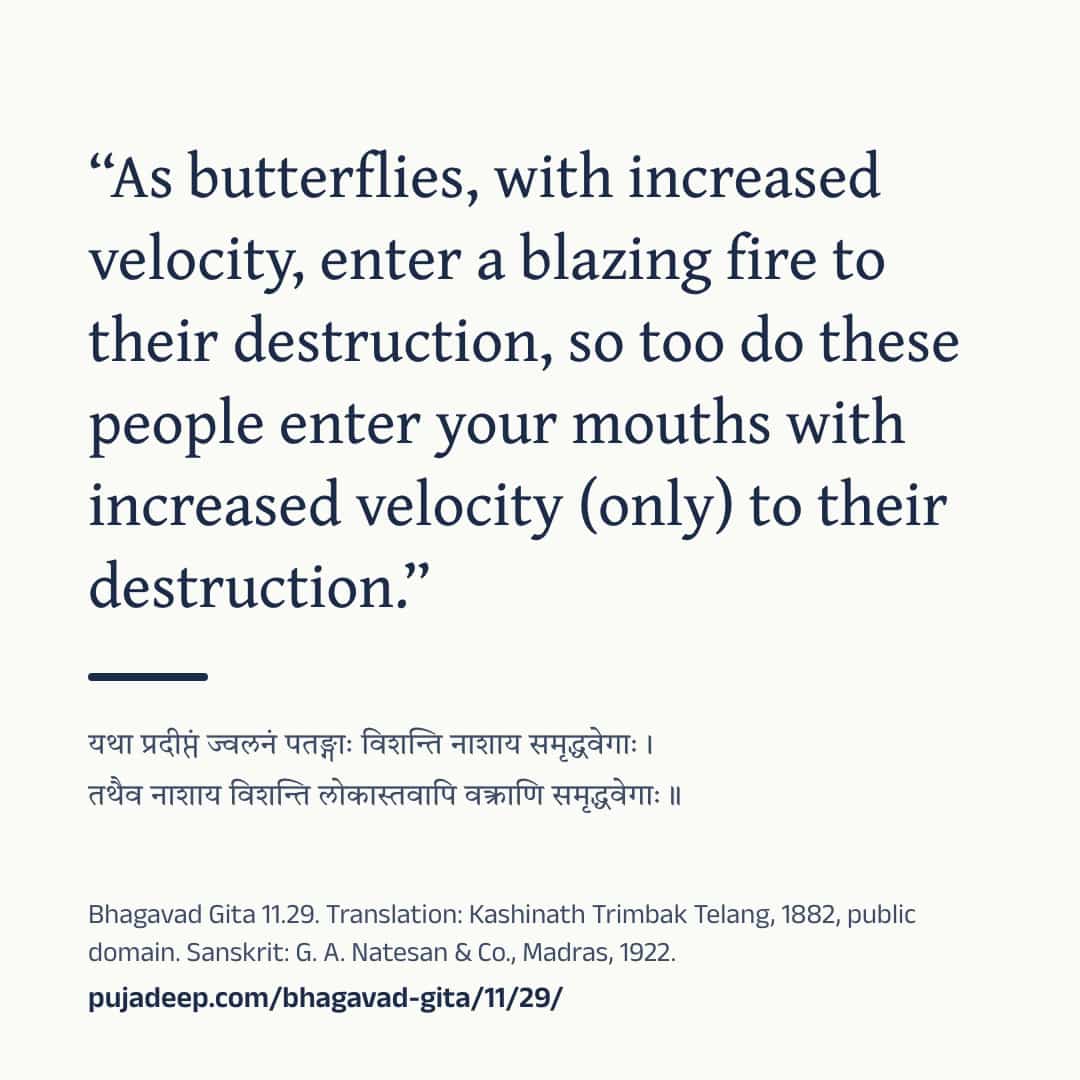
Drawing the picture
See the words
Bhagavad Gita 11.29

यथा प्रदीप्तं ज्वलनं पतङ्गाः विशन्ति नाशाय समृद्धवेगाः ।
तथैव नाशाय विशन्ति लोकास्तवापि वक्त्राणि समृद्धवेगाः ॥

“As butterflies, with increased velocity, enter a blazing fire to their destruction, so too do these people enter your mouths with increased velocity (only) to their destruction.”
(K. T. Telang, The Bhagavadgîtâ (The Sacred Books of the East, vol. VIII, Oxford: Clarendon Press, 1882), p. 95, public domain)

“As moths with quickened speed will headlong fly Into a flaming light, to fall destroyed, So also these, in haste precipitate, Enter within Thy mouths destroyed to fall.”
(Annie Besant, The Bhagavad Gîtâ, or The Lord's Song (London: Theosophical Publishing Society, 1895), pp. 109–110, public domain)

“As moths precipitately rush into a blazing fire to perish, just so do these creatures also precipitately rush into Thy mouths only to perish.”
(Swami Swarupananda, Srimad-Bhagavad-Gita (Mayavati: Prabuddha Bharata Press, 1909; first printed in Prabuddha Bharata, 1907–1909), p. 226, public domain)

Sanskrit: G. A. Natesan & Co., Madras, 1922.
https://pujadeep.com/bhagavad-gita/11/29/ Nothing is sent from this site. Your own app sends it, to the chat you choose. The picture quotes the translation you chose on this page, with its name and year.
Sanskrit text: The Bhagavad-Gita, or The Lord's Song, with the text in Devanagari and an English translation, 1922. Meanings: written for Pujadeep and checked against the cited edition. Source and changes
Questions families ask
Who speaks Bhagavad Gita 11.29?
Arjuna speaks this verse, in chapter 11 (Vishvarupa Darshana Yoga).
Where does the Sanskrit text come from?
Sanskrit text: The Bhagavad-Gita, or The Lord's Song, with the text in Devanagari and an English translation, 1922. Meanings: written for Pujadeep and checked against the cited edition. See the source
Is the meaning on this page a translation?
Explanation written for this site from the sources listed here, and checked against the cited edition. It is not a translation and not the only way to read the text. Free to quote with credit.
Source and licence
- Sanskrit text
- The Bhagavad-Gita, or The Lord's Song, with the text in Devanagari and an English translation (Annie Besant, G. A. Natesan & Co., Madras, 1922). Public domain. The Sanskrit on these pages was read from this printing’s page images.
- Translation
- The Bhagavadgîtâ with the Sanatsugâtîya and the Anugîtâ, translated by Kâshinâth Trimbak Telang (The Sacred Books of the East, vol. VIII, ed. F. Max Müller) (Kashinath Trimbak Telang, F. Max Müller, Clarendon Press, Oxford, 1882). Public domain. Shown verbatim, as printed.
- Translation
- The Bhagavad Gîtâ, or The Lord's Song, translated by Annie Besant (Annie Besant, Theosophical Publishing Society, London, 1895). Public domain. Shown verbatim, as printed.
- Translation
- Srimad-Bhagavad-Gita, with Sanskrit Text; Paraphrase with Word-by-word Literal Translation; English Rendering and Comments, Index, &c., by the Swami Swarupananda (Himalayan Series, No. XX) (Swami Swarupananda, The Editors and Publishers, Advaita Ashrama, Mayavati, Prabuddha Bharata Press, Mayavati, Almora, Himalayas, 1909). Public domain. Shown verbatim, as printed.
- Common wording
- In this text, 32 words follow today's common wording, checked against sanskritdocuments.org; Sanskrit Wikisource; Gita Press, Gorakhpur; GRETIL, Göttingen and Bhaktivedanta Book Trust.
- Our explanation
- Explanation written for this site from the sources listed here, and checked against the cited edition. It is not a translation and not the only way to read the text. Free to quote with credit.
- Checked
- Checked against the cited edition, October 27, 2026.