Bhagavad Gita 11.21: meaning and translation
Chapter 11: Vishvarupa Darshana Yoga. Arjuna says
Arjuna says hosts of gods are entering into Krishna; some, in awe, praise him with joined palms.
Click or tap a word for its meaning and its dictionary page.
Text and layers
Text and layers
These choices stay in this browser.
Bhagavad Gita 11.21
अमी हि त्वां सुरसङ्घा विशन्ति केचिद्भीताः प्राञ्जलयो गृणन्ति ।स्वस्तीत्युक्त्वा महर्षिसिद्धसङ्घाः स्तुवन्ति त्वां स्तुतिभिः पुष्कलाभिः ॥
Ami hi tvam surasangha vishanti kechidbhitah pranjalayo grinantiSvastityuktva maharshisiddhasanghah stuvanti tvam stutibhih pushkalabhih
amī hi tvāṃ surasaṅghā viśanti kecidbhītāḥ prāñjalayo gṛṇanti |svastītyuktvā maharṣisiddhasaṅghāḥ stuvanti tvāṃ stutibhiḥ puṣkalābhiḥ ||
Our explanation Arjuna says hosts of gods are entering into Krishna; some, in awe, praise him with joined palms. Hosts of great sages and siddhas say 'svasti' ('may it be well') and praise him with many hymns. The schools explain who the gods entering him are (see the views).
हिंदी अर्थ अर्जुन कहते हैं कि देवताओं के समूह कृष्ण में प्रवेश कर रहे हैं; कुछ भय और श्रद्धा से हाथ जोड़कर उनकी स्तुति कर रहे हैं। महर्षियों और सिद्धों के समूह “स्वस्ति” (कल्याण हो) कहकर अनेक स्तोत्रों से उनकी स्तुति कर रहे हैं। उनमें प्रवेश करने वाले देवता कौन हैं, इसे परंपराएँ अलग-अलग ढंग से समझाती हैं।
Word by word
Every word, with its dictionary page
Word by word
- अमी amī · these (pronoun (masculine), nominative plural) Dictionary: adas, Monier-Williams 1899, p. 18, col. 1 “that; a certain”
- हि hi · indeed (indeclinable) Dictionary: 2. hi, Monier-Williams 1899, p. 1297, col. 3 “for, because, on account of”
- त्वाम् tvām · into you (pronoun, accusative singular) Dictionary: yuṣmad, Monier-Williams 1899, p. 855, col. 3 “the base of the 2nd pers. pron. as used in comp.”
- सुरसङ्घाः surasaṅghāḥ · hosts of gods (compound (masculine), nominative plural) Dictionary: sura-saṃgha, Monier-Williams 1899, p. 1235, col. 1 “a company or assemblage of gods”
- विशन्ति viśanti · enter (present, 3rd person plural) Dictionary: 1. viś, Monier-Williams 1899, p. 989, col. 2 “to enter, enter in or settle down on, go into”
- केचित् kecit · some (pronoun (masculine), nominative plural) Dictionary: kim, Monier-Williams 1899, p. 282, col. 2 “what? how? whence? wherefore? why?”; 2. cid, Monier-Williams 1899, p. 398, col. 1 “even, indeed, also”
- भीताः bhītāḥ · afraid (past participle (masculine), nominative plural) Dictionary: bhīta, Monier-Williams 1899, p. 758, col. 1 “frightened, alarmed, terrified, timid”
- प्राञ्जलयः prāñjalayaḥ · with joined palms (compound (masculine), nominative plural) Dictionary: prāñjali, Monier-Williams 1899, p. 705, col. 1 “joining and holding out the hollowed open hands”
- गृणन्ति gṛṇanti · praise, call out (present, 3rd person plural) Dictionary: 1. gṝ, Monier-Williams 1899, p. 363, col. 1 “to call, call out to, invoke”
- स्वस्ति svasti · may it be well (indeclinable) Dictionary: sv-asti, Monier-Williams 1899, p. 1283, col. 1 “well-being, fortune, luck, success, prosperity, RV.; VS.; ŚBr.; MBh.; R.; BhP.”
- इति iti · thus (closes the words) (indeclinable) Dictionary: 2. iti, Monier-Williams 1899, p. 165, col. 1 “in this manner, thus”
- उक्त्वा uktvā · having said (absolutive (having done)) Dictionary: vac, Monier-Williams 1899, p. 912, col. 1 “to speak, say, tell, utter, announce”
- महर्षिसिद्धसङ्घाः maharṣisiddhasaṅghāḥ · hosts of great sages and Siddhas (compound (masculine), nominative plural) Dictionary: maharṣi, Monier-Williams 1899, p. 794, col. 2 “a great Ṛishi, any great sage or saint”; siddha-saṃgha, Monier-Williams 1899, p. 1215, col. 3 “a company of Siddhas, assemblage of perfected beings”
- स्तुवन्ति stuvanti · praise (present, 3rd person plural) Dictionary: 1. stu, Monier-Williams 1899, p. 1259, col. 1 “to praise, laud, eulogize, extol”
- त्वाम् tvām · you (pronoun, accusative singular) Dictionary: yuṣmad, Monier-Williams 1899, p. 855, col. 3 “the base of the 2nd pers. pron. as used in comp.”
- स्तुतिभिः stutibhiḥ · with hymns of praise (noun (feminine), instrumental plural) Dictionary: stuti, Monier-Williams 1899, p. 1259, col. 1 “praise, eulogy, panegyric, commendation”
- पुष्कलाभिः puṣkalābhiḥ · abundant, rich (adjective (feminine), instrumental plural) Dictionary: puṣkala, Monier-Williams 1899, p. 639, col. 1 “much, many, numerous, copious, abundant”
Old translations
Kashinath Trimbak Telang, 1882. Public domain. Page 94.
For here these groups of gods are entering into you. Some being afraid are praying with joined hands, and the groups of great sages and Siddhas are saying 'Welfare1!' and praising you with abundant (hymns) of praise.
Footnotes (the translator’s own) - Seeing signs of some great cataclysm, they say, 'May it be well with the universe,' and then proceed to pray to you. ↩
Compare 3 translations
Kashinath Trimbak Telang, 1882. Public domain. Page 94.
For here these groups of gods are entering into you. Some being afraid are praying with joined hands, and the groups of great sages and Siddhas are saying 'Welfare1!' and praising you with abundant (hymns) of praise.
Footnotes (the translator’s own) - Seeing signs of some great cataclysm, they say, 'May it be well with the universe,' and then proceed to pray to you. ↩
You are reading this one
Annie Besant, 1895. Public domain. Page 107.
To Thee the troops of Suras enter in,
Some with joined palms in awe invoking Thee;
Banded Maharshis, Siddhas, "Svasti!" cry,
Chanting Thy praises with resounding songs.
You are reading this one
Swami Swarupananda, 1909 (first printed 1907). Public domain. Page 221.
Verily, into Thee enter these hosts of the Devas; some extol Thee in fear with joined palms; "May it be well!" thus saying, bands of Great Rishis and Siddhas praise Thee with splendid hymns.
You are reading this one
Cite this verse
The translation: K. T. Telang, The Bhagavadgîtâ (The Sacred Books of the East, vol. VIII, Oxford: Clarendon Press, 1882), p. 94. Bhagavad Gita 11.21.
The translation: Annie Besant, The Bhagavad Gîtâ, or The Lord's Song (London: Theosophical Publishing Society, 1895), p. 107. Bhagavad Gita 11.21.
The translation: Swami Swarupananda, Srimad-Bhagavad-Gita (Mayavati: Prabuddha Bharata Press, 1909; first printed in Prabuddha Bharata, 1907–1909), p. 221. Bhagavad Gita 11.21.
Our explanation: “Bhagavad Gita 11.21: meaning and translation.” Pujadeep. Updated October 27, 2026. https://pujadeep.com/bhagavad-gita/11/21/
Pujadeep’s explanations are free to quote with credit: name Pujadeep and link to the page. How to credit
Classical readings, by school
Each reading is named by its school. None is presented as the only meaning.
What Advaita, Vishishtadvaita and Dvaita teach, in short
Shankara Advaita
Shankara says the hosts of gods entering Krishna are the warriors in the battle, gods such as the Vasus who were born as men to lighten the earth's burden. The great sages and siddhas, seeing omens as the war comes near, pray that it may be well with the world.
Source: The Bhagavad-Gita, with the commentary of Sri Sankaracharya, translated by A. Mahadeva Sastri (2nd ed., Mysore: G. T. A. Printing Works, 1901), commentary on 11.21, p. 253. Summarised in our own words; none of its text is reproduced.
Ramanuja Vishishtadvaita
Ramanuja says the hosts of gods, good by nature, rejoice at the sight of the universal form and come towards the Lord; some, overawed, join their palms and praise him as each is able.
Source: Sri Bhagavad-Gita with Sri Ramanujacharya's Visishtadvaita commentary, translated by A. Govindacharya (Madras, 1898), commentary on 11.21, pp. 358–359. Summarised in our own words; none of its text is reproduced.
Madhva Dvaita
Madhva identifies these hosts of gods as freed souls (muktas), who in his view may pass into the Lord and come out again at will.
Source: The Bhagavad-Gita: translation and commentaries in English according to Sri Madhwacharya's Bhashyas, by S. Subba Rau (Madras, 1906), commentary on 11.21, p. 226 (leaf n224). Summarised in our own words; none of its text is reproduced.
Share
Show the ways to share
Send one picture or the text to one chat. The picture names its source and the address of this page.
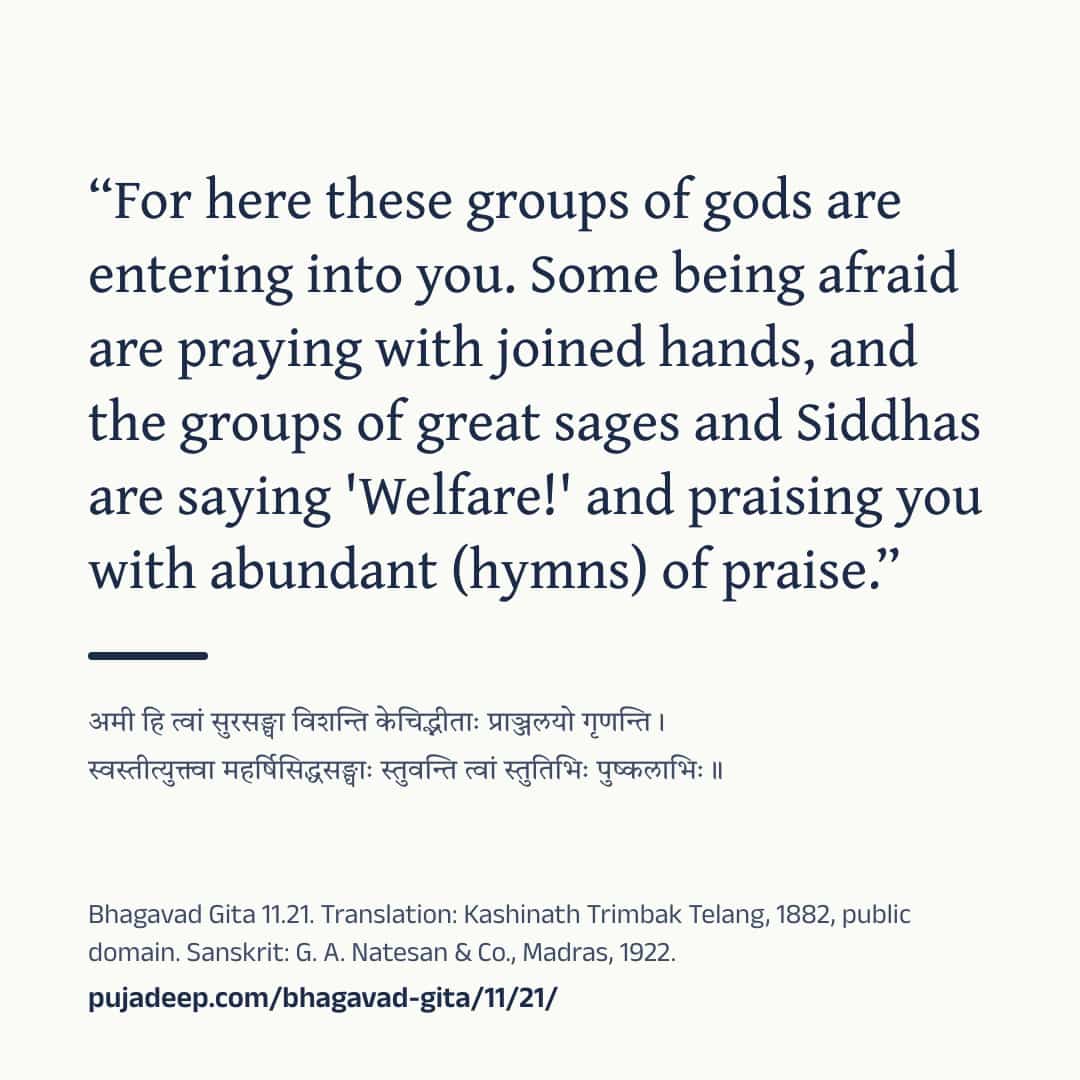
Drawing the picture
See the words
Bhagavad Gita 11.21

अमी हि त्वां सुरसङ्घा विशन्ति केचिद्भीताः प्राञ्जलयो गृणन्ति ।
स्वस्तीत्युक्त्वा महर्षिसिद्धसङ्घाः स्तुवन्ति त्वां स्तुतिभिः पुष्कलाभिः ॥

“For here these groups of gods are entering into you. Some being afraid are praying with joined hands, and the groups of great sages and Siddhas are saying 'Welfare!' and praising you with abundant (hymns) of praise.”
(K. T. Telang, The Bhagavadgîtâ (The Sacred Books of the East, vol. VIII, Oxford: Clarendon Press, 1882), p. 94, public domain)

“To Thee the troops of Suras enter in, Some with joined palms in awe invoking Thee; Banded Maharshis, Siddhas, "Svasti!" cry, Chanting Thy praises with resounding songs.”
(Annie Besant, The Bhagavad Gîtâ, or The Lord's Song (London: Theosophical Publishing Society, 1895), p. 107, public domain)

“Verily, into Thee enter these hosts of the Devas; some extol Thee in fear with joined palms; "May it be well!" thus saying, bands of Great Rishis and Siddhas praise Thee with splendid hymns.”
(Swami Swarupananda, Srimad-Bhagavad-Gita (Mayavati: Prabuddha Bharata Press, 1909; first printed in Prabuddha Bharata, 1907–1909), p. 221, public domain)

Sanskrit: G. A. Natesan & Co., Madras, 1922.
https://pujadeep.com/bhagavad-gita/11/21/ Nothing is sent from this site. Your own app sends it, to the chat you choose. The picture quotes the translation you chose on this page, with its name and year.
Sanskrit text: The Bhagavad-Gita, or The Lord's Song, with the text in Devanagari and an English translation, 1922. Meanings: written for Pujadeep and checked against the cited edition. Source and changes
Questions families ask
Who speaks Bhagavad Gita 11.21?
Arjuna speaks this verse, in chapter 11 (Vishvarupa Darshana Yoga).
Where does the Sanskrit text come from?
Sanskrit text: The Bhagavad-Gita, or The Lord's Song, with the text in Devanagari and an English translation, 1922. Meanings: written for Pujadeep and checked against the cited edition. See the source
Is the meaning on this page a translation?
Explanation written for this site from the sources listed here, and checked against the cited edition. It is not a translation and not the only way to read the text. Free to quote with credit.
Source and licence
- Sanskrit text
- The Bhagavad-Gita, or The Lord's Song, with the text in Devanagari and an English translation (Annie Besant, G. A. Natesan & Co., Madras, 1922). Public domain. The Sanskrit on these pages was read from this printing’s page images.
- Translation
- The Bhagavadgîtâ with the Sanatsugâtîya and the Anugîtâ, translated by Kâshinâth Trimbak Telang (The Sacred Books of the East, vol. VIII, ed. F. Max Müller) (Kashinath Trimbak Telang, F. Max Müller, Clarendon Press, Oxford, 1882). Public domain. Shown verbatim, as printed.
- Translation
- The Bhagavad Gîtâ, or The Lord's Song, translated by Annie Besant (Annie Besant, Theosophical Publishing Society, London, 1895). Public domain. Shown verbatim, as printed.
- Translation
- Srimad-Bhagavad-Gita, with Sanskrit Text; Paraphrase with Word-by-word Literal Translation; English Rendering and Comments, Index, &c., by the Swami Swarupananda (Himalayan Series, No. XX) (Swami Swarupananda, The Editors and Publishers, Advaita Ashrama, Mayavati, Prabuddha Bharata Press, Mayavati, Almora, Himalayas, 1909). Public domain. Shown verbatim, as printed.
- Commentary
- The Bhagavad-Gita, with the commentary of Sri Sankaracharya, translated by A. Mahadeva Sastri (2nd ed., Mysore: G. T. A. Printing Works, 1901) (Public-domain scan, University of California Libraries). Summarised in our own words; none of its text is reproduced.
- Commentary
- Sri Bhagavad-Gita with Sri Ramanujacharya's Visishtadvaita commentary, translated by A. Govindacharya (Madras, 1898) (Scan uploaded to archive.org (folkscanomy collection)). Summarised in our own words; none of its text is reproduced.
- Commentary
- The Bhagavad-Gita: translation and commentaries in English according to Sri Madhwacharya's Bhashyas, by S. Subba Rau (Madras, 1906) (Scan uploaded to archive.org (folkscanomy collection)). Summarised in our own words; none of its text is reproduced.
- Common wording
- In this text, 32 words follow today's common wording, checked against sanskritdocuments.org; Sanskrit Wikisource; Gita Press, Gorakhpur; GRETIL, Göttingen and Bhaktivedanta Book Trust.
- Our explanation
- Explanation written for this site from the sources listed here, and checked against the cited edition. It is not a translation and not the only way to read the text. Free to quote with credit.
- Checked
- Checked against the cited edition, October 27, 2026.