Bhagavad Gita 11.17: meaning and translation
Chapter 11: Vishvarupa Darshana Yoga. Arjuna says
Arjuna says he sees Krishna with crown, mace and discus: a mass of light shining on every side, hard to look at, blazing all around like fire and the sun, and beyond measure.
Click or tap a word for its meaning and its dictionary page.
Text and layers
Text and layers
These choices stay in this browser.
Bhagavad Gita 11.17
किरीटिनं गदिनं चक्रिणं च तेजोराशिं सर्वतो दीप्तिमन्तम् ।पश्यामि त्वां दुर्निरीक्ष्यं समन्ताद् दीप्तानलार्कद्युतिमप्रमेयम् ॥
Kiritinam gadinam chakrinam cha tejorashim sarvato diptimantamPashyami tvam durnirikshyam samantad diptanalarkadyutimaprameyam
kirīṭinaṃ gadinaṃ cakriṇaṃ ca tejorāśiṃ sarvato dīptimantam |paśyāmi tvāṃ durnirīkṣyaṃ samantād dīptānalārkadyutimaprameyam ||
Our explanation Arjuna says he sees Krishna with crown, mace and discus: a mass of light shining on every side, hard to look at, blazing all around like fire and the sun, and beyond measure.
हिंदी अर्थ अर्जुन कहते हैं कि वे कृष्ण को मुकुट, गदा और चक्र के साथ देख रहे हैं: तेज का पुंज, जो हर ओर चमक रहा है, जिसे देख पाना कठिन है, जो जलती आग और सूर्य की तरह सब ओर दीप्त है, और जिसका माप नहीं।
Word by word
Every word, with its dictionary page
Word by word
- किरीटिनम् kirīṭinam · wearing a crown (adjective (masculine), accusative singular) Dictionary: kirīṭin, Monier-Williams 1899, p. 284, col. 1 “decorated with a diadem”
- गदिनम् gadinam · holding a mace (adjective (masculine), accusative singular) Dictionary: gadin, Monier-Williams 1899, p. 344, col. 3 “armed with a club (said of Kṛishṇa)”
- चक्रिणम् cakriṇam · holding a discus (adjective (masculine), accusative singular) Dictionary: cakrin, Monier-Williams 1899, p. 381, col. 3 “bearing a discus, or (m.) 'discus-bearer,' Kṛishṇa”
- च ca · and (indeclinable) Dictionary: 2. ca, Monier-Williams 1899, p. 380, col. 1 “and, both, also, moreover, as well as”
- तेजोराशिम् tejorāśim · a mass of radiance (compound (masculine), accusative singular) Dictionary: tejo-rāśi, Monier-Williams 1899, p. 454, col. 3 “‘mass of splendour,’ all splendour”
- सर्वतः sarvataḥ · on all sides (indeclinable) Dictionary: sarvatas, Monier-Williams 1899, p. 1189, col. 1 “from all sides, in every direction, everywhere”
- दीप्तिमन्तम् dīptimantam · shining (adjective (masculine), accusative singular) Dictionary: dīpti-mat, Monier-Williams 1899, p. 481, col. 3 “bright, splendid, brilliant”
- पश्यामि paśyāmi · see (present, 1st person singular) Dictionary: 1. paś, Monier-Williams 1899, p. 611, col. 2 “to see, behold, look at, observe, perceive, notice”
- त्वाम् tvām · you (pronoun, accusative singular) Dictionary: yuṣmad, Monier-Williams 1899, p. 855, col. 3 “the base of the 2nd pers. pron. as used in comp.”
- दुर्निरीक्ष्यम् durnirīkṣyam · hard to look at (adjective (masculine), accusative singular) Dictionary: dur-nirīkṣya, Monier-Williams 1899, p. 486, col. 1 “d° to be looked at or seen”
- समन्तात् samantāt · from all sides (indeclinable) Dictionary: sam-anta, Monier-Williams 1899, p. 1155, col. 1 “on all sides, around”
- दीप्तानलार्कद्युतिम् dīptānalārkadyutim · with the glow of blazing fire and sun (compound (masculine), accusative singular) Dictionary: dīpta, Monier-Williams 1899, p. 481, col. 2 “blazing, flaming, hot, shining, bright, brilliant, splendid”; anala, Monier-Williams 1899, p. 26, col. 2 “fire; the god of fire”; arka, Monier-Williams 1899, p. 89, col. 1 “Ved. a ray, flash of lightning, RV. &c.; the sun”; dyuti, Monier-Williams 1899, p. 500, col. 1 “splendour (as a goddess, Hariv. 14035), brightness, lustre, majesty, dignity”
- अप्रमेयम् aprameyam · immeasurable (adjective (masculine), accusative singular) Dictionary: a-prameya, Monier-Williams 1899, p. 58, col. 3 “immeasurable, unlimited, unfathomable”
Old translations
Kashinath Trimbak Telang, 1882. Public domain. Page 93–94.
I see you bearing a coronet and a mace and a discus—a mass of glory, brilliant on all sides, difficult to look at, having on all sides the effulgence of a blazing fire or sun, and indefinable.
Compare 3 translations
Kashinath Trimbak Telang, 1882. Public domain. Page 93–94.
I see you bearing a coronet and a mace and a discus—a mass of glory, brilliant on all sides, difficult to look at, having on all sides the effulgence of a blazing fire or sun, and indefinable.
You are reading this one
Annie Besant, 1895. Public domain. Page 106.
Shining, a mass of splendour everywhere,
With discus, mace, tiara, I behold:
Blazing as fire, as sun, dazzling the gaze
From all sides in the sky, immeasurable.
This sentence begins in 11.16.
You are reading this one
Swami Swarupananda, 1909 (first printed 1907). Public domain. Page 219.
I see Thee with diadem, club, and discus; a mass of radiance shining everywhere, very hard to look at, all around blazing like burning fire and sun, immeasurable.
You are reading this one
Cite this verse
The translation: K. T. Telang, The Bhagavadgîtâ (The Sacred Books of the East, vol. VIII, Oxford: Clarendon Press, 1882), pp. 93–94. Bhagavad Gita 11.17.
The translation: Annie Besant, The Bhagavad Gîtâ, or The Lord's Song (London: Theosophical Publishing Society, 1895), p. 106. Bhagavad Gita 11.17.
The translation: Swami Swarupananda, Srimad-Bhagavad-Gita (Mayavati: Prabuddha Bharata Press, 1909; first printed in Prabuddha Bharata, 1907–1909), p. 219. Bhagavad Gita 11.17.
Our explanation: “Bhagavad Gita 11.17: meaning and translation.” Pujadeep. Updated October 27, 2026. https://pujadeep.com/bhagavad-gita/11/17/
Pujadeep’s explanations are free to quote with credit: name Pujadeep and link to the page. How to credit
Classical readings, by school
No readings by school on this verse yet.
Share
Show the ways to share
Send one picture or the text to one chat. The picture names its source and the address of this page.
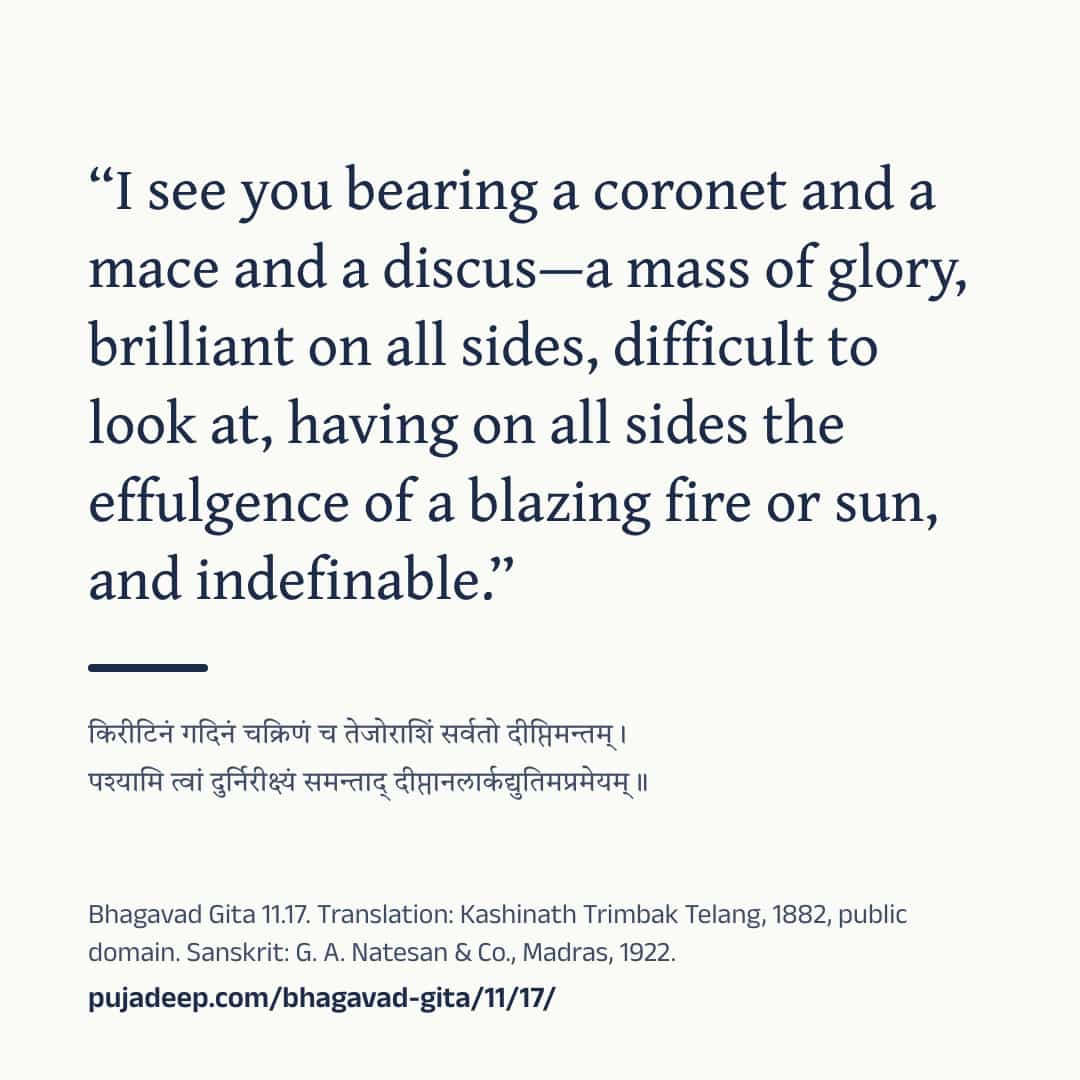
Drawing the picture
See the words
Bhagavad Gita 11.17

किरीटिनं गदिनं चक्रिणं च तेजोराशिं सर्वतो दीप्तिमन्तम् ।
पश्यामि त्वां दुर्निरीक्ष्यं समन्ताद् दीप्तानलार्कद्युतिमप्रमेयम् ॥

“I see you bearing a coronet and a mace and a discus—a mass of glory, brilliant on all sides, difficult to look at, having on all sides the effulgence of a blazing fire or sun, and indefinable.”
(K. T. Telang, The Bhagavadgîtâ (The Sacred Books of the East, vol. VIII, Oxford: Clarendon Press, 1882), pp. 93–94, public domain)

“Shining, a mass of splendour everywhere, With discus, mace, tiara, I behold: Blazing as fire, as sun, dazzling the gaze From all sides in the sky, immeasurable.”
(Annie Besant, The Bhagavad Gîtâ, or The Lord's Song (London: Theosophical Publishing Society, 1895), p. 106, public domain)
This sentence begins in 11.16.

“I see Thee with diadem, club, and discus; a mass of radiance shining everywhere, very hard to look at, all around blazing like burning fire and sun, immeasurable.”
(Swami Swarupananda, Srimad-Bhagavad-Gita (Mayavati: Prabuddha Bharata Press, 1909; first printed in Prabuddha Bharata, 1907–1909), p. 219, public domain)

Sanskrit: G. A. Natesan & Co., Madras, 1922.
https://pujadeep.com/bhagavad-gita/11/17/ Nothing is sent from this site. Your own app sends it, to the chat you choose. The picture quotes the translation you chose on this page, with its name and year.
Sanskrit text: The Bhagavad-Gita, or The Lord's Song, with the text in Devanagari and an English translation, 1922. Meanings: written for Pujadeep and checked against the cited edition. Source and changes
Questions families ask
Who speaks Bhagavad Gita 11.17?
Arjuna speaks this verse, in chapter 11 (Vishvarupa Darshana Yoga).
Where does the Sanskrit text come from?
Sanskrit text: The Bhagavad-Gita, or The Lord's Song, with the text in Devanagari and an English translation, 1922. Meanings: written for Pujadeep and checked against the cited edition. See the source
Is the meaning on this page a translation?
Explanation written for this site from the sources listed here, and checked against the cited edition. It is not a translation and not the only way to read the text. Free to quote with credit.
Source and licence
- Sanskrit text
- The Bhagavad-Gita, or The Lord's Song, with the text in Devanagari and an English translation (Annie Besant, G. A. Natesan & Co., Madras, 1922). Public domain. The Sanskrit on these pages was read from this printing’s page images.
- Translation
- The Bhagavadgîtâ with the Sanatsugâtîya and the Anugîtâ, translated by Kâshinâth Trimbak Telang (The Sacred Books of the East, vol. VIII, ed. F. Max Müller) (Kashinath Trimbak Telang, F. Max Müller, Clarendon Press, Oxford, 1882). Public domain. Shown verbatim, as printed.
- Translation
- The Bhagavad Gîtâ, or The Lord's Song, translated by Annie Besant (Annie Besant, Theosophical Publishing Society, London, 1895). Public domain. Shown verbatim, as printed.
- Translation
- Srimad-Bhagavad-Gita, with Sanskrit Text; Paraphrase with Word-by-word Literal Translation; English Rendering and Comments, Index, &c., by the Swami Swarupananda (Himalayan Series, No. XX) (Swami Swarupananda, The Editors and Publishers, Advaita Ashrama, Mayavati, Prabuddha Bharata Press, Mayavati, Almora, Himalayas, 1909). Public domain. Shown verbatim, as printed.
- Common wording
- In this text, 32 words follow today's common wording, checked against sanskritdocuments.org; Sanskrit Wikisource; Gita Press, Gorakhpur; GRETIL, Göttingen and Bhaktivedanta Book Trust.
- Our explanation
- Explanation written for this site from the sources listed here, and checked against the cited edition. It is not a translation and not the only way to read the text. Free to quote with credit.
- Checked
- Checked against the cited edition, October 27, 2026.