Bhagavad Gita 11.9: meaning and translation
Chapter 11: Vishvarupa Darshana Yoga. Sanjaya says
Sanjaya, who is telling the story to King Dhritarashtra, speaks.
Click or tap a word for its meaning and its dictionary page.
Text and layers
Text and layers
These choices stay in this browser.
Bhagavad Gita 11.9
सञ्जय उवाच ।
एवमुक्त्वा ततो राजन् महायोगेश्वरो हरिः ।दर्शयामास पार्थाय परमं रूपमैश्वरम् ॥
Evamuktva tato rajan mahayogeshvaro harihDarshayamasa parthaya paramam rupamaishvaram
evamuktvā tato rājan mahāyogeśvaro hariḥ |darśayāmāsa pārthāya paramaṃ rūpamaiśvaram ||
Our explanation Sanjaya, who is telling the story to King Dhritarashtra, speaks. Having said this, he says, Hari, the great lord of yoga, showed Arjuna (Pārtha) his supreme form as the Lord.
हिंदी अर्थ संजय बोलते हैं, जो राजा धृतराष्ट्र को यह कथा सुना रहे हैं। वे कहते हैं कि यह कहकर महान योगेश्वर हरि ने अर्जुन (पार्थ) को अपना परम ऐश्वर रूप दिखाया।
Word by word
Every word, with its dictionary page
Word by word
- एवम् evam · thus (indeclinable) Dictionary: evam, Monier-Williams 1899, p. 232, col. 2 “thus, in this way, in such a manner”
- उक्त्वा uktvā · having said (absolutive (having done)) Dictionary: vac, Monier-Williams 1899, p. 912, col. 1 “to speak, say, tell, utter, announce”
- ततः tataḥ · then (indeclinable) Dictionary: tatas, Monier-Williams 1899, p. 432, col. 2 “thereupon, then, after that”
- राजन् rājan · O king (Dhritarashtra) (noun (masculine), vocative singular) Dictionary: 1. rājan, Monier-Williams 1899, p. 874, col. 3 “a king, sovereign, prince, chief”
- महायोगेश्वरः mahāyogeśvaraḥ · the great Lord of yoga (compound (masculine), nominative singular) Dictionary: mahā-yogeśvara, Monier-Williams 1899, p. 799, col. 2 “a gr° master of the Yoga system”
- हरिः hariḥ · Hari (Krishna) (noun (masculine), nominative singular) Dictionary: hari, Monier-Williams 1899, p. 1289, col. 3 “(esp.) N. of Vishṇu-Kṛishṇa”
- दर्शयामास darśayāmāsa · showed (causative periphrastic perfect, 3rd person singular) Dictionary: 1. dṛś, Monier-Williams 1899, p. 491, col. 2 “to see, behold, look at, regard, consider”
- पार्थाय pārthāya · to Partha (Arjuna) (noun (masculine), dative singular) Dictionary: 2. pārtha, Monier-Williams 1899, p. 621, col. 3 “metron. of Yudhi-shṭhira or Bhīma-sena or Arjuna”
- परमम् paramam · supreme (adjective (neuter), accusative singular) Dictionary: parama, Monier-Williams 1899, p. 588, col. 1 “chief, highest, primary, most prominent or conspicuous”
- रूपम् rūpam · form (noun (neuter), accusative singular) Dictionary: rūpa, Monier-Williams 1899, p. 885, col. 3 “form, shape, figure”
- ऐश्वरम् aiśvaram · divine, of the Lord (adjective (neuter), accusative singular) Dictionary: aiśvara, Monier-Williams 1899, p. 234, col. 3 “relating to or coming from a mighty lord or king”
1 printing differs
Edition differences. Another printing or text reads this place differently.
- Spelling A digital text reads Same letters. The 1922 edition prints राजन् महायोगेश्वरो as two words; the e-text joins them.
Old translations
Kashinath Trimbak Telang, 1882. Public domain. Page 92–93.
Sañgaya said:
Having spoken thus, O king! Hari, the great lord of the possessors of mystic power, then showed to the son of Prithâ his supreme divine form,
This sentence goes on in 11.10.
Compare 3 translations
Kashinath Trimbak Telang, 1882. Public domain. Page 92–93.
Sañgaya said:
Having spoken thus, O king! Hari, the great lord of the possessors of mystic power, then showed to the son of Prithâ his supreme divine form,
This sentence goes on in 11.10.
You are reading this one
Annie Besant, 1895. Public domain. Page 104.
Sanjaya said:
Having thus spoken, O King, the great Lord of Yoga, Hari, showed to Pârtha His supreme Form as Îshvara:
This sentence goes on in 11.10.
You are reading this one
Swami Swarupananda, 1909 (first printed 1907). Public domain. Page 216.
Sanjaya said:
Having thus spoken, O king, Hari, the Great Lord of Yoga, then showed unto the son of Prithâ, His Supreme Ishvara-Form—
This sentence goes on in 11.10.
You are reading this one
Cite this verse
The translation: K. T. Telang, The Bhagavadgîtâ (The Sacred Books of the East, vol. VIII, Oxford: Clarendon Press, 1882), pp. 92–93. Bhagavad Gita 11.9.
The translation: Annie Besant, The Bhagavad Gîtâ, or The Lord's Song (London: Theosophical Publishing Society, 1895), p. 104. Bhagavad Gita 11.9.
The translation: Swami Swarupananda, Srimad-Bhagavad-Gita (Mayavati: Prabuddha Bharata Press, 1909; first printed in Prabuddha Bharata, 1907–1909), p. 216. Bhagavad Gita 11.9.
Our explanation: “Bhagavad Gita 11.9: meaning and translation.” Pujadeep. Updated October 27, 2026. https://pujadeep.com/bhagavad-gita/11/9/
Pujadeep’s explanations are free to quote with credit: name Pujadeep and link to the page. How to credit
Classical readings, by school
No readings by school on this verse yet.
Share
Show the ways to share
Send one picture or the text to one chat. The picture names its source and the address of this page.
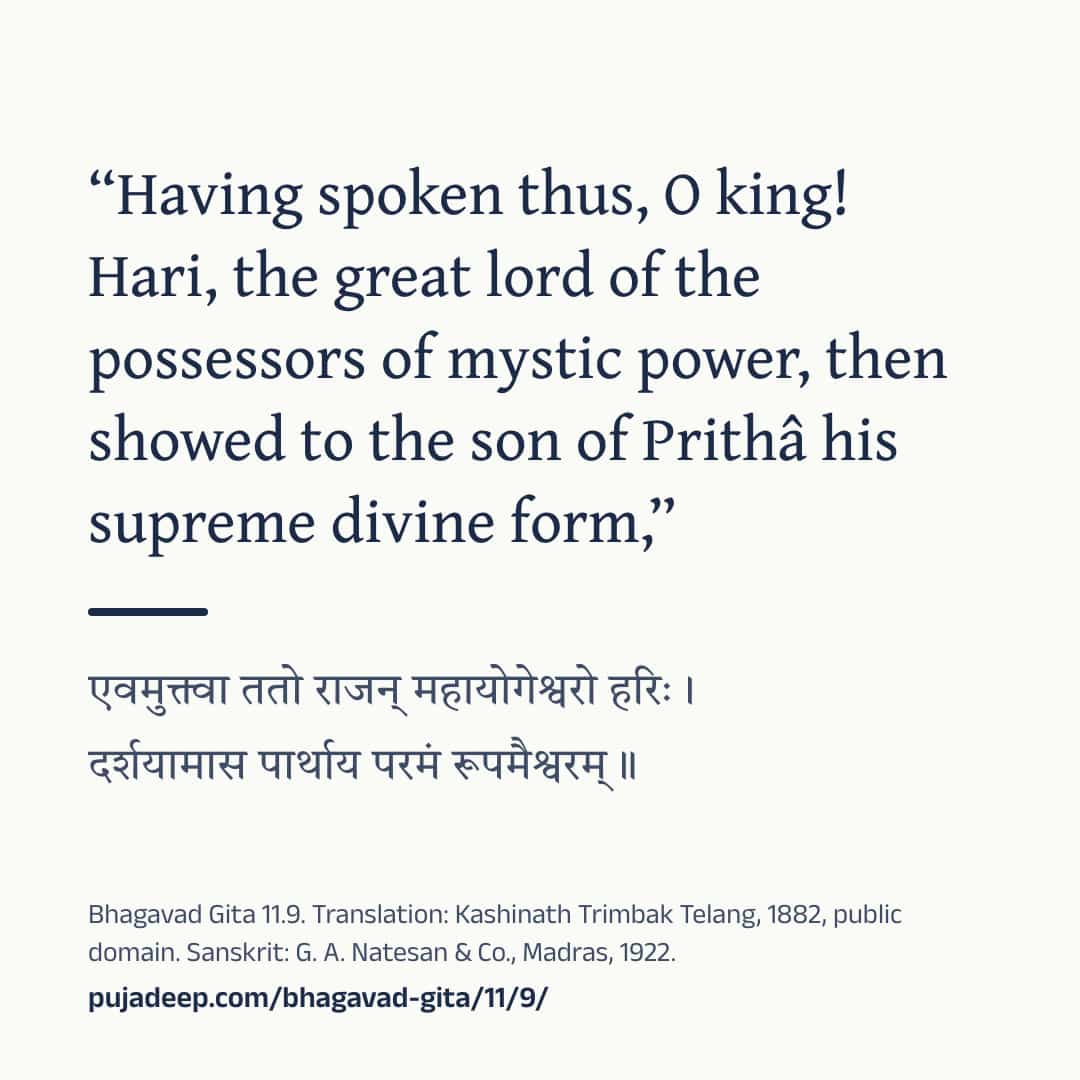
Drawing the picture
See the words
Bhagavad Gita 11.9

एवमुक्त्वा ततो राजन् महायोगेश्वरो हरिः ।
दर्शयामास पार्थाय परमं रूपमैश्वरम् ॥

“Having spoken thus, O king! Hari, the great lord of the possessors of mystic power, then showed to the son of Prithâ his supreme divine form,”
(K. T. Telang, The Bhagavadgîtâ (The Sacred Books of the East, vol. VIII, Oxford: Clarendon Press, 1882), pp. 92–93, public domain)
This sentence goes on in 11.10.

“Having thus spoken, O King, the great Lord of Yoga, Hari, showed to Pârtha His supreme Form as Îshvara:”
(Annie Besant, The Bhagavad Gîtâ, or The Lord's Song (London: Theosophical Publishing Society, 1895), p. 104, public domain)
This sentence goes on in 11.10.

“Having thus spoken, O king, Hari, the Great Lord of Yoga, then showed unto the son of Prithâ, His Supreme Ishvara-Form—”
(Swami Swarupananda, Srimad-Bhagavad-Gita (Mayavati: Prabuddha Bharata Press, 1909; first printed in Prabuddha Bharata, 1907–1909), p. 216, public domain)
This sentence goes on in 11.10.

Sanskrit: G. A. Natesan & Co., Madras, 1922.
https://pujadeep.com/bhagavad-gita/11/9/ Nothing is sent from this site. Your own app sends it, to the chat you choose. The picture quotes the translation you chose on this page, with its name and year.
Sanskrit text: The Bhagavad-Gita, or The Lord's Song, with the text in Devanagari and an English translation, 1922. Meanings: written for Pujadeep and checked against the cited edition. Source and changes
Questions families ask
Who speaks Bhagavad Gita 11.9?
Sanjaya speaks this verse, in chapter 11 (Vishvarupa Darshana Yoga).
Where does the Sanskrit text come from?
Sanskrit text: The Bhagavad-Gita, or The Lord's Song, with the text in Devanagari and an English translation, 1922. Meanings: written for Pujadeep and checked against the cited edition. See the source
Is the meaning on this page a translation?
Explanation written for this site from the sources listed here, and checked against the cited edition. It is not a translation and not the only way to read the text. Free to quote with credit.
Source and licence
- Sanskrit text
- The Bhagavad-Gita, or The Lord's Song, with the text in Devanagari and an English translation (Annie Besant, G. A. Natesan & Co., Madras, 1922). Public domain. The Sanskrit on these pages was read from this printing’s page images.
- Translation
- The Bhagavadgîtâ with the Sanatsugâtîya and the Anugîtâ, translated by Kâshinâth Trimbak Telang (The Sacred Books of the East, vol. VIII, ed. F. Max Müller) (Kashinath Trimbak Telang, F. Max Müller, Clarendon Press, Oxford, 1882). Public domain. Shown verbatim, as printed.
- Translation
- The Bhagavad Gîtâ, or The Lord's Song, translated by Annie Besant (Annie Besant, Theosophical Publishing Society, London, 1895). Public domain. Shown verbatim, as printed.
- Translation
- Srimad-Bhagavad-Gita, with Sanskrit Text; Paraphrase with Word-by-word Literal Translation; English Rendering and Comments, Index, &c., by the Swami Swarupananda (Himalayan Series, No. XX) (Swami Swarupananda, The Editors and Publishers, Advaita Ashrama, Mayavati, Prabuddha Bharata Press, Mayavati, Almora, Himalayas, 1909). Public domain. Shown verbatim, as printed.
- Common wording
- In this text, 32 words follow today's common wording, checked against sanskritdocuments.org; Sanskrit Wikisource; Gita Press, Gorakhpur; GRETIL, Göttingen and Bhaktivedanta Book Trust.
- Our explanation
- Explanation written for this site from the sources listed here, and checked against the cited edition. It is not a translation and not the only way to read the text. Free to quote with credit.
- Checked
- Checked against the cited edition, October 27, 2026.