Bhagavad Gita 11.2: meaning and translation
Chapter 11: Vishvarupa Darshana Yoga. Arjuna says
Arjuna says he has heard from Krishna in detail how beings come into being and how they pass away, and also about Krishna's greatness, which never fails.
Click or tap a word for its meaning and its dictionary page.
Text and layers
Text and layers
These choices stay in this browser.
Bhagavad Gita 11.2
भवाप्ययौ हि भूतानां श्रुतौ विस्तरशो मया ।त्वत्तः कमलपत्राक्ष माहात्म्यमपि चाव्ययम् ॥
Bhavapyayau hi bhutanam shrutau vistarasho mayaTvattah kamalapatraksha mahatmyamapi chavyayam
bhavāpyayau hi bhūtānāṃ śrutau vistaraśo mayā |tvattaḥ kamalapatrākṣa māhātmyamapi cāvyayam ||
Our explanation Arjuna says he has heard from Krishna in detail how beings come into being and how they pass away, and also about Krishna's greatness, which never fails. He calls Krishna lotus-eyed (kamala-patrākṣa).
हिंदी अर्थ अर्जुन कहते हैं कि उन्होंने कृष्ण से विस्तार से सुना है कि प्राणी कैसे उत्पन्न होते हैं और कैसे लीन होते हैं, और कृष्ण की उस महिमा के बारे में भी जो कभी नष्ट नहीं होती। वे कृष्ण को कमलपत्राक्ष (कमल के पत्ते जैसी आँखों वाले) कहते हैं।
Word by word
Every word, with its dictionary page
Word by word
- भवाप्ययौ bhavāpyayau · origin and dissolution (compound (masculine), nominative dual) Dictionary: bhava, Monier-Williams 1899, p. 748, col. 3 “coming into existence, birth, production, origin”; apy-aya, Monier-Williams 1899, p. 55, col. 3 “entering into”
- हि hi · indeed, for (indeclinable) Dictionary: 2. hi, Monier-Williams 1899, p. 1297, col. 3 “for, because, on account of”
- भूतानाम् bhūtānām · of beings (noun (neuter), genitive plural) Dictionary: bhūta, Monier-Williams 1899, p. 761, col. 3 “that which is or exists, any living being”
- श्रुतौ śrutau · (both) have been heard (past participle (masculine), nominative dual) Dictionary: śruta, Monier-Williams 1899, p. 1101, col. 1 “heard, listened to, heard about or of, taught”
- विस्तरशः vistaraśaḥ · in detail (indeclinable) Dictionary: vi-stara, Monier-Williams 1899, p. 1001, col. 3 “diffusely, at length”
- मया mayā · by "me" (Arjuna) (pronoun, instrumental singular) Dictionary: 1. mad, Monier-Williams 1899, p. 777, col. 2 “base of the first pers. pron. in the sg. number (esp. in comp.)”
- त्वत्तः tvattaḥ · from you (pronoun, ablative singular) Dictionary: yuṣmad, Monier-Williams 1899, p. 855, col. 3 “the base of the 2nd pers. pron. as used in comp.”
- कमलपत्राक्ष kamalapatrākṣa · O lotus-eyed one (Krishna) (compound (masculine), vocative singular) Dictionary: kamala-pattrākṣa, Monier-Williams 1899, p. 252, col. 1 “having eyes like leaves of the lotus-flower”
- माहात्म्यम् māhātmyam · greatness (noun (neuter), nominative singular) Dictionary: māhātmya, Monier-Williams 1899, p. 815, col. 1 “magnanimity, high-mindedness”
- अपि api · also (indeclinable) Dictionary: api, Monier-Williams 1899, p. 55, col. 1 “even, also, very”
- च ca · and (indeclinable) Dictionary: 2. ca, Monier-Williams 1899, p. 380, col. 1 “and, both, also, moreover, as well as”
- अव्ययम् avyayam · imperishable (adjective (neuter), nominative singular) Dictionary: 2. a-vyaya, Monier-Williams 1899, p. 111, col. 3 “not liable to change, imperishable, undecaying”
Old translations
Kashinath Trimbak Telang, 1882. Public domain. Page 92.
O you whose eyes are like lotus leaves! I have heard from you at large about the production and dissolution of things, and also about your inexhaustible greatness.
Compare 3 translations
Kashinath Trimbak Telang, 1882. Public domain. Page 92.
O you whose eyes are like lotus leaves! I have heard from you at large about the production and dissolution of things, and also about your inexhaustible greatness.
You are reading this one
Annie Besant, 1895. Public domain. Page 103.
The production and destruction of beings have been heard by me in minute detail from Thee, O Lotus-eyed, and also Thy imperishable greatness.
You are reading this one
Swami Swarupananda, 1909 (first printed 1907). Public domain. Page 213.
Of Thee, O lotus-eyed, I have heard at length, of the origin and dissolution of beings, as also Thy inexhaustible greatness.
You are reading this one
Cite this verse
The translation: K. T. Telang, The Bhagavadgîtâ (The Sacred Books of the East, vol. VIII, Oxford: Clarendon Press, 1882), p. 92. Bhagavad Gita 11.2.
The translation: Annie Besant, The Bhagavad Gîtâ, or The Lord's Song (London: Theosophical Publishing Society, 1895), p. 103. Bhagavad Gita 11.2.
The translation: Swami Swarupananda, Srimad-Bhagavad-Gita (Mayavati: Prabuddha Bharata Press, 1909; first printed in Prabuddha Bharata, 1907–1909), p. 213. Bhagavad Gita 11.2.
Our explanation: “Bhagavad Gita 11.2: meaning and translation.” Pujadeep. Updated October 27, 2026. https://pujadeep.com/bhagavad-gita/11/2/
Pujadeep’s explanations are free to quote with credit: name Pujadeep and link to the page. How to credit
Classical readings, by school
No readings by school on this verse yet.
Share
Show the ways to share
Send one picture or the text to one chat. The picture names its source and the address of this page.
Drawing the picture
See the words
Bhagavad Gita 11.2

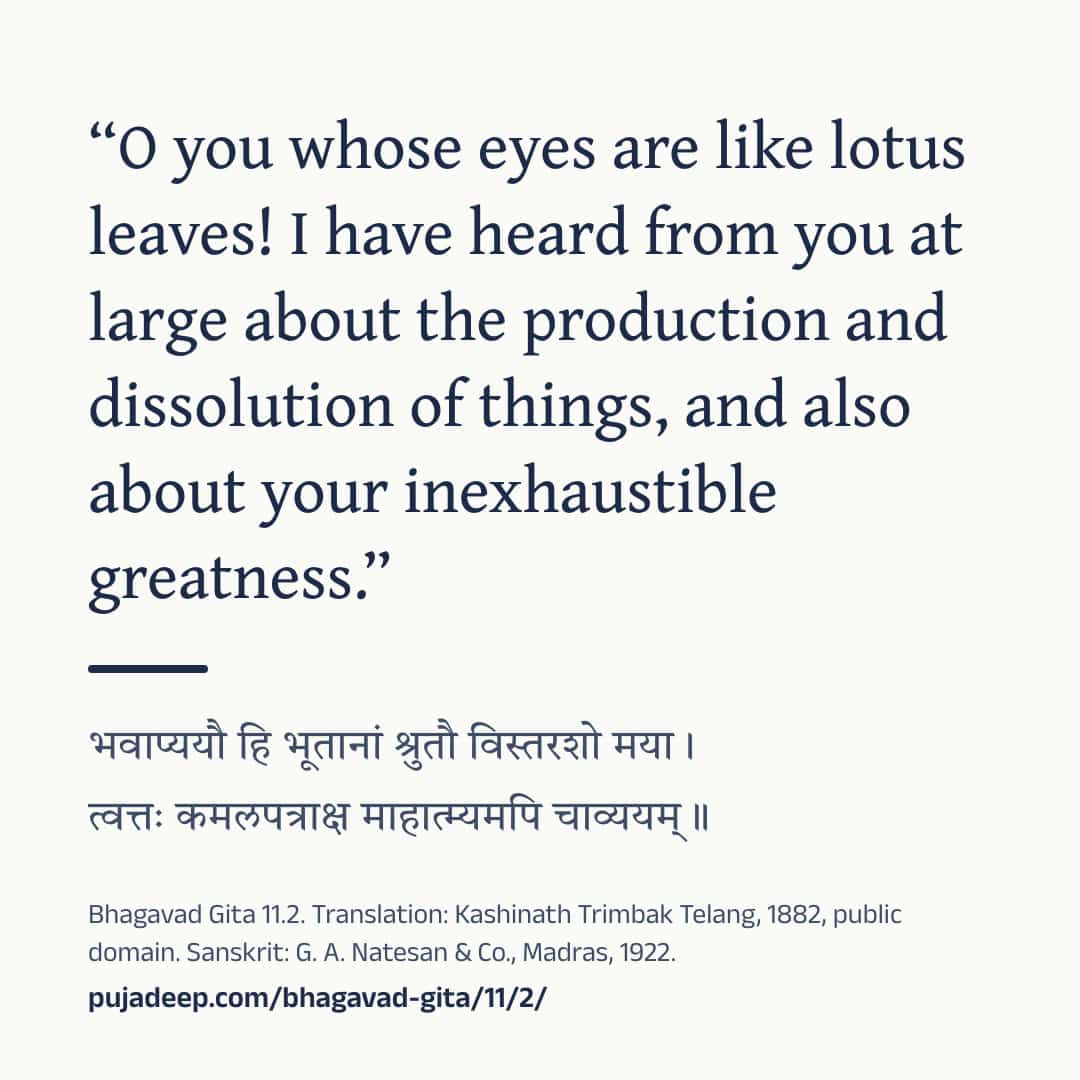
भवाप्ययौ हि भूतानां श्रुतौ विस्तरशो मया ।
त्वत्तः कमलपत्राक्ष माहात्म्यमपि चाव्ययम् ॥

“O you whose eyes are like lotus leaves! I have heard from you at large about the production and dissolution of things, and also about your inexhaustible greatness.”
(K. T. Telang, The Bhagavadgîtâ (The Sacred Books of the East, vol. VIII, Oxford: Clarendon Press, 1882), p. 92, public domain)

“The production and destruction of beings have been heard by me in minute detail from Thee, O Lotus-eyed, and also Thy imperishable greatness.”
(Annie Besant, The Bhagavad Gîtâ, or The Lord's Song (London: Theosophical Publishing Society, 1895), p. 103, public domain)

“Of Thee, O lotus-eyed, I have heard at length, of the origin and dissolution of beings, as also Thy inexhaustible greatness.”
(Swami Swarupananda, Srimad-Bhagavad-Gita (Mayavati: Prabuddha Bharata Press, 1909; first printed in Prabuddha Bharata, 1907–1909), p. 213, public domain)

Sanskrit: G. A. Natesan & Co., Madras, 1922.
https://pujadeep.com/bhagavad-gita/11/2/ Nothing is sent from this site. Your own app sends it, to the chat you choose. The picture quotes the translation you chose on this page, with its name and year.
Sanskrit text: The Bhagavad-Gita, or The Lord's Song, with the text in Devanagari and an English translation, 1922. Meanings: written for Pujadeep and checked against the cited edition. Source and changes
Questions families ask
Who speaks Bhagavad Gita 11.2?
Arjuna speaks this verse, in chapter 11 (Vishvarupa Darshana Yoga).
Where does the Sanskrit text come from?
Sanskrit text: The Bhagavad-Gita, or The Lord's Song, with the text in Devanagari and an English translation, 1922. Meanings: written for Pujadeep and checked against the cited edition. See the source
Is the meaning on this page a translation?
Explanation written for this site from the sources listed here, and checked against the cited edition. It is not a translation and not the only way to read the text. Free to quote with credit.
Source and licence
- Sanskrit text
- The Bhagavad-Gita, or The Lord's Song, with the text in Devanagari and an English translation (Annie Besant, G. A. Natesan & Co., Madras, 1922). Public domain. The Sanskrit on these pages was read from this printing’s page images.
- Translation
- The Bhagavadgîtâ with the Sanatsugâtîya and the Anugîtâ, translated by Kâshinâth Trimbak Telang (The Sacred Books of the East, vol. VIII, ed. F. Max Müller) (Kashinath Trimbak Telang, F. Max Müller, Clarendon Press, Oxford, 1882). Public domain. Shown verbatim, as printed.
- Translation
- The Bhagavad Gîtâ, or The Lord's Song, translated by Annie Besant (Annie Besant, Theosophical Publishing Society, London, 1895). Public domain. Shown verbatim, as printed.
- Translation
- Srimad-Bhagavad-Gita, with Sanskrit Text; Paraphrase with Word-by-word Literal Translation; English Rendering and Comments, Index, &c., by the Swami Swarupananda (Himalayan Series, No. XX) (Swami Swarupananda, The Editors and Publishers, Advaita Ashrama, Mayavati, Prabuddha Bharata Press, Mayavati, Almora, Himalayas, 1909). Public domain. Shown verbatim, as printed.
- Common wording
- In this text, 32 words follow today's common wording, checked against sanskritdocuments.org; Sanskrit Wikisource; Gita Press, Gorakhpur; GRETIL, Göttingen and Bhaktivedanta Book Trust.
- Our explanation
- Explanation written for this site from the sources listed here, and checked against the cited edition. It is not a translation and not the only way to read the text. Free to quote with credit.
- Checked
- Checked against the cited edition, October 27, 2026.