Bhagavad Gita 11.1: meaning and translation
Chapter 11: Vishvarupa Darshana Yoga. Arjuna says
Arjuna speaks.
Click or tap a word for its meaning and its dictionary page.
Text and layers
Text and layers
These choices stay in this browser.
Bhagavad Gita 11.1
अर्जुन उवाच ।
मदनुग्रहाय परमं गुह्यमध्यात्मसंज्ञितम् ।यत्त्वयोक्तं वचस्तेन मोहोऽयं विगतो मम ॥
Madanugrahaya paramam guhyamadhyatmasanjnitamYattvayoktam vachastena mohoyam vigato mama
madanugrahāya paramaṃ guhyamadhyātmasaṃjñitam |yattvayoktaṃ vacastena moho’yaṃ vigato mama ||
Our explanation Arjuna speaks. He says that Krishna, out of kindness to him, has spoken words on the highest secret, the teaching called adhyātma (about the self). By these words, he says, his confusion (moha) has gone. The schools explain adhyātma differently (see the views).
हिंदी अर्थ अर्जुन बोलते हैं। वे कहते हैं कि कृष्ण ने उन पर कृपा करके परम गुप्त विषय पर वचन कहे हैं, वह उपदेश जिसे अध्यात्म (आत्मा का ज्ञान) कहते हैं। वे कहते हैं कि इन वचनों से उनका मोह दूर हो गया है। अध्यात्म को परंपराएँ अलग-अलग ढंग से समझती हैं।
Word by word
Every word, with its dictionary page
Word by word
- मदनुग्रहाय madanugrahāya · as a favour to "me" (Arjuna) (compound (masculine), dative singular) Dictionary: 1. mad, Monier-Williams 1899, p. 777, col. 2 “base of the first pers. pron. in the sg. number (esp. in comp.)”; anu-graha, Monier-Williams 1899, p. 32, col. 1 “favour, kindness, showing favour”
- परमम् paramam · highest, supreme (adjective (neuter), nominative singular) Dictionary: parama, Monier-Williams 1899, p. 588, col. 1 “chief, highest, primary, most prominent or conspicuous”
- गुह्यम् guhyam · secret (adjective (neuter), nominative singular) Dictionary: guhya, Monier-Williams 1899, p. 360, col. 3 “private, secret, mysterious, mystical”
- अध्यात्मसंज्ञितम् adhyātmasaṃjñitam · called adhyātma, about the Self (compound (neuter), nominative singular) Dictionary: adhy-ātma, Monier-Williams 1899, p. 23, col. 2 “the Supreme Spirit”; saṃ-jñita, Monier-Williams 1899, p. 1133, col. 3 “called, named, termed (generally ifc.)”
- यत् yat · which (pronoun (neuter), nominative singular) Dictionary: yad, Monier-Williams 1899, p. 844, col. 2 “who, which, what, whichever, whatever, that”
- त्वया tvayā · by you (pronoun, instrumental singular) Dictionary: yuṣmad, Monier-Williams 1899, p. 855, col. 3 “the base of the 2nd pers. pron. as used in comp.”
- उक्तम् uktam · spoken (past participle (neuter), nominative singular) Dictionary: ukta, Monier-Williams 1899, p. 171, col. 3 “uttered, said, spoken”
- वचः vacaḥ · words, speech (noun (neuter), nominative singular) Dictionary: 1. vacas, Monier-Williams 1899, p. 912, col. 3 “speech, voice, word”
- तेन tena · by that (pronoun (neuter), instrumental singular) Dictionary: tad, Monier-Williams 1899, p. 434, col. 1 “m. he, f. she, n. it, that, this”
- मोहः mohaḥ · delusion (noun (masculine), nominative singular) Dictionary: moha, Monier-Williams 1899, p. 836, col. 1 “loss of consciousness, bewilderment, perplexity, distraction, infatuation, delusion”
- अयम् ayam · this (pronoun (masculine), nominative singular) Dictionary: 1. idam, Monier-Williams 1899, p. 165, col. 2 “this, this here”
- विगतः vigataḥ · is gone (past participle (masculine), nominative singular) Dictionary: 2. vi-gata, Monier-Williams 1899, p. 956, col. 3 “gone away, departed, disappeared, ceased, gone”
- मम mama · "my" (Arjuna's) (pronoun, genitive singular) Dictionary: 1. mad, Monier-Williams 1899, p. 777, col. 2 “base of the first pers. pron. in the sg. number (esp. in comp.)”
Old translations
Kashinath Trimbak Telang, 1882. Public domain. Page 92.
Arguna said:
In consequence of the excellent and mysterious words concerning the relation of the supreme and individual soul, which you have spoken for my welfare, this delusion of mine is gone away.
Compare 3 translations
Kashinath Trimbak Telang, 1882. Public domain. Page 92.
Arguna said:
In consequence of the excellent and mysterious words concerning the relation of the supreme and individual soul, which you have spoken for my welfare, this delusion of mine is gone away.
You are reading this one
Annie Besant, 1895. Public domain. Page 103.
Arjuna said:
This word Thou hast spoken for my benefit of the Supreme Secret, named Adhyâtmâ, by this my delusion is taken away.
You are reading this one
Swami Swarupananda, 1909 (first printed 1907). Public domain. Page 212.
Arjuna said:
By the supremely profound words, on the discrimination of self, that have been spoken by Thee out of compassion towards me, this my delusion is gone.
You are reading this one
Cite this verse
The translation: K. T. Telang, The Bhagavadgîtâ (The Sacred Books of the East, vol. VIII, Oxford: Clarendon Press, 1882), p. 92. Bhagavad Gita 11.1.
The translation: Annie Besant, The Bhagavad Gîtâ, or The Lord's Song (London: Theosophical Publishing Society, 1895), p. 103. Bhagavad Gita 11.1.
The translation: Swami Swarupananda, Srimad-Bhagavad-Gita (Mayavati: Prabuddha Bharata Press, 1909; first printed in Prabuddha Bharata, 1907–1909), p. 212. Bhagavad Gita 11.1.
Our explanation: “Bhagavad Gita 11.1: meaning and translation.” Pujadeep. Updated October 27, 2026. https://pujadeep.com/bhagavad-gita/11/1/
Pujadeep’s explanations are free to quote with credit: name Pujadeep and link to the page. How to credit
Classical readings, by school
Each reading is named by its school. None is presented as the only meaning.
What Advaita, Vishishtadvaita and Dvaita teach, in short
Shankara Advaita
Shankara says adhyātma is the teaching on the difference between the Self and what is not the Self, and the confusion that has gone is the failure to tell them apart.
Source: The Bhagavad-Gita, with the commentary of Sri Sankaracharya, translated by A. Mahadeva Sastri (2nd ed., Mysore: G. T. A. Printing Works, 1901), commentary on 11.1, p. 248. Summarised in our own words; none of its text is reproduced.
Ramanuja Vishishtadvaita
Ramanuja says Arjuna had mistaken the body for the self. The teaching on the self, from 2.12 to the end of chapter 6, has removed this mistake.
Source: Sri Bhagavad-Gita with Sri Ramanujacharya's Visishtadvaita commentary, translated by A. Govindacharya (Madras, 1898), commentary on 11.1, p. 348. Summarised in our own words; none of its text is reproduced.
Madhva Dvaita
Madhva takes ātmā here to mean the Lord, so adhyātma is the teaching about the Lord. The confusion that has gone, in his reading, is Arjuna's mistaken attachment to his relatives.
Source: The Bhagavad-Gita: translation and commentaries in English according to Sri Madhwacharya's Bhashyas, by S. Subba Rau (Madras, 1906), commentary on 11.1, p. 222 (leaf n220). Summarised in our own words; none of its text is reproduced.
Share
Show the ways to share
Send one picture or the text to one chat. The picture names its source and the address of this page.
Drawing the picture
See the words
Bhagavad Gita 11.1

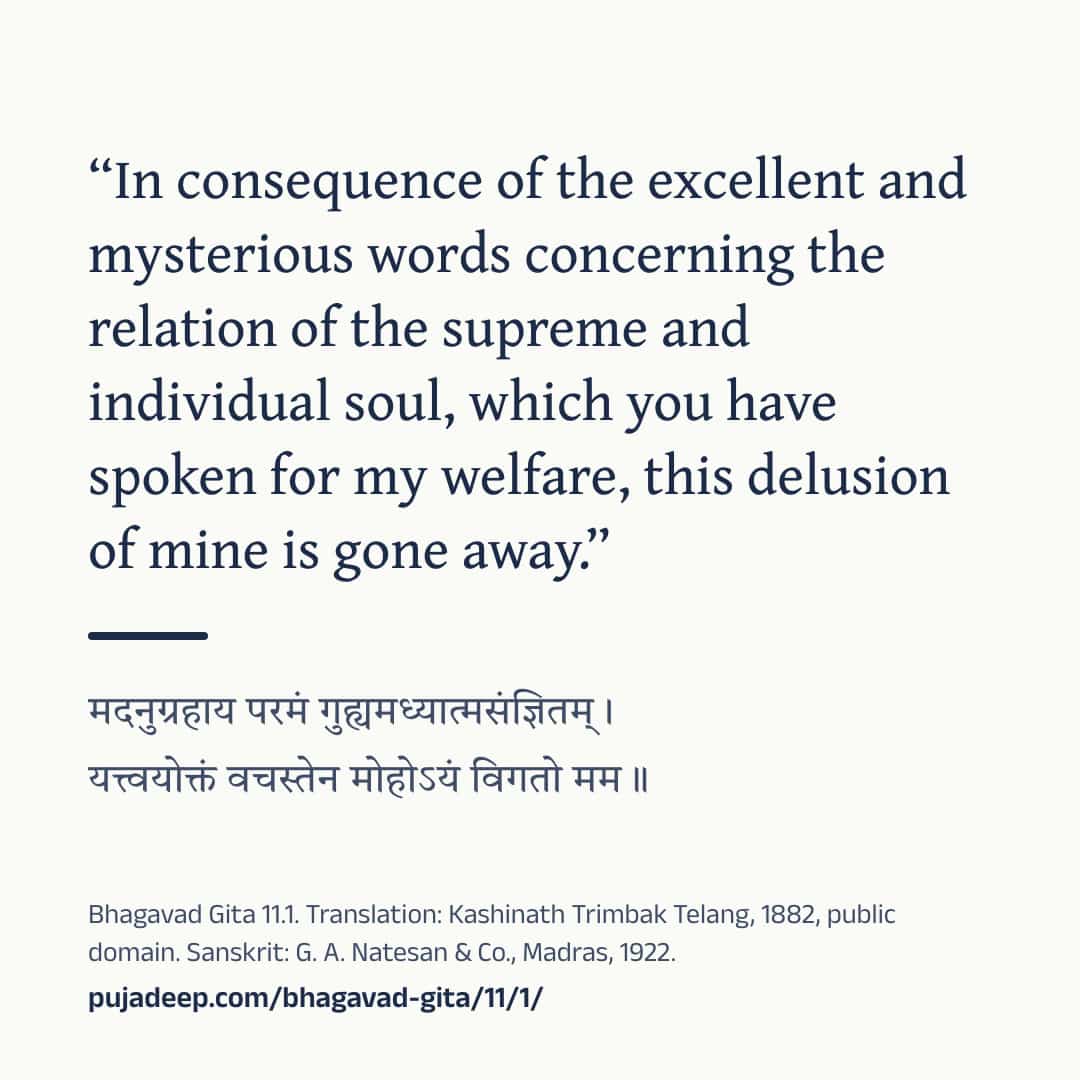
मदनुग्रहाय परमं गुह्यमध्यात्मसंज्ञितम् ।
यत्त्वयोक्तं वचस्तेन मोहोऽयं विगतो मम ॥

“In consequence of the excellent and mysterious words concerning the relation of the supreme and individual soul, which you have spoken for my welfare, this delusion of mine is gone away.”
(K. T. Telang, The Bhagavadgîtâ (The Sacred Books of the East, vol. VIII, Oxford: Clarendon Press, 1882), p. 92, public domain)

“This word Thou hast spoken for my benefit of the Supreme Secret, named Adhyâtmâ, by this my delusion is taken away.”
(Annie Besant, The Bhagavad Gîtâ, or The Lord's Song (London: Theosophical Publishing Society, 1895), p. 103, public domain)

“By the supremely profound words, on the discrimination of self, that have been spoken by Thee out of compassion towards me, this my delusion is gone.”
(Swami Swarupananda, Srimad-Bhagavad-Gita (Mayavati: Prabuddha Bharata Press, 1909; first printed in Prabuddha Bharata, 1907–1909), p. 212, public domain)

Sanskrit: G. A. Natesan & Co., Madras, 1922.
https://pujadeep.com/bhagavad-gita/11/1/ Nothing is sent from this site. Your own app sends it, to the chat you choose. The picture quotes the translation you chose on this page, with its name and year.
Sanskrit text: The Bhagavad-Gita, or The Lord's Song, with the text in Devanagari and an English translation, 1922. Meanings: written for Pujadeep and checked against the cited edition. Source and changes
Questions families ask
Who speaks Bhagavad Gita 11.1?
Arjuna speaks this verse, in chapter 11 (Vishvarupa Darshana Yoga).
Where does the Sanskrit text come from?
Sanskrit text: The Bhagavad-Gita, or The Lord's Song, with the text in Devanagari and an English translation, 1922. Meanings: written for Pujadeep and checked against the cited edition. See the source
Is the meaning on this page a translation?
Explanation written for this site from the sources listed here, and checked against the cited edition. It is not a translation and not the only way to read the text. Free to quote with credit.
Source and licence
- Sanskrit text
- The Bhagavad-Gita, or The Lord's Song, with the text in Devanagari and an English translation (Annie Besant, G. A. Natesan & Co., Madras, 1922). Public domain. The Sanskrit on these pages was read from this printing’s page images.
- Translation
- The Bhagavadgîtâ with the Sanatsugâtîya and the Anugîtâ, translated by Kâshinâth Trimbak Telang (The Sacred Books of the East, vol. VIII, ed. F. Max Müller) (Kashinath Trimbak Telang, F. Max Müller, Clarendon Press, Oxford, 1882). Public domain. Shown verbatim, as printed.
- Translation
- The Bhagavad Gîtâ, or The Lord's Song, translated by Annie Besant (Annie Besant, Theosophical Publishing Society, London, 1895). Public domain. Shown verbatim, as printed.
- Translation
- Srimad-Bhagavad-Gita, with Sanskrit Text; Paraphrase with Word-by-word Literal Translation; English Rendering and Comments, Index, &c., by the Swami Swarupananda (Himalayan Series, No. XX) (Swami Swarupananda, The Editors and Publishers, Advaita Ashrama, Mayavati, Prabuddha Bharata Press, Mayavati, Almora, Himalayas, 1909). Public domain. Shown verbatim, as printed.
- Commentary
- The Bhagavad-Gita, with the commentary of Sri Sankaracharya, translated by A. Mahadeva Sastri (2nd ed., Mysore: G. T. A. Printing Works, 1901) (Public-domain scan, University of California Libraries). Summarised in our own words; none of its text is reproduced.
- Commentary
- Sri Bhagavad-Gita with Sri Ramanujacharya's Visishtadvaita commentary, translated by A. Govindacharya (Madras, 1898) (Scan uploaded to archive.org (folkscanomy collection)). Summarised in our own words; none of its text is reproduced.
- Commentary
- The Bhagavad-Gita: translation and commentaries in English according to Sri Madhwacharya's Bhashyas, by S. Subba Rau (Madras, 1906) (Scan uploaded to archive.org (folkscanomy collection)). Summarised in our own words; none of its text is reproduced.
- Common wording
- In this text, 32 words follow today's common wording, checked against sanskritdocuments.org; Sanskrit Wikisource; Gita Press, Gorakhpur; GRETIL, Göttingen and Bhaktivedanta Book Trust.
- Our explanation
- Explanation written for this site from the sources listed here, and checked against the cited edition. It is not a translation and not the only way to read the text. Free to quote with credit.
- Checked
- Checked against the cited edition, October 27, 2026.