Bhagavad Gita 11.10: meaning and translation
Chapter 11: Vishvarupa Darshana Yoga. Sanjaya says
Sanjaya describes the form: it had many mouths and eyes, many wonderful sights, many divine ornaments and many divine weapons held up.
Click or tap a word for its meaning and its dictionary page.
Text and layers
Text and layers
These choices stay in this browser.
Bhagavad Gita 11.10
अनेकवक्त्रनयनमनेकाद्भुतदर्शनम् ।अनेकदिव्याभरणं दिव्यानेकोद्यतायुधम् ॥
AnekavaktranayanamanekadbhutadarshanamAnekadivyabharanam divyanekodyatayudham
anekavaktranayanamanekādbhutadarśanam |anekadivyābharaṇaṃ divyānekodyatāyudham ||
Our explanation Sanjaya describes the form: it had many mouths and eyes, many wonderful sights, many divine ornaments and many divine weapons held up.
हिंदी अर्थ संजय उस रूप का वर्णन करते हैं: उसके अनेक मुख और अनेक नेत्र थे, अनेक अद्भुत दृश्य थे, अनेक दिव्य आभूषण थे, और अनेक दिव्य अस्त्र उठे हुए थे।
Word by word
Every word, with its dictionary page
Word by word
- अनेकवक्त्रनयनम् anekavaktranayanam · with many mouths and eyes (compound (neuter), accusative singular) Dictionary: an-eka, Monier-Williams 1899, p. 42, col. 2 “not one, many, much”; vaktra, Monier-Williams 1899, p. 912, col. 2 “‘organ of speech,’ the mouth, face”; nayana, Monier-Williams 1899, p. 528, col. 3 “‘the leading organ,’ the eye”
- अनेकाद्भुतदर्शनम् anekādbhutadarśanam · with many wondrous sights (compound (neuter), accusative singular) Dictionary: an-eka, Monier-Williams 1899, p. 42, col. 2 “not one, many, much”; adbhuta, Monier-Williams 1899, p. 19, col. 1 “supernatural, wonderful, marvellous”; darśana, Monier-Williams 1899, p. 470, col. 3 “seeing, observing, looking, noticing, observation, perception”
- अनेकदिव्याभरणम् anekadivyābharaṇam · with many divine ornaments (compound (neuter), accusative singular) Dictionary: an-eka, Monier-Williams 1899, p. 42, col. 2 “not one, many, much”; 2. divya, Monier-Williams 1899, p. 479, col. 2 “divine, heavenly, celestial”; ā-bharaṇa, Monier-Williams 1899, p. 146, col. 1 “ornament, decoration (as jewels &c.)”
- दिव्यानेकोद्यतायुधम् divyānekodyatāyudham · with many divine weapons raised (compound (neuter), accusative singular) Dictionary: 2. divya, Monier-Williams 1899, p. 479, col. 2 “divine, heavenly, celestial”; an-eka, Monier-Williams 1899, p. 42, col. 2 “not one, many, much”; ud-yata, Monier-Williams 1899, p. 190, col. 3 “raised, held up, elevated, high”; ā-yudha, Monier-Williams 1899, p. 149, col. 1 “a weapon”
Old translations
Kashinath Trimbak Telang, 1882. Public domain. Page 93.
having many mouths and eyes, having (within it) many wonderful sights, having many celestial ornaments, having many celestial weapons held erect,
This sentence begins in 11.9. This sentence goes on in 11.11.
Compare 3 translations
Kashinath Trimbak Telang, 1882. Public domain. Page 93.
having many mouths and eyes, having (within it) many wonderful sights, having many celestial ornaments, having many celestial weapons held erect,
This sentence begins in 11.9. This sentence goes on in 11.11.
You are reading this one
Annie Besant, 1895. Public domain. Page 105.
With many mouths and eyes, with visions of many marvels, with many divine ornaments, with many divine weapons;
This sentence begins in 11.9. This sentence goes on in 11.11.
You are reading this one
Swami Swarupananda, 1909 (first printed 1907). Public domain. Page 216.
With numerous mouths and eyes, with numerous wondrous sights, with numerous celestial ornaments, with numerous celestial weapons uplifted.
This sentence begins in 11.9.
You are reading this one
Cite this verse
The translation: K. T. Telang, The Bhagavadgîtâ (The Sacred Books of the East, vol. VIII, Oxford: Clarendon Press, 1882), p. 93. Bhagavad Gita 11.10.
The translation: Annie Besant, The Bhagavad Gîtâ, or The Lord's Song (London: Theosophical Publishing Society, 1895), p. 105. Bhagavad Gita 11.10.
The translation: Swami Swarupananda, Srimad-Bhagavad-Gita (Mayavati: Prabuddha Bharata Press, 1909; first printed in Prabuddha Bharata, 1907–1909), p. 216. Bhagavad Gita 11.10.
Our explanation: “Bhagavad Gita 11.10: meaning and translation.” Pujadeep. Updated October 27, 2026. https://pujadeep.com/bhagavad-gita/11/10/
Pujadeep’s explanations are free to quote with credit: name Pujadeep and link to the page. How to credit
Classical readings, by school
No readings by school on this verse yet.
Share
Show the ways to share
Send one picture or the text to one chat. The picture names its source and the address of this page.
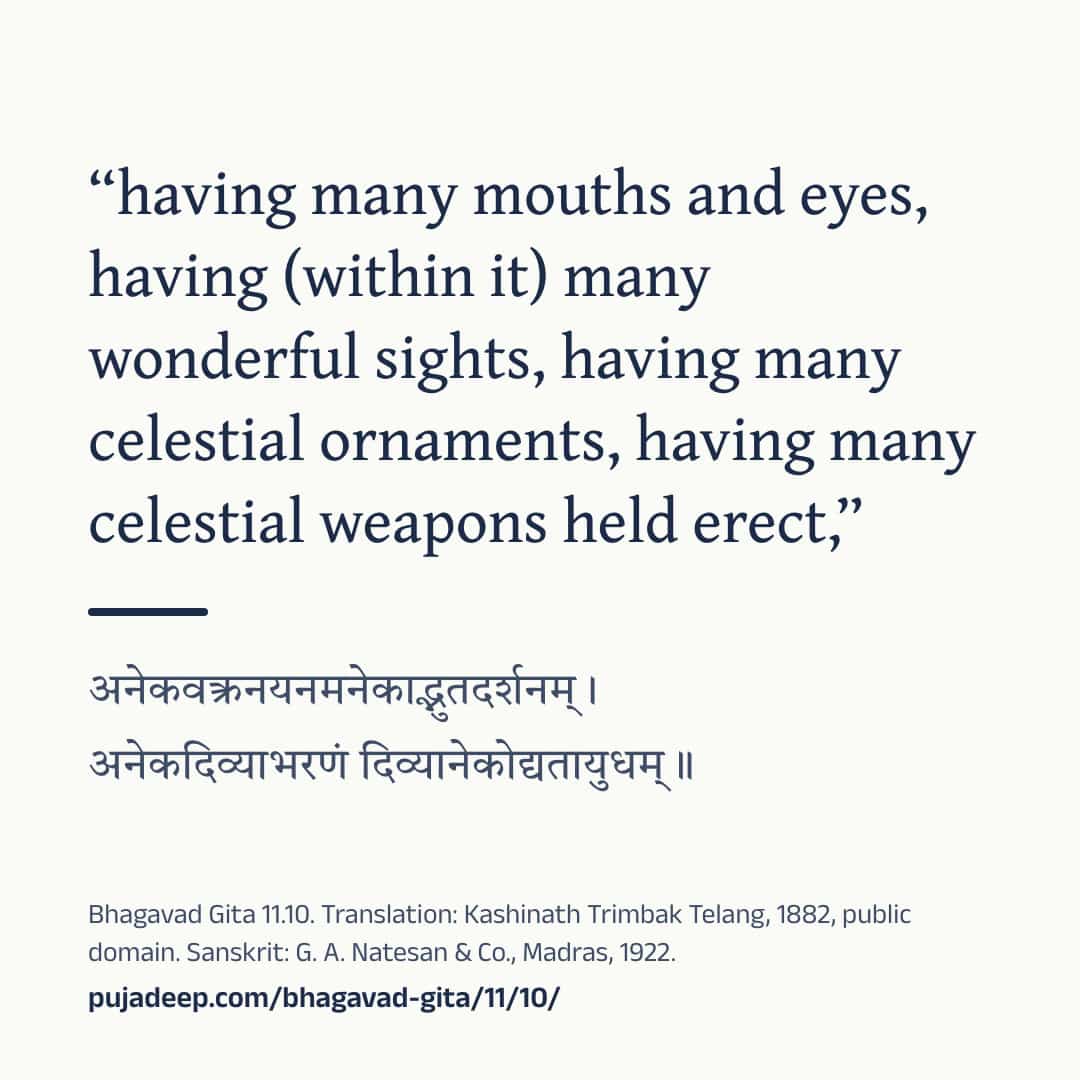
Drawing the picture
See the words
Bhagavad Gita 11.10

अनेकवक्त्रनयनमनेकाद्भुतदर्शनम् ।
अनेकदिव्याभरणं दिव्यानेकोद्यतायुधम् ॥

“having many mouths and eyes, having (within it) many wonderful sights, having many celestial ornaments, having many celestial weapons held erect,”
(K. T. Telang, The Bhagavadgîtâ (The Sacred Books of the East, vol. VIII, Oxford: Clarendon Press, 1882), p. 93, public domain)
This sentence begins in 11.9. This sentence goes on in 11.11.

“With many mouths and eyes, with visions of many marvels, with many divine ornaments, with many divine weapons;”
(Annie Besant, The Bhagavad Gîtâ, or The Lord's Song (London: Theosophical Publishing Society, 1895), p. 105, public domain)
This sentence begins in 11.9. This sentence goes on in 11.11.

“With numerous mouths and eyes, with numerous wondrous sights, with numerous celestial ornaments, with numerous celestial weapons uplifted.”
(Swami Swarupananda, Srimad-Bhagavad-Gita (Mayavati: Prabuddha Bharata Press, 1909; first printed in Prabuddha Bharata, 1907–1909), p. 216, public domain)
This sentence begins in 11.9.

Sanskrit: G. A. Natesan & Co., Madras, 1922.
https://pujadeep.com/bhagavad-gita/11/10/ Nothing is sent from this site. Your own app sends it, to the chat you choose. The picture quotes the translation you chose on this page, with its name and year.
Sanskrit text: The Bhagavad-Gita, or The Lord's Song, with the text in Devanagari and an English translation, 1922. Meanings: written for Pujadeep and checked against the cited edition. Source and changes
Questions families ask
Who speaks Bhagavad Gita 11.10?
Sanjaya speaks this verse, in chapter 11 (Vishvarupa Darshana Yoga).
Where does the Sanskrit text come from?
Sanskrit text: The Bhagavad-Gita, or The Lord's Song, with the text in Devanagari and an English translation, 1922. Meanings: written for Pujadeep and checked against the cited edition. See the source
Is the meaning on this page a translation?
Explanation written for this site from the sources listed here, and checked against the cited edition. It is not a translation and not the only way to read the text. Free to quote with credit.
Source and licence
- Sanskrit text
- The Bhagavad-Gita, or The Lord's Song, with the text in Devanagari and an English translation (Annie Besant, G. A. Natesan & Co., Madras, 1922). Public domain. The Sanskrit on these pages was read from this printing’s page images.
- Translation
- The Bhagavadgîtâ with the Sanatsugâtîya and the Anugîtâ, translated by Kâshinâth Trimbak Telang (The Sacred Books of the East, vol. VIII, ed. F. Max Müller) (Kashinath Trimbak Telang, F. Max Müller, Clarendon Press, Oxford, 1882). Public domain. Shown verbatim, as printed.
- Translation
- The Bhagavad Gîtâ, or The Lord's Song, translated by Annie Besant (Annie Besant, Theosophical Publishing Society, London, 1895). Public domain. Shown verbatim, as printed.
- Translation
- Srimad-Bhagavad-Gita, with Sanskrit Text; Paraphrase with Word-by-word Literal Translation; English Rendering and Comments, Index, &c., by the Swami Swarupananda (Himalayan Series, No. XX) (Swami Swarupananda, The Editors and Publishers, Advaita Ashrama, Mayavati, Prabuddha Bharata Press, Mayavati, Almora, Himalayas, 1909). Public domain. Shown verbatim, as printed.
- Common wording
- In this text, 32 words follow today's common wording, checked against sanskritdocuments.org; Sanskrit Wikisource; Gita Press, Gorakhpur; GRETIL, Göttingen and Bhaktivedanta Book Trust.
- Our explanation
- Explanation written for this site from the sources listed here, and checked against the cited edition. It is not a translation and not the only way to read the text. Free to quote with credit.
- Checked
- Checked against the cited edition, October 27, 2026.