Bhagavad Gita 11.19: meaning and translation
Chapter 11: Vishvarupa Darshana Yoga. Arjuna says
Arjuna says he sees Krishna without beginning, middle or end, of endless power and endless arms, with the moon and the sun for eyes and a mouth like a blazing fire, heating the universe with his own radiance.
Click or tap a word for its meaning and its dictionary page.
Text and layers
Text and layers
These choices stay in this browser.
Bhagavad Gita 11.19
अनादिमध्यान्तमनन्तवीर्यमनन्तबाहुं शशिसूर्यनेत्रम् ।पश्यामि त्वां दीप्तहुताशवक्त्रम् स्वतेजसा विश्वमिदं तपन्तम् ॥
Anadimadhyantamanantaviryamanantabahum shashisuryanetramPashyami tvam diptahutashavaktram svatejasa vishvamidam tapantam
anādimadhyāntamanantavīryamanantabāhuṃ śaśisūryanetram |paśyāmi tvāṃ dīptahutāśavaktram svatejasā viśvamidaṃ tapantam ||
Our explanation Arjuna says he sees Krishna without beginning, middle or end, of endless power and endless arms, with the moon and the sun for eyes and a mouth like a blazing fire, heating the universe with his own radiance.
हिंदी अर्थ अर्जुन कहते हैं कि वे कृष्ण को आदि, मध्य और अंत से रहित देख रहे हैं, अनंत शक्ति और अनंत भुजाओं वाले; चंद्रमा और सूर्य उनके नेत्र हैं, उनका मुख जलती आग जैसा है, और वे अपने तेज से इस विश्व को तपा रहे हैं।
Word by word
Every word, with its dictionary page
Word by word
- अनादिमध्यान्तम् anādimadhyāntam · without beginning, middle or end (compound (masculine), accusative singular) Dictionary: an-ādi, Monier-Williams 1899, p. 28, col. 1 “having no beginning, existing from eternity”; madhya, Monier-Williams 1899, p. 781, col. 3 “the middle, midst, centre, inside, interior”; anta, Monier-Williams 1899, p. 42, col. 3 “end, limit, boundary, term”
- अनन्तवीर्यम् anantavīryam · of endless power (compound (masculine), accusative singular) Dictionary: an-anta, Monier-Williams 1899, p. 25, col. 1 “endless, boundless, eternal, infinite”; vīrya, Monier-Williams 1899, p. 1006, col. 3 “manliness, valour, strength, power, energy”
- अनन्तबाहुम् anantabāhum · of endless arms (compound (masculine), accusative singular) Dictionary: an-anta, Monier-Williams 1899, p. 25, col. 1 “endless, boundless, eternal, infinite”; bāhu, Monier-Williams 1899, p. 730, col. 2 “the arm, (esp.) the fore-arm”
- शशिसूर्यनेत्रम् śaśisūryanetram · with moon and sun as eyes (compound (masculine), accusative singular) Dictionary: śaśin, Monier-Williams 1899, p. 1060, col. 2 “‘containing a hare,’ the moon”; sūrya, Monier-Williams 1899, p. 1243, col. 1 “the sun or its deity”; netra, Monier-Williams 1899, p. 568, col. 3 “the eye”
- पश्यामि paśyāmi · see (present, 1st person singular) Dictionary: 1. paś, Monier-Williams 1899, p. 611, col. 2 “to see, behold, look at, observe, perceive, notice”
- त्वाम् tvām · you (pronoun, accusative singular) Dictionary: yuṣmad, Monier-Williams 1899, p. 855, col. 3 “the base of the 2nd pers. pron. as used in comp.”
- दीप्तहुताशवक्त्रम् dīptahutāśavaktram · with a mouth of blazing fire (compound (masculine), accusative singular) Dictionary: dīpta, Monier-Williams 1899, p. 481, col. 2 “blazing, flaming, hot, shining, bright, brilliant, splendid”; hutāśa, Monier-Williams 1899, p. 1301, col. 1 “obl°-eater, fire”; vaktra, Monier-Williams 1899, p. 912, col. 2 “‘organ of speech,’ the mouth, face”
- स्वतेजसा svatejasā · by your own radiance (compound (neuter), instrumental singular) Dictionary: sva-tejas, Monier-Williams 1899, p. 1275, col. 3 “o° own splendour”
- विश्वम् viśvam · the universe (noun (neuter), accusative singular) Dictionary: viśva, Monier-Williams 1899, p. 992, col. 2 “all, every, every one; whole, entire, universal”
- इदम् idam · this (pronoun (neuter), accusative singular) Dictionary: 1. idam, Monier-Williams 1899, p. 165, col. 2 “this, this here”
- तपन्तम् tapantam · heating (present participle (masculine), accusative singular) Dictionary: 2. tap, Monier-Williams 1899, p. 436, col. 3 “to give out heat, be hot, shine (as the sun)”
1 printing differs
Edition differences. Another printing or text reads this place differently.
- Spelling A digital text reads Same words. At the printed line end the 1922 edition writes वक्त्रम्; the e-text writes वक्त्रं.
Old translations
Kashinath Trimbak Telang, 1882. Public domain. Page 94.
I see you void of beginning, middle, end—of infinite power, of unnumbered arms, having the sun and moon for eyes, having a mouth like a blazing fire, and heating the universe with your radiance.
Compare 3 translations
Kashinath Trimbak Telang, 1882. Public domain. Page 94.
I see you void of beginning, middle, end—of infinite power, of unnumbered arms, having the sun and moon for eyes, having a mouth like a blazing fire, and heating the universe with your radiance.
You are reading this one
Annie Besant, 1895. Public domain. Page 107.
Nor source, nor midst, nor end! infinite force,
Unnumbered arms, the sun and moon as eyes!
I see Thy face, as sacrificial fire
Blazing, its splendour burneth up the worlds.
You are reading this one
Swami Swarupananda, 1909 (first printed 1907). Public domain. Page 220.
I see Thee without beginning, middle or end, infinite in power, of manifold arms; the sun and the moon Thine eyes, the burning fire Thy mouth; heating the whole Universe with Thy radiance.
You are reading this one
Cite this verse
The translation: K. T. Telang, The Bhagavadgîtâ (The Sacred Books of the East, vol. VIII, Oxford: Clarendon Press, 1882), p. 94. Bhagavad Gita 11.19.
The translation: Annie Besant, The Bhagavad Gîtâ, or The Lord's Song (London: Theosophical Publishing Society, 1895), p. 107. Bhagavad Gita 11.19.
The translation: Swami Swarupananda, Srimad-Bhagavad-Gita (Mayavati: Prabuddha Bharata Press, 1909; first printed in Prabuddha Bharata, 1907–1909), p. 220. Bhagavad Gita 11.19.
Our explanation: “Bhagavad Gita 11.19: meaning and translation.” Pujadeep. Updated October 27, 2026. https://pujadeep.com/bhagavad-gita/11/19/
Pujadeep’s explanations are free to quote with credit: name Pujadeep and link to the page. How to credit
Classical readings, by school
No readings by school on this verse yet.
Share
Show the ways to share
Send one picture or the text to one chat. The picture names its source and the address of this page.
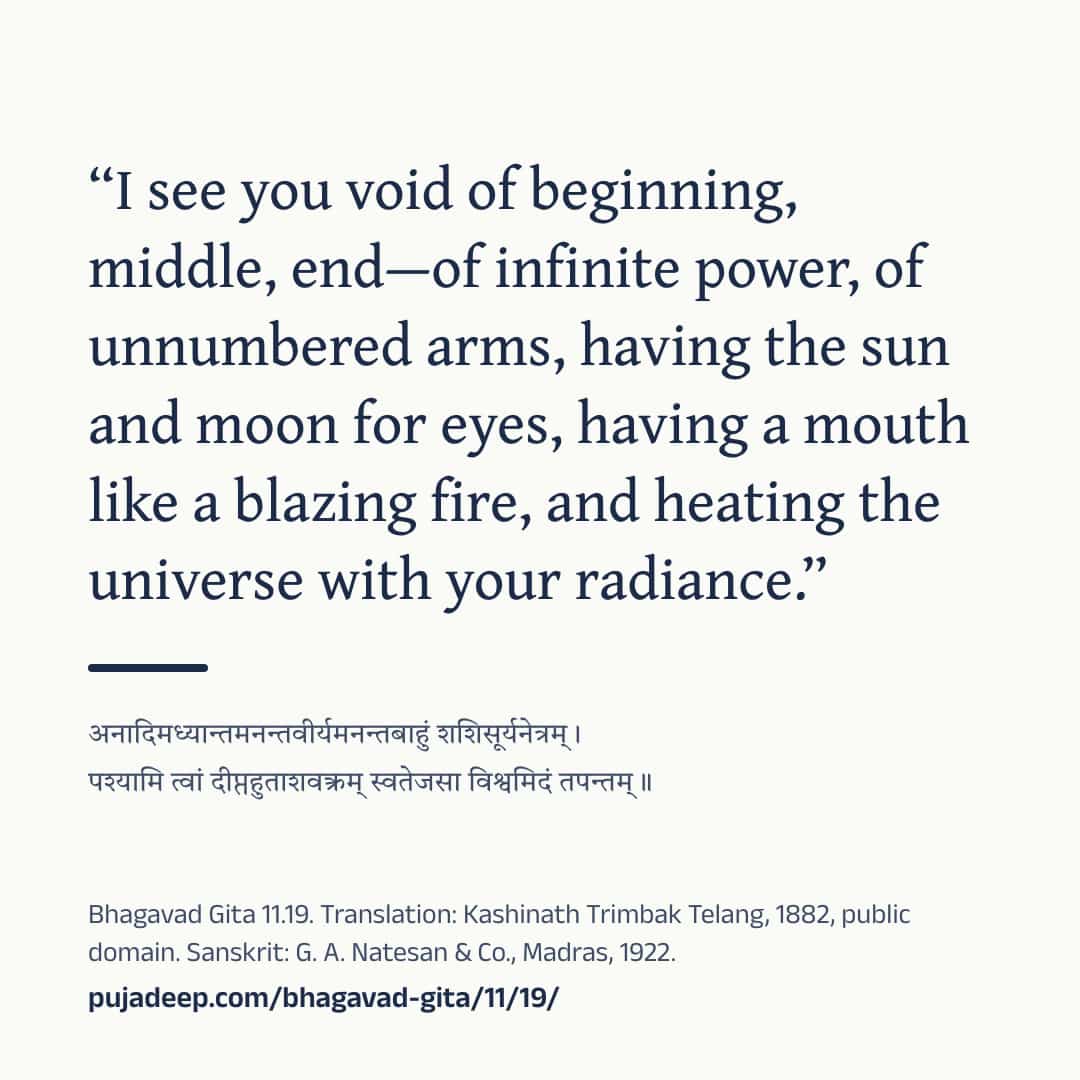
Drawing the picture
See the words
Bhagavad Gita 11.19

अनादिमध्यान्तमनन्तवीर्यमनन्तबाहुं शशिसूर्यनेत्रम् ।
पश्यामि त्वां दीप्तहुताशवक्त्रम् स्वतेजसा विश्वमिदं तपन्तम् ॥

“I see you void of beginning, middle, end—of infinite power, of unnumbered arms, having the sun and moon for eyes, having a mouth like a blazing fire, and heating the universe with your radiance.”
(K. T. Telang, The Bhagavadgîtâ (The Sacred Books of the East, vol. VIII, Oxford: Clarendon Press, 1882), p. 94, public domain)

“Nor source, nor midst, nor end! infinite force, Unnumbered arms, the sun and moon as eyes! I see Thy face, as sacrificial fire Blazing, its splendour burneth up the worlds.”
(Annie Besant, The Bhagavad Gîtâ, or The Lord's Song (London: Theosophical Publishing Society, 1895), p. 107, public domain)

“I see Thee without beginning, middle or end, infinite in power, of manifold arms; the sun and the moon Thine eyes, the burning fire Thy mouth; heating the whole Universe with Thy radiance.”
(Swami Swarupananda, Srimad-Bhagavad-Gita (Mayavati: Prabuddha Bharata Press, 1909; first printed in Prabuddha Bharata, 1907–1909), p. 220, public domain)

Sanskrit: G. A. Natesan & Co., Madras, 1922.
https://pujadeep.com/bhagavad-gita/11/19/ Nothing is sent from this site. Your own app sends it, to the chat you choose. The picture quotes the translation you chose on this page, with its name and year.
Sanskrit text: The Bhagavad-Gita, or The Lord's Song, with the text in Devanagari and an English translation, 1922. Meanings: written for Pujadeep and checked against the cited edition. Source and changes
Questions families ask
Who speaks Bhagavad Gita 11.19?
Arjuna speaks this verse, in chapter 11 (Vishvarupa Darshana Yoga).
Where does the Sanskrit text come from?
Sanskrit text: The Bhagavad-Gita, or The Lord's Song, with the text in Devanagari and an English translation, 1922. Meanings: written for Pujadeep and checked against the cited edition. See the source
Is the meaning on this page a translation?
Explanation written for this site from the sources listed here, and checked against the cited edition. It is not a translation and not the only way to read the text. Free to quote with credit.
Source and licence
- Sanskrit text
- The Bhagavad-Gita, or The Lord's Song, with the text in Devanagari and an English translation (Annie Besant, G. A. Natesan & Co., Madras, 1922). Public domain. The Sanskrit on these pages was read from this printing’s page images.
- Translation
- The Bhagavadgîtâ with the Sanatsugâtîya and the Anugîtâ, translated by Kâshinâth Trimbak Telang (The Sacred Books of the East, vol. VIII, ed. F. Max Müller) (Kashinath Trimbak Telang, F. Max Müller, Clarendon Press, Oxford, 1882). Public domain. Shown verbatim, as printed.
- Translation
- The Bhagavad Gîtâ, or The Lord's Song, translated by Annie Besant (Annie Besant, Theosophical Publishing Society, London, 1895). Public domain. Shown verbatim, as printed.
- Translation
- Srimad-Bhagavad-Gita, with Sanskrit Text; Paraphrase with Word-by-word Literal Translation; English Rendering and Comments, Index, &c., by the Swami Swarupananda (Himalayan Series, No. XX) (Swami Swarupananda, The Editors and Publishers, Advaita Ashrama, Mayavati, Prabuddha Bharata Press, Mayavati, Almora, Himalayas, 1909). Public domain. Shown verbatim, as printed.
- Common wording
- In this text, 32 words follow today's common wording, checked against sanskritdocuments.org; Sanskrit Wikisource; Gita Press, Gorakhpur; GRETIL, Göttingen and Bhaktivedanta Book Trust.
- Our explanation
- Explanation written for this site from the sources listed here, and checked against the cited edition. It is not a translation and not the only way to read the text. Free to quote with credit.
- Checked
- Checked against the cited edition, October 27, 2026.