Bhagavad Gita 11.24: meaning and translation
Chapter 11: Vishvarupa Darshana Yoga. Arjuna says
Arjuna addresses Krishna as Viṣṇu.
Click or tap a word for its meaning and its dictionary page.
Text and layers
Text and layers
These choices stay in this browser.
Bhagavad Gita 11.24
नभः स्पृशं दीप्तमनेकवर्णम् व्यात्ताननं दीप्तविशालनेत्रम् ।दृष्ट्वा हि त्वां प्रव्यथितान्तरात्मा धृतिं न विन्दामि शमं च विष्णो ॥
Nabhah sprisham diptamanekavarnam vyattananam diptavishalanetramDrishtva hi tvam pravyathitantaratma dhritim na vindami shamam cha vishno
nabhaḥ spṛśaṃ dīptamanekavarṇam vyāttānanaṃ dīptaviśālanetram |dṛṣṭvā hi tvāṃ pravyathitāntarātmā dhṛtiṃ na vindāmi śamaṃ ca viṣṇo ||
Our explanation Arjuna addresses Krishna as Viṣṇu. Seeing him touching the sky, blazing, of many colours, with mouths wide open and large shining eyes, Arjuna says he is shaken within and finds neither steadiness nor peace.
हिंदी अर्थ अर्जुन कृष्ण को विष्णु कहकर पुकारते हैं। वे कहते हैं कि आकाश को छूते, दीप्त, अनेक रंगों वाले, खुले मुखों और बड़ी चमकती आँखों वाले उस रूप को देखकर उनका अंतर्मन व्यथित है, और उन्हें न धीरज मिलता है, न शांति।
Word by word
Every word, with its dictionary page
Word by word
- नभःस्पृशम् nabhaḥspṛśam · touching the sky (compound (masculine), accusative singular) Dictionary: nabhaḥ-spṛś, Monier-Williams 1899, p. 527, col. 3 “‘sky-touching,’ attaining heaven”; nabhas, Monier-Williams 1899, p. 527, col. 3 “the sky or atmosphere”
- दीप्तम् dīptam · blazing (past participle (masculine), accusative singular) Dictionary: dīpta, Monier-Williams 1899, p. 481, col. 2 “blazing, flaming, hot, shining, bright, brilliant, splendid”
- अनेकवर्णम् anekavarṇam · of many colours (compound (masculine), accusative singular) Dictionary: an-eka, Monier-Williams 1899, p. 42, col. 2 “not one, many, much”; varṇa, Monier-Williams 1899, p. 924, col. 2 “colour, tint, dye, pigment”
- व्यात्ताननम् vyāttānanam · with mouths wide open (compound (masculine), accusative singular) Dictionary: vy-āttānana, Monier-Williams 1899, p. 1037, col. 1 “open-mouthed”
- दीप्तविशालनेत्रम् dīptaviśālanetram · with large blazing eyes (compound (masculine), accusative singular) Dictionary: dīpta, Monier-Williams 1899, p. 481, col. 2 “blazing, flaming, hot, shining, bright, brilliant, splendid”; viśāla, Monier-Williams 1899, p. 990, col. 1 “spacious, extensive, broad, wide, large”; netra, Monier-Williams 1899, p. 568, col. 3 “the eye”
- दृष्ट्वा dṛṣṭvā · having seen (absolutive (having done)) Dictionary: 1. dṛś, Monier-Williams 1899, p. 491, col. 2 “to see, behold, look at, regard, consider”
- हि hi · indeed (indeclinable) Dictionary: 2. hi, Monier-Williams 1899, p. 1297, col. 3 “for, because, on account of”
- त्वाम् tvām · you (pronoun, accusative singular) Dictionary: yuṣmad, Monier-Williams 1899, p. 855, col. 3 “the base of the 2nd pers. pron. as used in comp.”
- प्रव्यथितान्तरात्मा pravyathitāntarātmā · shaken in the inmost self (compound (masculine), nominative singular) Dictionary: pra-vyathita, Monier-Williams 1899, p. 694, col. 2 “affrighted, distressed, pained”; antar-ātman, Monier-Williams 1899, p. 43, col. 2 “the soul; the internal feelings, the heart or mind”
- धृतिम् dhṛtim · steadiness, courage (noun (feminine), accusative singular) Dictionary: dhṛti, Monier-Williams 1899, p. 519, col. 3 “firmness, constancy, resolution”
- न na · not (indeclinable) Dictionary: 2. na, Monier-Williams 1899, p. 523, col. 1 “not, no, nor, neither”
- विन्दामि vindāmi · find (present, 1st person singular) Dictionary: 3. vid, Monier-Williams 1899, p. 964, col. 3 “to find, discover, meet or fall in with, obtain, get, acquire”
- शमम् śamam · calm, peace (noun (masculine), accusative singular) Dictionary: śama, Monier-Williams 1899, p. 1053, col. 3 “tranquillity, calmness, rest, equanimity, quietude or quietism, absence of passion”
- च ca · and (indeclinable) Dictionary: 2. ca, Monier-Williams 1899, p. 380, col. 1 “and, both, also, moreover, as well as”
- विष्णो viṣṇo · O Vishnu (noun (masculine), vocative singular) Dictionary: viṣṇu, Monier-Williams 1899, p. 999, col. 1 “(prob. fr. √vish, 'All-pervader' or 'Worker') N. of one of the principal Hindū deities”
1 printing differs
Edition differences. Another printing or text reads this place differently.
- Spelling A digital text reads Same words. The 1922 edition prints नभः स्पृशं as two words and writes वर्णम् at the printed line end; the e-text joins नभःस्पृशं and writes वर्णं.
Old translations
Kashinath Trimbak Telang, 1882. Public domain. Page 94.
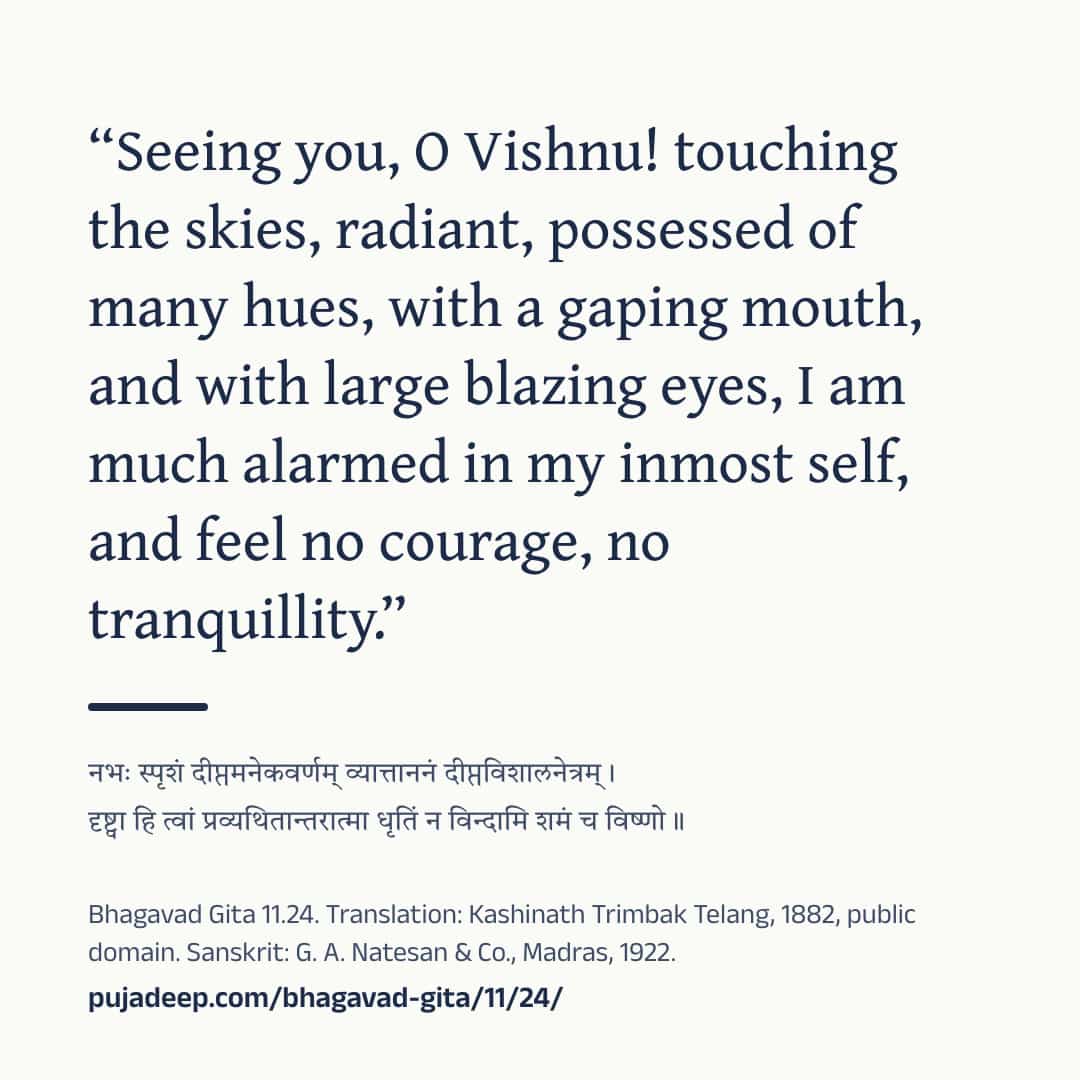
Seeing you, O Vishnu! touching the skies, radiant, possessed of many hues, with a gaping mouth, and with large blazing eyes, I am much alarmed in my inmost self, and feel no courage, no tranquillity.
Compare 3 translations
Kashinath Trimbak Telang, 1882. Public domain. Page 94.
Seeing you, O Vishnu! touching the skies, radiant, possessed of many hues, with a gaping mouth, and with large blazing eyes, I am much alarmed in my inmost self, and feel no courage, no tranquillity.
You are reading this one
Annie Besant, 1895. Public domain. Page 108.
Radiant Thou touchest heaven; rainbow-hued,
With opened mouths and shining vast-orbed eyes.
My inmost self is quaking, having seen,
My strength is withered, Vishnu, and my peace.
You are reading this one
Swami Swarupananda, 1909 (first printed 1907). Public domain. Page 223.
On seeing Thee touching the sky, shining in many a colour, with mouths wide open, with large fiery eyes, I am terrified at heart, and find no courage nor peace, O Vishnu.
You are reading this one
Cite this verse
The translation: K. T. Telang, The Bhagavadgîtâ (The Sacred Books of the East, vol. VIII, Oxford: Clarendon Press, 1882), p. 94. Bhagavad Gita 11.24.
The translation: Annie Besant, The Bhagavad Gîtâ, or The Lord's Song (London: Theosophical Publishing Society, 1895), p. 108. Bhagavad Gita 11.24.
The translation: Swami Swarupananda, Srimad-Bhagavad-Gita (Mayavati: Prabuddha Bharata Press, 1909; first printed in Prabuddha Bharata, 1907–1909), p. 223. Bhagavad Gita 11.24.
Our explanation: “Bhagavad Gita 11.24: meaning and translation.” Pujadeep. Updated October 27, 2026. https://pujadeep.com/bhagavad-gita/11/24/
Pujadeep’s explanations are free to quote with credit: name Pujadeep and link to the page. How to credit
Classical readings, by school
No readings by school on this verse yet.
Share
Show the ways to share
Send one picture or the text to one chat. The picture names its source and the address of this page.
Drawing the picture
See the words
Bhagavad Gita 11.24

नभः स्पृशं दीप्तमनेकवर्णम् व्यात्ताननं दीप्तविशालनेत्रम् ।
दृष्ट्वा हि त्वां प्रव्यथितान्तरात्मा धृतिं न विन्दामि शमं च विष्णो ॥

“Seeing you, O Vishnu! touching the skies, radiant, possessed of many hues, with a gaping mouth, and with large blazing eyes, I am much alarmed in my inmost self, and feel no courage, no tranquillity.”
(K. T. Telang, The Bhagavadgîtâ (The Sacred Books of the East, vol. VIII, Oxford: Clarendon Press, 1882), p. 94, public domain)

“Radiant Thou touchest heaven; rainbow-hued, With opened mouths and shining vast-orbed eyes. My inmost self is quaking, having seen, My strength is withered, Vishnu, and my peace.”
(Annie Besant, The Bhagavad Gîtâ, or The Lord's Song (London: Theosophical Publishing Society, 1895), p. 108, public domain)

“On seeing Thee touching the sky, shining in many a colour, with mouths wide open, with large fiery eyes, I am terrified at heart, and find no courage nor peace, O Vishnu.”
(Swami Swarupananda, Srimad-Bhagavad-Gita (Mayavati: Prabuddha Bharata Press, 1909; first printed in Prabuddha Bharata, 1907–1909), p. 223, public domain)

Sanskrit: G. A. Natesan & Co., Madras, 1922.
https://pujadeep.com/bhagavad-gita/11/24/ Nothing is sent from this site. Your own app sends it, to the chat you choose. The picture quotes the translation you chose on this page, with its name and year.
Sanskrit text: The Bhagavad-Gita, or The Lord's Song, with the text in Devanagari and an English translation, 1922. Meanings: written for Pujadeep and checked against the cited edition. Source and changes
Questions families ask
Who speaks Bhagavad Gita 11.24?
Arjuna speaks this verse, in chapter 11 (Vishvarupa Darshana Yoga).
Where does the Sanskrit text come from?
Sanskrit text: The Bhagavad-Gita, or The Lord's Song, with the text in Devanagari and an English translation, 1922. Meanings: written for Pujadeep and checked against the cited edition. See the source
Is the meaning on this page a translation?
Explanation written for this site from the sources listed here, and checked against the cited edition. It is not a translation and not the only way to read the text. Free to quote with credit.
Source and licence
- Sanskrit text
- The Bhagavad-Gita, or The Lord's Song, with the text in Devanagari and an English translation (Annie Besant, G. A. Natesan & Co., Madras, 1922). Public domain. The Sanskrit on these pages was read from this printing’s page images.
- Translation
- The Bhagavadgîtâ with the Sanatsugâtîya and the Anugîtâ, translated by Kâshinâth Trimbak Telang (The Sacred Books of the East, vol. VIII, ed. F. Max Müller) (Kashinath Trimbak Telang, F. Max Müller, Clarendon Press, Oxford, 1882). Public domain. Shown verbatim, as printed.
- Translation
- The Bhagavad Gîtâ, or The Lord's Song, translated by Annie Besant (Annie Besant, Theosophical Publishing Society, London, 1895). Public domain. Shown verbatim, as printed.
- Translation
- Srimad-Bhagavad-Gita, with Sanskrit Text; Paraphrase with Word-by-word Literal Translation; English Rendering and Comments, Index, &c., by the Swami Swarupananda (Himalayan Series, No. XX) (Swami Swarupananda, The Editors and Publishers, Advaita Ashrama, Mayavati, Prabuddha Bharata Press, Mayavati, Almora, Himalayas, 1909). Public domain. Shown verbatim, as printed.
- Common wording
- In this text, 32 words follow today's common wording, checked against sanskritdocuments.org; Sanskrit Wikisource; Gita Press, Gorakhpur; GRETIL, Göttingen and Bhaktivedanta Book Trust.
- Our explanation
- Explanation written for this site from the sources listed here, and checked against the cited edition. It is not a translation and not the only way to read the text. Free to quote with credit.
- Checked
- Checked against the cited edition, October 27, 2026.